
Plugging multiple strands of decorative or functional lighting into a single outlet is common during holidays, events, or home décor upgrades. However, doing so without calculating the total wattage can lead to circuit overloads, tripped breakers, damaged devices, or even fire hazards. Understanding how to determine the exact wattage load of 12 light strands ensures both electrical safety and reliable performance. This guide walks through the technical fundamentals, practical steps, and real-world considerations for safely connecting multiple light strings.
Understanding Electrical Load Basics
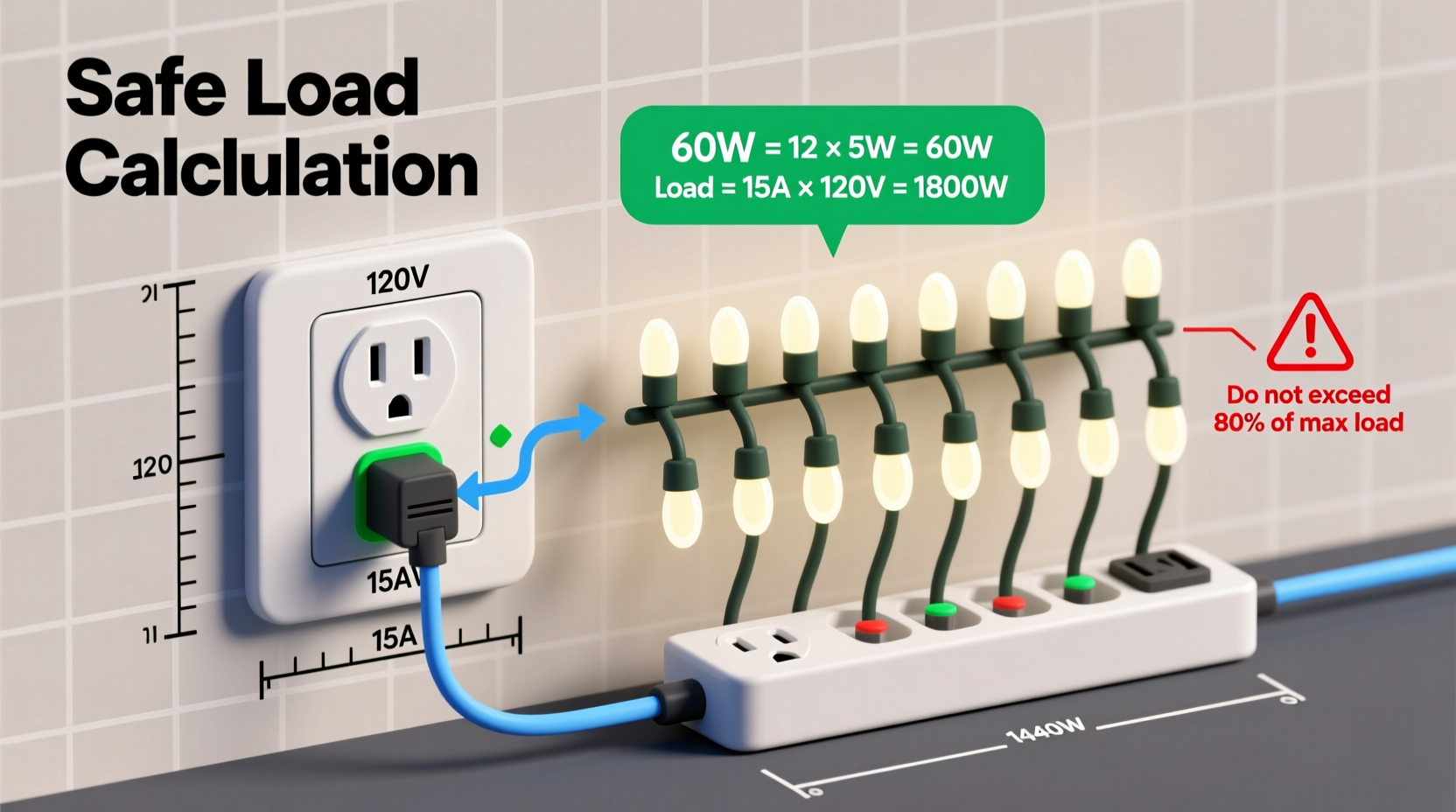
Every electrical outlet in a standard U.S. home is connected to a circuit protected by a breaker, typically rated at 15 or 20 amps. The amount of power any device draws is measured in watts, which is determined by the formula:
Watts = Volts × Amps
In most homes, household circuits operate at 120 volts. A 15-amp circuit can therefore handle up to 1,800 watts (120V × 15A), while a 20-amp circuit supports 2,400 watts. However, electrical codes recommend using only 80% of a circuit’s capacity for continuous loads—those lasting three hours or more—to prevent overheating. That means:
- Maximum safe load on a 15-amp circuit: 1,440 watts
- Maximum safe load on a 20-amp circuit: 1,920 watts
The outlet itself doesn’t limit wattage; it's the underlying circuit that matters. Multiple outlets often share one circuit, so plugging high-draw devices into different nearby outlets may still overload the same breaker.
Determining the Wattage of a Single Light Strand
To calculate the total load of 12 strands, first determine the wattage of one strand. This information is usually found on the product label, packaging, or manufacturer’s website. There are several types of lighting commonly used in strands:
- Incandescent mini lights: Typically consume 40–50 watts per 100-bulb strand.
- LED mini lights: Much more efficient—usually 4–10 watts per 100 bulbs.
- C7 or C9 bulbs: Used outdoors; each bulb may draw 5–7 watts, so a 25-light strand could use 125–175 watts.
If the wattage isn’t listed, you can calculate it using the amperage rating:
- Find the amp draw listed on the plug or label (e.g., “0.33A”).
- Multiply by 120 volts: 0.33A × 120V = 39.6 watts.
For example, if one incandescent strand uses 40 watts, twelve strands would draw 480 watts. If they’re LED strands using 5 watts each, the total is just 60 watts—well within safe limits.
“Never assume all light strands are created equal. A mix of old incandescent and new LED strings on the same outlet can create unexpected imbalances.” — Carlos Mendez, Licensed Electrician & Home Safety Consultant
Step-by-Step Guide to Calculating Total Load
Follow this process to determine whether 12 strands can be safely plugged into one outlet:
- Identify the type and specifications of each light strand. Check labels for wattage or amperage. Note differences between strands—don’t assume uniformity.
- Calculate individual wattage. Use the formula Watts = Volts × Amps if only amps are listed.
- Sum the total wattage for all 12 strands. Add each strand’s wattage together.
- Check your circuit’s capacity. Locate the breaker controlling the outlet. Confirm if it’s 15 or 20 amps. Multiply by 120V, then apply the 80% rule.
- Account for other devices on the same circuit. Are lamps, heaters, or TVs also drawing power from nearby outlets? Subtract their wattage from the available capacity.
- Determine safe headroom. Ensure the total load—including lights and other devices—stays below 80% of the circuit’s maximum.
Example calculation:
- Strand type: Incandescent mini lights
- Wattage per strand: 40W
- Total for 12 strands: 12 × 40W = 480W
- Circuit: 15A / 120V → Max safe load: 1,440W
- Other devices on circuit: Space heater (1,000W)
- Total load: 480W + 1,000W = 1,480W
This exceeds the 1,440W safe limit. Result: unsafe configuration. Either remove the heater, reduce the number of light strands, or move the lights to a different circuit.
Using Extension Cords and Power Strips Safely
While extension cords and power strips allow you to connect multiple strands, they don’t increase circuit capacity. In fact, daisy-chaining too many strands or using undersized cords can create resistance, heat buildup, and fire risks.
Most light strings have a “maximum load” specification indicating how many can be safely linked end-to-end. For example, many incandescent sets are rated for “max 3 sets in series.” Exceeding this violates safety standards and may void insurance in case of fire.
| Light Type | Typical Max Series Connection | Notes |
|---|---|---|
| Incandescent Mini Lights | 3–4 strands | High heat and current draw limit chaining |
| LED Mini Lights | Up to 40+ strands | Low wattage allows longer chains; check manufacturer specs |
| C7/C9 Bulbs (Incandescent) | 2–3 strands | Each bulb draws significant power |
| C7/C9 LEDs | 10–20 strands | More efficient but verify cord gauge and connectors |
Use heavy-duty, outdoor-rated extension cords if running power outside. Look for 16-gauge wire or lower (14- or 12-gauge is better for long runs). Never run cords under rugs or through doorways where they can be damaged.
Real Example: Holiday Lighting Setup Gone Wrong
A homeowner in Ohio decided to decorate their front porch and yard for Christmas using 12 strands of older incandescent mini lights. Each strand was labeled as 48 watts. They connected them all to a single outdoor outlet using two power strips and an extension cord.
They didn’t realize the outlet shared a circuit with the living room TV, floor lamp, and sound system—adding about 500 watts. The lights alone drew 576 watts (12 × 48W). Combined load: ~1,076 watts.
Although this was under the 1,440-watt threshold, the setup failed because:
- The power strips were low-quality, rated for only 8 amps (960 watts).
- The extension cord was thin (18-gauge) and overheated under sustained load.
- One of the light strands had a frayed connection, increasing resistance.
After two hours, the outlet began to buzz and emit a burning smell. The homeowner unplugged everything just in time. An electrician later confirmed the circuit was near capacity and the wiring connections were loose.
Solution: Switched to LED lights (total draw now 72 watts), used a dedicated 20-amp outdoor circuit, and installed commercial-grade power distribution boxes. The display now runs safely for weeks.
Checklist: Safe Multi-Strand Lighting Setup
Before plugging in 12 strands of lights, go through this checklist:
- ✅ Identify the wattage or amperage of each light strand
- ✅ Calculate total wattage: 12 × individual strand wattage
- ✅ Confirm the circuit amperage (15A or 20A)
- ✅ Apply 80% rule: 15A = 1,440W max, 20A = 1,920W max
- ✅ Account for other devices on the same circuit
- ✅ Verify manufacturer’s daisy-chain limits
- ✅ Use heavy-duty extension cords (14-gauge or lower for long runs)
- ✅ Avoid overloading power strips—check their wattage rating
- ✅ Inspect cords and plugs for damage before use
- ✅ Test the setup incrementally—turn on in stages and monitor heat
Frequently Asked Questions
Can I plug 12 strands of LED lights into one outlet?
Yes, in most cases. Typical LED mini light strands use 4–10 watts each. Twelve strands would draw 48–120 watts—well under the 1,440-watt safe limit. Just ensure the power strip or outlet isn’t sharing the load with high-wattage appliances.
What happens if I overload an outlet?
Overloading doesn’t damage the outlet directly but stresses the entire circuit. Consequences include tripped breakers, melted plugs, damaged insulation, and potential fire. Signs of overload include warm outlets, flickering lights, buzzing sounds, or burning smells.
Do outlets on different walls use the same circuit?
Often, yes. Circuits typically serve multiple rooms or areas. One breaker may control all outlets in a bedroom, kitchen, or exterior. Use a circuit tester or consult your home’s electrical panel map to confirm which outlets share a breaker.
Final Recommendations and Safety Reminders
Calculating wattage isn’t just about math—it’s about preventing real danger. Even low-risk scenarios can escalate due to faulty wiring, poor-quality components, or environmental factors like moisture and temperature.
When in doubt, choose LED lights. Their energy efficiency reduces total load dramatically. Twelve strands of LEDs often use less power than a single incandescent lamp. Additionally, LEDs generate less heat, reducing fire risk and extending lifespan.
Consider splitting your lighting across multiple circuits. Use outlets in different rooms or on opposite sides of the house to distribute the load. Smart plugs can help monitor real-time energy usage and send alerts if thresholds are exceeded.
“The safest decoration is one that doesn’t trip a breaker—or worse, cause a fire. Take ten minutes to calculate the load. It could save your home.” — National Fire Protection Association (NFPA) Safety Bulletin
Take Action Today
Don’t wait until the night before an event to test your lighting setup. Gather your strands, read the labels, and do the math. Label outlets and circuits in your home for future reference. Share this knowledge with family members who help with decorating.
Safety isn’t complicated—it’s just often overlooked. By taking a few deliberate steps, you can enjoy bright, beautiful displays without risking your home or peace of mind.




 浙公网安备
33010002000092号
浙公网安备
33010002000092号 浙B2-20120091-4
Comments
No comments yet. Why don't you start the discussion?