
Every year, thousands of households wrestle with the same holiday conundrum: Why does the tree look sparse near the trunk but blindingly bright at the tips? Why do some branches drown in light while others vanish into shadow? The answer isn’t “more lights”—it’s better calculation. Guessing based on memory, tradition, or packaging claims leads to wasted money, tangled frustration, and underlit trees that undermine months of festive planning. Professional lighting designers, retail display specialists, and even municipal tree decorators don’t rely on instinct—they use measurable geometry, light density standards, and real-world spacing logic. This guide distills those principles into a clear, adaptable framework you can apply to any tree, real or artificial, 3 feet tall or 14 feet tall. No assumptions. No approximations. Just actionable math—and the confidence that every inch of your tree will glow with intention.
The Core Principle: Light Density, Not Tree Height Alone
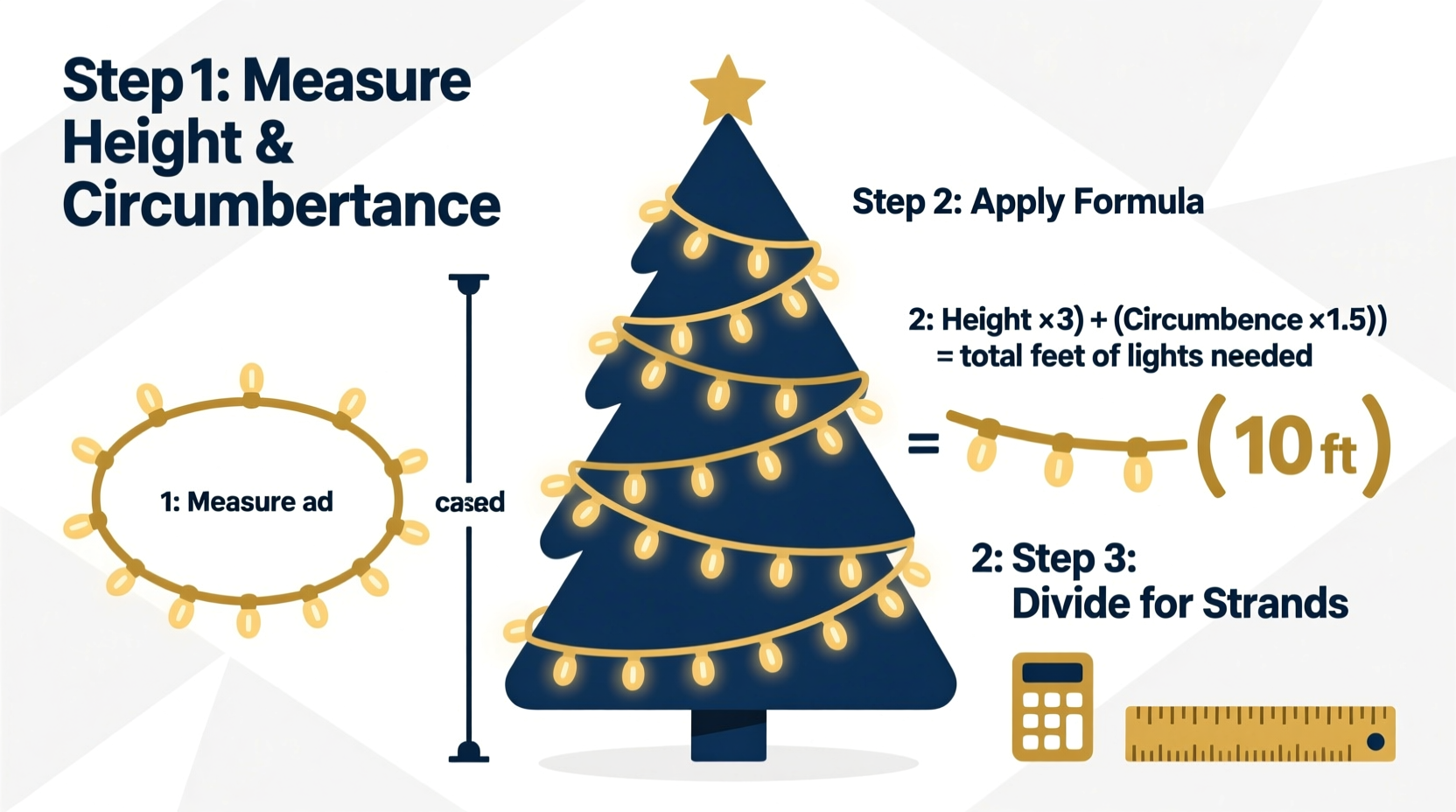
Most people start by checking the label on a box of lights that says “for 6–7 ft trees.” That’s misleading. A 6-foot pencil tree has roughly 1/3 the surface area of a full-bodied 6-foot Fraser fir. Likewise, a 9-foot slim-profile tree may need fewer lights than a 7-foot bushy one. What matters is surface coverage, not vertical height. Think of your tree as a three-dimensional cone—or, more accurately, a frustum (a cone with the top cut off). Its surface area determines how many points of light are needed to create visual continuity and warmth without saturation.
Industry-standard light density for residential trees falls between 100 and 200 lights per vertical foot—but that range only works if you know your tree’s fullness factor. A sparse tree requires closer to 175–200 lights/ft; a dense, layered tree performs beautifully at 125–150 lights/ft. Going beyond 200 lights/ft rarely improves aesthetics—it increases heat output, power load, and tangling risk, while diminishing the soft, dimensional glow people associate with professional displays.
A Step-by-Step Calculation Method
Forget rules of thumb. Follow this five-step process—designed for accuracy, adaptability, and repeatability.
- Determine your tree’s approximate surface area (in square feet). Use this simplified formula for a conical frustum:
Surface Area ≈ π × r × (r + √(h² + r²)), wherer = base radius (in feet)andh = height (in feet). For practicality: convert your base circumference (C) to radius:r = C ÷ (2π). Example: A 7-ft tree with a 54-inch (4.5-ft) base circumference → r = 4.5 ÷ (2 × 3.14) ≈ 0.72 ft. Then SA ≈ 3.14 × 0.72 × (0.72 + √(7² + 0.72²)) ≈ 3.14 × 0.72 × (0.72 + 7.04) ≈ 17.6 sq ft. - Choose your target light density. Base this on tree type and desired effect:
- Full, traditional evergreen (Fraser, Balsam): 125–150 lights/ft²
- Sparse or slim profile (Nordmann, pencil, artificial “slim” models): 160–190 lights/ft²
- Ultra-dense or multi-tiered artificial tree: 110–135 lights/ft² (to avoid overloading inner layers)
- Multiply surface area × density. Using the example above (17.6 sq ft × 140 lights/ft²) = 2,464 total lights.
- Divide by lights per strand. Standard incandescent mini lights: 100 lights/strand. LED mini: often 50, 70, or 100. Commercial-grade LED: up to 150. Always verify the exact count—don’t assume “50 ft strand = 50 lights.” Many 50-ft LED strands contain only 35–50 bulbs due to wider spacing.
- Round up—but intelligently. If your math yields 24.3 strands, buy 25. But if it yields 24.9 and you’re using 100-light strands, consider whether 25 strands (2,500 lights) creates glare. In that case, test with 24 strands (2,400 lights), then add a single accent strand (e.g., warm white micro-LEDs) to the lowest tier for depth.
Real-World Validation: The Thompson Family Tree
In December 2023, the Thompsons purchased a 7.5-ft pre-lit artificial Noble Fir tree—advertised as “1,200 built-in lights.” They added two 100-light strands, expecting enhancement. Instead, the lower third appeared washed out, while the upper crown looked thin and disjointed. Frustrated, they measured: height = 7.5 ft, base circumference = 58 inches (4.83 ft), giving r = 0.77 ft. Surface area calculated to 20.1 sq ft. Their tree’s dense, layered branch structure warranted 130 lights/ft² → 2,613 total lights needed. The pre-lit 1,200 plus their 200 extras left them 1,213 lights short—not counting voltage drop across long runs. They replaced the two generic strands with three custom-spaced 100-light LED strands (warm white, 4-inch spacing) wound from bottom to top in a gentle spiral. Result: balanced luminance, zero dark zones, and a cohesive “glowing from within” effect. Total investment: $42. Time saved re-hanging: 47 minutes.
Key Variables That Change Your Math
Your calculation isn’t static. These five factors require adjustment before finalizing strand count:
| Factor | Impact on Strand Count | Adjustment Rule |
|---|---|---|
| Light bulb size & spacing | Micro-LEDs (2–3mm) appear denser than standard 5mm LEDs at same count; wider spacing (>6\") creates visible gaps | Add 10–15% more strands if spacing >5\"; subtract 5% if using micro-LEDs with ≤3.5\" spacing |
| Tree color & material | White or frosted artificial trees reflect more light; dark green firs absorb more. Matte finishes reduce glare vs. glossy PVC | Reduce strand count by 8–12% for white/frosted trees; increase by 5–7% for dark, matte-finish firs |
| Power limitations | Most household outlets support ≤210 watts (1.75A @ 120V). Incandescents draw 0.3–0.4W/bulb; LEDs draw 0.04–0.07W/bulb | At 0.05W/bulb, 2,500 LEDs = 125W → safe. At 0.35W/bulb, same count = 875W → requires 5+ outlets or heavy-duty extension |
| Desired aesthetic | \"Subtle glow\" (dinner party) ≠ \"festive spectacle\" (front-yard display). Warm white (2200K–2700K) feels softer than cool white (4000K+) | For subtle: use 80–110 lights/ft². For spectacle: max 190 lights/ft²—but never exceed manufacturer’s max-connect limit |
| Branch layering | Trees with 3+ distinct horizontal tiers (common in premium artificial models) allow strategic placement: denser at base/mid, lighter at apex | Allocate 45% of lights to bottom 1/3, 35% to middle 1/3, 20% to top 1/3—reduces total needed by ~8% vs. uniform distribution |
Expert Insight: What Lighting Designers Know
“Amateur decorators focus on quantity. Professionals focus on luminance distribution. A tree lit with 1,800 thoughtfully placed lights—spiral-wound at 4-inch intervals, with 10% more concentrated near the trunk—will outperform a chaotic 2,500-light tangle every time. Light isn’t decorative until it’s directional, rhythmic, and rooted in the tree’s natural form.” — Rafael Mendoza, Lead Lighting Designer, Holiday Illuminations Co. (12+ years designing Rockefeller Center, Chicago Magnificent Mile, and private estates)
Mendoza’s team uses laser-measured 3D tree scans to generate optimal strand paths—yet his core principle applies to all: spacing rhythm matters more than total count. Human vision perceives consistent 3–5 inch intervals between bulbs as “even.” Gaps over 6 inches register as “sparse”; clusters under 2.5 inches feel “busy” or “harsh.” This is why the step-by-step method prioritizes surface area and density over raw numbers—it respects how light interacts with human perception and physical form.
Practical Checklist: Before You Buy or Hang
- ☑ Measure tree height and base circumference (use a fabric tape measure—not string)
- ☑ Identify tree type (real species or artificial model) and note branch density (sparse, medium, dense)
- ☑ Check light strand specs: exact bulb count, spacing (inches), wattage per bulb, and max-connect limit
- ☑ Calculate surface area using the frustum formula—or use our simplified reference table below
- ☑ Determine target density (125–190 lights/ft²) based on tree type and aesthetic goal
- ☑ Multiply surface area × density → divide by lights/strand → round up
- ☑ Verify total wattage against outlet capacity (≤210W per standard circuit)
- ☑ Plan winding direction: bottom-to-top spiral, not random crisscross
Quick-Reference Surface Area Table
For common tree heights and base circumferences, here’s a pre-calculated surface area guide (rounded to nearest 0.5 sq ft). Use this if manual calculation feels cumbersome:
| Height (ft) | Base Circumference (in) | Approx. Surface Area (sq ft) | Recommended Total Lights* (Medium Density) |
|---|---|---|---|
| 4.5 | 36 | 8.5 | 1,100–1,300 |
| 6 | 48 | 14.0 | 1,750–2,100 |
| 7 | 54 | 17.5 | 2,200–2,600 |
| 7.5 | 58 | 20.0 | 2,500–3,000 |
| 9 | 66 | 27.5 | 3,400–4,100 |
| 12 | 84 | 44.0 | 5,500–6,600 |
*Based on 125–150 lights/ft² for full evergreens. Adjust ±20% for sparse/dense trees.
FAQ
How do I account for a tree skirt or presents hiding the bottom tier?
You don’t reduce lights for the skirt—but you do shift placement. Position 60–70% of your lower-third lights on the lowest visible branches, not the trunk base. This ensures the skirt appears softly illuminated from within, not dark and recessed. Avoid wrapping lights tightly around the trunk below the first branch row—that creates a harsh “light pole” effect.
Can I mix LED and incandescent strands safely?
Yes—but only if both are rated for outdoor/indoor use and share identical voltage (typically 120V AC) and plug types. Never daisy-chain incandescent strands into LED controllers or vice versa. More critically: mixing color temperatures (e.g., 2200K warm white LEDs with 2700K incandescents) creates visible inconsistency. Stick to one color temp across all strands for cohesive ambiance.
My tree has pre-installed lights. How many additional strands should I add?
First, count the built-in lights (check manufacturer specs—don’t guess). Subtract that number from your calculated total. Example: Your 7-ft tree needs 2,400 lights. Pre-lit with 1,000? Add 1,400 more—i.e., 14 strands of 100-light LEDs. Crucially: do not exceed the manufacturer’s maximum strand-connect limit, even if wattage allows. Overloading internal wiring risks heat buildup and voids warranties.
Conclusion
Calculating strand count isn’t about rigid formulas—it’s about honoring the unique architecture of your tree and the intention behind your celebration. A 7-foot Douglas fir draped in 2,600 evenly spaced, warm-white LEDs will radiate calm elegance. A 4-foot tabletop tree lit with 900 micro-LEDs at 3-inch intervals becomes a jewel-box centerpiece. The math empowers choice, not constraint. It replaces seasonal frustration with quiet confidence—the certainty that when you flip the switch, light will fall where it belongs: gently, generously, and wholly yours.
This year, skip the guesswork. Measure once. Calculate deliberately. Wind with purpose. Let your tree shine—not because it’s covered, but because it’s considered.




 浙公网安备
33010002000092号
浙公网安备
33010002000092号 浙B2-20120091-4
Comments
No comments yet. Why don't you start the discussion?