
Gaining weight in a healthy, sustainable way requires more than just eating extra snacks or skipping workouts. For many people—especially those with fast metabolisms, high activity levels, or underlying health conditions—putting on quality mass can be as challenging as losing weight. The key lies in understanding your body’s energy needs and creating a precise calorie surplus that supports muscle growth without excessive fat accumulation. This guide breaks down the science of effective weight gain, offering a clear method to calculate your ideal daily calorie intake and implement it successfully.
Determine Your Basal Metabolic Rate (BMR)
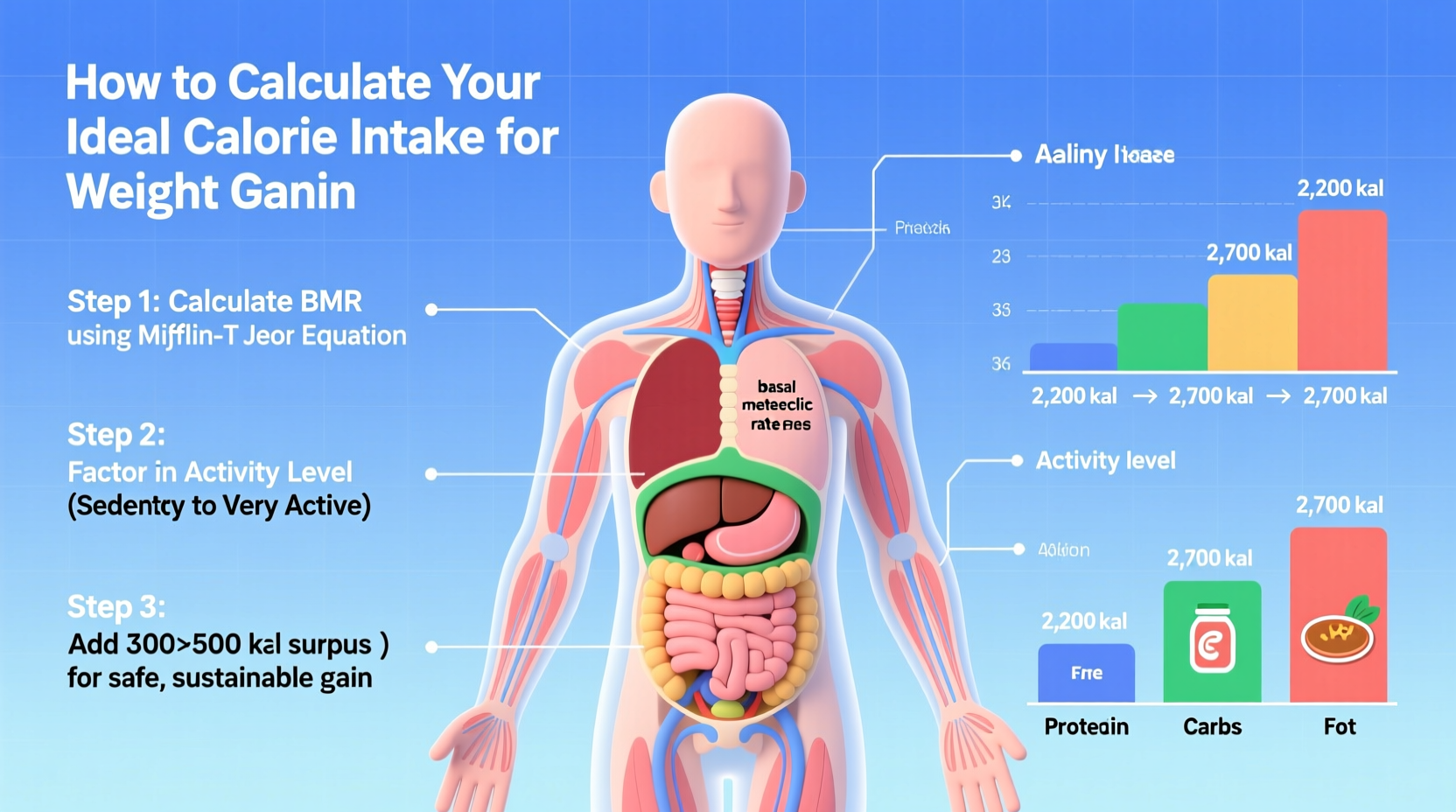
Your BMR is the number of calories your body burns at rest to maintain basic physiological functions like breathing, circulation, and cell production. It forms the foundation of your total daily energy expenditure (TDEE). To estimate your BMR, use the Mifflin-St Jeor Equation—one of the most accurate formulas available:
For men: BMR = 10 × weight (kg) + 6.25 × height (cm) – 5 × age (years) + 5
For women: BMR = 10 × weight (kg) + 6.25 × height (cm) – 5 × age (years) – 161
For example, a 28-year-old man who weighs 70 kg and is 175 cm tall would calculate his BMR as follows:
(10 × 70) + (6.25 × 175) – (5 × 28) + 5 = 700 + 1093.75 – 140 + 5 = 1,658.75 kcal/day
Calculate Your Total Daily Energy Expenditure (TDEE)
BMR alone doesn’t account for physical activity. Multiply your BMR by an activity factor to determine your TDEE—the total calories you burn in a day.
| Activity Level | Description | Multiplier |
|---|---|---|
| Sedentary (little or no exercise) | Office job, minimal walking | BMR × 1.2 |
| Lightly active | Light exercise 1–3 days/week | BMR × 1.375 |
| Moderately active | Exercise 3–5 days/week | BMR × 1.55 |
| Very active | Hard exercise 6–7 days/week | BMR × 1.725 |
| Extra active | Physical job or twice-daily training | BMR × 1.9 |
Using the previous example, if our 28-year-old man exercises 4 times per week, he falls into the “moderately active” category. His TDEE would be:
1,658.75 × 1.55 = 2,571 kcal/day
“Accurate TDEE estimation is crucial. Overestimating activity level is one of the biggest reasons people fail to gain weight despite thinking they’re in a surplus.” — Dr. Lena Patel, Sports Nutritionist
Create a Sustainable Calorie Surplus
To gain weight, you must consume more calories than your TDEE. However, too large a surplus leads to excess fat gain, while too small a surplus yields no results. A moderate surplus of 300–500 calories per day is optimal for lean mass gain.
- Beginners or underweight individuals: Start with a +500 kcal surplus for faster initial gains.
- Intermediate lifters or those close to ideal weight: Use a +300 kcal surplus to minimize fat accumulation.
- Average weekly gain goal: 0.25–0.5 kg (0.5–1 lb) per week.
Continuing the example: 2,571 + 500 = 3,071 kcal/day target intake.
Adjust Based on Progress
Weigh yourself weekly under consistent conditions (same time, clothing, scale). If weight increases by less than 0.25 kg per week, increase intake by 100–200 kcal. If gaining more than 0.75 kg per week, reduce by 100–200 kcal to avoid excessive fat gain.
Nutrient Balance Matters Just as Much as Calories
Not all calories are equal when building quality weight. Focus on nutrient-dense foods to support muscle growth and overall health.
Protein: Aim for 1.6–2.2 grams per kilogram of body weight to support muscle synthesis. For a 70 kg person, that’s 112–154 grams daily.
Fats: Include 20–30% of total calories from healthy fats (avocados, nuts, olive oil, fatty fish).
Carbohydrates: Fill the remaining calories with complex carbs (oats, brown rice, sweet potatoes, fruits) to fuel workouts and recovery.
Sample Daily Intake (3,070 kcal)
- Breakfast: Oatmeal with peanut butter, banana, whole milk, and protein powder (~700 kcal)
- Snack: Greek yogurt with honey and mixed nuts (~400 kcal)
- Lunch: Grilled chicken, quinoa, roasted vegetables, olive oil drizzle (~800 kcal)
- Post-workout: Protein shake with banana and almond butter (~600 kcal)
- Dinner: Salmon, mashed sweet potatoes, broccoli, avocado (~700 kcal)
- Before bed: Cottage cheese with berries and flaxseed (~370 kcal)
Step-by-Step Guide to Gaining Weight Effectively
- Calculate your BMR using the Mifflin-St Jeor equation.
- Determine your activity level and multiply BMR by the appropriate factor to get TDEE.
- Add 300–500 calories to your TDEE for your daily intake goal.
- Track your food intake for 7–14 days to ensure consistency.
- Weigh yourself weekly and adjust intake up or down by 100–200 kcal based on progress.
- Prioritize protein and calorie-dense foods throughout the day.
- Strength train 3–5 times per week to direct surplus toward muscle growth.
Mini Case Study: Alex’s Lean Bulk Journey
Alex, a 24-year-old software developer, struggled to gain weight despite eating what he thought was “a lot.” At 68 kg and 180 cm tall, he felt weak and underdeveloped. After calculating his BMR (1,620 kcal) and TDEE (2,511 kcal, moderately active), he realized he was only consuming ~2,200 kcal daily—actually a deficit.
He set a target of 3,000 kcal/day, added strength training three times a week, and incorporated calorie boosters like nut butters, whole milk, and rice into meals. Within six weeks, he gained 2.3 kg, mostly muscle, and reported increased energy and strength. By adjusting his intake monthly based on scale trends, he reached 73 kg of lean mass within five months.
Common Mistakes That Hinder Weight Gain
- Underestimating actual intake: Many think they eat more than they do.
- Over-relying on junk food: Empty calories lead to fat gain without muscle support.
- Skipping resistance training: Without stimulus, surplus calories turn into fat, not muscle.
- Inconsistent tracking: Fluctuating intake prevents steady progress.
- Impatience: Healthy weight gain takes months, not weeks.
FAQ
Can I gain weight without getting fat?
Yes, by maintaining a moderate calorie surplus (300–500 kcal) and combining it with regular strength training. This promotes muscle growth while minimizing fat storage.
How long does it take to see results?
Most people notice small changes in weight and strength within 3–4 weeks. Visible muscle gains typically appear after 8–12 weeks of consistent effort.
What if I’m gaining weight but not feeling stronger?
This may indicate you’re gaining fat rather than muscle. Reassess your calorie surplus, ensure adequate protein (≥1.6g/kg), and confirm you’re progressively overloading in the gym.
Checklist: Your Weight Gain Action Plan
- ✅ Calculate your BMR using your age, weight, and height
- ✅ Multiply BMR by activity factor to find TDEE
- ✅ Add 300–500 calories to establish your daily target
- ✅ Track food intake for at least two weeks
- ✅ Weigh yourself weekly under consistent conditions
- ✅ Adjust intake based on weekly progress
- ✅ Eat 1.6–2.2g of protein per kg of body weight
- ✅ Strength train 3+ times per week with progressive overload
- ✅ Prioritize sleep and recovery (7–9 hours per night)
Conclusion
Gaining weight effectively isn’t about mindless overeating—it’s about strategic surplus, precision, and consistency. By calculating your true calorie needs and aligning them with smart nutrition and training, you can build strong, functional mass that enhances both appearance and performance. Start today: measure your numbers, set your target, and commit to the process. The results will follow.




 浙公网安备
33010002000092号
浙公网安备
33010002000092号 浙B2-20120091-4
Comments
No comments yet. Why don't you start the discussion?