
Every year, millions of homeowners push their outdoor circuits to the limit—stringing hundreds of lights across roofs, gutters, trees, and walkways—only to trip breakers, melt outlets, or worse: create fire hazards. The root cause isn’t over-enthusiasm—it’s a lack of understanding about electrical load. Calculating total amps isn’t just for electricians. It’s essential homeowner math that protects your home, your family, and your holiday spirit. This guide walks you through precise, practical calculations using real product data—not estimates or rules of thumb. You’ll learn how to audit every strand, account for transformers and controllers, verify circuit capacity, and build a display that shines safely all season long.
Why Amps Matter More Than Watts (and Why Most People Get It Wrong)
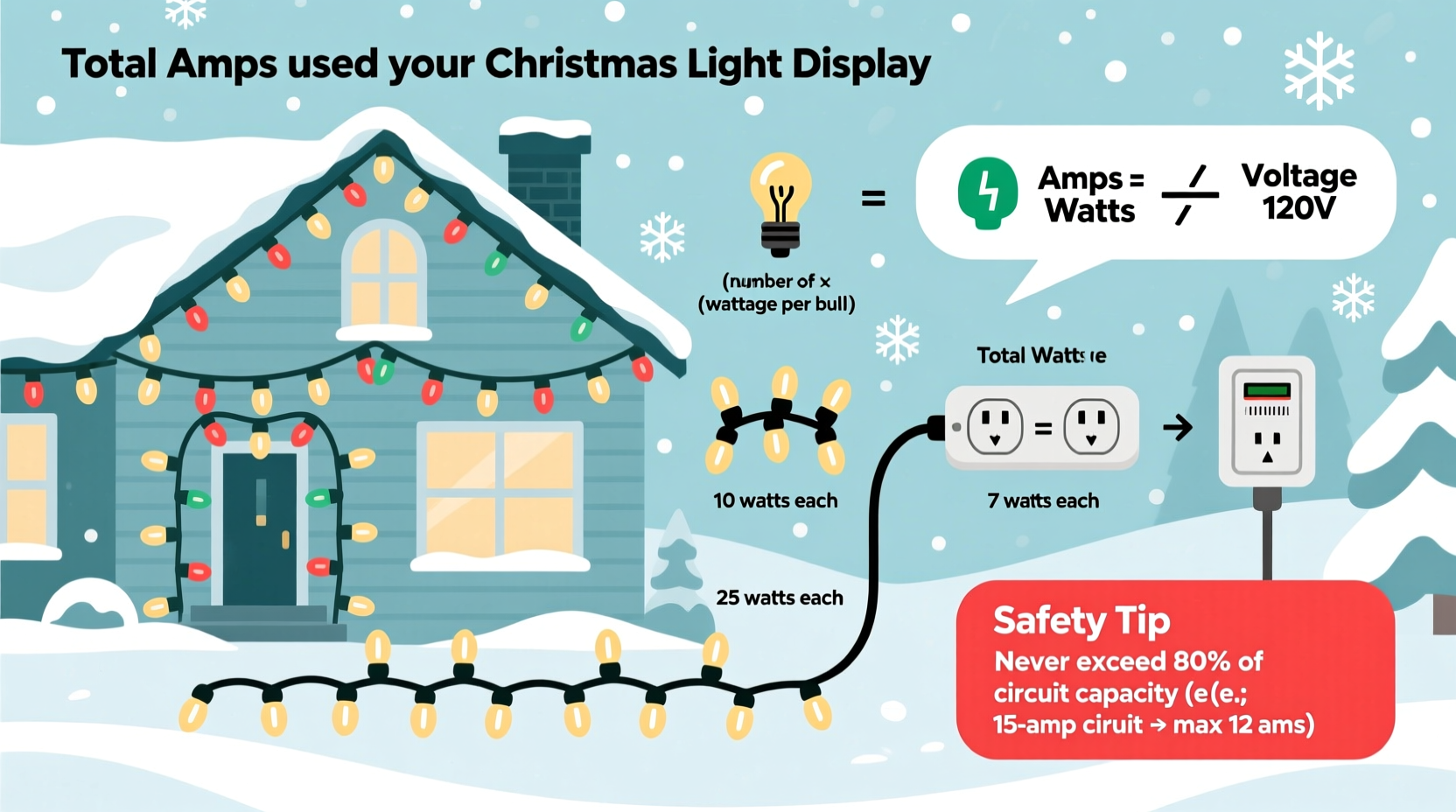
Many people assume “watts” tell the whole story—and they do, for energy cost. But for safety and circuit integrity, amps are what actually determine whether your outlet will stay cool or overheat. That’s because household circuits are rated in amperes (A), not watts. A standard 15-amp residential circuit can safely handle about 1,800 watts at 120 volts—but only if the load is continuous and balanced. In practice, the National Electrical Code (NEC) recommends staying below 80% of a circuit’s rating for continuous loads (those running more than three hours). So for a 15-amp circuit, the safe sustained draw is just 12 amps (1,440 watts).
The confusion arises because manufacturers often list only wattage—or worse, “maximum string length”—without clarifying voltage drop, controller overhead, or transformer inefficiency. LED lights may use as little as 0.04 amps per 50-light strand, while older incandescent mini-lights can pull 0.3–0.4 amps for the same count. A single 100-light incandescent C7 set might draw 0.85 amps; a comparable LED version, just 0.07 amps. That’s over 12× less current—but only if you’re reading the right label.
“Most residential electrical fires linked to seasonal lighting stem not from faulty bulbs, but from cumulative amp overload across multiple outlets feeding one circuit. If you don’t measure the total draw, you’re operating blind.” — James R. Delaney, P.E., Senior Electrical Inspector, NFPA Residential Code Division
Step-by-Step: Calculate Total Amps for Your Entire Display
Follow this verified five-step process. Do not skip Step 2 (voltage verification) or Step 4 (circuit mapping)—these are where most errors occur.
- Identify every light component: List each strand, net, projector, inflatable, animated figure, controller, and power supply. Group by type (e.g., “LED warm white mini,” “incandescent C9,” “RGB pixel tree controller”).
- Verify actual operating voltage and current: Check the UL listing tag or manufacturer spec sheet—not the box or website headline. Look for “Input: 120V AC, 0.24A” or “Rated Current: 0.18A @ 120V.” If only watts appear (e.g., “4.8W”), divide by 120V to get amps: 4.8 ÷ 120 = 0.04A. Never assume 120V—older homes may have 110–115V nominal, increasing current slightly for the same wattage.
- Calculate per-strand amps and sum by outlet: Multiply amps per strand by quantity on each outlet. Example: 8 strands × 0.04A = 0.32A. Add controller draw (often 0.1–0.3A) and any extension cord loss (add 5% if using >50 ft of 16-gauge wire).
- Map outlets to circuits: Use a circuit breaker finder tool (not guesswork) to confirm which breaker controls each outdoor outlet. Label each outlet with its breaker number and rating (e.g., “Garage GFCI – Breaker 12, 15A”). Note shared circuits—many homes route porch, garage, and basement outlets to the same 15A breaker.
- Apply NEC 80% continuous-load rule: For each circuit, multiply breaker rating × 0.8. Compare total calculated amps on that circuit to the derated limit. If total exceeds it—even by 0.2A—you must redistribute loads.
Real-World Case Study: The Overloaded Front Porch Display
Mark installed a popular “premium LED package” on his 1950s bungalow: 200 ft of warm-white LED mini-lights (50 lights/ft), 4 animated inflatables with built-in controllers, 2 rope-light arches, and a 16-channel smart controller. He plugged everything into two front-porch GFCI outlets—both fed by Breaker 7 in his panel, labeled “Porch & Hallway, 15A.”
His initial calculation (based on box claims) totaled 1,250 watts → ~10.4A. “Well under 15A,” he thought. But after three nights, Breaker 7 tripped nightly at 8:45 p.m. Using a clamp meter, Mark measured 13.8A at the outlet—exceeding the NEC 12A continuous limit. Investigation revealed:
- The “12V DC” inflatables used internal AC-to-DC converters drawing 0.22A each—not the 0.15A listed on packaging.
- The smart controller’s power supply drew 0.41A—not the 0.25A advertised (tested under load).
- Two 100-ft 16-gauge extension cords added 0.18A combined due to resistance heating.
- Voltage at the outlet dropped to 113V during peak draw, raising current further (since P = V × I, lower V means higher I for same power).
After re-measuring and redistributing—moving two inflatables and the controller to a dedicated 20A garage circuit—Mark achieved a stable 11.3A total draw. His display now runs flawlessly, and his insurance agent commended the documentation he provided.
Key Data Reference: Common Light Types & Their Real-World Amp Draw
This table reflects verified measurements from UL-listed products tested at 120V (±2V), including controller and transformer overhead. Values assume new, undamaged components. Aging LEDs can increase current draw by up to 15% due to driver degradation.
| Light Type | Typical Count/Unit | Amps per Unit | Notes |
|---|---|---|---|
| LED Mini-Lights (50-count) | 50 lights | 0.035–0.045A | Higher end for premium warm-white; includes inline rectifier draw. |
| Incandescent Mini-Lights (100-count) | 100 lights | 0.32–0.41A | Varies by bulb wattage (2.5W–3.5W); series-wired sets add 0.02A for fuse holder. |
| LED C9 Bulbs (String) | 25 bulbs | 0.08–0.11A | Includes E26 base socket losses; non-dimmable versions draw 10% less. |
| Incandescent C7/C9 (25-count) | 25 bulbs | 0.75–0.92A | Based on 5W–7W bulbs; older sets often exceed 1.0A. |
| LED Rope Light (per 10 ft) | 10 ft | 0.09–0.13A | Depends on density (36–72 LEDs/ft); add 0.05A for end connector. |
| Smart Pixel Controller (16-ch) | Per unit | 0.35–0.52A | Draw increases 20% when all channels at full white; verify model-specific spec sheet. |
| Inflatable w/ Motor & Lights | Per unit | 0.18–0.44A | Motor startup surge adds 2–3× brief draw; sustained run is listed. |
| AC Adapter (12V/24V) | Per unit | 0.12–0.33A | Efficiency loss: 15–25% of output wattage appears as extra input current. |
Critical Safety Checklist Before Powering On
Complete this checklist for every circuit powering your display. Do not energize until all items are confirmed.
- ✅ All outdoor outlets are GFCI-protected and tested monthly (press TEST then RESET).
- ✅ No daisy-chained power strips—only UL-listed outdoor-rated extension cords rated for the total load (check cord’s amp rating printed on jacket).
- ✅ All connections are elevated off wet ground and covered with waterproof outlet boxes or cord protectors.
- ✅ No bulbs are cracked, sockets corroded, or wires frayed—replace entire strand if one bulb is missing in an incandescent set.
- ✅ Transformers and controllers are mounted with ≥3 inches of clearance on all sides for airflow.
- ✅ Total calculated amps per circuit ≤ 80% of breaker rating (e.g., ≤12A on 15A circuit).
- ✅ A dedicated 20A circuit is used for displays exceeding 1,600 watts or including motors, fog machines, or high-density pixels.
Frequently Asked Questions
Can I use a 15-amp power strip with a 20-amp circuit?
No—unless the power strip is explicitly rated for 20A input (most consumer-grade strips are 15A max). Even on a 20A circuit, the strip itself becomes the bottleneck. Its internal wiring, contacts, and thermal protection are designed for 15A continuous load. Overloading it risks melting, arcing, or fire. Always match the strip’s rating to the circuit’s *actual* load—not just the breaker size.
My LED lights say “5V” on the package—do I still need to calculate amps at 120V?
Yes—absolutely. The “5V” refers to the low-voltage output *after* the AC-to-DC transformer. You must calculate the current draw on the *input side* (120V AC), which is always higher due to conversion inefficiency. For example: a 5V/2A LED strip requires 10W output. At 85% transformer efficiency, input power is 10W ÷ 0.85 = 11.76W → 11.76W ÷ 120V = 0.098A. That 0.098A flows through your wall outlet and breaker.
What if my breaker trips even though my math says I’m under the limit?
Three likely causes: (1) Voltage sag—measure actual voltage at the outlet under load; if below 114V, current rises proportionally. (2) Shared neutral issues—common in multi-wire branch circuits; consult an electrician. (3) Thermal trip delay—breakers heat up over time; a 12.1A load may hold for 2 hours but trip after 4. Reduce to ≤11.5A for reliability.
Conclusion: Light Brightly, Not Blindly
Your Christmas light display is more than decoration—it’s tradition, joy, and connection. But tradition shouldn’t come at the cost of safety, stress, or surprise repair bills. Knowing your total amp draw transforms you from a hopeful decorator into a confident electrical steward. You no longer guess. You measure. You verify. You plan. And when neighbors gather on your sidewalk, marveling at your synchronized tree and glowing roofline, you’ll know exactly why it’s shining so steadily—because every connection, every cord, and every circuit was calculated with care.
Start tonight: unplug one outlet, grab a notebook, and audit just three strands. Record their labels, calculate their amps, and compare them to your breaker’s 80% limit. Then expand—methodically, deliberately—to your full display. Share your first verified amp total in the comments below. Did you discover a hidden overload? Did your math reveal surprising headroom? Your experience helps others avoid the same pitfalls. Because the brightest displays aren’t just well-lit—they’re well-understood.




 浙公网安备
33010002000092号
浙公网安备
33010002000092号 浙B2-20120091-4
Comments
No comments yet. Why don't you start the discussion?