
Understanding how to calculate a total percentage is a fundamental skill used in everyday life—from academics and finance to shopping and fitness tracking. Despite its simplicity, many people make avoidable errors due to confusion about formulas or misinterpreting data. This guide breaks down the process into clear, actionable steps, ensuring you achieve accurate results every time. Whether you're calculating your exam average, determining a discount on a purchase, or analyzing survey responses, mastering percentage calculation builds confidence and precision.
The Basic Formula for Calculating Percentage
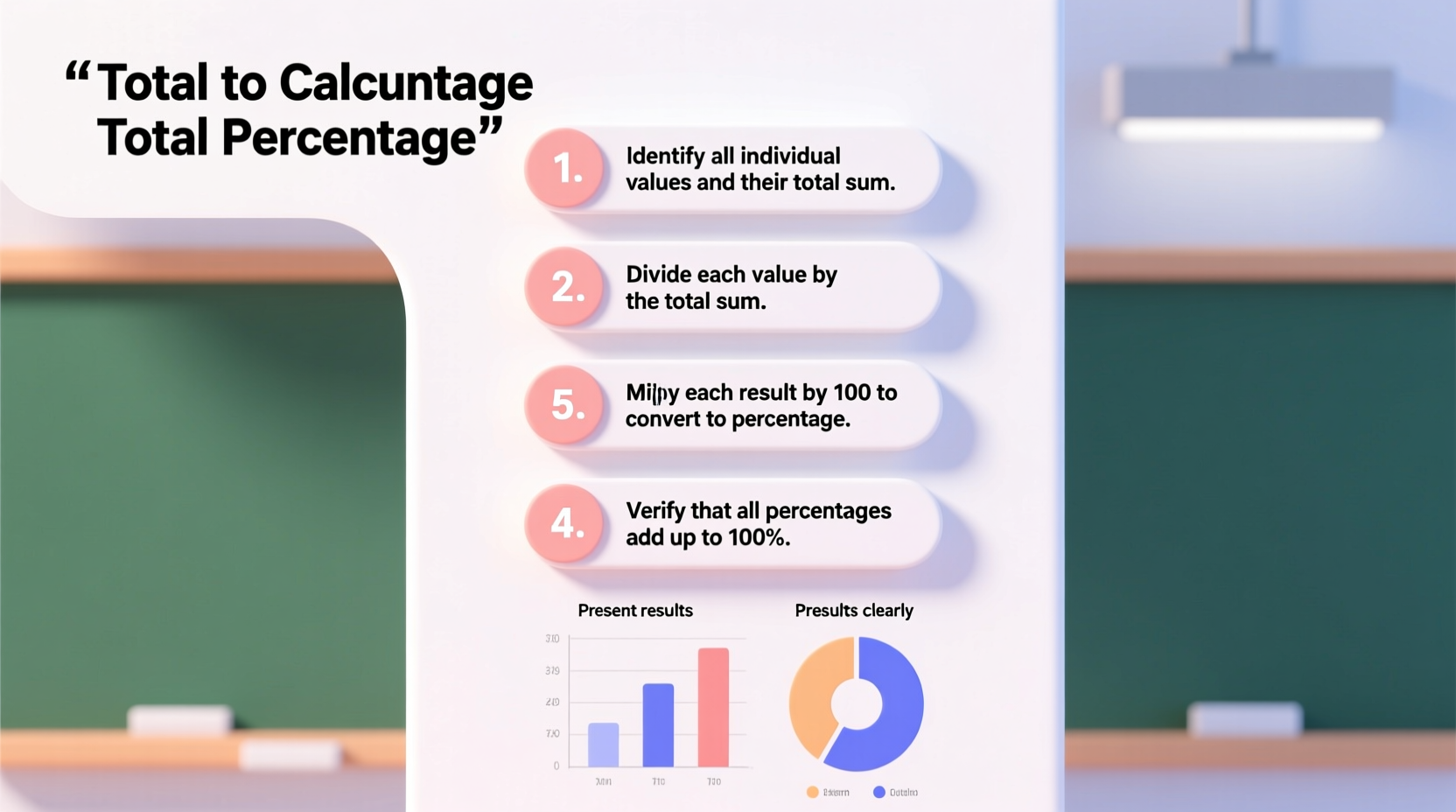
At its core, a percentage expresses a part of a whole as a fraction of 100. The foundational formula is:
Percentage = (Value / Total Value) × 100
This formula applies whether you’re finding what portion one number is of another or combining multiple percentages into a meaningful total. For example, if you scored 45 out of 60 on a test, the calculation would be:
(45 ÷ 60) × 100 = 75%
This tells you that your score represents 75% of the total possible points.
Step-by-Step Guide to Calculating Total Percentage
When dealing with multiple values—such as several test scores, sales figures, or budget items—you need to aggregate data correctly before converting to a percentage. Follow these five steps for consistent accuracy.
- Gather all relevant values. Identify the individual components you want to include in your total. For instance, if calculating an overall grade, collect all assignment, quiz, and exam scores.
- Sum the actual values obtained. Add up all the marks, amounts, or quantities you've earned or recorded.
- Sum the maximum possible values. Similarly, add up the highest possible scores or totals for each component.
- Divide the total obtained by the total possible. Apply the basic percentage formula using the two sums.
- Multiply by 100 to get the percentage. Convert the decimal result into a percentage format.
Let’s say a student received the following scores across four subjects:
| Subject | Marks Obtained | Total Marks |
|---|---|---|
| Math | 85 | 100 |
| Science | 78 | 90 |
| English | 92 | 100 |
| History | 65 | 80 |
Total marks obtained: 85 + 78 + 92 + 65 = 320
Total possible marks: 100 + 90 + 100 + 80 = 370
Now apply the formula:
(320 ÷ 370) × 100 ≈ 86.49%
The student's overall performance is approximately 86.49%.
Common Pitfalls and How to Avoid Them
Even experienced users can fall into traps when calculating percentages. Here are frequent mistakes and how to prevent them.
- Averaging percentages incorrectly. Taking the average of individual percentages without weighting them by their base values leads to skewed results. For example, averaging 50% of 20 and 90% of 200 gives a misleading figure if not weighted properly.
- Ignoring different total scales. Combining scores from tests with different point totals without normalizing first distorts the outcome.
- Rounding too early. Premature rounding during intermediate steps introduces inaccuracies. Wait until the final step to round your answer.
- Confusing percentage increase with percentage of total. These are distinct concepts. A 10% increase means adding 10% of the original value, whereas 10% of total refers to a fraction of the whole.
“Accuracy in percentage calculation starts with clarity in data structure. Always verify your denominators.” — Dr. Alan Reyes, Mathematics Educator and Assessment Specialist
Real-World Example: Tracking Monthly Budget Performance
Samantha tracks her monthly expenses against a $3,000 budget. At the end of the month, she tallies her spending:
- Housing: $1,200 of $1,200
- Groceries: $450 of $500
- Transportation: $280 of $300
- Entertainment: $120 of $200
- Utilities: $180 of $200
Total spent: $1,200 + $450 + $280 + $120 + $180 = $2,230
Total budgeted: $3,000
Percentage of budget used: (2,230 ÷ 3,000) × 100 ≈ 74.3%
This shows Samantha stayed under her limit, using just over 74% of her allocated funds. Without summing both sides first, she might have averaged category percentages and gotten an incorrect overall usage rate.
When to Use Weighted Percentages
In some cases, not all components carry equal importance. Academic courses, employee evaluations, and financial portfolios often assign weights to reflect relative significance.
To calculate a weighted total percentage:
- Multiply each percentage by its weight (as a decimal).
- Sum the weighted values.
- Divide by the sum of the weights if they don’t total 1.0 (or 100%).
For example, a course grades as follows:
| Component | Weight | Score (%) |
|---|---|---|
| Midterm | 30% | 80 |
| Final Exam | 50% | 88 |
| Assignments | 20% | 95 |
Calculation:
(0.30 × 80) + (0.50 × 88) + (0.20 × 95) = 24 + 44 + 19 = 87
The final weighted percentage is 87%.
Quick Checklist for Accurate Percentage Calculation
Before finalizing your result, run through this checklist:
- ✅ All data entries are complete and correctly recorded.
- ✅ Numerator and denominator use consistent units.
- ✅ Individual percentages are not averaged unless equally weighted.
- ✅ Totals are summed before division when combining multiple components.
- ✅ Final result is multiplied by 100 and includes the % symbol.
- ✅ Rounding is applied only at the final step (typically to one or two decimal places).
Frequently Asked Questions
Can I average percentages directly?
No, unless each percentage is based on the same total. Otherwise, you must use a weighted average or return to raw values to compute an accurate total percentage.
How do I calculate percentage when totals are missing?
If the total value isn't provided, you cannot compute a valid percentage. You must either find the total or estimate it based on reliable context, such as sample size in surveys.
What if my percentage exceeds 100%?
A percentage over 100% is valid in certain contexts—like sales exceeding targets, growth rates, or completion beyond expectations. It simply means the value is greater than the reference total.
Conclusion: Build Confidence Through Practice
Calculating total percentage accurately is more than a math exercise—it's a tool for informed decision-making. Whether you're evaluating academic progress, managing personal finances, or analyzing business metrics, a solid grasp of percentage calculation empowers you to interpret data with confidence. By following structured steps, avoiding common errors, and applying the right method for your scenario, you ensure reliability in every result.




 浙公网安备
33010002000092号
浙公网安备
33010002000092号 浙B2-20120091-4
Comments
No comments yet. Why don't you start the discussion?