
Every holiday season, homes come alive with dazzling lights, animated figures, and festive decorations. But behind the sparkle lies a serious concern: electrical safety. A poorly planned Christmas display can easily overload circuits, trip breakers, or even pose fire risks. The key to a safe and sustainable setup? Knowing exactly how much power your display consumes. Calculating the total wattage isn’t just for electricians—it’s essential knowledge for any homeowner who wants their holiday lights to shine without sparking trouble.
Why Total Wattage Matters
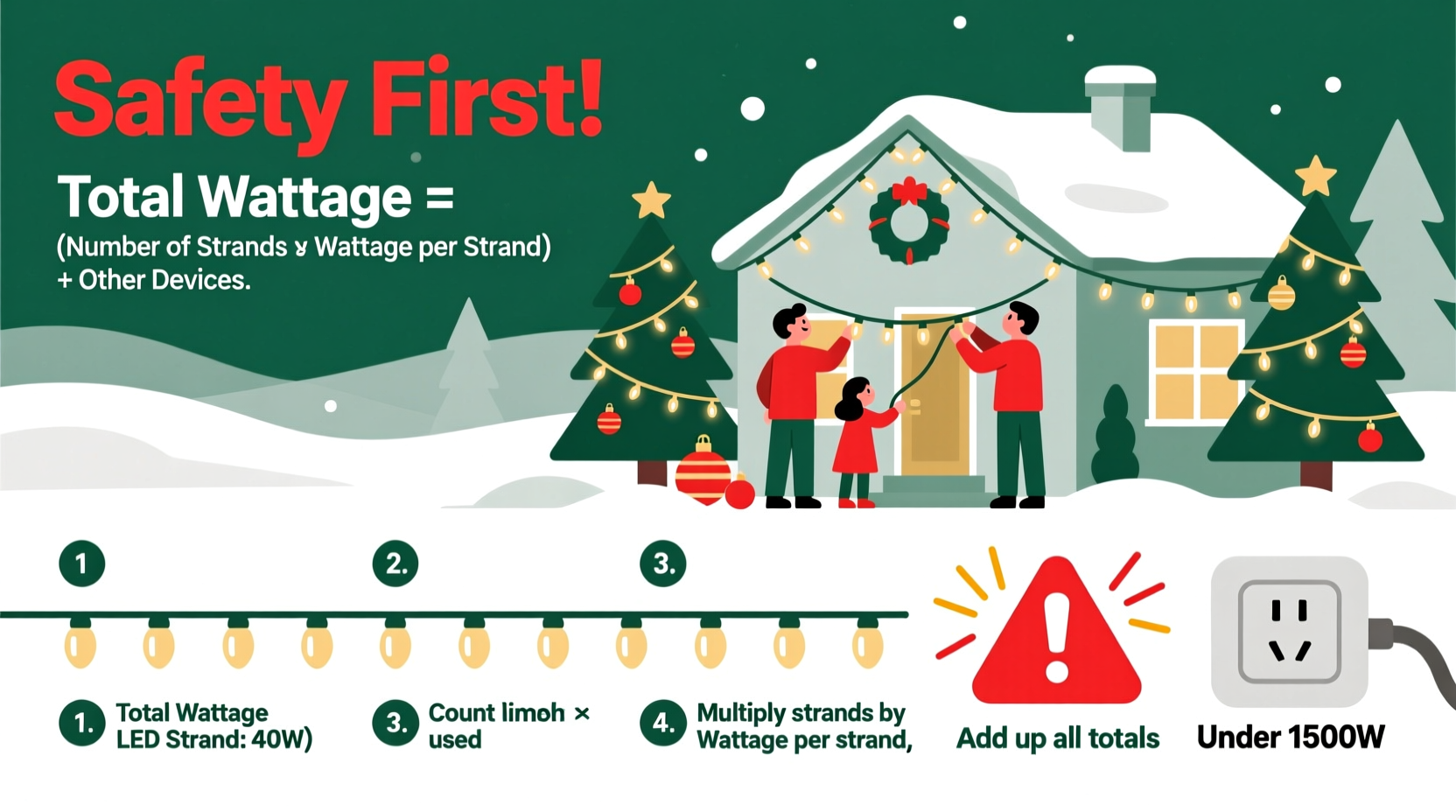
Household circuits are designed to handle a limited amount of electricity—typically 15 to 20 amps. Exceeding this limit causes overheating, blown fuses, or tripped breakers. Since most outdoor outlets are connected to indoor circuits, it's easy to exceed capacity when plugging in multiple strings of lights, inflatables, and motorized decorations.
Wattage is a measure of electrical power. Every device plugged into an outlet draws a certain number of watts. Add too many, and you surpass the circuit’s load capacity. For example, a standard 15-amp circuit operating at 120 volts can safely support up to 1,800 watts (15 × 120). However, experts recommend using only 80% of that capacity—about 1,440 watts—for continuous loads like holiday lighting.
“Many people don’t realize that decorative lighting adds up fast. One overloaded outlet can lead to damaged wiring or worse.” — James Rutherford, Licensed Electrician and Home Safety Consultant
Step-by-Step Guide to Calculating Total Wattage
To ensure your Christmas display stays within safe limits, follow this practical process:
- Inventory all electrical components – List every light string, projector, inflatable, tree, and animated figure you plan to use.
- Find the wattage of each item – Check labels, packaging, or manufacturer websites. If only amperage is listed, multiply by 120 (volts) to get watts.
- Group items by outlet and circuit – Determine which devices will plug into the same outlet or circuit.
- Add up the wattage per circuit – Sum the wattage of all devices on each circuit.
- Compare to the 80% rule – Ensure total wattage does not exceed 80% of the circuit’s maximum capacity.
- Adjust as needed – Replace high-wattage items with LEDs, stagger usage, or add dedicated circuits if necessary.
Understanding Your Equipment: LED vs. Incandescent
The type of lighting you use dramatically affects total wattage. Traditional incandescent bulbs consume significantly more power than modern LED alternatives.
| Bulb Type | Watts per Bulb | Bulbs per String | Total Watts per String | Lifespan (Hours) |
|---|---|---|---|---|
| Mini Incandescent | 0.4 – 0.5 | 50 | 20 – 25 | 3,000 |
| LED Mini Lights | 0.04 – 0.08 | 50 | 2 – 4 | 50,000 |
| C7 Incandescent | 5 | 25 | 125 | 6,000 |
| C7 LED | 0.4 | 25 | 10 | 50,000 |
| Large Inflatable (with fan & lights) | N/A | N/A | 150 – 300 | Varies |
As shown, switching from incandescent to LED can reduce power consumption by up to 90%. A single strand of mini incandescent lights uses about as much power as six LED strands. This efficiency allows for larger, brighter displays without exceeding circuit limits.
Real Example: The Johnson Family’s Front Yard Display
The Johnsons love Christmas. Their yard features two 8-foot trees wrapped in lights, 15 strands of roofline lighting, three animated reindeer, and a 12-foot inflatable snowman. Last year, their outdoor breaker kept tripping after sunset.
A quick audit revealed:
- Two trees: 300 incandescent mini lights each = 600 bulbs × 0.45W = 270W
- Roofline: 15 strands of C7 incandescents = 15 × 125W = 1,875W
- Animated reindeer (3): 60W each = 180W
- Inflatable snowman: 250W
Total: 270 + 1,875 + 180 + 250 = **2,575 watts**
All these were running off a single 15-amp outdoor circuit rated for 1,440 watts at 80% load. They were nearly double the safe limit.
Solution: They replaced all incandescent strings with LED equivalents. New totals:
- Trees: 600 LED bulbs × 0.06W = 36W
- Roofline: 15 × 10W (LED C7) = 150W
- Reindeer and snowman: unchanged (430W)
New total: **616 watts** — well under the 1,440-watt threshold. No more tripped breakers, lower energy bills, and a safer display.
Common Mistakes That Lead to Overloads
Even experienced decorators make errors that compromise safety and performance. Avoid these pitfalls:
- Daisy-chaining too many light strings – Most manufacturers limit daisy-chaining to 3–5 sets. Going beyond risks overheating wires.
- Ignoring extension cord ratings – Using indoor cords outdoors or undersized cords can cause voltage drop and fire hazards.
- Assuming all \"outdoor\" lights are low-draw – Some outdoor-rated lights still use high-wattage bulbs. Always verify specifications.
- Plugging everything into one outlet – Even with low-wattage LEDs, clustering too many devices on one circuit can overload it.
- Forgetting timers and controllers – These devices also draw power, albeit small amounts. Include them in calculations for precision.
Checklist: Pre-Display Electrical Safety Review
Before turning on your display, go through this checklist to ensure safety and efficiency:
- ✅ Inventory all electrical decorations (lights, inflatables, motors, projectors).
- ✅ Record wattage for each item (from label or manual).
- ✅ Group items by outlet and circuit.
- ✅ Calculate total wattage per circuit.
- ✅ Confirm no circuit exceeds 80% of its capacity (e.g., ≤1,440W on a 15A circuit).
- ✅ Replace high-wattage incandescent strings with LEDs where possible.
- ✅ Use heavy-duty, outdoor-rated extension cords (16-gauge or thicker).
- ✅ Install GFCI (Ground Fault Circuit Interrupter) protection on all outdoor outlets.
- ✅ Test the setup during daylight before full nighttime operation.
- ✅ Set timers to turn off lights after midnight to reduce strain and energy costs.
Advanced Tips for Large Displays
If you run a neighborhood-famous light show with synchronized music and dozens of elements, consider these upgrades:
- Dedicated Circuits – Have an electrician install one or more 20-amp circuits solely for holiday use. This removes strain from household systems.
- Power Distribution Box – Use a weatherproof box with multiple outlets and built-in surge protection to manage multiple runs efficiently.
- Smart Plugs and Monitoring – Devices like smart outlets allow remote control and real-time energy tracking via smartphone apps.
- Zoning Your Display – Break the display into zones (roof, yard, porch) and power each from separate circuits to balance load.
“Homeowners with elaborate displays should treat their setup like a temporary electrical installation. Plan it like an electrician would.” — Maria Lopez, Residential Electrical Inspector
Frequently Asked Questions
Can I use a power strip for my Christmas lights?
Yes, but only if it’s rated for outdoor use, has surge protection, and is connected to a GFCI outlet. Avoid overloading the strip—check its maximum wattage (usually 1,800W) and stay below 80% of that. Never daisy-chain power strips.
How do I know which circuit powers my outdoor outlet?
Turn off the main power, plug a radio or lamp into the outlet, then flip breakers one by one until the device turns off. Label the correct breaker immediately. Alternatively, use a circuit tracer tool for accuracy.
Do solar-powered Christmas lights help reduce wattage concerns?
Solar lights eliminate grid draw during operation, making them ideal for pathway markers or accent lighting. However, they’re generally dimmer and less reliable in cloudy winter climates. Best used as supplements, not primary lighting.
Conclusion: Shine Bright, Stay Safe
Your Christmas display is a labor of love—and it should be safe as much as it is spectacular. By calculating total wattage, choosing efficient LEDs, and respecting circuit limits, you protect your home, family, and neighbors from preventable electrical issues. Whether you're decorating a small porch or orchestrating a block-wide light festival, taking the time to understand your power needs pays off in peace of mind and uninterrupted holiday cheer.
Start planning now. Audit last year’s setup, upgrade inefficient lights, and map out your circuit usage before the first bulb goes up. A little preparation ensures your display dazzles all season long—without a single breaker trip.




 浙公网安备
33010002000092号
浙公网安备
33010002000092号 浙B2-20120091-4
Comments
No comments yet. Why don't you start the discussion?