
Stringing up Christmas lights is one of the most joyful parts of the holiday season. Whether you're wrapping trees, outlining rooflines, or illuminating your porch, the right lighting setup can transform your home into a winter wonderland. But behind the sparkle lies an important technical consideration: electrical safety. Connecting too many light strands together can overload circuits, trip breakers, or even pose fire hazards. The key to avoiding these risks is understanding how to calculate total wattage across multiple connected strands.
This guide walks through the essential principles of wattage, voltage, amperage, and circuit capacity. You’ll learn how to read product labels, perform accurate calculations, and make informed decisions about how many strings you can safely link. With this knowledge, you can create a vibrant, festive display without compromising safety or functionality.
Understanding Basic Electrical Terms
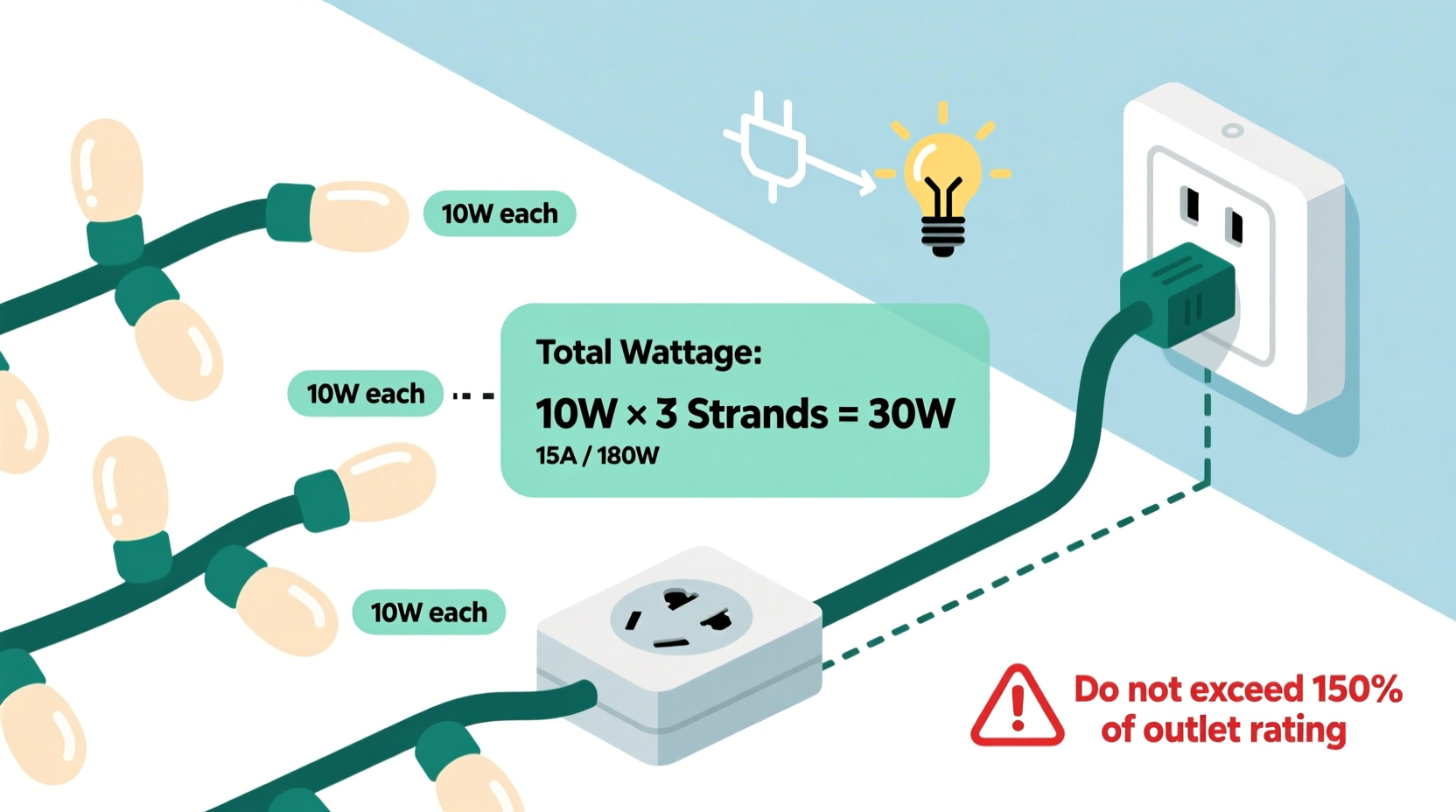
Before calculating total wattage, it’s crucial to understand the basic units of electricity involved in powering Christmas lights:
- Watt (W): A measure of power consumption. It tells you how much energy a device uses per second. For Christmas lights, lower wattage means less energy use and heat generation.
- Volt (V): The unit of electrical potential. Most household outlets in the U.S. supply 120 volts.
- Amp (A): Short for ampere, this measures the flow of electric current. Standard indoor circuits are typically rated for 15 or 20 amps.
- Ohm (Ω): A measure of electrical resistance, though less relevant for basic wattage calculations with pre-wired light sets.
The relationship between these units is defined by a simple formula:
If you know any two of these values, you can calculate the third. For example, if a string of lights draws 0.2 amps at 120 volts, its wattage is 120 × 0.2 = 24 watts.
Most Christmas light packaging lists wattage directly, but some only provide amperage. In those cases, you’ll need to multiply by 120 (standard U.S. voltage) to find the wattage.
How to Read Light Strand Labels
Every strand of Christmas lights comes with a label—usually on the plug end or included in the packaging—that provides vital electrical information. To calculate total wattage accurately, locate the following details:
- Maximum Connectable Sets: Many manufacturers specify how many identical strands can be safely linked end-to-end. This number varies based on wire gauge, fuse rating, and bulb type.
- Wattage per Strand: Often listed as “Total Watts” or “Rated Power.” For LED lights, this might be as low as 4–10 watts; incandescent sets can range from 20 to over 100 watts.
- Amps per Strand: If wattage isn’t listed, look for amperage. Multiply by 120 to get wattage.
- Bulb Count and Type: LEDs consume significantly less power than incandescent bulbs. A 50-light LED strand may use just 5 watts, while a similar incandescent set uses 25–40 watts.
“Never assume all light strings are created equal. Even within the same brand, different models have different load limits.” — James Holloway, Residential Electrician with 18 years of experience
Step-by-Step Guide to Calculating Total Wattage
Follow this process to determine whether your planned light configuration is safe for your electrical system.
- Gather all light strands you plan to connect. Group them by type (LED vs. incandescent) and model, as mixing types can complicate calculations and increase risk.
- Find the wattage or amperage of one strand. Check the label. If only amperage is listed, multiply by 120 to get watts.
- Multiply by the number of strands. Total Wattage = Wattage per Strand × Number of Strands.
- Determine your circuit’s capacity. Most household circuits are 15 or 20 amps. Multiply amps by 120 volts to get maximum wattage:
- 15-amp circuit: 15 × 120 = 1,800 watts
- 20-amp circuit: 20 × 120 = 2,400 watts
- Apply the 80% safety rule. Electrical codes recommend using no more than 80% of a circuit’s capacity for continuous loads (those running three hours or more). So:
- Safe load for 15-amp circuit: 1,800 × 0.8 = 1,440 watts
- Safe load for 20-amp circuit: 2,400 × 0.8 = 1,920 watts
- Compare total light wattage to safe circuit capacity. If your total is below the safe limit, you’re good to go. If not, reduce the number of strands or split them across multiple circuits.
Example Calculation
You have 10 identical LED light strands, each rated at 7 watts. You want to connect them all to a single outlet on a 15-amp circuit.
- Total wattage: 10 × 7 = 70 watts
- Circuit capacity: 15 × 120 = 1,800 watts
- Safety limit (80%): 1,440 watts
Since 70 watts is well under 1,440, this setup is perfectly safe—even allowing room for additional decorations like inflatables or a tree motor.
Do’s and Don’ts When Connecting Multiple Strands
| Do’s | Don’ts |
|---|---|
| Use LED lights—they consume less power and generate less heat. | Daisy-chain more strands than the manufacturer recommends. |
| Check labels for wattage and max connectable sets. | Mix incandescent and LED strands on the same daisy chain. |
| Use outdoor-rated extension cords for exterior lighting. | Overload a single outlet or power strip. |
| Split large displays across multiple circuits. | Ignore flickering lights or warm plugs—these signal overload. |
| Test connections before leaving lights unattended. | Use indoor lights outdoors, even temporarily. |
Real Example: Holiday Home Lighting Project
Consider Sarah, a homeowner decorating her two-story house for the holidays. She plans to outline the roofline, wrap porch columns, and illuminate front bushes. Her initial design includes:
- 8 strands of 100-count incandescent mini-lights (each 40 watts)
- 6 strands of 50-light LED warm white (each 5 watts)
- 1 inflatable snowman (120 watts)
All will connect via a single outdoor-rated power strip plugged into a garage outlet on a 15-amp circuit.
Calculation:
- Incandescent total: 8 × 40 = 320 watts
- LED total: 6 × 5 = 30 watts
- Inflatable: 120 watts
- Grand total: 470 watts
The 15-amp circuit supports up to 1,440 watts safely. At 470 watts, Sarah is well within limits. However, she realizes that adding a second inflatable or connecting her indoor tree could push the load higher. She decides to run the tree lights from a different circuit in the living room, ensuring balanced distribution.
She also checks that no daisy chain exceeds the incandescent strand’s “max 3 sets” limit. Instead of linking all eight together, she uses Y-splitters and extension cords to group them in threes, plugging each group into the power strip.
Checklist: Safe Christmas Light Setup
Use this checklist before turning on your holiday display:
- ✅ Confirm wattage or amperage for each light strand
- ✅ Calculate total wattage of all connected devices
- ✅ Verify circuit rating (15A or 20A) and apply 80% rule
- ✅ Ensure no daisy chain exceeds manufacturer’s max connectable sets
- ✅ Use outdoor-rated extension cords and GFCI-protected outlets outside
- ✅ Avoid overloading power strips—never daisy-chain multiple strips
- ✅ Inspect cords for fraying, cracks, or exposed wires
- ✅ Test setup during daylight before leaving unattended
- ✅ Install timers to limit runtime and reduce fire risk
- ✅ Label circuits so others know which breaker controls the lights
Frequently Asked Questions
Can I connect different brands of Christmas lights together?
Yes, but only if they are the same voltage and bulb type (e.g., both 120V LED). Mixing brands increases risk if one has a lower current tolerance. Always check individual ratings and never exceed the lowest-rated strand’s connection limit.
Why do my lights keep tripping the breaker?
This usually means you’ve exceeded the circuit’s safe load. Unplug all lights and reconnect them gradually to identify the threshold. Also, check for damaged cords or moisture in outdoor connections. Using a dedicated circuit for holiday lighting often resolves the issue.
Are LED lights really safer than incandescent?
Yes. LEDs use up to 90% less energy, produce minimal heat, and last longer. Their lower wattage allows more strands to be connected safely. They’re especially recommended for indoor trees, garlands, and enclosed spaces where heat buildup is a concern.
Final Thoughts and Safety Reminder
Calculating total wattage isn’t just a technical exercise—it’s a critical step in protecting your home and family. A dazzling light display shouldn’t come at the cost of electrical safety. By understanding wattage, respecting manufacturer guidelines, and distributing loads wisely, you can enjoy peace of mind along with your holiday glow.
As tempting as it may be to add “just one more strand,” remember that small oversights can lead to big problems. Take the time to plan, calculate, and test. Your future self—and your circuit breaker—will thank you.




 浙公网安备
33010002000092号
浙公网安备
33010002000092号 浙B2-20120091-4
Comments
No comments yet. Why don't you start the discussion?