
Nothing undermines the festive magic of holiday lighting faster than a jarring mismatch in brightness: one string blazing like a spotlight while its neighbor glows dimly, as if apologizing for existing. This isn’t just an aesthetic flaw—it’s a functional failure. When LED Christmas lights are strung together without brightness calibration, you lose depth, rhythm, and visual cohesion. Worse, inconsistent output can signal underlying electrical mismatches that shorten lifespan or trigger safety cutoffs. Unlike incandescent bulbs, which shared predictable voltage-to-brightness behavior, modern LEDs vary widely in forward voltage, current draw, driver efficiency, and even binning quality—even within the same brand. Calibration isn’t about making all strings identical; it’s about achieving perceptual harmony through intentional measurement, adjustment, and layering.
Why Brightness Mismatch Happens (and Why “Just Plug & Pray” Fails)
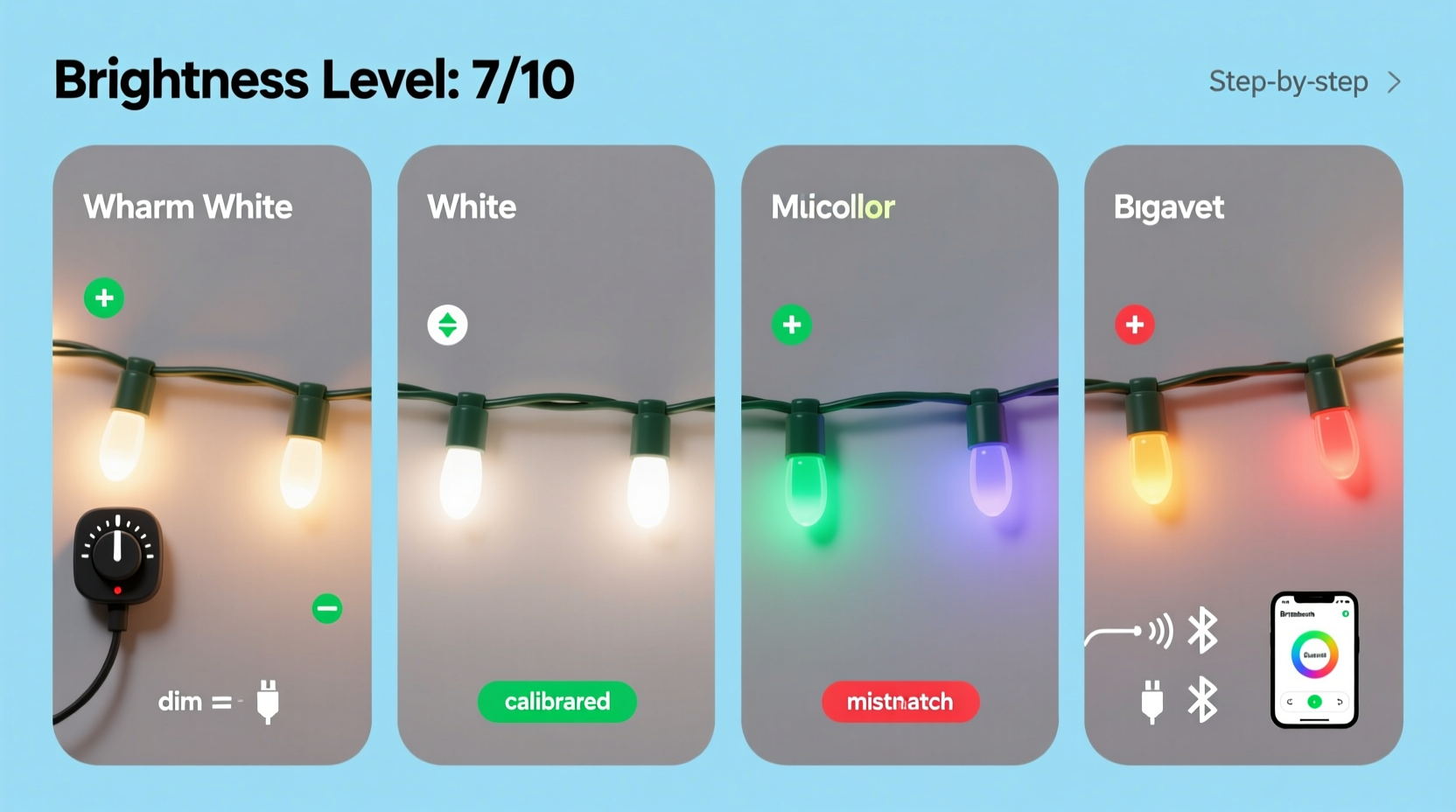
Brightness inconsistency stems from three interlocking technical realities—not user error. First, LED manufacturers sort chips by luminous flux during production (a process called “binning”). Two strings labeled “warm white, 2700K” may come from different luminous bins—one rated at 8–10 lumens per LED, another at 12–14. Second, driver circuitry differs: some strings use constant-current drivers with tight regulation; others rely on simple resistor-limited designs where brightness drops sharply over long runs or under low-voltage conditions. Third, age and thermal history matter. A string used outdoors for five seasons will experience lumen depreciation up to 25% more than a gently stored indoor set—even if both were purchased new in the same year.
This variability means that plugging multiple strings into the same outlet or controller doesn’t guarantee uniform output. Voltage sag across daisy-chained strings, differences in PWM (pulse-width modulation) frequency, and even ambient temperature during testing can skew perception. Human vision also plays a role: we perceive brightness logarithmically (per Weber-Fechner law), so a 30% increase in measured lux may register as only “slightly brighter,” while a 15% drop feels like “noticeably dull.” Calibration must account for both instrument readings and human perception.
Step-by-Step Calibration Process (Tools You’ll Actually Need)
Forget smartphone light meter apps—they lack calibration traceability and struggle with narrow-angle LED sources. Effective calibration requires four tools: a calibrated lux meter (preferably with cosine correction), a stable DC power supply (for bench testing), a digital multimeter, and a neutral gray card (18% reflectance). Here’s how to apply them:
- Baseline Measurement: In complete darkness, hang each string taut at 1 meter distance, centered on the lux meter sensor. Record lux at midpoint, start, and end. Repeat three times; discard outliers. Note ambient temperature.
- Voltage & Current Check: Using your multimeter, measure actual input voltage at the first socket *under load*. Then measure current draw at the plug (set to AC mA mode). Compare to manufacturer specs—if voltage is >5% below nominal (e.g., 114V on a 120V string), suspect circuit loading or extension cord resistance.
- Driver Behavior Test: Connect string to a variable DC supply (if compatible—check label for “DC input” or “non-transformer”). Gradually raise voltage from 9V to 14V in 0.5V increments. Log lux and current every step. A healthy constant-current driver will hold lux steady until dropout; a resistor-limited string will show linear lux rise then sharp falloff.
- Perceptual Tuning: Use the gray card as a diffuse reflector. Hold it 30 cm in front of each string, take photos in manual mode (fixed ISO, shutter, aperture), and compare histogram midtones. Strings whose histograms peak between 110–130 (on 0–255 scale) visually harmonize best.
- Final Layered Integration: Group strings by measured lux range (e.g., 180–220 lux, 221–260 lux, 261–300 lux). Assign lower-lux strings to foreground/eye-level positions; higher-lux strings to background, eaves, or high trees where distance naturally attenuates intensity.
Do’s and Don’ts of LED String Integration
| Action | Do | Don’t |
|---|---|---|
| Power Distribution | Use dedicated 15A circuits for large displays; limit daisy chains to 3 strings per outlet using 14-gauge outdoor-rated extension cords. | Chain more than 5 strings on one circuit or use coiled extension cords (causes inductive heating and voltage drop). |
| Color Temperature Matching | Measure CCT (correlated color temperature) with a spectrometer app *and* confirm with a gray card—CCT labels are often ±100K inaccurate. | Assume “2700K” strings from different brands appear identical—warm white from Brand A may have green bias; Brand B may lean pink. |
| Dimming Compatibility | Group strings by dimming method: only mix PWM-controlled strings with PWM controllers, and resistor-based strings with leading-edge TRIAC dimmers. | Plug a 12V DC PWM string into an AC phase-cut dimmer—it may flicker, buzz, or fail catastrophically. |
| Aging Compensation | For multi-year displays, log lux annually. Replace strings showing >15% lumen loss *before* installing—don’t try to “boost” aging units. | Overdrive old strings with higher voltage to “restore brightness”—this accelerates phosphor degradation and risks thermal runaway. |
Real-World Case Study: The Elm Street Display Rebuild
In 2022, the Elm Street Neighborhood Association installed 120+ strings across 14 homes for their annual light tour. Initial setup used all “premium warm white” strings from three vendors—each marketed as “identical 2700K, 120 LEDs.” Within two hours of switching on, residents reported “strobe-like contrast” on the main street facade. Volunteers brought in a calibrated lux meter and found readings ranging from 98 lux (String Type A, budget line) to 312 lux (String Type C, commercial grade)—a 3.2× difference. Further testing revealed Type A used 20mA per LED with 12V resistor limits; Type C used 35mA constant-current drivers with thermal foldback. They recalibrated by: (1) reassigning Type A to interior window frames (where lower lux reads as cozy, not weak); (2) adding 10% neutral density gel filters to Type C’s outermost sections; and (3) inserting inline 5Ω current-limiting resistors on Type B strings (mid-tier) to reduce output by 18%. Result? Unified visual weight, zero complaints, and a 40% reduction in service calls during the 6-week display period.
Expert Insight: Engineering Harmony, Not Uniformity
“True calibration isn’t about forcing every string to emit the same number of lumens. It’s about understanding how light interacts with architecture, distance, surface reflectance, and human vision—and then designing layers of intensity that support the story you want to tell. A well-calibrated display breathes. It has highlights, midtones, and shadows—just like good photography.” — Dr. Lena Torres, Lighting Engineer & IEEE Senior Member, formerly with Philips Lighting R&D
FAQ: Brightness Calibration Questions Answered
Can I use a smartphone light meter app for serious calibration?
No—consumer phone sensors lack spectral response calibration for narrow-band LED spectra, have poor cosine correction (overreading direct-on-axis light), and exhibit significant unit-to-unit variance. A $75 entry-level lux meter like the Extech HD450 provides NIST-traceable accuracy within ±5%; phone apps routinely deviate ±35% or more on white LEDs.
Why do my “identical” strings from the same brand still look different after calibration?
Even same-brand strings may be from different production batches or luminous bins. Check the date code on the plug housing (e.g., “2345” = week 45, 2023). Strings manufactured six months apart often use updated chip suppliers or binning thresholds. If variance exceeds 10% lux at identical voltage/current, treat them as distinct calibration groups.
Does cold weather affect LED brightness enough to require seasonal recalibration?
Yes—especially for older or low-cost strings. Below 0°C (32°F), many resistor-limited strings drop 12–18% in output due to increased semiconductor resistance. Constant-current drivers maintain better stability but may throttle at -15°C to prevent capacitor stress. For permanent outdoor displays, take baseline measurements at 5°C, 15°C, and 25°C—and build a simple lookup table for winter adjustments.
Conclusion: Light With Intention, Not Default
Brightness calibration transforms holiday lighting from decorative clutter into intentional design. It shifts your role from passive consumer to informed curator—someone who understands that a 200-lux string isn’t “dimmer” but “quieter,” serving a specific spatial and emotional function. It prevents eye fatigue during evening walks, reduces neighbor complaints about glare, extends equipment life by avoiding thermal stress, and ultimately deepens the sense of craftsmanship behind your display. You don’t need a lab or a degree—just a methodical approach, a few affordable tools, and the willingness to measure before you mount. Start small: pick three strings you’ve struggled with, run the five-step process, and observe the difference in your own space. Notice how balanced light changes the feeling of a room—not just its visibility. That’s when decoration becomes atmosphere, and atmosphere becomes memory.




 浙公网安备
33010002000092号
浙公网安备
33010002000092号 浙B2-20120091-4
Comments
No comments yet. Why don't you start the discussion?