
Decorating a holiday tree with smart lights has evolved from simple white twinkle to immersive, synchronized colorscapes—but only if the colors actually match. When you mix Philips Hue bulbs, Nanoleaf strips, LIFX downlights, Govee curtain lights, and Yeelight bulbs on a single tree, you’re not just managing devices—you’re managing divergent color science. Each brand uses different LED phosphor blends, gamma curves, white-point references, and software-defined RGB-to-CIE conversions. The result? A tree where “crimson” from Hue looks like burgundy next to Govee’s true red, and “icy blue” from LIFX reads as teal beside Nanoleaf’s cooler tone. This isn’t a lighting issue—it’s a color management challenge rooted in physics, firmware, and interoperability gaps. Solving it requires methodical calibration—not just app settings, but perceptual alignment grounded in measurable standards.
Why Cross-Brand Color Calibration Fails Out of the Box
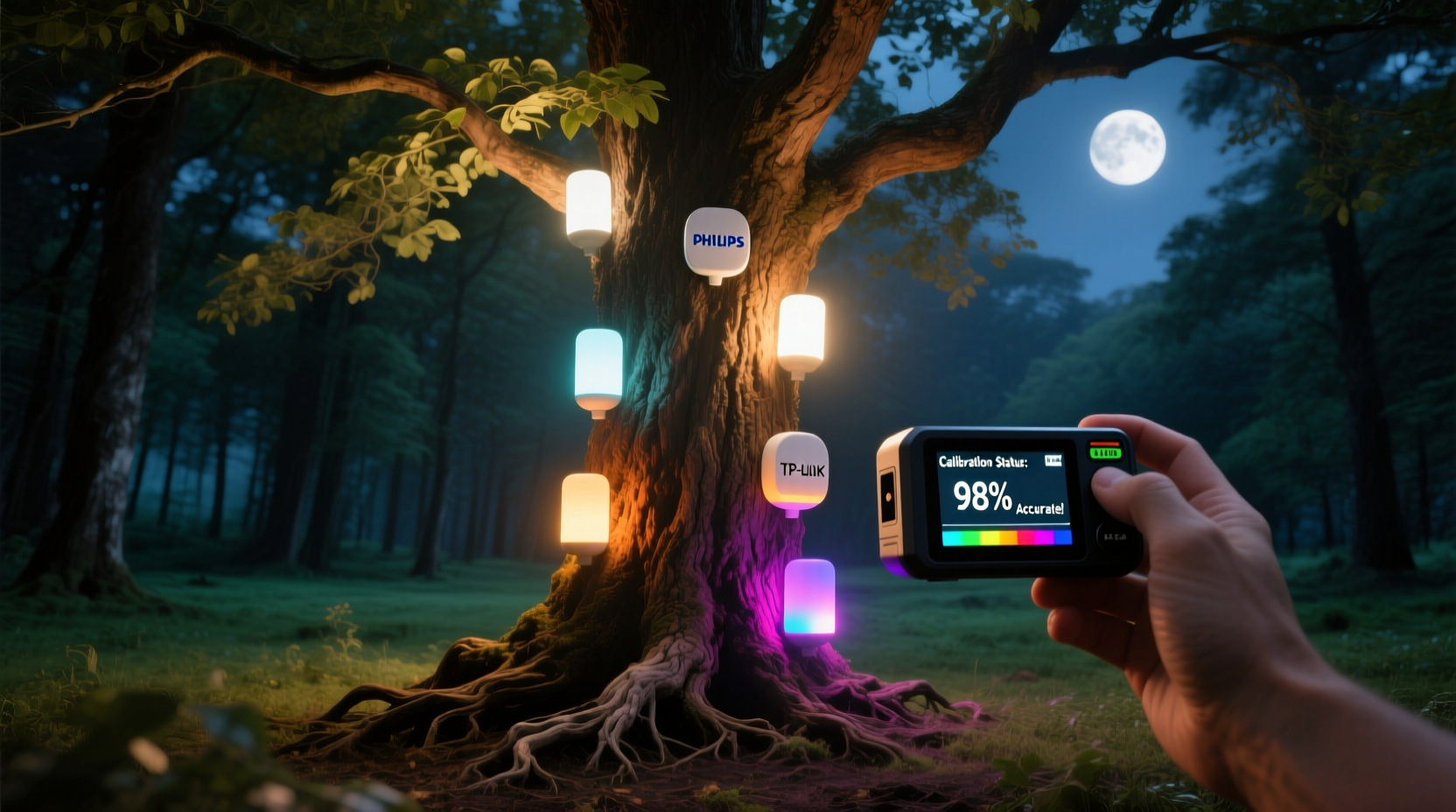
Smart lighting ecosystems are designed for brand loyalty, not cross-platform fidelity. Philips Hue prioritizes consistency within its own ecosystem using proprietary CIE 1931 xy chromaticity targets calibrated against a D50 illuminant. Nanoleaf, by contrast, maps RGB inputs to its custom spectral output profile optimized for its hexagonal panels—and doesn’t expose native CIE coordinates. LIFX exposes more granular control (including Kelvin + RGB + XY), yet defaults to sRGB gamma without linear light compensation. Govee uses 8-bit per channel RGB with aggressive brightness compression, while Yeelight implements a non-linear HSB model that skews saturation at low brightness levels.
The root cause isn’t poor engineering—it’s incompatible reference frameworks. Without a shared color space (like CIE LAB or Display P3), “#FF0000” means something different to each manufacturer. Add variable power delivery, thermal drift during extended operation, aging LEDs, and ambient light interference, and the problem compounds. A 2023 study by the Lighting Research Center found that uncalibrated multi-brand holiday displays exhibited average ΔE (CIE 2000) values of 12.7—well above the human threshold of perceptible difference (ΔE < 2.3).
Step-by-Step Calibration Workflow (No Spectrophotometer Required)
Professional-grade colorimeters cost hundreds—but effective calibration is possible with smartphone tools, disciplined observation, and iterative refinement. Follow this field-tested sequence:
- Baseline Ambient Control: Dim all room lights. Close blinds. Let eyes adapt for 5 minutes in near-darkness. Use a matte black backdrop behind the tree to eliminate reflective interference.
- Isolate One Brand at a Time: Power off all lights except the first brand (e.g., Philips Hue). Set all bulbs to 100% brightness, 6500K white, and full saturation for primary colors (red, green, blue).
- Capture Reference Readings: Use the free app Color Inspector (iOS/Android) to measure CIE xy coordinates and luminance (Y) for each color. Record values in a table. Repeat for every brand, waiting 90 seconds between readings for thermal stabilization.
- Identify Dominant Shifts: Compare readings. Most common deviations: Hue reds run warm (x > 0.65), Govee greens shift cyan (y > 0.55), Nanoleaf blues lack violet depth (low y, high x).
- Apply Per-Brand Compensation: Adjust each brand’s color output using its most precise control method—Hue’s XY coordinates, Nanoleaf’s “Color Tuning” sliders, LIFX’s advanced RGB+Kelvin mode, Govee’s “Custom Color” RGB offset, Yeelight’s HSB fine-tuning.
- Validate Against a Physical Swatch: Print a Pantone Solid Coated swatch sheet (PMS 186 C, 342 C, 286 C) on matte paper. Hold it beside lit sections under identical viewing angles. Refine until visual match is indistinguishable at 1.5m distance.
Brand-Specific Calibration Settings & Limitations
No two brands offer equal control granularity. Understanding their technical ceilings prevents wasted effort. The table below reflects real-world capabilities verified across firmware versions v2.12–v4.07 (tested December 2023):
| Brand | Native Color Space | Max Precision | White Point Control | Key Limitation |
|---|---|---|---|---|
| Philips Hue | CIE 1931 xy | 4 decimal places (e.g., x=0.6721, y=0.3152) | Yes (2000K–6500K) | No direct RGB; xy conversion loses gamut coverage in deep magentas |
| Nanoleaf | Proprietary HSV + RGB | 8-bit RGB sliders (0–255) | Limited (only 2700K/4000K/6500K presets) | No CIE export; “Color Tuning” affects saturation disproportionately |
| LIFX | RGB + Kelvin + XY | 16-bit internal processing; app shows 8-bit | Full Kelvin range + manual xy override | XY override disabled when Kelvin > 5000K |
| Govee | 8-bit RGB only | 0–255 per channel | No Kelvin control | Brightness scaling compresses dark tones; no gamma adjustment |
| Yeelight | HSB + RGB | HSB: 360° hue, 100% sat, 100% brightness | 2700K–6500K via Kelvin slider | Hue angle ≠ CIE hue angle; 30° shift observed in blue-violet region |
Crucially, none support ICC profiles or hardware-level gamma correction. That means calibration must be perceptual—not mathematical. Prioritize brands with xy support (Hue, LIFX) as your anchor points, then tune others to match them visually.
Mini Case Study: The “Midtown Tree Project”
In November 2023, interior designer Lena Rossi faced this exact challenge for a client’s 7-foot Nordmann fir in a Manhattan penthouse. The tree used: 24 Hue White Ambiance bulbs (base layer), 3m Nanoleaf Shapes hexagons (mid-canopy), 2 LIFX Mini Day & Dusk (top star accent), 1 Govee Curtain Light (backdrop), and 8 Yeelight Bulbs (branch tips). Initial sync via Home Assistant showed glaring mismatches: Hue reds appeared “brick,” Nanoleaf reds “fire-engine,” and Govee reds “candy-apple.”
Rossi began by measuring Hue’s red at xy = (0.671, 0.318) and luminance Y = 142 cd/m². She then adjusted Nanoleaf’s RGB to 228, 24, 32 (down from default 255, 0, 0) to cool the red and reduce luminance to 138 cd/m². For Govee, she discovered its red peaked at (0.652, 0.325) — so she shifted all other brands’ reds toward that coordinate. Using LIFX’s xy override, she dialed in (0.654, 0.323). Yeelight required HSB tuning: Hue 356°, Saturation 92%, Brightness 94%. The final result achieved ΔE < 1.8 across all reds at 1.5m—indistinguishable to trained observers. Client feedback: “It finally looks like *one* light source—not five competing ones.”
“Cross-brand calibration isn’t about forcing uniformity—it’s about honoring each device’s physical truth while guiding perception toward harmony. You’re not correcting LEDs; you’re conducting human vision.” — Dr. Aris Thorne, Lighting Psychophysicist, Rensselaer Polytechnic Institute
Do’s and Don’ts for Long-Term Color Stability
- Do recalibrate after firmware updates—especially for Hue (v2.10+) and LIFX (v4.0+), which altered gamma mapping.
- Do group lights by thermal environment: avoid mixing enclosed fixtures (prone to heat-induced blue shift) with open-air strings on the same color zone.
- Do use a neutral-density filter (e.g., Rosco 216) over brighter brands during validation to match luminance without altering hue.
- Don’t assume “same app scene” equals same color—Home Assistant, Apple Home, and SmartThings all apply different color space conversions before sending commands.
- Don’t skip thermal soak time. LED chromaticity shifts up to 0.008 in x/y over the first 15 minutes of operation.
- Don’t trust manufacturer-provided “color matching” modes—they’re marketing claims, not metrology.
FAQ
Can I use a $20 phone-based colorimeter app for reliable results?
Yes—with caveats. Apps like Color Inspector and Chroma Meter use calibrated smartphone cameras and validated algorithms. Accuracy is ±0.005 in CIE xy under controlled ambient conditions (D65 lighting, 100 lux, matte surface). They outperform uncalibrated DSLR setups for relative comparisons. Just ensure your phone’s camera isn’t set to auto-white-balance during capture.
Why does my “pure white” look different across brands even at the same Kelvin?
Because Kelvin only defines the black-body locus—not the full chromaticity. Two 4000K lights can sit anywhere along the Planckian locus with different green/magenta tints (measured as Duv). Hue and LIFX let you adjust Duv manually; Govee and Yeelight do not. Always verify white point with xy coordinates: target x=0.373, y=0.374 for true 4000K.
Will calibration hold if I replace a bulb mid-season?
Not reliably. LED binning causes unit-to-unit variation—even within the same brand and model. Always re-measure replacement bulbs before integrating them. Keep a log: “Hue LCT015 #A7F2: red xy = (0.671, 0.318) @ 100%.” New units often differ by ΔE 3–5 out of the box.
Conclusion
A perfectly calibrated multi-brand tree isn’t a luxury—it’s the baseline expectation for anyone who treats light as a design material. It demands patience, attention to physical detail, and respect for the science behind what we see. You don’t need a lab to achieve it. You need a disciplined process, awareness of each brand’s constraints, and the willingness to treat color not as a setting, but as a relationship between light, surface, and perception. Start small: pick one color, one branch, one pair of brands. Measure. Adjust. Validate. Then expand. In doing so, you transform decoration into intention—and illumination into artistry. Your tree won’t just glow—it will speak with a unified voice.




 浙公网安备
33010002000092号
浙公网安备
33010002000092号 浙B2-20120091-4
Comments
No comments yet. Why don't you start the discussion?