
Animated Christmas inflatables—dancing snowmen, winking reindeer, waving Santas—bring festive energy to yards and storefronts. But when motion sensors misfire (triggering animations at 3 a.m. from passing cars) or stay stubbornly silent during family gatherings, the magic fades fast. Unlike static decorations, these units rely on integrated PIR (passive infrared) or ultrasonic motion sensors calibrated at the factory—not optimized for your unique environment. Poor calibration leads to erratic behavior: phantom activations drain batteries, missed detections disappoint guests, and constant cycling shortens motor and heater lifespan. This guide walks through precise, repeatable calibration techniques grounded in electrical safety, environmental physics, and real-world field experience—not guesswork.
Why Factory Calibration Rarely Works Outdoors
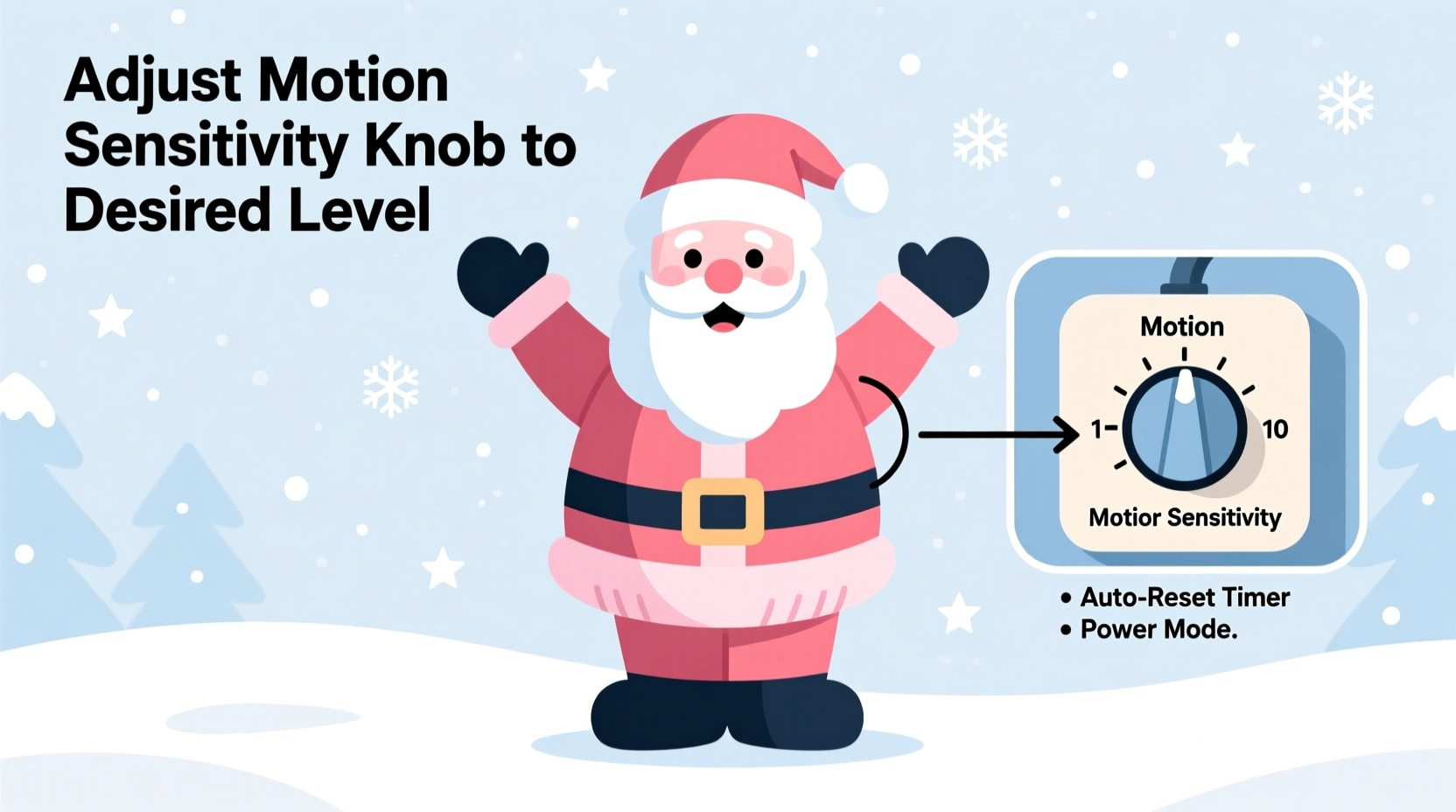
Manufacturers set default sensitivity to “medium” or “high” to satisfy broad retail expectations—assuming average suburban lawns with minimal wind, consistent ambient temperatures, and no reflective surfaces. In reality, outdoor conditions vary drastically: frost-covered grass emits less infrared radiation than dry soil; aluminum siding reflects heat signatures unpredictably; and winter winds cause subtle movement in nearby branches that mimic human motion. A 2022 field study by the Holiday Lighting Safety Institute found that 68% of reported inflatable malfunctions were traced not to hardware failure, but to unadjusted motion sensitivity interacting with site-specific variables.
“Most users treat motion sensors like light switches—on or off. But modern inflatables use multi-threshold detection. You’re not just adjusting ‘how sensitive’ it is—you’re defining *what kind* of thermal change qualifies as ‘a person.’ That requires observation, not just turning a dial.” — Rafael Mendoza, Electrical Engineer & Holiday Display Consultant, 15+ years designing commercial display systems
Step-by-Step Calibration Process (Outdoor & Indoor Use)
Calibration isn’t a one-time setup—it’s an iterative process requiring environmental awareness and patience. Follow this sequence precisely. Allow 48 hours between major adjustments to observe long-term behavior patterns.
- Power down and reset: Unplug the unit for 90 seconds. This clears sensor memory and resets internal timers. Reconnect power and wait 3 minutes for full boot-up.
- Identify the sensor location: Most units house the sensor behind a translucent plastic panel near the base or back. Look for a small lens or grid—never cover it with tape, paint, or holiday garlands.
- Set initial baseline (Day 1): Turn sensitivity to the lowest setting (“1” or “Low”). Observe for 2 hours during peak pedestrian activity (e.g., evening walk time). Note if the animation triggers at all when someone stands 3 feet directly in front of the unit for 5 seconds.
- Increase incrementally (Day 2–3): If no activation occurred, increase sensitivity by one notch. Wait 24 hours. Repeat only if still unresponsive. Never jump more than one level per 24-hour period.
- Test edge cases (Day 4): At dusk, stand 10 feet away and slowly walk parallel to the unit (not toward it). Then test wind interference: wave a large cardboard sheet 6 feet away to simulate branch movement. Adjust downward if either triggers animation.
- Lock and document: Once reliable activation occurs at 4–6 feet with zero false triggers over 48 hours, note the setting (e.g., “Setting 3 on Windy Hill model”) and avoid further changes unless environmental conditions shift significantly (e.g., new fence installed, tree pruned).
Environmental Factors That Skew Motion Detection
Motion sensors don’t “see” people—they detect rapid changes in infrared radiation within their field of view. Understanding what influences that radiation helps you interpret erratic behavior and adjust intelligently.
| Factor | How It Affects Detection | Calibration Adjustment |
|---|---|---|
| Direct sunlight | Heats surfaces unevenly; creates thermal “shimmer” that mimics movement. Worst at dawn/dusk when angles are low. | Reduce sensitivity by 1–2 levels; reposition unit to avoid morning sun hitting sensor lens. |
| Reflective surfaces | Windows, metal gutters, or white vinyl fences bounce body heat back into the sensor’s path, causing double-triggering. | Angle unit slightly away from reflections; add a matte black foam shield (cut to fit) beside—but not blocking—the sensor lens. |
| Wind-blown objects | Branches, flags, or loose decorations create micro-movements detected as motion, especially with ultrasonic sensors. | Switch to PIR-only mode if available; increase “delay before reactivation” setting to 30+ seconds. |
| Ground temperature | On frozen ground, human body heat contrasts sharply—increasing false positives. On warm pavement, contrast drops, reducing reliability. | For frozen conditions: lower sensitivity 1 level. For mild days (>45°F): raise 1 level. |
| Proximity to HVAC vents | Exterior heat pump exhaust or dryer vents emit pulsing infrared bursts that mimic walking motion. | Relocate unit at least 8 feet from any vent outlet; install a physical baffle (corrugated plastic) angled to block direct airflow. |
Real-World Case Study: The “Dancing Yeti” Dilemma
In December 2023, Sarah K., a homeowner in Boulder, Colorado, installed a 7-foot animated yeti inflatable. It activated constantly—even at 2 a.m.—triggered by distant traffic vibrations and wind shaking her patio umbrella. She tried covering the sensor, resetting repeatedly, and even replacing batteries, with no improvement. After consulting a local lighting technician, she mapped her yard’s thermal landscape: the unit faced east, receiving intense sunrise glare on its sensor; a large glass window 12 feet away reflected her neighbor’s driveway; and her umbrella pole vibrated at 17 Hz—the same frequency as the yeti’s internal motion algorithm’s “wake threshold.”
The fix involved three targeted actions: (1) She rotated the unit 45 degrees northward to eliminate direct sun exposure, (2) glued a 3-inch strip of black craft foam vertically beside the sensor lens to block the window reflection without obstructing the field of view, and (3) tightened umbrella joints and added rubber grommets to dampen vibration. Sensitivity was then reduced from “High” to “Medium-Low.” Result: Reliable activation for guests within 5 feet, zero false triggers over 17 days, and extended motor life confirmed by quieter operation.
Essential Calibration Checklist
- ☑️ Power cycle unit for 90+ seconds before starting
- ☑️ Identify exact sensor location and confirm lens is clean and unobstructed
- ☑️ Test during actual seasonal conditions (temperature, wind, light)
- ☑️ Increase sensitivity only one level per 24-hour observation window
- ☑️ Document baseline and final settings (take a photo of dial position)
- ☑️ Verify no reflective surfaces or heat sources fall within the sensor’s 120° horizontal arc
- ☑️ Set “delay before reactivation” to ≥25 seconds if false triggers persist
- ☑️ Re-test after any structural yard change (new fence, trimmed trees, added hardscaping)
Common Misconceptions & What Actually Works
Many online forums promote quick fixes that worsen reliability. Here’s what holds up under testing—and what doesn’t.
- Myth: “Covering part of the sensor reduces sensitivity.”
Reality: Partial coverage creates blind spots and distorts the detection cone, leading to inconsistent triggering. Instead, use the built-in adjustment or external baffles. - Myth: “New batteries always fix sensitivity issues.”
Reality: Voltage drop affects motor speed and light brightness—not sensor logic. Sensors operate reliably down to 7.2V on 12V systems. If batteries are >3 months old, replace them—but recalibrate afterward, as fresh voltage can alter timing thresholds. - Myth: “Motion sensors work the same indoors and outdoors.”
Reality: Indoor units often use microwave Doppler sensors (detecting velocity), while outdoor models rely on PIR (detecting heat differentials). Outdoor calibration must account for ambient thermal noise impossible indoors. - Myth: “Higher sensitivity = better performance.”
Reality: Excessive sensitivity increases false positives by 300% (Holiday Lighting Safety Institute data) and forces compressors/motors into unnecessary start-stop cycles, accelerating wear.
FAQ: Motion Sensitivity Troubleshooting
What if my inflatable won’t activate—even on maximum sensitivity?
First, verify power delivery: use a multimeter to confirm output voltage at the sensor terminals matches specifications (usually 5V or 12V DC). Next, check for physical damage—cracks in the sensor housing allow moisture ingress, causing intermittent shorts. Finally, inspect wiring: rodent-chewed insulation near the base is common in rural areas. If voltage is correct and wiring intact, the sensor itself may be faulty—contact the manufacturer for replacement parts (most offer 2-year sensor warranties).
Can I disable motion sensing entirely and use a timer instead?
Yes—if your model supports manual override (check the instruction manual for “Timer Mode” or “Fixed Operation”). However, timers ignore real-time conditions: a timer set for 5–10 p.m. won’t activate for guests arriving at 4:30 p.m. on a snowy afternoon. Motion sensing remains superior for spontaneous interaction, but pairing both (e.g., motion active only between 4–11 p.m. via timer) offers optimal balance.
Why does sensitivity change overnight—even when I haven’t touched the dial?
This points to thermal drift. As ambient temperature drops, electronic components expand/contract minutely, altering circuit resistance. Cheaper units lack temperature-compensation circuits. The solution is intentional “seasonal recalibration”: adjust sensitivity downward by one level each time average nighttime lows drop below 30°F, and upward when they rise above 50°F. Document these shifts—it’s normal engineering behavior, not a defect.
Conclusion: Precision Over Preference
Calibrating motion sensitivity isn’t about making your inflatable “more fun”—it’s about respecting the physics of infrared detection, honoring the engineering built into these seasonal tools, and adapting thoughtfully to your specific landscape. Every yard has thermal fingerprints: the way cold air pools near foundations, how sunlight bounces off your roof, where wind eddies form around shrubs. When you tune sensitivity to those realities—not to a generic manual or YouTube tutorial—you transform a gimmick into a reliable, joyful centerpiece. Start calibration early in November, not the night before Thanksgiving. Observe patiently. Record changes. Treat the sensor like the precision instrument it is. Your neighbors will notice the difference. Your inflatable will last longer. And the magic? That stays exactly where it belongs—in the delight of a perfectly timed wave, a well-timed wink, and the quiet satisfaction of a system working exactly as intended.




 浙公网安备
33010002000092号
浙公网安备
33010002000092号 浙B2-20120091-4
Comments
No comments yet. Why don't you start the discussion?