
Whether you're signing important documents, journaling, or taking fast notes during a meeting, nothing disrupts the flow like smudged ink. A smudge can ruin clarity, professionalism, and even legibility. The solution lies in selecting a pen designed for rapid drying—ink that sets almost instantly and resists transfer from skin or paper. But not all \"quick-drying\" pens deliver on their promise. Choosing the right one requires understanding ink chemistry, tip design, and paper compatibility. This guide breaks down what really matters when selecting a pen that dries fast and stays clean.
Understanding Ink Types and Drying Speed
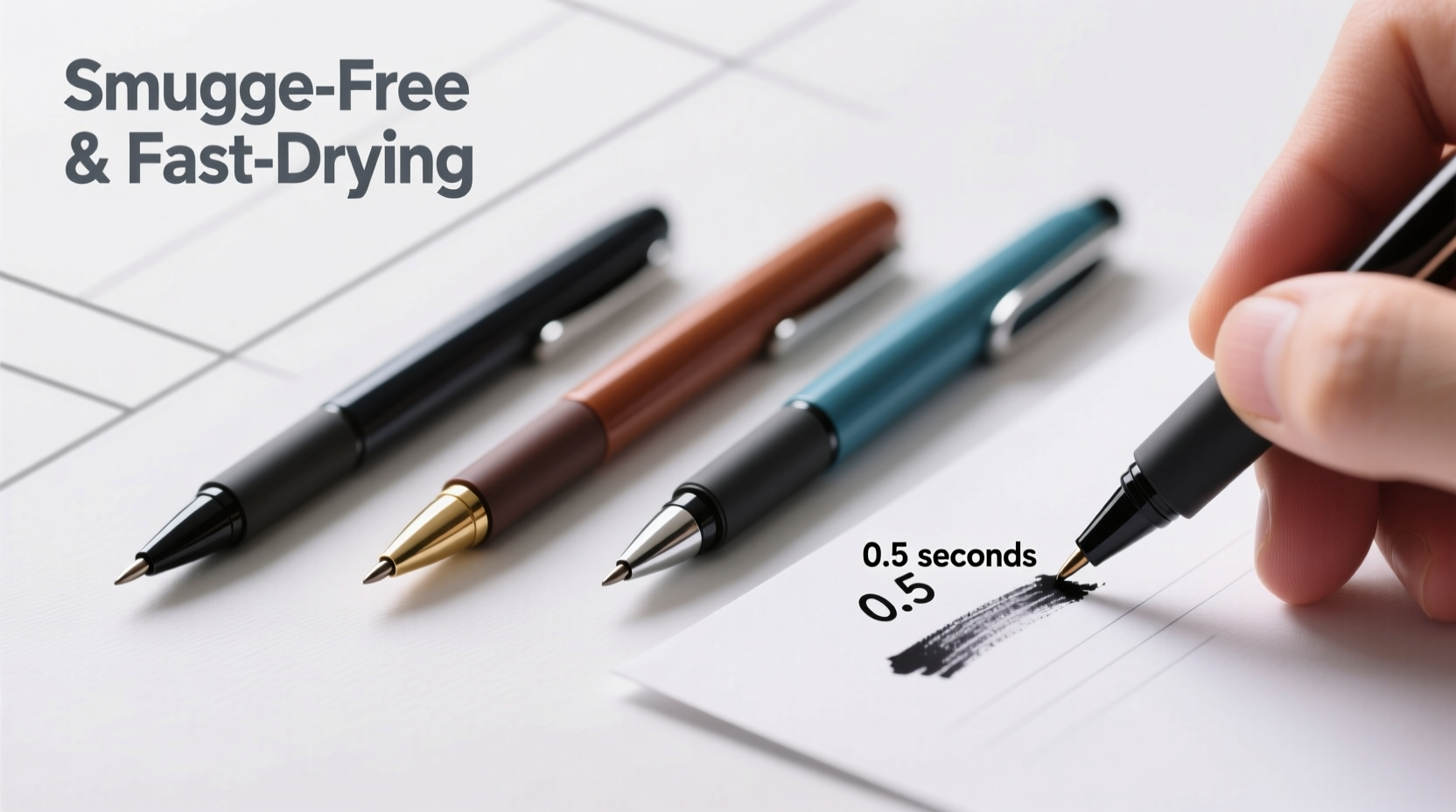
The foundation of a smudge-free writing experience starts with the ink. Most pens use one of three primary ink types: ballpoint, gel, or rollerball. Each has different drying characteristics due to viscosity, solvent base, and delivery mechanism.
- Ballpoint ink is oil-based, thick, and dries quickly. It’s the most smudge-resistant but often sacrifices smoothness.
- Gel ink uses water-based gel, offering vibrant color and smooth flow—but traditionally dries slower. However, newer formulations have significantly improved drying times.
- Rollerball ink is water-based and flows freely, making it very smooth but prone to smearing and longer dry times.
For maximum smudge resistance, oil-based ballpoint and advanced hybrid gel inks are your best bets. Look for brands that specifically mention “fast-drying” or “smudge-proof” on packaging—these often contain modified solvents or quick-evaporating carriers.
Key Features of a Smudge-Free Pen
Beyond ink type, several design elements influence how fast ink dries and whether it remains intact. These include:
- Nib or Tip Material and Size: Finer tips (0.5mm–0.7mm) deposit less ink, which dries faster than broad tips. Stainless steel or tungsten carbide balls in ballpoint pens reduce friction and improve consistency.
- Ink Flow Regulation: Pens with precision feed mechanisms prevent excess ink leakage, reducing pooling and smear risk.
- Drying Accelerators in Formulation: Some premium brands add evaporation-enhancing compounds to their ink, cutting drying time without sacrificing smoothness.
- Paper Compatibility: Even the fastest-drying ink can fail on coated or glossy paper. Opt for pens tested on multiple paper types.
A well-designed pen balances these factors to deliver both speed and comfort. For left-handed writers especially, where hand contact with fresh ink is unavoidable, these features are non-negotiable.
Top Quick-Drying Pens Compared
| Pen Model | Ink Type | Dry Time (avg) | Smudge Resistance | Best For |
|---|---|---|---|---|
| Pilot Precise V5 RT | Hybrid Gel | 2–3 sec | ★★★★★ | Everyday writing, left-handers |
| Uni-ball Jetstream | Hybrid Ink (Gel + Liquid) | 1–2 sec | ★★★★★ | Forms, signatures, fast note-taking |
| Sharpie Fine Point Pen | Water-Based Gel | 4–5 sec | ★★★☆☆ | Casual use, moderate smudging |
| Parker Jotter Ballpoint | Oil-Based | 1–2 sec | ★★★★☆ | Professional settings, durability |
| Zebra Sarasa Clip | Retractable Gel | 3–4 sec | ★★★★☆ | Students, color coding |
The Uni-ball Jetstream consistently ranks highest in independent tests for drying speed and reliability. Its “Super Ink” formulation combines gel fluidity with near-ballpoint dry times, making it ideal for high-volume writing tasks.
Real-World Testing: A Left-Handed Writer’s Experience
Sarah, a university student and avid bullet journaler, struggled for years with smudged pages and smeared margins. As a left-handed writer, her hand constantly dragged across freshly written lines. She tested five popular pens over two weeks, using standard notebook paper and minimal pressure.
The Zebra F-301 and basic Bic Cristal left heavy smears every time. The Pilot G-2 showed improvement but still transferred ink under stress. Only the Uni-ball Jetstream and Pilot Precise V5 delivered consistent smudge-free results. Sarah now uses the Jetstream exclusively, noting that she can write full pages without blotting or waiting.
“Switching to a truly fast-drying pen changed how I interact with my notebooks. No more ghosting, no more frustration—just clean, confident writing.” — Sarah Lin, Student & Journaling Enthusiast
Step-by-Step Guide to Choosing Your Ideal Pen
Follow this practical sequence to ensure you select a pen that meets your smudge-free needs:
- Identify Your Use Case: Are you signing documents, journaling, or taking lecture notes? High-frequency writing demands faster drying.
- Check Ink Type: Prioritize oil-based ballpoints or hybrid gel formulas known for speed.
- Test Dry Time: Write a short sentence and touch it gently after 1–3 seconds. Look for zero ink transfer.
- Evaluate Tip Size: Choose 0.5mm or 0.7mm for balance between precision and ink load.
- Try Multiple Brands: Sample packs from Pilot, Uni-ball, or Zebra offer cost-effective comparison.
- Assess Comfort and Grip: A fast-drying pen is useless if it fatigues your hand during extended use.
- Review Refill Availability: Ensure replacements are easy to find to maintain long-term performance.
Common Mistakes That Lead to Smudging
Even with the best pen, user habits can compromise results. Avoid these pitfalls:
- Pressing too hard: Excessive pressure deposits more ink, increasing drying time and smear risk.
- Using low-quality paper: Thin or glossy stock absorbs poorly, causing ink to sit on the surface longer.
- Ignoring hand position: Left-handed writers should angle the pen slightly upward to minimize contact.
- Not letting ink settle: Rushing to flip pages or close notebooks traps wet ink against other surfaces.
Pairing the right tool with proper technique ensures optimal results. A quality pen is only as effective as the way it’s used.
Frequently Asked Questions
Do quick-drying pens last as long as regular ones?
Yes. Drying speed is determined by ink formulation, not volume. Many fast-drying pens, like the Uni-ball Jetstream, offer up to 800 meters of writing life—on par with standard gels or ballpoints.
Are there smudge-proof pens for artistic use?
For drawing or illustration, consider pigment-based fineliners like the Pigma Micron. They dry quickly, resist fading, and are waterproof once set. Avoid standard gel pens for artwork unless labeled archival-safe.
Can I make a slow-drying pen dry faster?
Not safely. Blowing on ink or using heat sources like hairdryers may cause bleeding or paper warping. The only reliable method is switching to a faster-drying ink system.
Final Recommendations and Action Plan
Choosing a smudge-free, quick-drying pen comes down to matching technology with personal needs. For professionals handling contracts or forms, the Uni-ball Jetstream offers unmatched reliability. Students and journalers may prefer the Pilot Precise V5 for its fine point and comfort. Left-handed individuals should prioritize ultra-fast drying hybrids and test extensively before committing.
Don’t assume marketing claims at face value. Always conduct a real-world dry-time test before adopting a new pen. Keep a trial kit with top contenders and rotate them weekly until you find your ideal match.
“The right pen doesn’t just write—it performs. When ink dries instantly and stays put, you gain confidence in every word.” — David Tran, Stationery Designer & Pen Technologist




 浙公网安备
33010002000092号
浙公网安备
33010002000092号 浙B2-20120091-4
Comments
No comments yet. Why don't you start the discussion?