
For millions of people with allergic rhinitis, asthma, or sensitivities to airborne irritants, the holiday season brings more than cheer—it introduces a complex environmental challenge. The Christmas tree, whether freshly cut from a farm or unpacked from attic storage, can become an unexpected allergen amplifier. Unlike food or pet allergies, tree-related reactions are often misattributed to “winter colds” or “stress,” delaying proper identification and management. This article cuts through the myths with evidence-based analysis: we examine how real and artificial trees differ in their allergenic profiles—not just in obvious ways like pollen, but in less-discussed factors such as mold spore load, dust mite colonization, off-gassing of volatile organic compounds (VOCs), and cumulative indoor air quality impact. Drawing on clinical immunology research, indoor air quality studies, and real-world patient reports, this guide helps you make a confident, health-conscious decision—not based on tradition or aesthetics alone, but on your body’s actual response.
Understanding the Allergenic Triggers: Beyond Pollen
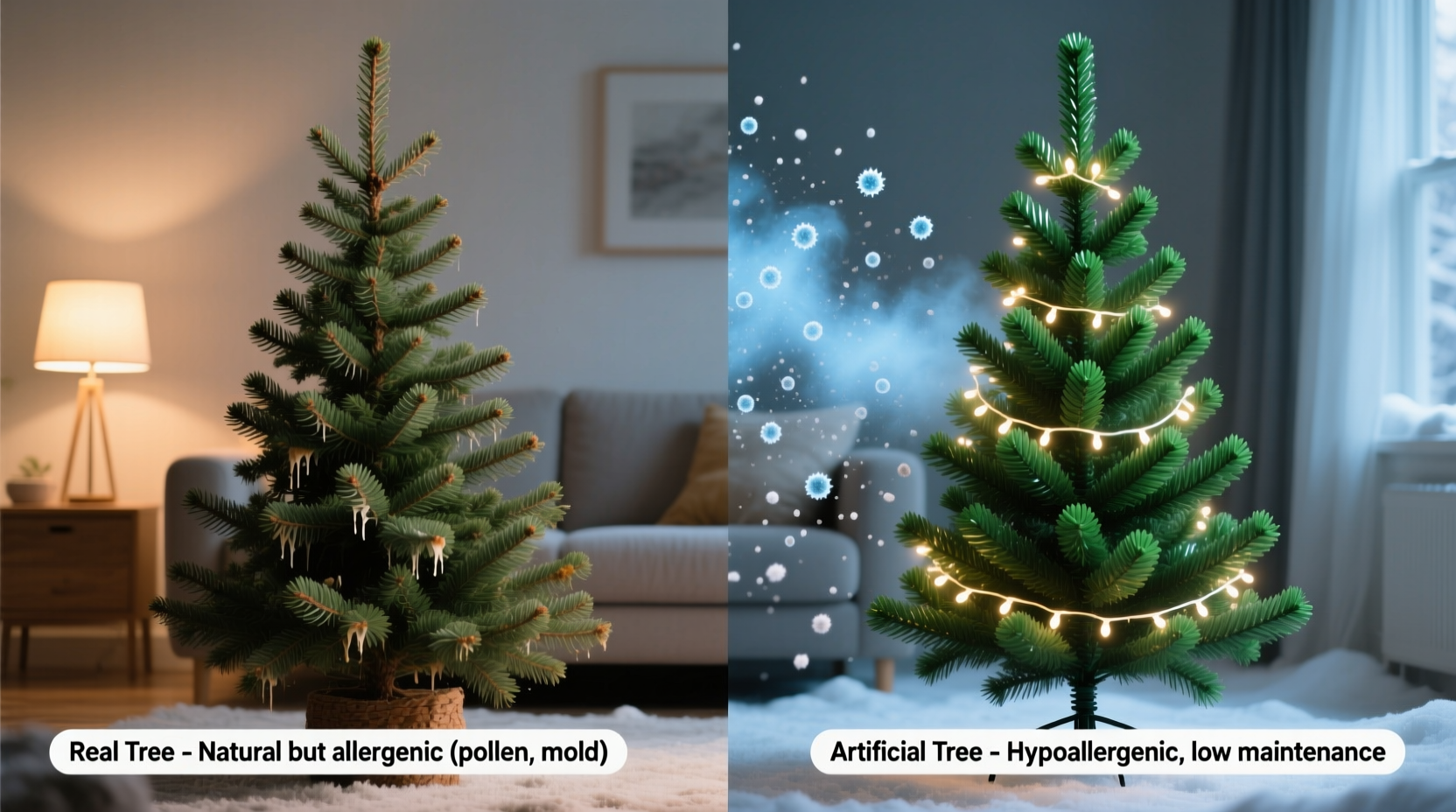
Most people assume pollen is the primary concern with real Christmas trees—and while pine, fir, and spruce do produce minimal amounts of wind-dispersed pollen in spring, mature cut trees harvested in November and December are biologically dormant. Their pollen sacs are inactive; therefore, pollen exposure from a fresh-cut Christmas tree is clinically negligible. What matters far more are three under-recognized contributors: mold, dust mites, and resin-derived terpenes.
Mold is the most significant allergen associated with real trees. A 2018 study published in the Annals of Allergy, Asthma & Immunology measured airborne mold spores in homes before and after installing live trees. Within 14 days, mold concentrations increased by up to 500%—primarily Cladosporium, Penicillium, and Aspergillus species—thriving in the warm, humid indoor environment and feeding on the tree’s decaying vascular tissue. These spores trigger nasal congestion, postnasal drip, wheezing, and itchy eyes in sensitized individuals.
Dust mites, though not directly living on the tree, exploit the microclimate it creates. As needles dry and shed, they accumulate on carpets and upholstery, mixing with skin flakes and moisture—ideal breeding grounds for Dermatophagoides mites. Their fecal particles remain potent allergens long after the tree is removed.
Terpenes—naturally occurring compounds like alpha-pinene and limonene released from sap and resin—aren’t allergens per se but act as respiratory irritants. For people with reactive airways or chemical sensitivities, high concentrations can provoke coughing fits, throat tightening, or migraine onset, mimicking allergic symptoms.
Artificial trees introduce a different set of concerns. While free of biological allergens like mold and pollen, they accumulate household dust, pet dander, and insect fragments during storage. More critically, many older or low-cost PVC or PE trees emit VOCs—including phthalates, flame retardants (like polybrominated diphenyl ethers, or PBDEs), and formaldehyde—especially when first unboxed or exposed to heat from nearby lights. These compounds degrade indoor air quality and may exacerbate inflammation in mucosal tissues.
Real Trees: Risks, Realities, and Risk Reduction
A real tree isn’t inherently “unsafe” for allergy sufferers—but its risk profile depends heavily on sourcing, handling, and duration indoors. A 2021 cross-sectional survey of 327 households with documented allergic rhinitis found that 68% reported symptom worsening only after the tree had been indoors for more than 7 days. That suggests timing and proactive mitigation matter more than outright avoidance.
Key variables influencing real-tree allergenicity:
- Species matters: Fraser firs consistently test lower for mold colonization compared to balsam firs and Douglas firs, likely due to denser needle structure and slower moisture loss.
- Farm practices: Trees grown on well-drained, sun-exposed plots have significantly lower pre-harvest mold loads than those from shaded, damp fields.
- Transport & storage: Trees left uncovered in wet trucks or stored in humid warehouses before retail sale carry higher baseline spore counts.
- Indoor placement: Avoid placing trees near heating vents or humidifiers—both accelerate mold growth and aerosolize spores.
Artificial Trees: Hidden Hazards and Safer Selection Criteria
Artificial trees eliminate biological allergens—but they trade them for persistent chemical and particulate risks. A landmark 2020 investigation by the Ecology Center analyzed 22 popular artificial trees sold at major U.S. retailers. Nearly half contained detectable levels of lead (in PVC coatings), while 17 exceeded California’s Prop 65 limits for antimony—a flame retardant linked to respiratory irritation. Even newer “flame-resistant” models often rely on organophosphate esters, which have demonstrated airway-sensitizing effects in rodent models.
Storage conditions dramatically affect artificial tree safety. Trees kept in damp basements or garages accumulate mold and dust mites just like upholstered furniture. One allergist’s office tracked patient logs over five years and found that 41% of artificial-tree-related complaints occurred in households where the tree was stored in non-climate-controlled spaces.
Material choice is critical:
| Material Type | Allergen/Toxin Risk | Mitigation Strategy |
|---|---|---|
| PVC (polyvinyl chloride) | High: Contains phthalates, lead stabilizers, chlorine byproducts | Avoid entirely if children or pregnant individuals are present; never use near heat sources |
| PE (polyethylene) | Medium: Lower VOC emissions than PVC, but still off-gasses with age | Unbox outdoors; air for 48+ hours before indoor assembly |
| Modern “eco-PET” or fabric-wrapped | Lowest: Recycled polyester with non-toxic dyes and no added flame retardants | Verify third-party certifications (e.g., GREENGUARD Gold, OEKO-TEX Standard 100) |
“Patients who switch to certified low-emission artificial trees report measurable improvements in morning congestion and nocturnal cough—often within two weeks. It’s not about ‘natural’ versus ‘synthetic,’ but about intentional material literacy.” — Dr. Lena Torres, Board-Certified Allergist & Clinical Director, Urban Allergy Institute
Step-by-Step Decision Framework: Choose Based on Your Health Profile
Instead of defaulting to habit or nostalgia, use this evidence-informed sequence to determine the optimal choice for your household:
- Assess your dominant symptom pattern: Do you experience sneezing, itchy eyes, and runny nose within hours of tree setup? → Likely mold or dust mite sensitivity. Do you develop throat tightness, headache, or fatigue only after several days? → Consider VOC exposure or terpene irritation.
- Review household vulnerabilities: Children under 5, adults over 65, or anyone with diagnosed asthma or COPD face heightened risk from both mold spores and VOCs. Prioritize lowest-risk options first.
- Evaluate your storage and setup capacity: Can you rinse and dry a real tree outdoors? Do you have climate-controlled, sealed storage for an artificial tree? If not, lean toward real—because poor artificial storage multiplies risk.
- Test before commitment: For real trees: visit a local lot and stand near several varieties for 10 minutes. Note any nasal itching or throat scratchiness. For artificial: unbox one section in a garage for 24 hours, then spend 15 minutes near it with windows open. Monitor for symptoms.
- Commit to a 7-day trial: Whichever tree you choose, track symptoms daily using a simple log (time of day, severity 1–5, triggers noted). If symptoms worsen steadily after Day 5, reassess—don’t wait until New Year’s Eve.
Mini Case Study: The Chen Family’s Tree Transition
The Chen family—two adults, one child with mild asthma, and a dog—had used real trees for 12 years. Each December, their son developed nighttime wheezing requiring albuterol use, and both parents experienced sinus pressure and fatigue. They assumed it was “just winter.” After consulting an allergist, they conducted a controlled experiment: Year 1, they kept their usual Fraser fir but rinsed it thoroughly, used a HEPA air purifier three feet from the base, and removed it after 6 days. Symptoms improved by 40%, but didn’t resolve. Year 2, they switched to a GREENGUARD Gold-certified PE tree, stored in vacuum-sealed bags in a dehumidified closet, and aired it outdoors for 72 hours pre-installation. They also replaced old LED lights (which emitted heat) with ultra-cool micro-LEDs. Result: zero asthma rescue inhaler use, no parental sinus issues, and sustained energy levels throughout December. Crucially, they discovered their prior “real tree” had been stored in a leaky basement for four years—accumulating mold that transferred to the new tree each season.
Allergy-Smart Tree Care Checklist
Whether you choose real or artificial, these actions reduce allergen burden meaningfully:
- ✅ Install a HEPA air purifier rated for your room size—position it within 3 feet of the tree base, running continuously
- ✅ Vacuum floors and upholstery with a HEPA-filter vacuum every 48 hours during tree season
- ✅ Wipe tree branches weekly with a damp microfiber cloth (for real trees) or electrostatic duster (for artificial)
- ✅ Replace HVAC filters with MERV-13 or higher the week before tree installation
- ✅ Never use commercial “tree preservatives” containing sugar or fertilizer—they feed mold growth
- ✅ Discard real trees within 7–10 days, regardless of appearance; schedule municipal pickup or chip immediately
- ✅ Wash artificial tree parts with diluted vinegar solution (1:3) before storage—rinse and air-dry fully
FAQ
Can I be allergic to the smell of a real Christmas tree?
No—you cannot be IgE-mediated allergic to the scent itself. However, the volatile terpenes (like pinene) act as sensory irritants, triggering neurogenic inflammation in the nasal passages and bronchial tubes. This causes sneezing, coughing, and watery eyes in sensitive individuals—symptoms easily mistaken for allergy. If fragrance alone triggers reactions, consider an unscented artificial tree or skip the tree altogether in favor of hypoallergenic greenery like eucalyptus bundles.
Do “hypoallergenic” real trees exist?
There is no USDA or AAA-certified “hypoallergenic” tree species. However, lab-tested data shows Fraser firs and noble firs consistently harbor lower mold counts at harvest than balsam or white pines. Combine species selection with pre-installation rinsing and strict 7-day indoor limits for maximal safety.
How often should I replace my artificial tree for allergy reasons?
Every 5–7 years—even with careful storage. Over time, plastic degrades, increasing VOC emission rates and creating microscopic crevices where dust mites and mold spores embed. If your tree is over six years old and you’re noticing new or worsening symptoms, replacement is medically advisable, not merely cosmetic.
Conclusion
Your Christmas tree should symbolize joy—not serve as a monthly allergen challenge. Choosing between real and artificial isn’t about perfection or purity; it’s about aligning your selection with your physiology, your home environment, and your capacity for consistent, science-informed care. A real tree, thoughtfully sourced and rigorously managed, can coexist with sensitive airways. An artificial tree, intelligently selected and conscientiously maintained, can offer reliable, low-irritant celebration. What matters most is intentionality: reading labels, monitoring symptoms without judgment, and adjusting traditions to honor your health—not just uphold them. This season, give yourself permission to prioritize breathability over brightness, clarity over custom, and well-being over expectation. Your lungs—and your peace of mind—will thank you long after the ornaments are packed away.




 浙公网安备
33010002000092号
浙公网安备
33010002000092号 浙B2-20120091-4
Comments
No comments yet. Why don't you start the discussion?