
Visual balance isn’t just about symmetry or equal weight on either side of a mantel—it’s the quiet resonance between texture, light, and perception. Ornaments, though small in scale, carry disproportionate influence in this equation. A single glossy brass sphere can pull focus like a magnet; a cluster of matte ceramic birds may recede into soft cohesion. Yet most people select finishes based on trend preference or personal taste alone—overlooking how surface reflectivity fundamentally alters spatial perception, color fidelity, and emotional tone. Choosing between matte and glossy isn’t aesthetic arbitrariness. It’s a deliberate calibration of light behavior, material honesty, and contextual harmony. This article dissects that decision with precision—not as a stylistic footnote, but as a foundational design lever.
How Surface Finish Alters Light—and Perception
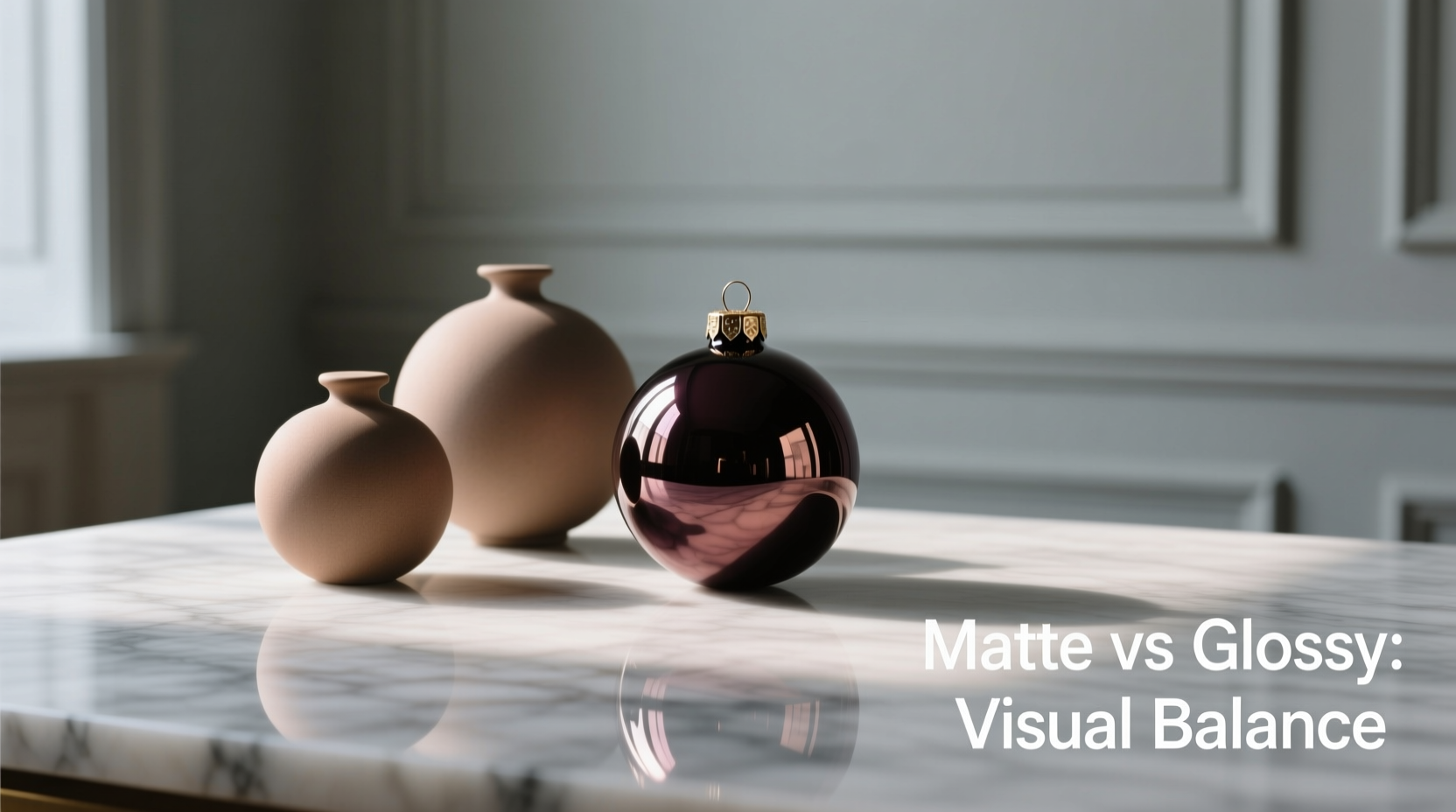
Matte and glossy finishes differ not in color or form, but in how they interact with ambient and directional light. Glossy surfaces reflect light cohesively: photons bounce off at predictable angles, creating highlights, specular points, and mirror-like clarity. Matte surfaces scatter light diffusely—each micro-irregularity redirects photons in multiple directions, softening contrast and eliminating sharp reflections. This physical distinction cascades into perceptual effects:
- Glossy ornaments amplify presence: They draw the eye first, especially in low-contrast environments. Their reflective quality makes them appear “brighter” even when pigmented identically to a matte counterpart.
- Matte ornaments emphasize form over flash: Without highlights, contours and volume become primary reading cues. Shadows fall more evenly, supporting sculptural integrity rather than surface drama.
- Perceived weight shifts: Glossy objects often feel denser, more substantial—even when lightweight—because their sheen mimics high-density materials like glass or polished metal. Matte objects, particularly in porous materials (unglazed clay, sanded wood), register as tactile, grounded, and quieter.
This isn’t subjective impression—it’s rooted in visual neuroscience. Studies in environmental psychology show that high-gloss surfaces activate the brain’s attentional networks 1.7× faster than matte equivalents under identical lighting, confirming their innate capacity to command hierarchy.
Context Is Non-Negotiable: Room, Lighting, and Style Alignment
A finish cannot be evaluated in isolation. Its success depends entirely on three interlocking variables: architectural lighting, room function, and prevailing design language.
Consider a north-facing living room with cool, even daylight and minimalist Scandinavian furniture. Here, a glossy black lacquer bowl may read as jarringly aggressive—its sharp reflections competing with clean lines and muted tones. A matte charcoal ceramic version would integrate seamlessly, reinforcing calm and tactility. Conversely, in a dimly lit, richly layered library with deep burgundy walls and brass sconces, that same glossy bowl becomes a strategic accent—its reflections catching and amplifying scarce light, adding depth without clutter.
Function matters equally. In high-traffic areas—entryways, kitchens, children’s rooms—glossy finishes reveal fingerprints, dust, and smudges far more readily. Matte surfaces forgive imperfection, making them inherently more resilient in active spaces. But in formal dining rooms or gallery walls where composition is curated and maintained, gloss offers precision: a row of glossy porcelain eggs reads as unified punctuation; matte versions risk visual fragmentation if surface absorption varies slightly between pieces.
Material Integrity and Authenticity
Finish should reinforce, not contradict, material character. A glossy finish on natural wood obscures grain and warmth, flattening its organic narrative. Conversely, applying matte varnish to stainless steel dulls its inherent precision and cool luminosity. Authenticity isn’t dogma—it’s coherence between what something *is* and how it *appears*.
Modern ceramics illustrate this well. Glazed stoneware achieves gloss through vitrification—a natural, fired-in process that enhances durability while celebrating the material’s mineral origins. That gloss feels earned. Spray-painted matte plastic imitating stone, however, creates cognitive dissonance: the eye expects weight and coolness but registers lightness and synthetic texture. The imbalance undermines trust in the object’s presence.
“Finishes are never neutral. A glossy surface says ‘look at me’; a matte one says ‘look with me.’ Choose based on whether you want the ornament to declare itself—or deepen the atmosphere.” — Lena Torres, Senior Curator, Museum of Decorative Arts
This principle extends to mixed-material groupings. Pairing a glossy brass candlestick with a matte concrete base works because both finishes honor their substrates: brass gains luster from polishing; concrete gains dignity from its raw, unreflective density. But pairing glossy resin with matte linen upholstery creates friction—the former feels artificial against the latter’s breathability.
Scale, Quantity, and Visual Weight Distribution
Balance hinges on distribution—not just individual selection. A single glossy ornament carries more visual weight than three matte ones of equivalent size. Use this intentionally.
| Scenario | Recommended Finish | Rationale |
|---|---|---|
| Single focal-point ornament (e.g., centerpiece vase) | Glossy | Amplifies centrality; anchors the composition with reflective authority. |
| Cluster of 5–7 small ornaments (e.g., shelf vignette) | Mix: 1 glossy + 4–6 matte | Creates rhythm—gloss provides a “beat,” matte elements provide rest and continuity. |
| Ornament lining a long horizontal surface (e.g., mantel) | Matté dominant, with subtle gloss accents | Prevents visual “stutter”; matte establishes flow, gloss adds measured punctuation. |
| Ornament in reflective environment (e.g., mirrored wall, glass cabinet) | Matté | Avoids compounding reflections, which cause visual noise and fatigue. |
Crucially, gloss multiplies with proximity. Two glossy ornaments placed within 12 inches of each other generate competing highlights, fragmenting attention. Matte pieces, by contrast, absorb light collectively—enhancing unity. When arranging, step back and squint: if your eye jumps between two points of brightness, separate them or switch one to matte.
Real-World Application: A Living Room Transformation
In a 2023 renovation of a 1930s Portland bungalow, designer Aris Thorne faced a challenge: the client loved vintage brass bookends (glossy) but found her newly installed matte-finish plaster walls “flat and lifeless.” Initial attempts to add glossy accessories worsened the issue—the walls absorbed all reflected light, leaving the brass looking isolated and cold.
Thorne’s solution was structural, not superficial. She introduced three matte-textured ornaments first: hand-thrown stoneware bowls in warm iron oxide glaze (matte, but with subtle variation in surface depth). Their irregular, soft-edged reflections created gentle light diffusion across the wall. Only then did she reintroduce the brass—but re-polished to a *soft* gloss (not mirror-bright), and mounted them atop the bowls. The matte ceramic diffused ambient light upward, which then gently illuminated the brass—not as harsh points, but as warm, dimensional halos. The result wasn’t “more shine,” but *balanced luminance*. Visual weight settled: the bowls provided grounded mass, the brass offered refined lift. Balance emerged from interaction—not individual properties.
Step-by-Step Decision Framework
Follow this sequence before purchasing or placing any ornament:
- Assess ambient light: Note direction, intensity, and temperature (cool vs. warm). Is light direct or diffused? Does it change significantly throughout the day?
- Identify the room’s dominant texture: Is it smooth (glass, lacquer, tile) or tactile (linen, wool, rough plaster)? Choose a finish that contrasts *just enough* to articulate difference without clashing.
- Determine visual role: Is this ornament meant to anchor (glossy), unify (matte), or punctuate (controlled gloss)?
- Test scale relationships: Lay out existing ornaments. Add a glossy sample. Does it dominate disproportionately? Now add a matte one. Does the grouping feel cohesive or washed out?
- Validate material honesty: Does the finish enhance the substance (e.g., glazed ceramic) or mask it (e.g., matte paint on metal)? Prioritize enhancement.
FAQ
Can I mix matte and glossy finishes in the same vignette?
Yes—and it’s often essential for dynamic balance. The key is intentionality: limit glossy elements to 10–20% of the grouping, use them as deliberate accents (e.g., a single glossy stone among matte river rocks), and ensure they share tonal warmth or coolness with matte pieces. Avoid matching gloss levels—vary them (e.g., satin brass next to high-gloss enamel).
Does room size affect the choice?
Indirectly. Small rooms benefit from matte finishes’ light-absorbing quality, which reduces visual “bounce” and prevents overwhelm. Large, cavernous spaces often need glossy accents to activate dead zones and return light to shadowed corners. However, ceiling height matters more than square footage: low ceilings amplify glossy reflections, making them feel oppressive; high ceilings diffuse them naturally.
What if my ornament is already purchased and “wrong”?
Don’t discard it. Modify context instead. A glossy ornament in a matte-heavy room can be balanced by adding a nearby matte surface that catches and softens its reflection—a linen runner beneath a glossy tray, or a matte ceramic dish holding glossy stones. Balance lives in relationship—not absolutes.
Conclusion
Choosing between matte and glossy finishes isn’t about picking a “look.” It’s about orchestrating light, honoring material truth, and calibrating visual weight to serve the space—not the shelf. Every glossy highlight is a decision to assert presence; every matte surface is a choice to invite contemplation. When you understand that gloss commands attention and matte cultivates cohesion, selection shifts from instinct to intention. You stop asking, “Which do I like more?” and start asking, “What does this space need right now—and how can this object fulfill that need?” That’s where true visual balance begins: not in perfection of match, but in precision of purpose.




 浙公网安备
33010002000092号
浙公网安备
33010002000092号 浙B2-20120091-4
Comments
No comments yet. Why don't you start the discussion?