
Selecting flameless candles for your Christmas tree is more than a matter of convenience—it’s an intentional design decision that affects visual harmony, emotional resonance, and seasonal safety. Unlike traditional candles, flameless options offer flicker realism, programmable timers, and zero fire hazard—but not all perform equally well in the context of a decorated tree. Poorly chosen units can clash with ornaments, overwhelm branches with glare, or create an artificial, disjointed impression. The right flameless candles integrate seamlessly: their light quality, scale, color temperature, and placement amplify the tree’s structure and personality rather than competing with it. This guide distills over a decade of holiday styling experience—including consultations with professional interior stylists, lighting designers, and certified fire safety educators—to help you make confident, aesthetically grounded choices.
Understand Light Quality Before You Buy
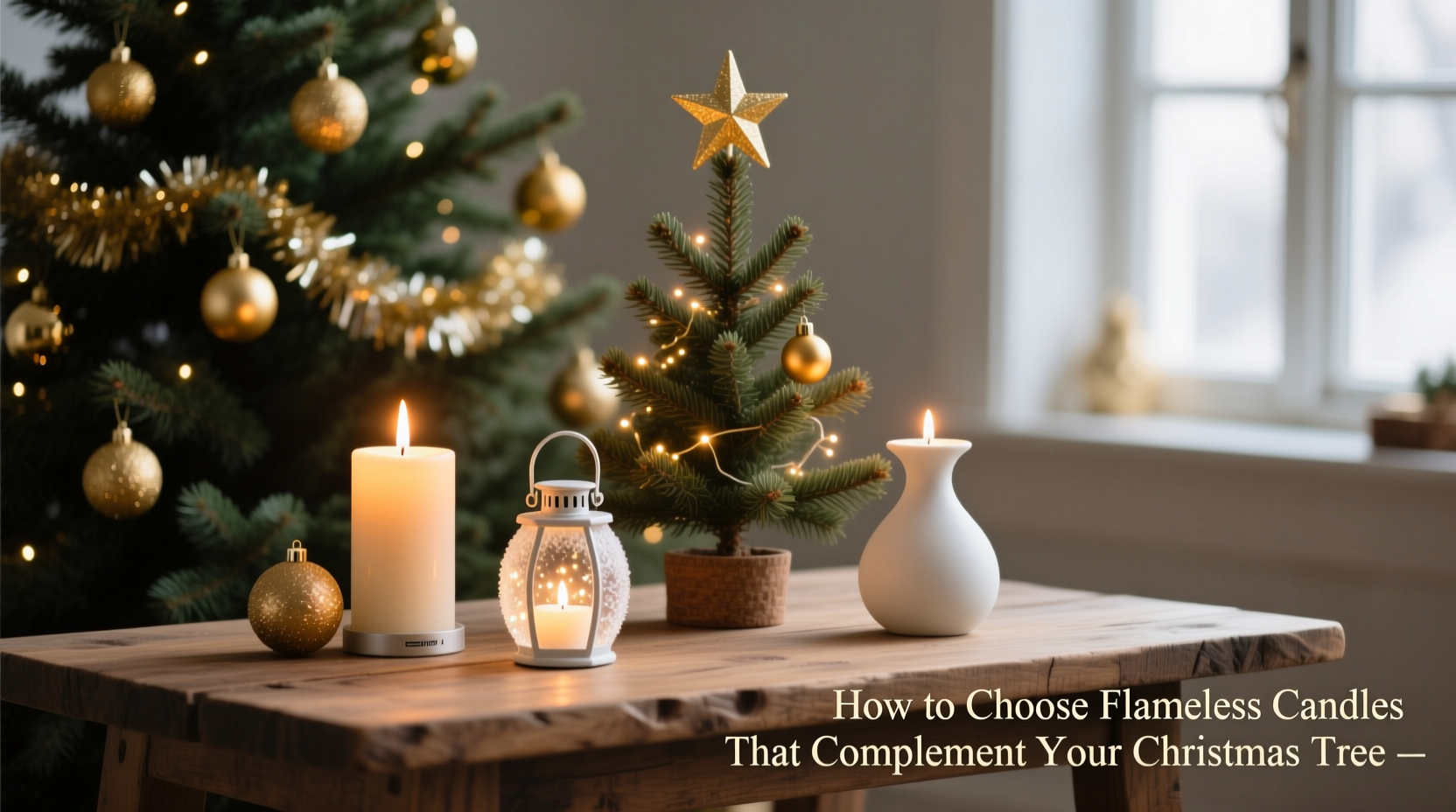
Flameless candles vary dramatically in how convincingly they replicate real candlelight—not just in appearance, but in behavior. Two technical factors dominate perception: color temperature and flicker algorithm.
Color temperature, measured in Kelvin (K), determines whether light reads as warm, neutral, or cool. Real beeswax or paraffin candles emit light between 1800K and 2200K—a deep, amber-gold glow that feels intimate and nostalgic. Many budget flameless candles default to 2700K–3000K, which appears noticeably whiter and clinical—especially against green pine needles and vintage glass ornaments. A 2100K LED will cast soft shadows and deepen reds and golds; a 2800K unit may wash out cream-colored baubles and mute velvet ribbons.
Flicker realism matters just as much. Basic models use simple on/off cycling, creating a jerky, strobe-like effect. Premium versions employ multi-layered algorithms that simulate wax pool movement, subtle wick glow variation, and gentle brightness modulation—mimicking how real flames respond to air currents. These subtleties become especially apparent at dusk or in dimmed rooms, where viewers’ pupils dilate and perceive nuance more acutely.
Match Scale and Proportion to Your Tree’s Architecture
A 4-inch taper candle looks elegant on a dining table—but absurdly undersized when tucked into the dense lower boughs of a 7-foot Fraser fir. Conversely, oversized pillar-style flameless candles (5+ inches tall) visually weigh down delicate branch tips and obscure ornament detail. Scale must serve the tree’s three-dimensional form—not just its height.
Professional stylists use a proportional framework based on branch density and viewing distance:
- Lower third (base): Use tapered or votive-sized units (2.5–4 inches tall) spaced every 8–12 inches along sturdy horizontal branches. Their vertical line reinforces trunk stability.
- Middle third (fullness zone): Opt for small pillars or tea lights (1.5–2.5 inches tall) nestled near ornament clusters. These act as ambient “glow points,” enhancing depth without drawing focus away from baubles.
- Upper third (crown): Choose ultra-slim, battery-operated fairy-light candles (under 1.5 inches) or micro-LED tapers. Their minimal footprint avoids crowding the apex and maintains silhouette clarity.
This tiered approach prevents visual monotony. A single uniform size across all levels flattens dimensionality—like applying the same font size to headings, body text, and captions. Varying scale creates rhythm, guiding the eye upward naturally.
Select Materials and Finishes That Harmonize With Your Decor Theme
The physical presence of the candle—its casing, texture, and finish—must coexist peacefully with nearby ornaments, garlands, and tree species. A matte ceramic taper pairs beautifully with rustic wood slices and burlap bows; a mirrored acrylic pillar reflects light elegantly beside mercury glass balls but clashes with hand-blown glass or matte-finish ceramics.
Consider these common decor themes and their ideal flameless candle materials:
| Decor Theme | Recommended Candle Materials | Materials to Avoid |
|---|---|---|
| Traditional Red & Green | Unfinished white ceramic, frosted glass, ivory wax-textured plastic | Chrome, neon silicone, high-gloss black acrylic |
| Nordic Minimalist | Matte white porcelain, natural birchwood sleeves, brushed nickel bases | Glitter-coated plastic, colored resin, textured metallics |
| Vintage Glamour | Antique brass housings, etched crystal sleeves, ivory satin-finish wax | Clear plastic, rubberized grips, cartoonish shapes |
| Rustic Farmhouse | Raw clay, unfinished pine cones embedded in wax, linen-wrapped bases | Glossy lacquer, mirrored surfaces, geometric metal |
Material choice also affects light diffusion. Frosted glass and matte ceramic soften and scatter light, producing gentle halos around ornaments. Clear acrylic or polished metal creates sharp highlights and specular reflections—ideal for modern settings but potentially distracting amid layered textures like wool, velvet, or dried citrus.
Timing, Placement, and Layering Techniques
Even the most beautiful flameless candle fails if activated at the wrong time or positioned without spatial awareness. Effective integration requires deliberate sequencing—not just “plug and place.”
- Start with the tree’s existing lighting: Turn on string lights first. Observe where they already provide ambient fill and where shadows pool. Flameless candles should augment—not duplicate—this base layer.
- Place from bottom up, working in sections: Begin at the trunk base and move outward along each major branch before ascending. This prevents overlooking lower zones and ensures even distribution.
- Use the “rule of threes” for grouping: Cluster candles in odd numbers (1, 3, or 5) near focal ornaments—e.g., three small votives flanking a large silver bell. Odd-numbered groupings feel more organic and balanced to the human eye.
- Angle for reflection, not glare: Tilt tapered candles slightly inward toward the tree’s center. This directs light onto ornaments and minimizes direct beam spill toward viewers’ eyes.
- Set timers strategically: Program candles to activate 30 minutes before sunset and deactivate 2 hours after bedtime. This aligns with natural circadian cues and avoids overnight battery drain. Avoid “always-on” modes unless using rechargeable lithium units with smart power management.
“Lighting isn’t decoration—it’s choreography. Every candle should have intention: to highlight, to soften, to frame. When placed without regard for shadow, scale, or sequence, even premium flameless units look like afterthoughts.” — Lena Torres, Award-Winning Holiday Stylist & Author of *The Lit Tree*
Real-World Application: A Mid-Century Modern Tree Transformation
Sarah, a graphic designer in Portland, struggled for years with her 6.5-foot Noble fir. She loved mid-century modern aesthetics—clean lines, walnut tones, mustard yellow accents—but found flameless candles either too clinical (bright white LEDs) or too kitschy (oversized glitter tapers). Her tree looked “lit but lifeless.”
She began by auditing her existing decor: walnut bead garlands, matte ceramic ornaments in ochre and charcoal, and thin brass wire stars. She chose 32 flameless candles: 12 matte ivory ceramic tapers (3.25 inches tall) for the lower branches, 16 frosted glass tea lights (1.75 inches) clustered near ornaments in the middle, and 4 slim birchwood-sleeved micro-tapers (1.25 inches) near the top. All operated at 2150K with advanced flicker algorithms.
Crucially, she programmed them to activate at 4:30 p.m. daily—matching Portland’s late autumn sunset—and used manual dimmers to reduce intensity by 30% during evening TV viewing. Within two days, guests commented on the “warmth” and “depth” of her tree—words previously reserved for photos of European Christmas markets. The difference wasn’t more light; it was light with purpose, proportion, and tonal fidelity.
FAQ
Can I mix flameless candles with traditional string lights?
Yes—and it’s often ideal. String lights provide even ambient fill; flameless candles add directional warmth and focal points. To avoid visual competition, ensure both share the same color temperature (ideally 2100K–2200K). If your string lights are cooler (2700K+), choose warm-white flameless candles and dim the strings slightly to harmonize.
How long do high-quality flameless candles last on a single battery set?
With efficient LED drivers and optimized flicker circuits, premium units typically run 120–180 hours on AA batteries. Rechargeable lithium models (USB-C or magnetic charging) offer 500+ hours per charge and maintain consistent brightness throughout their cycle—unlike alkaline batteries, which dim noticeably after 60–80 hours.
Are flameless candles safe to use on artificial trees with PVC or PE branches?
Yes—provided they’re certified to UL 498 or EN 60598 standards. Unlike real candles, flameless units generate negligible heat (<32°C surface temperature). However, avoid placing any candle—flameless or otherwise—directly against foil-wrapped ornaments or metallic garlands, as reflective surfaces can concentrate light and cause uneven glare or sensor interference in motion-activated models.
Conclusion
Your Christmas tree is a living composition—one that balances tradition and personal expression, nostalgia and contemporary taste. Flameless candles, when selected with intention, become quiet collaborators in that composition: deepening shadows, warming tones, and inviting pause. They are not substitutes for real flame—they are thoughtful reinterpretations, designed for today’s homes, families, and values. Choosing wisely means honoring the tree’s structure, respecting your decor language, and prioritizing sensory authenticity over novelty. It means understanding that a 2150K flicker feels like memory, while a 2800K pulse feels like a nightlight. It means knowing that three small candles near a handmade ornament tell a different story than one large unit glowing alone.
You don’t need dozens of candles to achieve impact. You need three well-chosen ones—placed with care, timed with rhythm, and lit with purpose. Start with your tree’s strongest visual anchor: perhaps a cluster of mercury glass balls, a hand-stitched felt star, or a family heirloom. Then ask: what light would honor that object? What warmth would make it feel like home? Let that question guide you—not marketing claims, not trends, but your own quiet sense of harmony.




 浙公网安备
33010002000092号
浙公网安备
33010002000092号 浙B2-20120091-4
Comments
No comments yet. Why don't you start the discussion?