
Nothing anchors a Christmas table like the soft, living glow of candlelight—the gentle sway, the subtle pulse of warmth, the quiet intimacy it creates. Yet open flames pose real risks: wax drips on heirloom linens, accidental contact with napkins or greenery, and the constant vigilance required around children and pets. Flameless candles have evolved far beyond static, battery-powered novelties. Today’s best models replicate not just the color and shape of real candles—but their behavior. The flicker isn’t a looped animation; it’s algorithmically randomized, with variations in intensity, duration, and rhythm that mirror how real wax melts and air currents shift a flame. Choosing the right ones requires understanding both engineering and ambiance—not just brightness specs, but how light interacts with surfaces, how motion reads at eye level, and how consistency across a grouping builds cohesion rather than distraction.
Why “Realistic Flicker” Matters More Than You Think
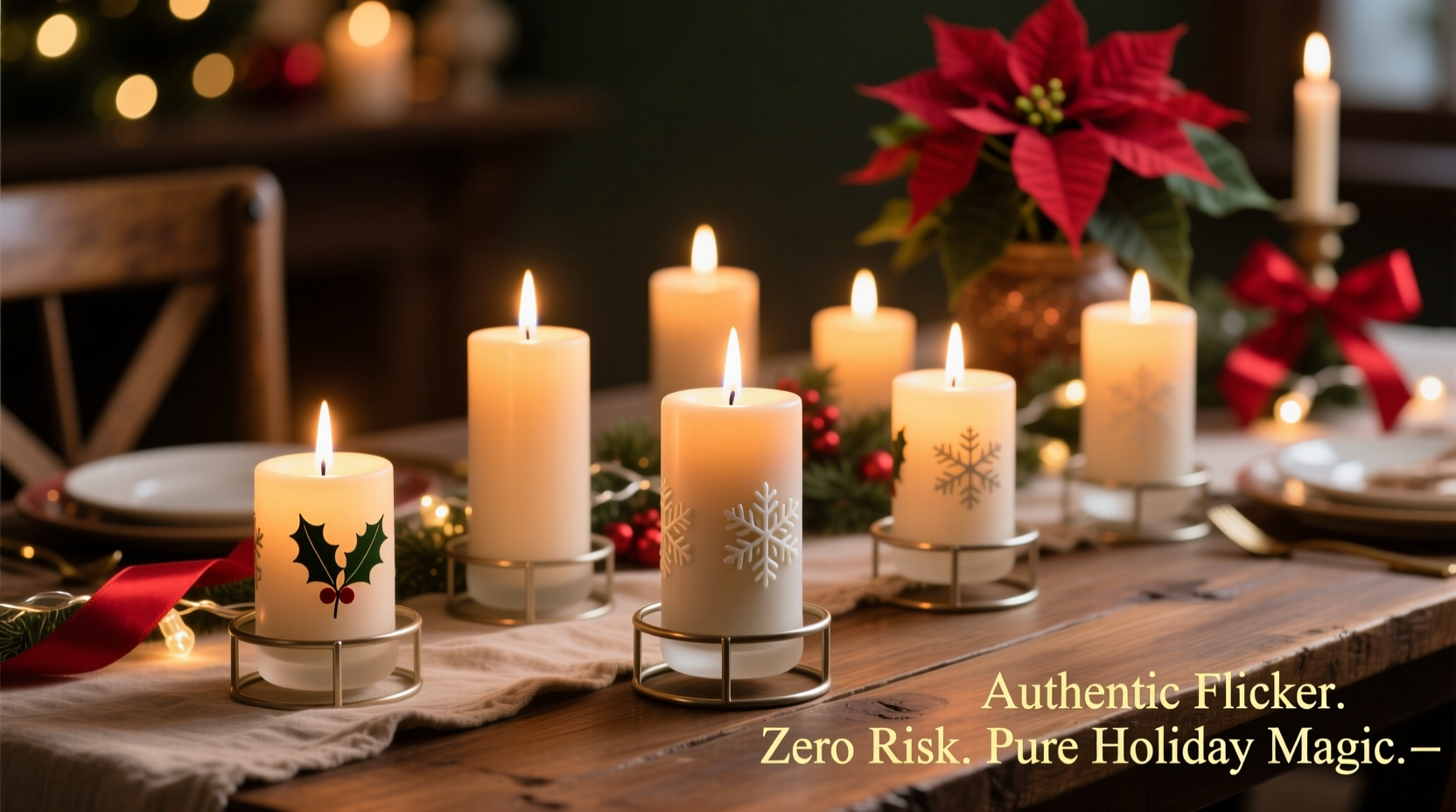
A poorly designed flameless candle doesn’t just look artificial—it breaks the sensory contract of the holiday table. Guests may not consciously register the issue, but they feel it: a slight cognitive dissonance when the “flame” pulses too evenly, or freezes mid-flicker when batteries dip, or glows with an unnatural blue-tinged white instead of warm amber. Research in environmental psychology shows that biologically familiar light patterns—like those produced by fire—trigger parasympathetic nervous system responses: lowered heart rate, increased feelings of safety, and deeper social engagement. In contrast, rigid, metronomic light can induce subtle fatigue or unease over time. For Christmas tables—where conversation, connection, and tradition are central—authentic flicker isn’t aesthetic polish. It’s functional design that supports the emotional purpose of the season.
The Four Technical Pillars of Authentic Flicker
Not all “flickering” LEDs are created equal. True realism rests on four interdependent technical elements—each measurable, each worth verifying before purchase.
- Dynamic Light Algorithm: The best units use multi-phase algorithms that simulate wax pool formation, wick carbonization, and ambient draft influence—not just random brightness changes. Look for terms like “adaptive flicker,” “3D flame simulation,” or “micro-timing variance.” Avoid products listing only “flicker mode” without elaboration.
- Warm Color Temperature (2000K–2200K): Real candlelight measures between 1850K and 2100K on the Kelvin scale. Anything above 2400K appears cool or clinical; below 1900K looks muddy or orange. Check packaging or spec sheets—don’t rely on product photos, which often oversaturate warmth.
- Diffused Light Source: A bare LED chip creates harsh, directional glare. Authentic units embed the diode behind frosted silicone “flame” tips, textured wax-like resin, or layered translucent sleeves that scatter light softly. Hold a sample up to a window—if you see a bright pinpoint, move on.
- Independent Flame Movement (for pillar/taper styles): High-end models separate the flame element from the base. This allows subtle, gravity-responsive wobble—even when placed on slightly uneven surfaces—mimicking how real flames tilt under air movement. Cheaper versions fix the “flame” rigidly to the housing.
Material & Form: Matching Realism to Your Table’s Personality
Your candle’s physical presence must harmonize with your table’s texture, scale, and tradition. A heavy brass candelabra demands tapered candles with tapered weight and tapering wax texture—not squat, plastic-looking cylinders. Likewise, a rustic farmhouse table benefits from hand-poured beeswax replicas with visible pour lines and natural color variation, not uniform ivory pillars.
| Table Style | Recommended Flameless Candle Type | Key Material & Detail Cues | What to Avoid |
|---|---|---|---|
| Traditional/Formal (e.g., damask linens, silver, crystal) | Taper candles (10–12\" height) or classic pillar (3\" diameter × 6\" height) | Matte-finish paraffin-look resin; subtle wax pooling at base; faint “wick shadow” etching on surface | Glossy plastic finishes; visible seams or mold lines; uniform white color without cream/ivory variation |
| Rustic/Farmhouse (e.g., wood slab, burlap, dried citrus) | Beeswax-style pillars or votives in amber/ivory; irregular heights | Textured surface mimicking natural beeswax grain; slight asymmetry in shape; warm honey-amber hue (not yellow) | Perfectly symmetrical shapes; synthetic “glossy wax” sheen; overly bright white tones |
| Modern/Minimalist (e.g., black marble, linen, monochrome) | Low-profile LED tealights or slim cylindrical pillars (2\" diameter × 4\" height) | Sleek matte ceramic or frosted glass housing; recessed flame element; neutral off-white or charcoal-gray base | Bulky bases; obvious plastic construction; warm amber that clashes with cool-toned tableware |
| Eclectic/Whimsical (e.g., mixed metals, velvet, vintage china) | Mix of sizes and styles—tapers + votives + lanterns—with varied flicker speeds | Different “flame personalities”: some slower and steadier, others more animated; bases in complementary metals (brass, brushed nickel, antique bronze) | Uniform flicker speed across all units; mismatched base metals that compete rather than complement |
A Real-World Example: The Thompson Family’s Table Transformation
The Thompsons hosted their first Christmas dinner in their newly renovated dining room—a space with high ceilings, oak floors, and a 10-foot live-edge table. Last year, they used basic flameless tapers with stiff, repetitive flicker. Guests complimented the setup, but several remarked later that the candles “felt like stage lighting”—bright but emotionally distant. This year, Sarah Thompson researched deeply: she chose six 12-inch tapers with adaptive flicker algorithms and 2100K warm light, housed in matte ivory resin with hand-applied “wax drip” textures at the base. She paired them with three amber-glass votives containing silicone flame elements that wobbled independently. Crucially, she arranged them in two groupings—four tapers flanking the centerpiece, two votives nestled beside sprigs of rosemary—so flicker rhythms overlapped organically, never synchronizing. At dinner, multiple guests paused mid-sentence, gazing at the candles. “It’s uncanny,” said her mother-in-law. “I keep forgetting they’re not real.” The difference wasn’t just visual—it was atmospheric. Conversation flowed more easily. Laughter lingered longer. The candles didn’t draw attention to themselves; they deepened the space around them.
Step-by-Step: Building a Cohesive, Realistic Candle Grouping
Follow this sequence to avoid common pitfalls and ensure your flameless arrangement feels intentional—not assembled.
- Define Your Focal Point: Identify your centerpiece (e.g., a floral arrangement, a wooden dough bowl with pinecones). Place it first. Your candles should frame—not overwhelm—it.
- Select Base Heights: Choose candle heights that create gentle visual rhythm. For tapers: use two at 12\", two at 10\", two at 8\". For pillars: vary diameters (3\", 2.5\", 2\") rather than height alone.
- Match Flicker “Personalities”: Don’t buy identical units. Select 2–3 models with subtly different flicker profiles (e.g., one with slower, deeper pulses; another with quicker, brighter surges). This mimics how real candles behave near each other.
- Test Placement & Sightlines: Arrange candles on the table, then walk around it at seated eye level. Ensure no flame is directly aligned with a guest’s line of sight—this causes glare and reduces perceived warmth. Adjust angles slightly if needed.
- Verify Battery Consistency: Install fresh, high-quality alkaline or lithium batteries in all units *at the same time*. Weak or mixed batteries cause flicker desynchronization and premature dimming during dinner.
- Add Tactile Anchors: Nestle candles in natural materials—crushed walnut shells, dried lavender buds, or small river stones. This grounds the illusion, reminding the eye that these belong to a physical, earthy setting—not a digital display.
“Authenticity in flameless candles isn’t about perfect replication—it’s about honoring the human experience of candlelight: its imperfection, its vulnerability, its quiet authority in a room. When the flicker breathes, the table breathes with it.” — Lena Petrova, Lighting Designer & Founder of Hearth & Hue Studio
Frequently Asked Questions
Can I mix flameless and real candles safely on the same table?
Yes—with strict boundaries. Place real candles at least 18 inches away from any flameless unit, and never inside the same enclosed holder (e.g., a lantern or hurricane vase). Real flames generate heat that can damage LED components or warp plastic housings. More importantly, mixing introduces inconsistent light behavior: one flame steady, another flickering, another pulsing. For cohesive ambiance, commit fully to one type per grouping—or use flameless exclusively for tabletops and reserve real candles for壁炉 mantels or outdoor sconces where heat dissipation is safe and sightlines differ.
How long do realistic flameless candles last before flicker degrades?
High-quality units maintain consistent flicker performance for 3–5 years with regular seasonal use (approx. 6–8 weeks/year). Degradation usually begins as reduced brightness or less nuanced flicker rhythm—not sudden failure. Replace batteries annually before the holiday season, even if they seem functional; voltage drop subtly flattens flicker dynamics. Units with replaceable LED modules (rare but available from brands like Luminara Pro or Balsam Hill’s premium line) offer longest service life.
Do flickering flameless candles work well with smart home systems?
Most do—but verify compatibility. Basic remotes often override smart scheduling. For true integration, seek candles with built-in Bluetooth or Matter support (e.g., Philips Hue Play Light Bar with candle mode, or newer GE Cync models). These allow precise dimming, synchronized on/off timing, and even “dinner mode” presets that soften flicker intensity during meals. Avoid Wi-Fi-only models unless your network is robust; latency can cause noticeable lag between command and response.
Conclusion: Light That Serves the Moment, Not the Gadget
Choosing flameless candles for your Christmas table isn’t about settling for convenience. It’s about curating light with intention—selecting technology that recedes so tradition can advance. The right flicker doesn’t shout “I’m fake!” It whispers “Breathe. Settle in. This moment matters.” It asks nothing of you but presence—and gives back warmth, safety, and a quiet reverence for the rituals we gather to uphold. Don’t chase the brightest bulb or the longest runtime. Chase the pause between pulses—the micro-second of near-darkness that makes the next glow feel earned. That’s where realism lives. That’s where Christmas begins.




 浙公网安备
33010002000092号
浙公网安备
33010002000092号 浙B2-20120091-4
Comments
No comments yet. Why don't you start the discussion?