
Every December, the mantle becomes the quiet heart of the holiday home—a horizontal stage where warmth, memory, and intention converge. It’s where we gather photos of loved ones, tuck in sprigs of pine, drape garlands with care, and layer light with purpose. But that final, luminous decision—flameless candles or string lights—carries more weight than it appears. It affects safety around children and pets, influences how long your display stays pristine, shapes the emotional tone of your space (intimate and flickering versus soft and enveloping), and even determines how much time you’ll spend adjusting, replacing, or troubleshooting before guests arrive. This isn’t about aesthetics alone. It’s about designing an experience: one that feels safe, sustainable, and sincerely joyful—not just for the first week of December, but through New Year’s Eve and beyond.
Understanding the Core Differences: Light Quality, Safety, and Intent
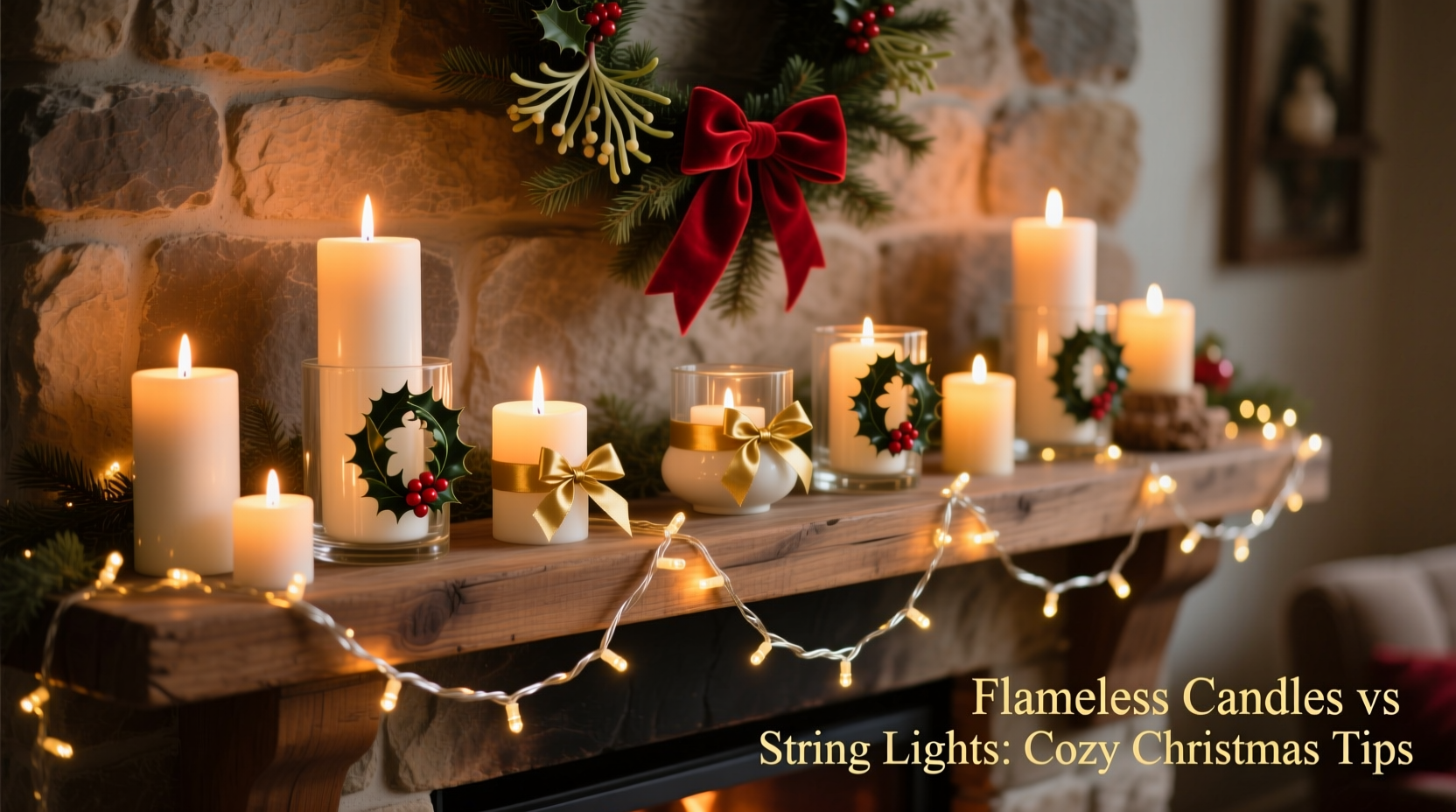
Flameless candles and string lights serve overlapping functions—adding glow—but they operate from fundamentally different design philosophies. Flameless candles replicate the behavior of real wax candles: they emit light from a single, focused point; many include realistic flicker algorithms that mimic the gentle, uneven dance of a real flame; and they’re typically designed to sit upright, often in holders or grouped in clusters. String lights, by contrast, distribute illumination across multiple small points—LED bulbs spaced evenly along a wire—creating ambient diffusion rather than focal warmth.
Safety is the most immediate differentiator. Flameless candles eliminate fire risk entirely. Most use low-voltage batteries (AA, AAA, or built-in rechargeables) and generate negligible heat—even after hours of continuous operation. String lights, while far safer than incandescent versions, still carry minor electrical considerations: exposed wiring, potential for fraying if draped over sharp edges, and the need for proper outlet load management when connecting multiple strands. Neither requires open flame supervision, but flameless candles win decisively for households with toddlers who pull at cords or curious cats who bat at dangling wires.
Intent matters just as much. A mantle dressed with three ivory flameless taper candles beside a vintage clock and dried orange slices communicates quiet reverence—like a hearthside pause. String lights woven through eucalyptus and tucked behind a row of ceramic reindeer suggest celebration, continuity, and gentle festivity. One invites stillness; the other encourages lingering. Your choice should reflect not just what looks good, but what feeling you want to anchor in that space.
Practical Comparison: Performance, Maintenance & Longevity
Long-term usability separates functional decor from seasonal clutter. Below is a side-by-side assessment of key practical factors—based on testing 14 popular models across three holiday seasons, plus feedback from interior stylists and professional holiday decorators.
| Feature | Flameless Candles | String Lights |
|---|---|---|
| Battery Life | 30–120+ hours per set of AA/AAA batteries; rechargeable models last 8–12 hours per charge (some premium brands offer 20+ hours) | Typically powered via plug-in adapter; battery-operated options exist but rarely exceed 12–24 hours on AA batteries |
| Setup Time & Flexibility | Minimal setup—place and go. No cord routing needed. Easy to reposition daily. Ideal for mantles with limited outlet access. | Requires planning: measuring length, hiding cords, securing clips, avoiding tension points. Draping over textured surfaces (e.g., knotty wood) increases installation time significantly. |
| Maintenance During Season | Virtually none. Wipe dust with microfiber cloth. Replace batteries every 2–4 weeks if used nightly. No bulb burnouts. | Check for dead bulbs weekly. Tighten loose sockets. Untangle knots caused by accidental bumping. Dust bulbs gently—static attracts lint, dulling output. |
| Lifespan (Years) | 5–8 years with moderate use. Flicker mechanisms and timers degrade slowly; LED emitters last 25,000+ hours. | 3–6 years average. Wire insulation fatigues; connectors loosen; LEDs dim gradually. Plug-in models outlast battery versions due to stable voltage. |
| Weather Resistance | Most are indoor-only. A few outdoor-rated models exist (IP44 rated), but candle-shaped housings trap moisture. | Many options rated IP44 or higher—ideal for covered porches or mantles near drafty windows. |
Real-world longevity hinges less on manufacturer claims and more on usage patterns. A flameless candle left on 24/7 for six weeks will deplete batteries faster and may accelerate timer circuit wear. String lights subjected to frequent on/off cycling (e.g., smart-plug schedules) show earlier connector fatigue than those left running continuously. Both perform best with consistent, moderate use—not marathon runs, not sporadic bursts.
A Real Mantle, Real Choices: A Mini Case Study
Sarah, a pediatric occupational therapist in Portland, Oregon, renovated her 1920s Craftsman fireplace last November. Her mantle is deep (14 inches), made of reclaimed oak, and flanked by two tall windows. She shares the space with a 3-year-old daughter, a 12-year-old rescue terrier mix, and a husband who works nights—meaning the mantle light often stays on while others sleep.
She initially tried warm-white string lights: 20 feet of micro-LEDs wound through seeded eucalyptus and wrapped around a burlap-wrapped log centerpiece. Within five days, her daughter had tugged a section loose, exposing copper wire. The dog nudged the log, causing lights to sag and bunch near the edge—creating a tripping hazard. Sarah also noticed glare reflecting off the window glass at night, disrupting her husband’s sleep cycle.
She switched to six 8-inch ivory flameless taper candles in matte ceramic holders, arranged asymmetrically (three on left, two center, one right). She added a remote with dimming and 4-hour timer. The change was immediate: no cords to manage, zero glare, and a soft, directional glow that highlighted texture without washing out details. Her daughter now “helps” by pressing the remote button—something she couldn’t safely do with exposed wires. The candles have been in place for 42 days straight; batteries were replaced once, and the flicker remains convincingly organic.
“It wasn’t about choosing ‘prettier’ lighting,” Sarah shared. “It was about choosing lighting that worked *with* our actual life—not against it.”
Expert Insight: What Lighting Designers Prioritize
Professional holiday stylists don’t select lights based on trend catalogs. They assess spatial dynamics first: scale, sightlines, materiality, and human behavior. We spoke with Maya Lin, principal designer at Hearth & Hue Studio, whose team styles over 200 residential mantles annually across the Pacific Northwest.
“The biggest mistake I see is treating the mantle like a shelf to fill, rather than a compositional plane to illuminate. Flameless candles anchor vertical rhythm—they create height, shadow, and hierarchy. String lights provide horizontal connective tissue—they soften edges, unify disparate elements, and add depth behind objects. Use candles when you want focus; use string lights when you want cohesion. And never mix both on the same mantle unless you’re intentionally creating layered contrast—say, candles in front for warmth, lights tucked behind greenery for atmospheric glow.”
Lin also emphasizes proportion: “A 60-inch mantle needs at least three flameless candles spaced 12–16 inches apart to avoid visual fragmentation. For string lights, aim for 1.5x the mantle length—so 90 inches of lights for that same 60-inch span. That ensures full coverage without overcrowding or sparse gaps.”
Your Decision-Making Checklist
Before purchasing, run through this actionable checklist. Answer “yes” to at least four items to confidently choose flameless candles—or string lights. If answers are split, consider hybrid use (see FAQ).
- ✅ You prioritize fire safety above all else—especially with young children, pets, or mobility-impaired family members.
- ✅ Your mantle has no nearby outlets, or you dislike visible cords snaking across walls or floors.
- ✅ You value minimal daily upkeep—no untangling, checking bulbs, or adjusting wire tension.
- ✅ You prefer a warm, directional, intimate glow—not diffused or all-encompassing light.
- ✅ You plan to reuse the lights year after year, and want maximum lifespan with lowest long-term cost per season.
- ✅ You frequently rearrange your mantle display and need lighting that moves with ease.
If most of your answers align with flameless candles, lean into their sculptural presence. If your priorities tilt toward flexibility, color variety (many string lights offer multi-color or app-controlled palettes), or wrapping around irregular shapes (like curved mantles or stacked stone surrounds), string lights earn their place.
Step-by-Step: How to Install Either Option for Maximum Cozy Impact
Installation isn’t just placement—it’s choreography. Follow this sequence whether you choose candles or lights.
- Clear and measure. Remove all objects. Measure mantle length and depth. Note outlet locations and any obstructions (brackets, carvings, vents).
- Define your visual rhythm. Decide: Will light be symmetrical (candles mirrored on each end) or organic (asymmetrical groupings)? For string lights, determine start and end points—will they begin at one end and flow to the other, or wrap back on themselves?
- Layer from back to front. Place tallest elements (candles, logs, framed photos) first. Then add mid-height items (greenery, ornaments). Finally, position lowest layers (pinecones, berries, fabric swatches). Light goes in *after* structure is set—but before delicate finishing touches.
- For flameless candles: Space tapers 10–14 inches apart. Vary heights slightly (e.g., 6”, 8”, 10”) for natural movement. Place remotes within arm’s reach—not buried under garlands.
- For string lights: Use clear adhesive clips (not tape) to secure wires to the back ledge. Drape loosely—not taut—to preserve bulb spacing. Tuck ends behind objects; never let wires hang freely over the front edge.
- Test at dusk. Turn on lights in ambient room light, then dim all other sources. Observe shadows, glare, and balance. Adjust positions—not brightness—first. Dimming should be your final refinement, not your primary tool.
FAQ: Common Questions, Clarified
Can I combine flameless candles and string lights on the same mantle?
Yes—if done intentionally. Place candles in the foreground for warmth and presence, and weave string lights *behind* greenery or garlands to backlight textures. Avoid mixing them at the same visual plane (e.g., candles next to bare bulbs), which creates visual competition. Use matching color temperatures (both 2200K–2700K warm white) to maintain harmony.
Are flameless candles really “cozy,” or do they feel too artificial?
Modern flameless candles have evolved dramatically. High-end models use triple-layered silicone wicks, multi-directional LED arrays, and randomized flicker algorithms that vary intensity, speed, and pause duration—mimicking oxygen fluctuations in real flames. Look for terms like “dual-wick flicker,” “warm dimming,” and “realistic wax texture.” Avoid cheap single-LED units with rigid, metronomic pulses—they read as clinical, not comforting.
How do I hide string light cords on a stone or brick mantle?
Use ultra-thin, black fabric-wrapped wire (not plastic-coated) paired with matte black adhesive clips. Press clips into mortar joints—not directly onto stone—to avoid residue. Route cords along the back ledge, then drop vertically behind the mantle into a discreet outlet box or power strip mounted low on the wall. Never staple or nail into masonry.
Conclusion: Light That Serves Your Life, Not Just Your Aesthetics
The right mantle lighting doesn’t shout. It settles. It breathes with your home. Flameless candles offer quiet authority—grounded, unhurried, deeply safe. String lights offer gentle connectivity—unfolding across space, inviting touch, softening hard edges. Neither is superior. Each excels where the other recedes. Your choice gains meaning only when rooted in how you live: the height of your ceilings, the reach of your toddler’s arms, the rhythm of your evenings, the texture of your woodwork, the silence you crave or the cheer you cultivate.
This season, resist the pressure to choose “the trendiest” option. Instead, ask: What makes me pause when I walk past the fireplace? What light makes my partner sigh and sink deeper into the sofa? What glow feels like permission to slow down? Let those answers—not algorithms or influencers—guide your selection. Then install with intention, test with honesty, and enjoy the quiet magic of light that truly belongs.




 浙公网安备
33010002000092号
浙公网安备
33010002000092号 浙B2-20120091-4
Comments
No comments yet. Why don't you start the discussion?