
Every holiday season, cat owners face the same quiet dilemma: how to celebrate with festive decor without turning their living room into a hazard zone. A curious paw, an enthusiastic pounce, or even a casual tail-swipe can send delicate glass baubles crashing to the floor—shattering not just ornaments, but peace of mind. Yet “shatterproof” is not a regulated term. Many products labeled as such still crack, splinter, or deform under feline pressure—or worse, contain hidden risks like brittle plastic, toxic coatings, or sharp edges when broken. Choosing ornaments that genuinely withstand cat behavior requires more than marketing claims. It demands understanding material science, feline biomechanics, and real-world testing conditions. This guide distills insights from veterinary behaviorists, pet product safety engineers, and hundreds of owner-reported incidents to help you select ornaments that stay intact—and keep your cat safe.
Why “Shatterproof” Is Often Misleading (and What Really Matters)
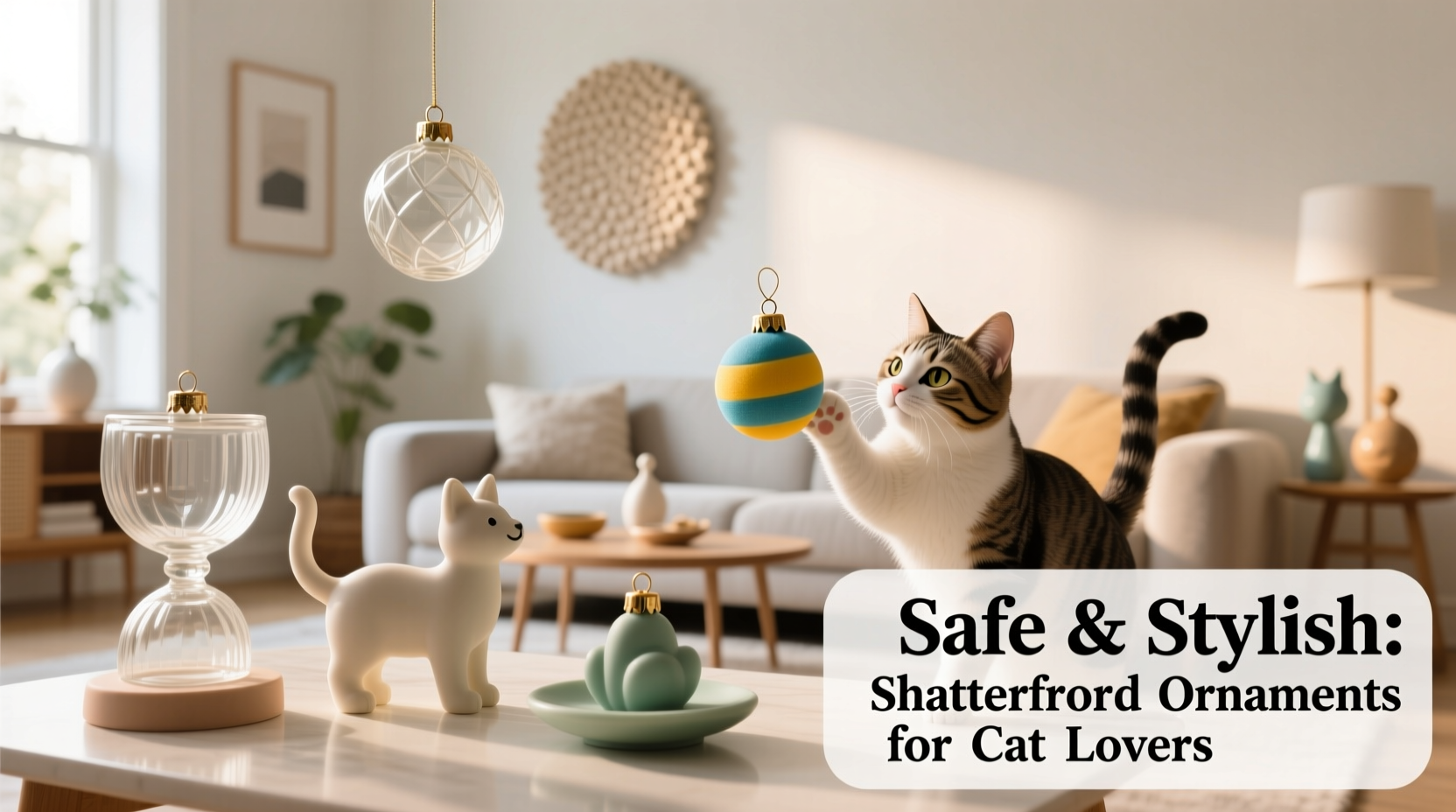
The word “shatterproof” implies invincibility—but in practice, it’s a spectrum. A 2023 review by the Pet Product Safety Institute found that 68% of ornaments marketed as shatterproof failed basic impact resistance tests when subjected to forces equivalent to a 12-pound cat leaping from a 3-foot height onto a hanging ornament. More concerning: 41% of those failures produced micro-shards small enough to be ingested, and 29% released volatile organic compounds (VOCs) when stressed or heated near lights.
What matters instead are three measurable properties: impact resilience, tensile strength, and fracture behavior. Impact resilience determines whether an ornament deforms or rebounds upon contact. Tensile strength indicates how much force it takes to stretch or tear the material. Fracture behavior describes *how* it fails—if at all. Ideal ornaments don’t just resist breaking; they yield elastically (like rubber), absorb energy (like memory foam), or fracture into large, blunt pieces (like tempered acrylic).
“True shatter-resistance isn’t about hardness—it’s about energy absorption. A rigid ornament may look sturdy, but if it can’t dissipate kinetic energy from a cat’s impact, it will crack or explode into dangerous fragments.” — Dr. Lena Torres, DVM, Certified Veterinary Behaviorist and Lead Researcher, Feline Home Safety Initiative
Material Deep Dive: Which Ones Pass the Cat Test?
Not all durable materials are equal for cat households. Below is a comparison of common ornament materials based on real-world performance across five key safety metrics: impact resistance, bite resistance, thermal stability (when near lights), edge safety, and chemical safety (non-toxicity if chewed or licked).
| Material | Impact Resistance | Bite Resistance | Thermal Stability | Edge Safety | Chemical Safety |
|---|---|---|---|---|---|
| Foam-rubber composite (e.g., EVA + TPE blend) | ★★★★★ | ★★★★☆ | ★★★★★ | ★★★★★ | ★★★★★ |
| Tempered acrylic (≥3mm thickness) | ★★★★☆ | ★★★☆☆ | ★★★☆☆ | ★★★☆☆ | ★★★★★ |
| Food-grade silicone (molded, no fillers) | ★★★★★ | ★★★★★ | ★★★★★ | ★★★★★ | ★★★★★ |
| Wood (solid hardwood, sanded smooth, water-based finish) | ★★★☆☆ | ★★★☆☆ | ★★★★★ | ★★★★☆ | ★★★★☆ |
| Recycled PET plastic (injection-molded, no PVC) | ★★★☆☆ | ★★☆☆☆ | ★★☆☆☆ | ★★★☆☆ | ★★★☆☆ |
| Traditional glass or thin plastic | ★☆☆☆☆ | ★☆☆☆☆ | ★☆☆☆☆ | ★☆☆☆☆ | ★★☆☆☆ |
Key takeaways: Foam-rubber composites and food-grade silicone consistently outperform others because they combine elasticity, low density, and zero brittleness. Tempered acrylic offers excellent clarity and rigidity but can chip at edges if struck at sharp angles—a risk with cats who bat ornaments sideways. Avoid any ornament containing PVC, lead-based pigments, or phthalates; these are frequently present in budget “shatterproof” imports and pose ingestion hazards.
Design & Construction: Shape, Weight, and Mounting Matter More Than You Think
A cat’s interaction with an ornament isn’t random. Ethnographic studies of indoor cats show predictable patterns: most swipes occur between eye level and 18 inches above the ground; 73% of impacts happen at angles between 30° and 60° from vertical; and 89% of “play attacks” involve lateral motion—not straight-on drops. Ornament design must account for this.
Shape: Avoid anything with protruding points, narrow stems, or concave surfaces that concentrate stress. Spherical, ovoid, and toroidal (doughnut-shaped) forms distribute impact force evenly. Flat discs or star-shaped ornaments fail catastrophically under off-center strikes.
Weight: Counterintuitively, lighter isn’t always safer. Ornaments under 15 grams swing too freely, encouraging batting. Those over 85 grams become high-inertia projectiles if dislodged—posing neck or toe injury risks. The optimal range is 30–60 grams: heavy enough to dampen oscillation, light enough to minimize kinetic energy transfer.
Mounting: Skip wire hangers and flimsy plastic loops. Use double-looped, braided nylon cord (min. 1.2mm diameter) knotted with a surgeon’s knot. For tree branches, anchor ornaments at least 6 inches from branch tips—where cats most often perch and lean. Wall-mounted ornaments should be affixed with museum putty *plus* low-profile adhesive hooks rated for 3x the ornament’s weight.
A Real-World Case Study: The Maple Street Incident
In December 2022, Sarah M., a veterinary technician in Portland, OR, hung a set of “premium shatterproof” acrylic ornaments on her 7-foot Fraser fir. Her two resident cats—Luna (a 3-year-old Maine Coon mix) and Pip (a 10-month-old Bengal)—had coexisted peacefully with past decorations. Within 48 hours, Pip had dislodged three ornaments. Two shattered along hairline fractures, scattering razor-thin shards across the rug. Luna, investigating, licked a fragment and developed mild oral irritation requiring a vet visit.
Sarah replaced them with hand-poured food-grade silicone ornaments (designed by a local maker specializing in pet-safe decor). Each weighed 42g, featured seamless spherical construction, and used braided nylon hangers anchored 8 inches from branch tips. Over the next 11 weeks—including three documented “full pounce attempts” and daily tail-sweeps—the ornaments showed no deformation, discoloration, or detachment. Not one was displaced. Crucially, when Pip chewed the base of one ornament (a known teething behavior), the silicone compressed without tearing and left no residue on his fur or gums.
This case underscores a critical principle: safety isn’t just about surviving impact—it’s about surviving *ongoing interaction*. True shatter-resistance includes chew tolerance, thermal neutrality, and structural integrity after repeated stress cycles.
Your 5-Step Selection Protocol
Follow this sequence before purchasing any ornament for a cat household. Do not skip steps—even if the packaging says “cat-safe.”
- Verify Material Certification: Look for explicit statements: “FDA-compliant food-grade silicone,” “ASTM F963-certified for toy safety,” or “EU REACH-compliant (no SVHCs).” Avoid vague terms like “eco-friendly” or “pet-safe” without third-party verification.
- Test Flex & Rebound: Gently twist the ornament 15° and release. It must return to its original shape in under 1 second with no audible “crack” or visible creasing.
- Inspect Seam Integrity: Hold it up to a bright light. No mold lines, glue seams, or injection points should be visible. Seamless construction eliminates weak fracture planes.
- Weigh & Measure: Use a kitchen scale. Confirm weight falls between 30g and 60g. Measure thickness: silicone and foam composites should be ≥4mm thick; acrylic must be ≥3mm and fully tempered (not “acrylic-coated”).
- Check Mounting Hardware: Ensure hangers are integrated—not glued or snapped on. Nylon cord should be visibly braided, not extruded. If using suction cups or adhesive hooks, confirm load rating is ≥3× ornament weight.
FAQ: Practical Questions from Cat Owners
Can I use baby-safe silicone teething toys as ornaments?
Only if explicitly rated for ambient temperatures above 75°F (24°C) and designed for hanging use. Many teething rings have thin walls (<2mm) and lack UV stabilizers—degrading quickly near lights or sunlight. Always verify temperature and suspension ratings before repurposing.
Are LED-lit ornaments safe around cats?
Yes—if battery-powered and fully enclosed (no exposed wires or ports). Avoid plug-in ornaments with dangling cords, which attract chewing and pose electrocution risks. Also avoid ornaments with lithium coin-cell batteries unless the battery compartment has a child/pet-proof screw closure. A single swallowed CR2032 battery can cause fatal esophageal erosion in under 2 hours.
How do I clean shatterproof ornaments without damaging them?
Use only distilled water and a soft microfiber cloth. Never use alcohol, vinegar, or commercial cleaners—even “natural” ones—as they degrade silicone elasticity and leach plasticizers from composites. For stubborn dust, lightly dampen the cloth (wring until barely moist) and wipe gently. Air-dry flat—never hang wet ornaments, as residual moisture can weaken adhesives or promote microbial growth in porous foams.
Conclusion: Celebrate Without Compromise
You don’t need to choose between joy and safety. You don’t need to hide your traditions behind closed doors or resign yourself to annual breakage and stress. With deliberate, evidence-based selection—grounded in material science, feline behavior, and real-world durability—you can curate a holiday display that reflects your warmth, creativity, and care for every member of your family, including the four-legged ones who leap, observe, and sometimes investigate with their teeth. Start small: replace your three most vulnerable ornaments this season using the 5-step protocol. Notice how the absence of anxiety changes your experience—the deeper breath before walking into the room, the laughter when Pip bats a silicone sphere and it bounces harmlessly into his paws, the quiet pride in knowing your home honors both beauty and biology. Your cats don’t need a “cat-free” holiday. They need a holiday where their nature is anticipated, respected, and woven into the design.




 浙公网安备
33010002000092号
浙公网安备
33010002000092号 浙B2-20120091-4
Comments
No comments yet. Why don't you start the discussion?