
Selecting the perfect pair of sunglasses shouldn’t feel like a guessing game. While many people wander through stores, stacking half a dozen frames on their nose in search of “the one,” there’s a smarter, more efficient way. The key lies in understanding your face shape and how different sunglass styles interact with it. With the right knowledge, you can confidently pick flattering sunglasses online or in-store—without the hassle of trying on dozens of pairs.
Sunglasses are more than just sun protection—they’re an extension of your personal style and facial harmony. When chosen well, they enhance your best features, balance proportions, and elevate your overall look. This guide breaks down exactly how to match frame shapes to your face type using clear principles, practical tools, and real-world insights from optical stylists and fashion experts.
Understanding Face Shapes: The Foundation of Flattering Frames
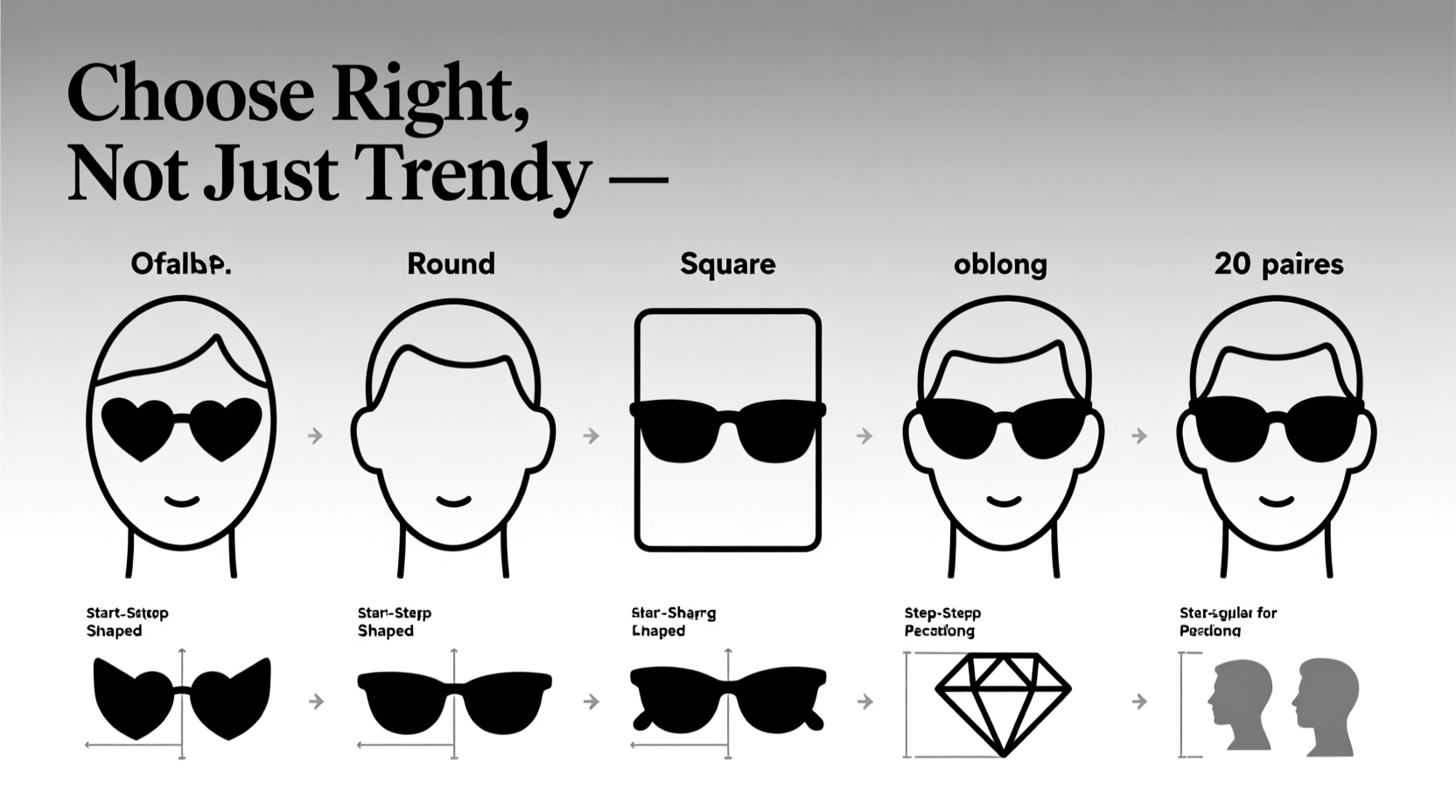
The first step in choosing sunglasses that work for you is identifying your face shape. While faces are rarely perfect geometric forms, most fall into one of six primary categories: oval, round, square, heart, diamond, and oblong. Each has distinct proportions that respond differently to various frame styles.
To determine your face shape, stand in front of a mirror with your hair pulled back. Use a washable marker or lipstick to trace the outline of your face on the glass. Step back and observe the general form:
- Oval: Forehead slightly wider than the jaw, with soft cheekbones and a gently rounded chin. Balanced proportions.
- Round: Width and length nearly equal, with full cheeks and a soft, curved jawline.
- Square: Strong jaw, wide forehead, and angular features. Length and width are similar, but edges are more defined.
- Heart: Broad forehead and temples, tapering to a narrow chin. Often seen with high cheekbones.
- Diamond: Narrow forehead and jaw, with high, dramatic cheekbones as the widest point.
- Oblong: Face is longer than it is wide, with a long forehead and straight cheeklines.
Matching Sunglasses to Your Face Shape
Once you’ve identified your face shape, the next step is selecting frame styles that complement rather than clash with your natural contours. The goal is balance—using eyewear to soften angles, add definition, or create symmetry.
| Face Shape | Best Frame Styles | Framing Goals | Avoid |
|---|---|---|---|
| Oval | Most styles: Wayfarers, aviators, cat-eye, rectangular | Maintain natural balance | Overly large or small frames |
| Round | Square, rectangular, angular, geometric | Add definition and length | Rounded or circular frames |
| Square | Round, oval, aviator, cat-eye | Softening strong angles | Boxy or sharp-edged frames |
| Heart | Aviators, round, bottom-heavy, rimless | Balancing wide forehead | Top-heavy or oversized upper frames |
| Diamond | Wayfarers, cat-eye, oval, rimless | Highlight eyes, widen forehead | Narrow or small frames |
| Oblong | Wide, deep, wraparound, flat-top | Shorten face appearance | Narrow or vertically tall frames |
For example, someone with a round face benefits from angular frames because they introduce visual structure and elongate the face. Conversely, a person with a square jaw will find relief in rounder lenses that smooth out harsh lines.
“Frame selection isn’t about trends—it’s about proportion. A well-chosen pair should make your face look more harmonious, not distract from it.” — Lena Torres, Eyewear Stylist & Consultant
Step-by-Step Guide: Choosing Sunglasses Without Trying Them On
You don’t need a fitting room to find the right sunglasses. Follow this five-step process to make confident choices every time:
- Measure your face. Use a ruler or measuring tape to record: face length (hairline to chin), width at cheekbones, width at forehead, and jawline width. Note which dimension is largest.
- Identify your dominant shape. Compare measurements. Is your face longer than wide? Are your cheekbones the widest part? Match these clues to the standard shapes above.
- Choose complementary frame geometry. If your face is round, opt for square or rectangular frames. If it’s angular, go for curves. Use the table above as a quick reference.
- Check bridge and temple fit specs. Even if the style suits your face, poor fit ruins comfort. Look for adjustable nose pads and temple lengths that match your head size. Standard lens widths range from 130–150mm; larger heads may need 145mm+.
- Review customer photos and videos. On retail sites, filter reviews by face shape or watch try-on videos. Seeing how a frame sits on someone with similar features is almost as good as trying it yourself.
Real Example: Sarah’s Online Purchase Success
Sarah, a 34-year-old graphic designer with a heart-shaped face, had long avoided buying sunglasses online. Her last attempt resulted in a pair of oversized square lenses that made her chin look pointy and her forehead even broader. Frustrated, she decided to approach it methodically.
She measured her face: forehead 6 inches, cheekbones 5.7 inches, jaw 5.2 inches, length 8.5 inches. Confirming her heart shape, she researched styles that would balance her proportions. She focused on aviators and cat-eye frames—styles known to add weight to the lower face.
She found a vintage-inspired cat-eye model with a slight upward tilt and gold detailing. Customer reviews mentioned “great for narrow chins” and “frames the face beautifully.” She checked the lens width (142mm) against her previous well-fitting pair (140mm) and felt confident. The sunglasses arrived, fit perfectly, and became her signature summer look—all without stepping into a store.
Common Mistakes That Lead to Poor Choices
Even with good intentions, shoppers often make avoidable errors that result in unflattering or uncomfortable sunglasses. Watch out for these pitfalls:
- Chasing trends over suitability. Oversized lenses or bold colors may be popular, but they can overwhelm smaller or softer face shapes.
- Ignoring scale. A frame might suit your shape in theory, but if it’s too wide or too tall, it dominates your features.
- Overlooking bridge fit. Especially for those with low nose bridges or high foreheads, poorly positioned frames slide down or sit too high.
- Assuming all “universal” shapes work. Aviators and Wayfarers are versatile, but not universally flattering. Their success depends on subtle variations in angle, depth, and proportions.
“The most common return reason we see is ‘too big.’ People love the look, but forget that facial width varies greatly. Always check the dimensions.” — Marcus Lin, E-commerce Manager at VisionEdge Optics
Expert Checklist: Before You Buy
Use this checklist to ensure your next sunglass purchase is both stylish and structurally sound:
- ✅ I’ve confirmed my face shape using measurements and visual cues.
- ✅ The frame shape contrasts or complements my face geometry (e.g., angular for round, curved for square).
- ✅ Lens width is within 5mm of my previous well-fitting pair (or matches average for my head size).
- ✅ Temple length is appropriate (typically 135–145mm for average adults).
- ✅ The bridge design suits my nose (adjustable pads for low bridges, keyhole bridges for higher ones).
- ✅ Customer photos show the frame on faces with similar proportions to mine.
- ✅ UV protection is labeled as 100% UVA/UVB blocking.
Frequently Asked Questions
Can I wear round glasses if I have a round face?
Generally, round frames on a round face can emphasize softness and make the face appear wider. However, if the frame is small, angular in detail, or contrastingly styled (e.g., thin metal with geometric accents), it can work as a deliberate fashion statement. For everyday wear, angular or rectangular frames are safer choices.
What if my face doesn’t fit neatly into one category?
Many people have hybrid shapes—like an oval-square or round-diamond blend. In such cases, prioritize the most dominant feature. For instance, if you have a square jaw but a rounded forehead, treat your face as square and choose frames that soften the lower half. Focus on what draws the most attention and aim to balance it.
Do gender or age affect frame choice?
Modern sunglasses are increasingly gender-neutral, so style should be based on face shape, not gender. Age doesn’t change face shape significantly, though skin elasticity and posture might affect how frames sit. Older wearers may prefer lighter materials or padded temples for comfort, but the core principles of proportion remain the same.
Final Thoughts: Confidence Comes From Clarity
Choosing sunglasses that flatter your face shape doesn’t require endless trial and error. It requires observation, measurement, and a basic understanding of visual balance. Once you know your shape and the rules of contrast and proportion, you can shop with precision—whether in a boutique or on a mobile app.
The right pair of sunglasses doesn’t just protect your eyes—it frames your identity. They should feel like a natural part of your look, not an accessory struggling to belong. By applying these principles, you save time, reduce returns, and build a collection of eyewear that consistently enhances your appearance.




 浙公网安备
33010002000092号
浙公网安备
33010002000092号 浙B2-20120091-4
Comments
No comments yet. Why don't you start the discussion?