
Selecting the perfect pair of sunglasses goes beyond UV protection or brand appeal—it’s about harmony between frame design and facial structure. Many people rely on in-store try-ons, but with online shopping dominating fashion purchases, knowing how to pick flattering sunglasses sight unseen is a valuable skill. Whether you're buying from a digital catalog or gifting someone remotely, understanding your face shape and which frames enhance it allows for confident, stylish choices—no mirror required.
Understanding Face Shapes: The Foundation of Sunglass Selection
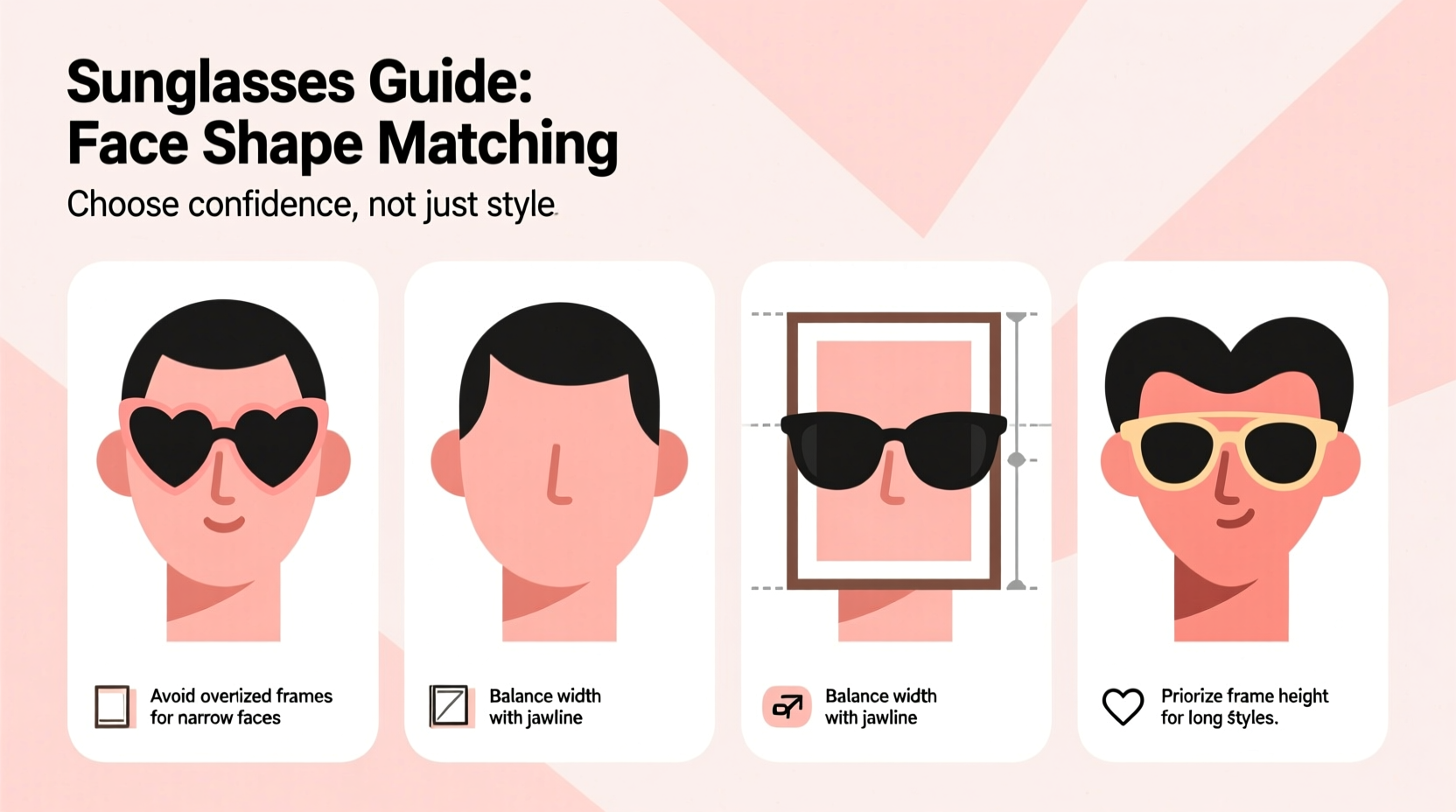
The first step in choosing suitable sunglasses is identifying your face shape. While faces vary subtly, most fall into one of six primary categories: oval, round, square, heart, diamond, and oblong. Each has distinct proportions and angles that respond differently to frame styles.
To determine your face shape without professional help, stand in front of a mirror with your hair pulled back. Use a washable marker to trace the outline of your face on the glass. Step back and analyze the silhouette:
- Oval: Forehead slightly wider than the jawline, with gently curved cheekbones and a soft chin. Balanced proportions.
- Round: Width and length nearly equal, with full cheeks and a rounded jawline.
- Square: Strong jaw, wide forehead, and angular features. Length and width are similar, but edges are more defined.
- Heart: Broad forehead tapering to a narrow chin. Often seen with high cheekbones and a pointed jaw.
- Diamond: Narrow forehead and jaw, with high, dramatic cheekbones forming the widest part of the face.
- Oblong: Face is longer than it is wide, with a relatively straight cheek line and a flat forehead or chin.
Once identified, use this classification as a roadmap for selecting frames that balance your natural contours.
Matching Frames to Facial Structure
The goal isn’t to hide your face shape but to complement it. Sunglasses should create visual equilibrium—softening sharp angles, adding definition to soft curves, or shortening the appearance of elongated features.
Oval Faces: The Versatile Canvas
Oval faces are considered proportionally ideal, allowing wearers to pull off most frame shapes. However, the best choices maintain balance rather than exaggerate length. Avoid overly tall or narrow frames that stretch the face further.
- Recommended: Wayfarers, aviators, cat-eye, rectangular frames
- Avoid: Oversized round frames or very small lenses
Round Faces: Add Definition
Round faces benefit from angular or geometric frames that introduce contrast. The objective is to elongate the face visually and break up circular symmetry.
- Recommended: Square, rectangular, or hexagonal frames; high-bridge designs
- Avoid: Small round frames (they make the face appear fuller)
Square Faces: Soften the Edges
With strong jawlines and broad foreheads, square faces look best with frames that soften angles. Round or oval lenses provide gentle contrast, while curved top lines reduce perceived width.
- Recommended: Round, oval, aviator, or semi-rimless styles
- Avoid: Box-shaped frames with sharp corners
Heart-Shaped Faces: Balance the Forehead
Narrow chins and wide foreheads call for frames that add lower-face volume. Bottom-heavy or wider-lens designs distribute visual weight downward, creating symmetry.
- Recommended: Cat-eye, round, rimless, or butterfly frames
- Avoid: Narrow or top-heavy styles that emphasize forehead width
Diamond Faces: Highlight Cheekbones
Diamond shapes shine with frames that follow cheekbone curvature. Rimmed styles that align with the widest part of the face enhance natural bone structure.
- Recommended: Oval, cat-eye, rimless, or rounded rectangular frames
- Avoid: Narrow frames that don’t span the cheekbones
Oblong Faces: Shorten the Silhouette
Longer faces need frames that reduce perceived length. Wider-than-tall designs with bold top lines compress vertical space, while low-set temples keep balance.
- Recommended: Wraparound, square, wayfarer, or flat-brow frames
- Avoid: Small, narrow, or round frames that elongate further
“Frame selection isn’t just fashion—it’s optical geometry. The right pair alters perception, enhancing symmetry and drawing attention to the eyes.” — Dr. Lena Torres, Optometric Stylist & Vision Consultant
Smart Buying Guide: How to Choose Without Trying On
Buying sunglasses online demands strategy. Without physical fitting, leverage measurements, virtual tools, and structured decision-making.
Step 1: Measure Your Face Accurately
Use a flexible tape measure to record:
- Forehead width: Across the widest point, usually above the eyebrows.
- Cheekbone span: From one prominent cheekbone to the other.
- Jawline width: At its broadest point.
- Face length: Hairline to chin.
- Pupil distance: Inner corner to inner corner of pupils (critical for lens alignment).
Compare these numbers to product specs. Most brands list frame width, lens size, bridge width, and temple length. Aim for a total frame width within 1–5mm of your face’s widest point.
Step 2: Use Virtual Try-On Tools
Many retailers offer augmented reality (AR) features through apps or websites. Upload a photo or use your camera to superimpose frames onto your face. While not perfect, these tools provide realistic previews of scale and proportion.
Step 3: Read Reviews with Photos
Customer reviews featuring real photos are gold. Look for reviewers with similar face shapes or skin tones. Pay attention to comments like “sits wide,” “nose bridge fits perfectly,” or “makes my face look longer.”
Step 4: Prioritize Adjustable Features
Frames with adjustable nose pads or spring hinges adapt better to individual anatomy. Titanium or flexible acetate materials also accommodate minor fit discrepancies.
Comparison Table: Best Sunglasses by Face Shape
| Face Shape | Best Frame Styles | Styles to Avoid | Example Lens Ratio |
|---|---|---|---|
| Oval | Wayfarer, Aviator, Rectangular | Tiny round, overly large | Width > Height (e.g., 55-14-145) |
| Round | Square, Geometric, Angular | Small round, curved | Height > Width (e.g., 50-18-140) |
| Square | Round, Oval, Aviator | Sharp-edged rectangles | Curved top line, soft angles |
| Heart | Cat-eye, Rimless, Bottom-heavy | Narrow frames, flat brows | Wider at bottom than top |
| Diamond | Oval, Rimless, Cat-eye | Frames too narrow at cheek level | Aligns with cheekbone width |
| Oblong | Flat-top, Wraparound, Wide | Small, vertically elongated | Total width ≥ face width |
Real-World Example: Choosing for a Friend
Sophie wanted to surprise her sister Maya with sunglasses for her birthday. Maya has a diamond-shaped face—high cheekbones, narrow forehead and jaw—but lives abroad, making in-person shopping impossible.
Sophie recalled Maya’s frequent compliments on cat-eye earrings and oval-framed glasses. She measured an old pair Maya loved and noted the width: 140mm. Searching online, she filtered for oval or cat-eye acetate frames around that width. She checked customer photos and found several women with similar bone structure praising how the frames \"followed their cheekbones.\"
She chose a tortoiseshell oval pair with slight upward flair at the temples. When Maya received them, she texted: “They sit perfectly—I can’t believe you picked these blind!”
This example shows how observation, measurement, and pattern recognition can replace physical try-ons.
Frequently Asked Questions
Can I wear round sunglasses if I have a round face?
You can, but proceed with caution. Small round frames tend to amplify roundness. Instead, opt for larger, angular-round hybrids—like hexagonal or softly squared circles—that add definition. Ensure the frame width matches or exceeds your cheekbone span to avoid a \"floating\" look.
What if my face shape falls between categories?
Most faces are blends. If you’re unsure, prioritize your most dominant feature. For example, if you have a square jaw but a narrow chin, treat it as a heart shape. Alternatively, choose universally flattering styles like aviators or modified wayfarers, which suit multiple shapes due to balanced proportions.
Do lens color and frame material affect face shape perception?
Indirectly, yes. Dark, opaque lenses create a bolder facial focal point, making frames appear larger. Transparent or light-colored frames feel lighter and less structuring. Thicker acetate adds presence; thin metal frames minimize impact. For subtle shaping effects, matte finishes reduce visual weight compared to glossy ones.
Final Checklist Before You Buy
Before clicking “Add to Cart,” run through this checklist:
- ✅ Identified your primary face shape using measurements or photos
- ✅ Researched frame styles known to flatter your shape
- ✅ Verified frame dimensions (especially width) against your face size
- ✅ Checked return policy in case fit isn’t ideal
- ✅ Reviewed customer images and feedback
- ✅ Considered adjustable features (nose pads, hinge flexibility)
- ✅ Confirmed UV400 protection (non-negotiable for eye health)
Conclusion: Confidence Starts with Clarity
Choosing sunglasses without trying them on isn’t guesswork—it’s a blend of self-knowledge, design awareness, and smart research. Once you understand how frame geometry interacts with facial contours, you can shop with precision, whether for yourself or someone else. The right pair doesn’t just protect your eyes; it elevates your entire presence. Use the principles outlined here to make informed decisions, trust your analysis, and step into the sun with confidence.




 浙公网安备
33010002000092号
浙公网安备
33010002000092号 浙B2-20120091-4
Comments
No comments yet. Why don't you start the discussion?