
Traveling shouldn’t mean sacrificing sound. Whether you’re hiking a mountain trail, lounging at a beachside resort, or camping under the stars, a reliable portable Bluetooth speaker can elevate your experience. But with dozens of models flooding the market—each boasting water resistance, long battery life, or booming bass—it’s easy to get overwhelmed. The right speaker balances durability, audio quality, portability, and connectivity in a way that fits your lifestyle. Understanding what truly matters helps you avoid buyer’s remorse and invest in a device that delivers where it counts.
Battery Life: Power That Keeps Up With You
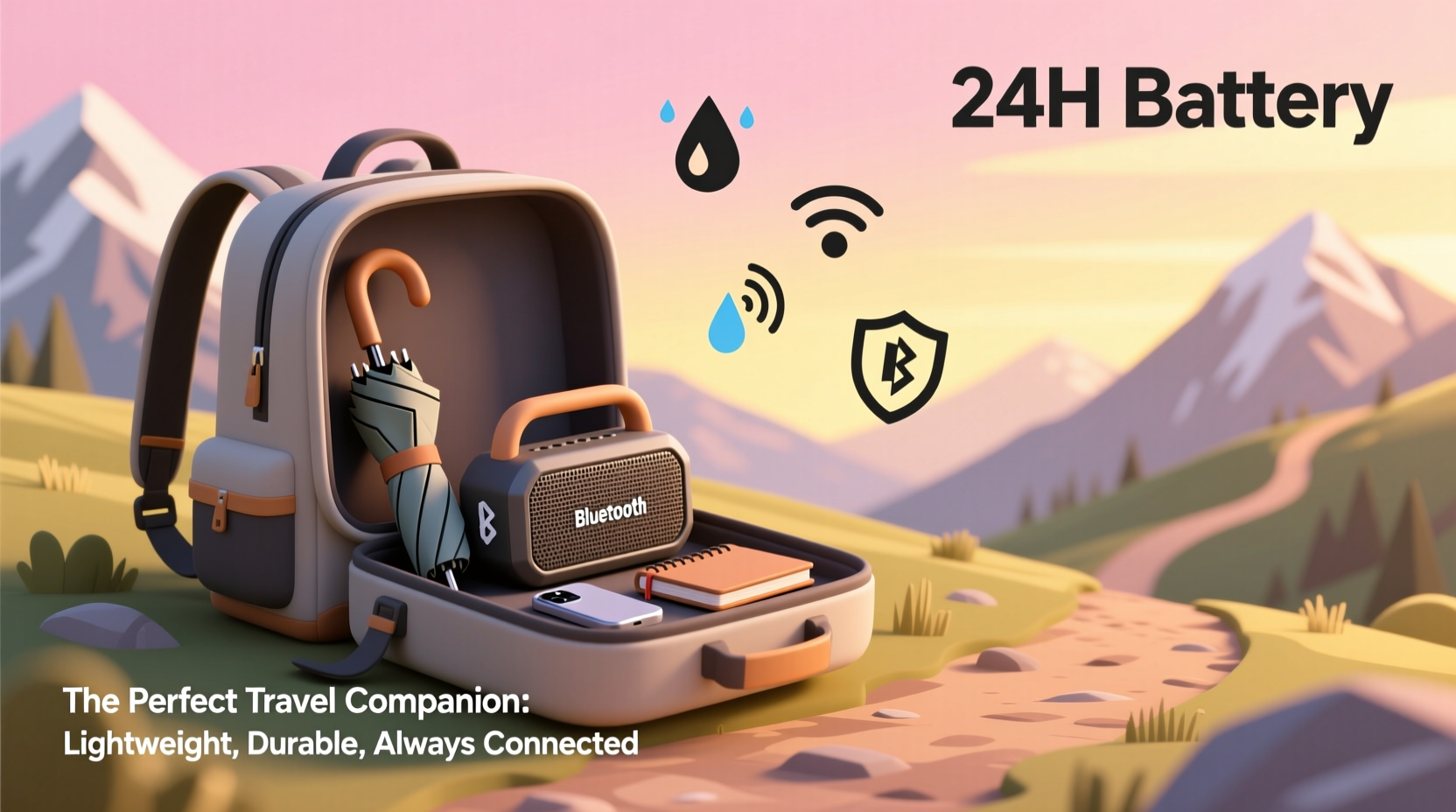
One of the most critical factors when selecting a travel speaker is battery longevity. A speaker that dies after three hours won’t survive a day trip, let alone a weekend getaway. Most portable speakers offer between 8 and 20 hours of playback, but real-world usage often falls short of manufacturer claims—especially at higher volumes or with bass-heavy music.
For extended trips without access to charging, aim for at least 15 hours of continuous play. Some high-end models, like the JBL Charge 5 or Ultimate Ears BOOM 3, provide up to 20 hours and even double as power banks to charge your phone in a pinch.
Also consider charging options. USB-C is now standard and faster than older micro-USB ports. Speakers with wireless charging compatibility are still rare but growing in availability—ideal if you travel light and prefer minimal cables.
Durability and Weather Resistance: Built for Adventure
If your speaker will face sand, rain, or accidental drops, durability isn’t optional—it’s essential. Look for an IP (Ingress Protection) rating, which indicates resistance to dust and moisture. For travel, IPX7 is ideal: it means the speaker can be submerged in water up to 1 meter deep for 30 minutes. IPX4 offers splash resistance, suitable for poolside use but not full immersion.
Rugged exteriors with rubberized bumpers absorb shock from falls. Brands like JBL, Sony, and Ultimate Ears design many of their travel models with outdoor conditions in mind. Avoid sleek, minimalist designs if you plan to use the speaker off paved paths—they may look good but lack the toughness needed for real adventure.
“Most speaker failures during travel happen not from use, but from exposure to elements users didn’t anticipate.” — Carlos Mendez, Audio Equipment Engineer at Outdoor Tech Labs
Sound Quality vs. Size: Finding the Balance
It’s tempting to assume bigger speakers always sound better, but modern engineering allows compact units to deliver impressive audio. What matters more is driver configuration, passive radiators, and digital signal processing (DSP).
A good travel speaker should produce clear mids and highs with noticeable bass—without distortion at moderate volumes. Stereo pairing capability (where two identical speakers connect for left/right channel separation) dramatically improves spatial sound and is worth considering if you frequently host small gatherings.
Keep in mind: smaller speakers naturally struggle with deep bass. If rich low-end is important, opt for models with passive radiators or dual woofers. However, these tend to be slightly bulkier. It’s a trade-off between portability and sonic depth.
Key Sound Features to Evaluate
- Driver size: 1.5–2 inches is typical; larger drivers usually mean better clarity.
- Frequency response: Look for a range of 60Hz–20kHz for balanced output.
- DSP tuning: Advanced models adjust output based on environment (e.g., boosting bass in open spaces).
- Stereo pairing: Enables true stereo separation when using two units.
Portability and Design: Lightweight Without Compromise
The best travel speakers disappear into your pack until you need them. Weight, dimensions, and form factor matter. Ideally, a travel speaker should weigh under 1.5 pounds and fit comfortably in a daypack or beach tote.
Some models feature built-in carabiner clips or lanyard loops, making them easy to attach to backpacks or hang from tents. Cylindrical designs like the UE WONDERBOOM series are popular for their compactness and 360-degree sound dispersion.
Flat-bottomed speakers sit more securely on tables or rocks, while spherical ones may roll. Consider how and where you’ll use it most—on a picnic table, floating in a pool, or clipped to a bike handlebar.
Connectivity and Smart Features
Bluetooth range and version affect reliability. Bluetooth 5.0 and above offer improved range (up to 30 meters/100 feet in open space), lower latency, and better power efficiency compared to older versions like 4.2.
Stable pairing matters most when moving around—imagine walking from your tent to the campfire without losing connection. NFC (Near Field Communication) simplifies pairing for Android users by allowing tap-to-connect functionality.
Some speakers include auxiliary inputs or support multi-device pairing, useful when traveling with companions who want to take turns playing music. Voice assistant integration (like Alexa or Google Assistant) is less common in compact models but available in select premium units.
Do’s and Don’ts of Connectivity
| Do | Don’t |
|---|---|
| Prioritize Bluetooth 5.0 or higher for stable connections | Assume maximum range works indoors through walls |
| Use NFC if your phone supports it for quick pairing | Ignore firmware updates—some improve connection stability |
| Check if the speaker supports party mode (daisy-chaining) | Overlook compatibility with your primary devices |
Real-World Scenario: Choosing for a Backpacking Trip
Lena, an avid hiker planning a 7-day trek through Patagonia, needed a speaker that could survive variable weather, fit in her pack, and last multiple days without charging. She considered several models but ultimately chose the JBL Clip 4. Why? It weighs just 0.5 pounds, has an IP67 rating (fully dustproof and waterproof), includes a carabiner clip, and delivers surprisingly robust sound for its size. Though not the loudest option, it was sufficient for evening relaxation at basecamp. More importantly, it didn’t add meaningful weight—and survived being caught in a sudden downpour.
Her decision highlights a crucial truth: the perfect travel speaker aligns with your actual usage, not just specs on paper.
Step-by-Step Buying Guide
Follow this sequence to make a confident purchase:
- Define your use case: Will you use it primarily for solo trips, group outings, or indoor hotel stays?
- Set a size and weight limit: Decide what you’re willing to carry daily.
- Determine minimum battery life: Choose based on access to power sources.
- Check IP rating: Select at least IPX7 for outdoor adventures.
- Test audio samples: Listen to reviews or demo units if possible—focus on clarity at mid-volume.
- Verify Bluetooth version: Opt for 5.0 or newer for fewer dropouts.
- Compare extra features: Consider speakerphone function, power bank ability, or stereo pairing.
- Read user reviews: Pay attention to long-term reliability and build quality feedback.
Frequently Asked Questions
Can I take a Bluetooth speaker on a plane?
Yes, most portable Bluetooth speakers are allowed in both carry-on and checked luggage. However, lithium-ion batteries must comply with airline regulations. Since nearly all travel speakers fall well under the 100Wh limit, they’re generally permitted. Check with your carrier if unsure.
How do I clean a waterproof speaker after beach use?
Rinse it with fresh water to remove salt and sand, then dry thoroughly with a soft cloth. Avoid submerging speakers without an IPX7 or higher rating, even if labeled “water-resistant.”
Are expensive speakers worth it for travel?
Not always. While premium brands like Bose or Bang & Olufsen offer refined sound, many mid-range models (e.g., Anker Soundcore, JBL Flip 6) deliver excellent value with rugged builds and strong performance. Focus on features you’ll actually use rather than brand prestige.
Final Checklist Before You Buy
- ✅ Battery lasts at least 12 hours at medium volume
- ✅ Has IPX7 or higher water resistance
- ✅ Weighs under 1.5 lbs and fits in your bag
- ✅ Uses Bluetooth 5.0 or later
- ✅ Includes secure attachment option (carabiner, strap, etc.)
- ✅ Sound remains clear at 70% volume
- ✅ Backed by warranty and positive long-term reviews
Conclusion
Selecting the perfect portable Bluetooth speaker for travel isn’t about chasing the highest specs—it’s about matching performance to your real-world needs. Prioritize durability, battery life, and practical portability over flashy features you won’t use. Whether you're winding through city streets or unwinding in the wilderness, the right speaker enhances moments without weighing you down. Take the time to assess your habits, test options, and choose wisely. Your soundtrack deserves nothing less.




 浙公网安备
33010002000092号
浙公网安备
33010002000092号 浙B2-20120091-4
Comments
No comments yet. Why don't you start the discussion?