
Selecting the right backpack for international travel isn’t just about style or brand preference—it’s a strategic decision that affects comfort, mobility, compliance with airline regulations, and overall travel experience. A poorly sized bag can lead to excess fees, back strain, or even forced check-ins at the gate. With so many variables—from destination climate to airline-specific restrictions—choosing the ideal backpack requires research, planning, and an understanding of both personal needs and industry standards.
This guide breaks down everything you need to know about selecting the correct backpack size, navigating global carry-on policies, and packing efficiently without sacrificing essentials.
Understanding Backpack Size Measurements
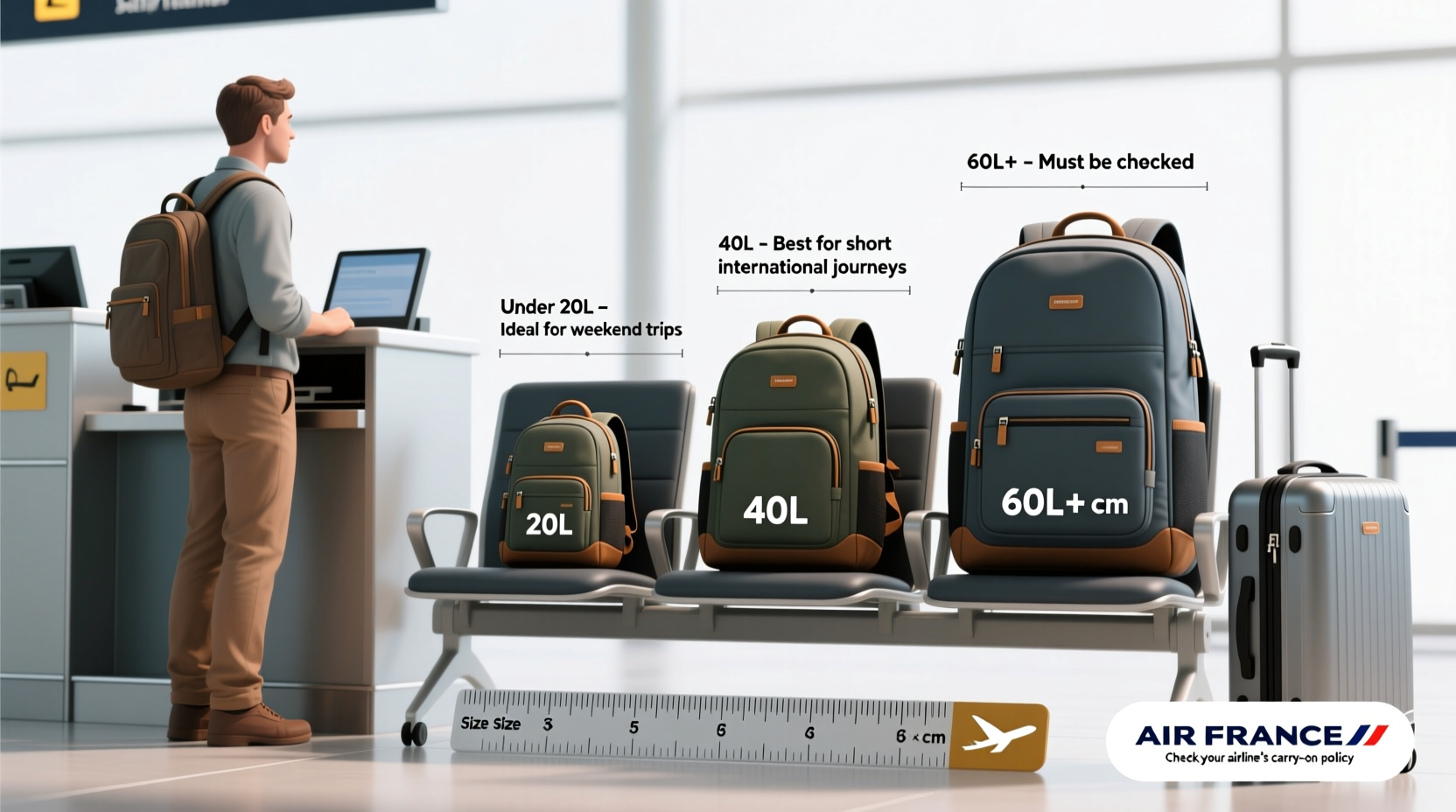
Backpack sizes are typically measured in liters, representing the total internal volume. This metric helps travelers estimate capacity, but it doesn’t always reflect external dimensions—which are what airlines care about most. Most travel backpacks range from 30L to 70L, with subcategories serving different trip lengths and styles.
The key is balancing capacity with practicality. A larger pack may hold more, but if it exceeds airline limits or doesn't fit overhead bins, it becomes a liability rather than an asset.
Common Backpack Sizes and Use Cases
| Size (Liters) | Trip Duration | Ideal For | Risks if Overpacked |
|---|---|---|---|
| 20–30L | Weekend trips, city breaks | Carry-on only, minimalist travelers | Limited space for clothing or toiletries |
| 35–45L | 1–3 weeks, urban destinations | Backpackers, digital nomads, carry-on compliant | May exceed weight limits if not packed carefully |
| 50–60L | Extended trips, mixed climates | Long-term travelers, outdoor adventures | Often too large for strict European carriers; may require checking |
| 65–70L+ | 6+ months, remote regions | Round-the-world journeys, expedition-style travel | Nearly always checked; increases risk of loss/damage |
A 40–45L backpack strikes the best balance for most international travelers aiming to avoid checked baggage fees while carrying sufficient gear. These models are designed with internal frames compatible with carry-on standards and often feature laptop sleeves, quick-access compartments, and lockable zippers.
Carry-On Rules: What Airlines Really Allow
While many assume carry-on rules are standardized, they vary significantly by region, airline, and even aircraft type. Budget carriers like Ryanair or EasyJet enforce tighter restrictions than full-service airlines such as Emirates or Singapore Airlines.
Most major airlines define carry-on luggage by linear dimensions—typically allowing up to 55 x 40 x 20 cm (21.5 x 15.5 x 7.5 inches), totaling around 45L. However, some low-cost carriers impose lower limits:
- Ryanair: 40 x 20 x 25 cm (15.7 x 7.9 x 9.8 in) for free cabin bags; larger bags cost extra.
- EasyJet: 56 x 45 x 25 cm (22 x 17.7 x 9.8 in)—one of the more generous among budget airlines.
- Delta, United, American Airlines: 56 x 36 x 23 cm (22 x 14 x 9 in).
- Emirates: 55 x 38 x 20 cm (21.6 x 15 x 7.9 in).
“Even if your bag fits the listed dimensions, boarding last means overhead bin space may be full. Airlines reserve the right to ‘gate check’ any bag that can’t be stowed safely.” — Sarah Lin, International Flight Attendant with 12 years of experience
To stay compliant, measure your backpack when fully packed—not just empty. Shoulder straps, hydration sleeves, and external attachments can add bulk that pushes your bag over the limit.
Regional Differences in Carry-On Enforcement
In North America, enforcement tends to be more lenient unless the flight is full. In Europe, especially with budget airlines, staff routinely measure bags at the gate using physical sizers. Asian carriers like ANA or Cathay Pacific emphasize weight limits (usually 7–10 kg) in addition to size.
If traveling through multiple regions, design your packing strategy around the strictest leg of your journey. For example, if flying Ryanair between European cities, your primary backpack must meet their smaller standard—even if other flights allow more.
Step-by-Step Guide to Choosing Your Travel Backpack
Follow this structured process to ensure your backpack supports your itinerary, complies with regulations, and enhances comfort.
- Determine Trip Length and Climate: A two-week summer trip across Southeast Asia requires less bulky clothing than a winter trek through Scandinavia. Plan layers accordingly.
- Check Airline Policies: Review the carry-on rules for every flight segment, especially connecting budget carriers.
- Assess Personal Gear Needs: Include electronics, adapters, medication, and specialty items (e.g., camera equipment).
- Select Frame Type: Internal frame packs offer better weight distribution and fit within airline limits. External frames are rare now and usually too rigid for cabin use.
- Try Before You Buy: Visit a store to test fit. Adjust shoulder straps, hip belt, and sternum strap to ensure load transfer to hips—not shoulders.
- Test Packed Weight: Load your intended items and weigh the bag. Stay under 7 kg (15 lbs) to avoid overweight fees and fatigue.
- Evaluate Accessibility: Top-loading vs. panel-loading designs impact how easily you retrieve items during security checks or mid-flight.
Real-World Example: One Bag Across Three Continents
Julia, a freelance designer from Toronto, planned a three-month solo journey through Portugal, Morocco, India, and Thailand. Her goal was to travel with only a carry-on backpack to avoid baggage claims and maximize flexibility.
She chose a 42L convertible backpack with a detachable daypack. The main compartment met IATA carry-on guidelines (55 x 40 x 20 cm), and she used ultralight merino wool clothing to minimize bulk. During her layover in Marrakech, she flew with Ryanair’s regional partner, which required passing her bag through a sizer. Thanks to meticulous packing and roll-top compression, her bag slid through with 2 cm to spare.
Her success came from pre-measuring her loaded pack and leaving room for souvenirs by wearing heavier items on travel days. She also avoided liquids over 100ml and kept her laptop in an easily accessible sleeve for security screening.
Julia’s experience shows that with the right backpack and disciplined packing, long-term international travel with a single carry-on is not only possible—it can be liberating.
Packing Smart: Maximize Space Without Breaking Rules
Even the best-sized backpack fails if packed inefficiently. Here’s how to optimize space while staying compliant:
- Roll clothes instead of folding: Reduces air pockets and prevents wrinkles.
- Use vacuum or compression bags: Especially helpful for down jackets or bulky sweaters.
- Wear your heaviest items: Boots, jackets, and belts take up significant space and add weight.
- Limit footwear: Two pairs max—one walking shoes, one casual. Use shoe bags to contain dirt.
- Stick to TSA-compliant liquids: All containers must be 100ml or less and stored in a clear quart-sized bag.
Beyond physical packing, consider digital minimalism. Store documents in the cloud, use e-tickets, and carry only essential chargers. Every ounce saved improves comfort and reduces stress at security checkpoints.
Do’s and Don’ts of Carry-On Backpack Use
| Do | Don't |
|---|---|
| Choose a backpack with a flat bottom for stability | Overpack beyond the recommended volume |
| Invest in a TSA-approved lock | Attach bulky items externally (e.g., sleeping bags) |
| Keep valuables and medications in easy reach | Ignore weight limits—many airports have hidden scales |
| Use packing lists tailored to climate and activities | Assume all airlines accept the same size |
Frequently Asked Questions
Can I bring a 50L backpack as carry-on?
It depends on the airline. While 50L is close to the upper limit, many 50L packs exceed the linear dimensions allowed (especially depth). Some 50L models are designed to compress to 45L for air travel. Always check the actual measurements of the specific model when packed, not just the advertised volume.
What happens if my backpack is slightly over the size limit?
Airlines may still accept it at their discretion, especially if there’s space. However, budget carriers often charge mandatory gate-check fees (€30–€60) and won’t guarantee timely return upon arrival. To avoid surprises, invest in a pack certified as carry-on compliant or arrive early to repack if needed.
Is a hiking backpack suitable for international flights?
Many modern hiking backpacks are designed with travel in mind and meet carry-on standards. Look for models labeled “travel-ready” or “cabin-sized.” Avoid traditional hiking packs with protruding frames, hydration bladders outside the main compartment, or excessive external attachment points—they’re likely to be flagged at boarding.
Final Checklist Before You Fly
- ✅ Measured packed backpack against airline dimension limits
- ✅ Weighed fully loaded bag (under 7–10 kg depending on carrier)
- ✅ Confirmed liquid containers are 100ml or less and in a clear bag
- ✅ Secured zippers with TSA-approved locks
- ✅ Worn heaviest clothing and footwear on travel day
- ✅ Verified carry-on allowance for each flight segment
- ✅ Packed essential medications and documents in accessible pockets
“The most experienced travelers aren’t those with the most gear—they’re the ones who move freely because they’ve mastered the art of less.” — Mark Rivera, Author of *Lighter Journeys*
Conclusion
Choosing the right backpack size for international travel is a blend of logistics, self-awareness, and preparation. It’s not just about fitting within airline rules—it’s about designing a mobile lifestyle where your gear supports your journey, not hinders it. By selecting a 35–45L carry-on compliant backpack, respecting regional airline policies, and packing with precision, you gain freedom, reduce costs, and travel with greater agility.
Your next adventure shouldn’t start with a struggle at the departure gate. Take time now to evaluate your needs, measure your options, and commit to smarter travel habits. The right backpack isn’t the biggest—it’s the one that lets you walk through the terminal, board your flight, and begin exploring without a second thought.




 浙公网安备
33010002000092号
浙公网安备
33010002000092号 浙B2-20120091-4
Comments
No comments yet. Why don't you start the discussion?