
Selecting the correct grip size for your tennis racket is one of the most overlooked yet critical decisions a player can make. While power, weight, and string pattern often dominate equipment discussions, the handle’s circumference directly affects comfort, control, and long-term joint health. A grip that's too small or too large forces your hand and forearm to compensate, leading to diminished performance and increased risk of injuries like tennis elbow. Yet, many players stick with whatever size came with their racket or guess based on what feels “okay.” This approach misses an opportunity to optimize both playability and physical well-being.
The ideal grip size allows for a natural, relaxed hold while still enabling precise maneuverability during aggressive swings and quick directional changes. It supports proper technique without encouraging tension in the wrist or forearm. Whether you're a beginner just starting out or an experienced player upgrading gear, understanding how to measure, test, and confirm the best grip size for your hand ensures every match starts from a foundation of comfort and efficiency.
Understanding Grip Sizes: The Basics
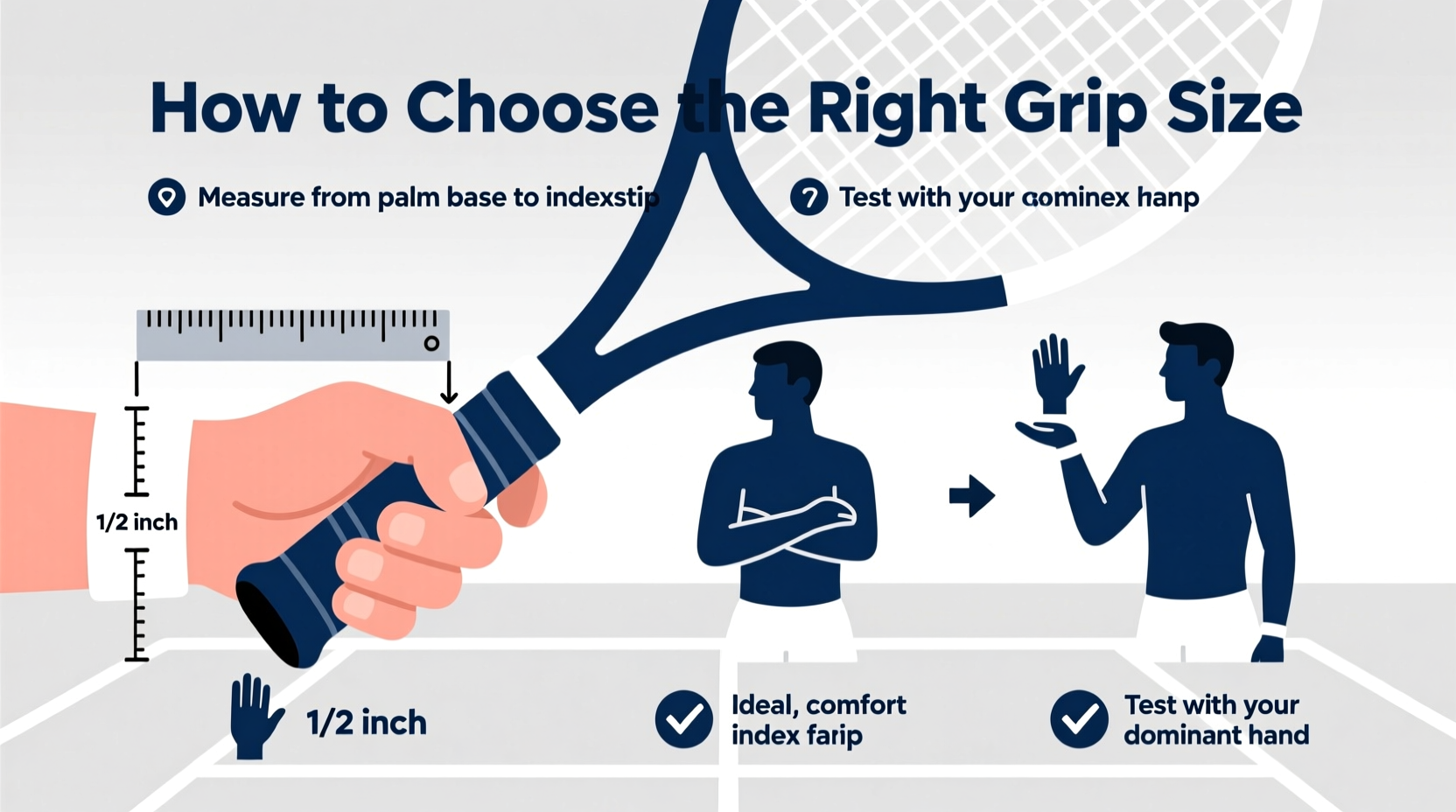
Tennis racket grips are standardized across brands and typically range from size 0 to 5 (also labeled L0 to L5), corresponding to specific circumferences measured in inches. These sizes apply universally whether you're using a Wilson, Babolat, Head, or Yonex racket. Each increment represents an increase of 1/8 inch (about 3.2 mm) in grip circumference.
The standard grip size chart is as follows:
| Grip Size | Circumference (inches) | Circumference (mm) |
|---|---|---|
| L0 | 4 1/8″ | 105 mm |
| L1 | 4 1/4″ | 108 mm |
| L2 | 4 3/8″ | 111 mm |
| L3 | 4 1/2″ | 114 mm |
| L4 | 4 5/8″ | 117 mm |
| L5 | 4 3/4″ | 120 mm |
Most adult rackets come stock with a size L3 or L4 grip. However, assuming these default sizes fit your hand can lead to inefficiencies. For example, junior players or adults with smaller hands may find even L2 too large, while larger-handed players might require L4 or L5 for optimal control without over-gripping.
How to Measure Your Ideal Grip Size
Choosing the right grip isn’t about preference alone—it’s rooted in biomechanics. Two reliable methods exist for determining your ideal grip size: the ruler method and the finger gap test. Both are simple, accurate, and require no special tools.
The Ruler Method
- Extend your dominant hand fully with fingers together and thumb out at a 90-degree angle.
- Using a ruler, measure from the middle crease of your palm (just below the base of the index finger) to the tip of your ring finger.
- Match the measurement to the recommended grip size:
- 4 inches → L0
- 4 1/8 inches → L1
- 4 1/4 inches → L2
- 4 3/8 inches → L3
- 4 1/2 inches → L4
- 4 5/8 inches → L5
This method correlates closely with actual grip fit because it measures the natural reach of your hand when wrapped around a handle.
The Finger Gap Test
A more functional way to assess fit is through the finger gap test, which evaluates how your hand interacts with a simulated racket handle:
- Hold a racket with your dominant hand using a standard Eastern forehand grip.
- Close your hand naturally around the grip.
- Check if you can fit your non-dominant index finger snugly between your fingertips and palm.
If there’s no space, the grip is likely too small. If more than one finger fits easily, it’s probably too large. A perfect fit allows just enough room for the tip of one finger—indicating sufficient leverage without requiring excessive squeezing.
“Getting the grip size wrong is like wearing shoes that don’t fit. You might adapt temporarily, but eventually, your body will pay the price.” — Dr. Mark Reynolds, Sports Biomechanist
Signs You’re Using the Wrong Grip Size
Even if you haven’t formally measured your grip, your body often sends clear signals when something is off. Recognizing these warning signs early can prevent chronic strain and improve overall stroke consistency.
Too Small a Grip
- Excessive forearm fatigue: Smaller grips force your muscles to work harder to stabilize the racket head during impact.
- Involuntary wrist movement: Players tend to flip or roll the wrist prematurely on serves and groundstrokes due to lack of control.
- Increased spin reliance: To compensate for instability, players unconsciously generate more topspin, altering stroke mechanics.
- Tennis elbow development: Chronic overuse of extensor tendons increases susceptibility to lateral epicondylitis.
Too Large a Grip
- Reduced racket head speed: Larger handles limit wrist snap, especially on serves and volleys.
- Poor transition between grips: Difficulty shifting from forehand to backhand grips reduces agility at net.
- Finger cramping: Inability to wrap fingers fully leads to tension and discomfort after short play sessions.
- Lack of touch: Reduced sensitivity makes drop shots and delicate angles harder to execute.
Real-World Example: From Pain to Performance
Sarah, a recreational player in her mid-30s, had been experiencing persistent soreness in her right forearm for months. She played twice weekly, used modern polyester strings, and believed she was following sound technique. Despite icing and rest, the discomfort worsened until she consulted a sports physiotherapist.
After reviewing her equipment, the therapist asked about her racket grip size. Sarah realized she’d never checked—it was whatever came with the frame (L3). Upon measuring her hand using the ruler method, she discovered her ideal size was actually L2. Her hand span measured only 4 1/4 inches, meaning the L3 grip forced her to claw at the handle with excessive muscle engagement.
She switched to an L2 racket and noticed immediate differences: reduced tension in her forearm, improved ball placement, and greater ease in executing one-handed backhands. Within three weeks, her pain subsided completely. This case underscores how a seemingly minor equipment mismatch can have significant physiological consequences.
Step-by-Step Guide to Choosing & Testing Your Grip Size
Follow this structured process to ensure you select the best possible grip size for your game:
- Measure your hand using either the ruler method or finger gap test described earlier.
- Narrow down your options to two adjacent sizes if measurements fall near a boundary (e.g., between L3 and L4).
- Borrow or demo rackets with both sizes from a pro shop or club. Use your own strings if possible for consistent feedback.
- Hit live balls for at least 20–30 minutes with each racket, focusing on serve, forehand, backhand, and volleys.
- Evaluate post-session sensations: Note any tightness, numbness, or fatigue in your hand, wrist, or forearm.
- Assess control vs. power trade-offs: Does one grip allow cleaner contact? Do you feel locked in or fighting the frame?
- Confirm your choice based on both physical comfort and technical performance—not just initial feel.
If purchasing online, buy a racket with a slightly smaller grip—you can always add an overgrip to increase size by 1/8 inch. Going from small to large is easier than reducing a large grip.
Do’s and Don’ts When Selecting a Grip Size
| Do’s | Don’ts |
|---|---|
| Use objective measurement methods before testing | Assume your old grip size still fits (hands change over time) |
| Try multiple grip styles (Eastern, Semi-Western, Continental) | Make a decision after only a few practice swings |
| Add an overgrip for slight size adjustment or moisture absorption | Layer more than two overgrips (can distort shape and reduce shock absorption) |
| Consider climate—if you sweat heavily, a tackier overgrip may help avoid tightening your hold | Ignore recurring arm pain—it may be grip-related |
Frequently Asked Questions
Can I change the grip size after buying a racket?
Yes. You can increase the grip size by adding overgrips (each adds ~1/8 inch) or installing a heat-shrink sleeve for a permanent enlargement of up to one full size. Decreasing grip size is not practical without re-handling, which is costly and rarely done.
Does grip size affect my risk of tennis elbow?
Significantly. A grip that’s too small causes excessive gripping force and overactivation of forearm muscles, increasing stress on the tendons attached to the elbow. Studies show players using undersized grips report higher incidence of lateral epicondylitis.
Should juniors use different grip sizing rules?
Juniors should follow the same measurement principles but often need L0 or L1 sizes depending on age and hand growth. Regular reassessment every 6–12 months is wise during growth spurts. Many junior rackets come in appropriately sized variants, so check specifications carefully.
Final Recommendations and Action Steps
Choosing the right grip size isn't a one-time guess—it's part of ongoing equipment optimization. Start by measuring your hand accurately, then validate the result through real hitting sessions. Pay attention not just to how the racket feels initially, but how your arm feels afterward. Comfort shouldn’t mean loose or floppy; it should mean secure, responsive, and sustainable.
Remember, grip size influences every stroke you make. It affects timing, precision, injury resilience, and confidence. Taking 15 minutes to get it right could extend your playing career by years.




 浙公网安备
33010002000092号
浙公网安备
33010002000092号 浙B2-20120091-4
Comments
No comments yet. Why don't you start the discussion?