
Selecting a Christmas tree isn’t just about aesthetics—it’s an exercise in spatial intelligence. A tree that’s too tall will press against ceiling fans, smoke detectors, or light fixtures; one too short looks lost in a high-ceilinged room and undermines visual balance. Yet most shoppers make this decision based on memory, guesswork, or what’s left on the lot. The result? Bent branches, lopsided ornaments, last-minute trimming, or worse—returning a $200 tree because it won’t fit through the front door *or* under the ceiling. This isn’t seasonal stress—it’s avoidable. With precise measurement, realistic allowances, and awareness of structural variables, choosing the right tree height is methodical, repeatable, and deeply satisfying.
Step 1: Measure Your Ceiling Height—Then Subtract Critical Clearance
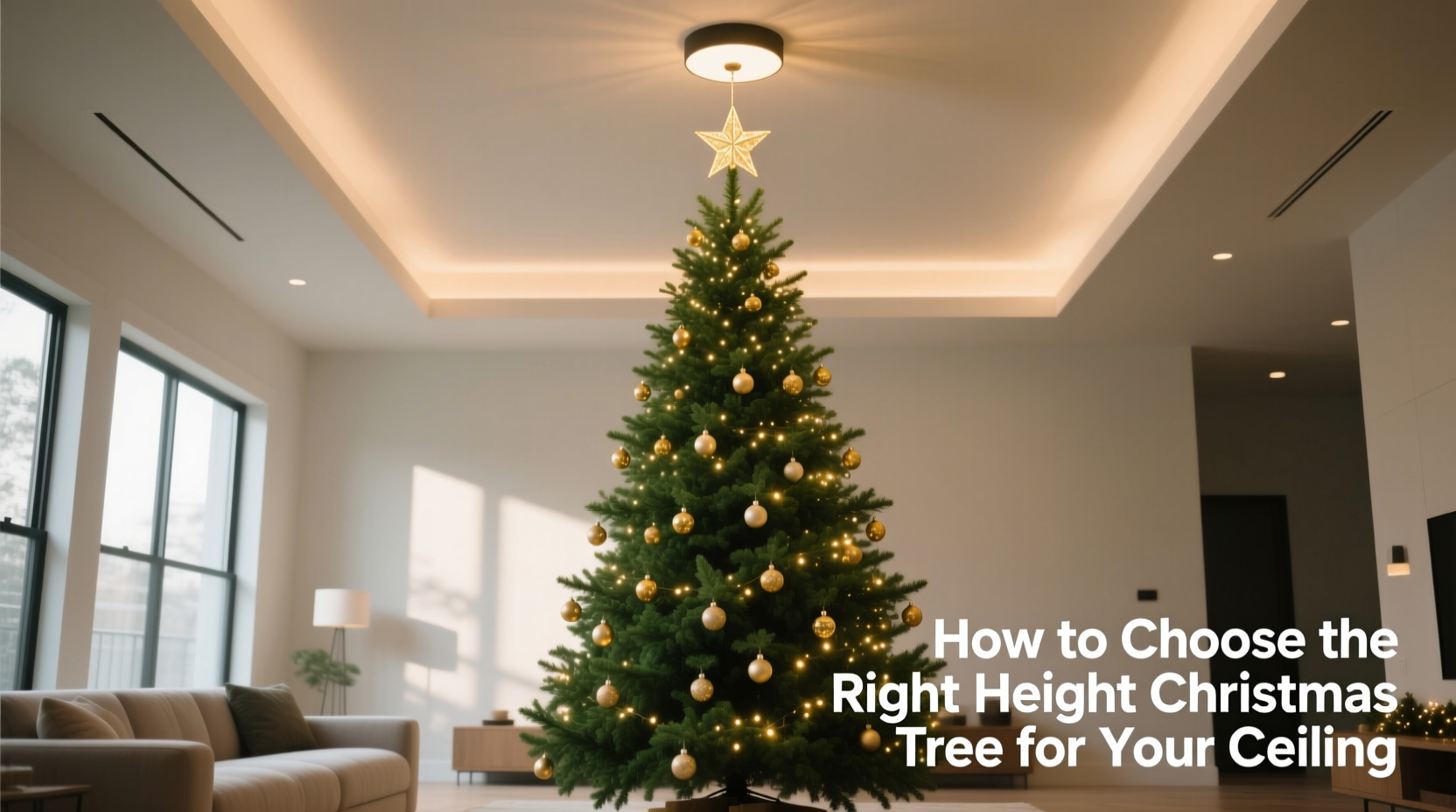
Begin not with the tree—but with your room. Use a laser distance measurer or a sturdy tape measure (a retractable 25-foot model works best). Measure from the floor to the ceiling at multiple points: corners and center. Ceilings aren’t always level—especially in older homes—and a ½-inch variance can mean the difference between clearance and contact. Record the *shortest* measurement.
Now subtract three non-negotiable allowances:
- Tree stand height: Most standard stands add 4–6 inches. Premium self-watering stands with reservoirs may add up to 8 inches. Measure yours—or assume 6 inches if uncertain.
- Tree topper clearance: Stars, angels, and finials extend 3–8 inches above the topmost branch. Even a modest 4-inch topper needs breathing room.
- Minimum safety buffer: Fire safety guidelines (NFPA 101 and UL 1081) recommend at least 3 inches between any combustible material (like pine needles) and heat sources—including recessed lighting, ceiling fans, or HVAC vents. If your ceiling has fixtures, increase this to 6 inches.
That final number—the ceiling height minus stand, topper, and buffer—is your absolute maximum tree height. Never round up. If your calculation yields 87.2 inches, your tree must be ≤87 inches. Trees are sold in half-foot increments (6', 6.5', 7'), so always round *down* to the nearest available size.
Step 2: Account for Real-World Tree Variability
A 7-foot tree tag doesn’t guarantee a 7-foot silhouette. Fresh-cut trees shrink as they dehydrate—typically ½ to 1 inch over 10 days. Pre-lit artificial trees often list “height” including the stand base, but the trunk itself may sit 3 inches *above* the floor plate. And let’s not forget taper: a full-bodied Fraser fir may appear taller than a slim-profile Nordmann due to branch density—even at identical heights.
This variability means relying solely on labeled dimensions is risky. Instead, use these field-tested benchmarks:
| Tree Type | Typical Height Tolerance | Key Consideration |
|---|---|---|
| Fresh Fraser Fir | −0.75″ after 7 days | Dense lower branches reduce perceived height; measure from tip of top leader—not highest branch. |
| Artificial PVC Tree (hinged) | +1.5″ when fully assembled | Branch tips spring outward during fluffing—add 1–2″ to listed height. |
| Artificial PE Tree (realistic) | ±0.25″ | Highly consistent; height matches label within ¼ inch if assembled per instructions. |
| Live Potted Tree (e.g., Balsam Fir) | −1.5″ to −2″ over season | Root ball adds 4–6″ to total base height; include this in stand calculation. |
For artificial trees, always consult the manufacturer’s “assembled height” spec—not the box dimensions. For live trees, ask the lot attendant to trim the base *before* measuring height. A freshly cut trunk compresses less and holds water more efficiently, minimizing early shrinkage.
Step 3: Match Tree Proportion to Room Scale
Height alone doesn’t determine harmony. A 9-foot tree may dominate a 10-foot ceiling—but feel dwarfed in a two-story great room with 18-foot ceilings. Proportion matters more than raw numbers. Interior designers use the “Golden Ratio of Holiday Scale”: ideal tree height should be 55–65% of your ceiling height. This creates visual rhythm without overwhelming vertical space.
Consider these real-world pairings:
- Standard 8-foot ceiling: 4.5'–5.5' tree (ideal: 5'). A 6' tree crowds the upper third and blocks sightlines across rooms.
- 10-foot ceiling (common in renovated homes): 5.5'–6.5' tree (ideal: 6'). Leaves 30–36 inches above treetop for ornaments, garlands, and air circulation.
- 12-foot+ cathedral ceiling: 7.5'–8.5' tree (ideal: 8'). Avoid going taller than 8.5' unless you have professional-grade ladder access for decorating—and fire department approval for ceiling proximity.
- Basement or low-clearance apartment (7.5' ceiling): 4'–4.5' tabletop or slim-profile tree only. Anything taller risks contact with sprinkler heads (which require 18\" minimum clearance per NFPA 13).
“The biggest mistake I see isn’t picking a tree that’s too tall—it’s ignoring the human factor. If you need a step stool to hang the star, you’ve already compromised safety and enjoyment.” — Marcus Bell, Certified Arborist & Holiday Safety Consultant, National Christmas Tree Association
Step 4: The Practical Setup Checklist
Before you commit to a tree, run through this field-proven checklist. It accounts for overlooked constraints that derail even well-measured plans:
- ✅ Doorway clearance: Measure height *and width* of all entry paths—including garage doors, front doors, and stairwell landings. Add 2 inches to tree height for safe maneuvering.
- ✅ Floor-to-ceiling obstructions: Note chandeliers, ceiling fans, wall-mounted TVs, or HVAC registers within 4 feet of intended tree location. Their lowest point dictates your effective ceiling height.
- ✅ Stand compatibility: Verify the tree trunk diameter fits your stand’s clamp range. A 5\" trunk won’t seat securely in a stand rated for 1\"–4\". Gaps cause instability—and leaning trees lose 2–3 inches of effective height.
- ✅ Electrical access: Count outlets within 6 feet of the base. Pre-lit trees require grounded outlets; extension cords add trip hazards and reduce usable height if routed overhead.
- ✅ Footprint allowance: Allow 18–24 inches of open floor space around the base for vacuuming, pet access, and guest flow. A cramped tree feels larger than it is.
If any item fails, adjust your target height *before* purchase. It’s far easier to downsize by 6 inches than to return a tree after transport and setup.
Mini Case Study: The Two-Story Foyer Dilemma
Sarah K., a homeowner in Portland, OR, purchased an 8.5-foot artificial tree for her two-story foyer—measured at 17.5 feet from floor to ceiling. She assumed a tree at half the ceiling height would look balanced. But she didn’t account for the wrought-iron chandelier suspended 10 feet above the floor, directly above the planned tree site. When assembled, the tree’s top branches brushed the chandelier’s lowest crystal tier. Worse, the 6-inch stand raised the base higher than expected, reducing clearance from the marble floor to the first branch—a tripping hazard for her toddler.
Sarah solved it in 48 hours: she swapped to a 7-foot tree with a low-profile 3-inch stand, added a 3-inch velvet tree collar to visually extend the base, and repositioned the chandelier chain to raise it 4 inches. The result? A tree that now occupies the ideal vertical zone—filling the lower two-thirds of the space while leaving 42 inches of airy volume above the topper. More importantly, her son walks safely beneath it, and the chandelier glints unobstructed through the branches.
Her lesson: ceiling height is only the starting point. Contextual elements—fixtures, furniture, traffic patterns, and family needs—define true usability.
FAQ: Common Height Questions—Answered Precisely
Can I trim the top of a fresh tree to fit my ceiling?
Yes—but only as a last resort, and never more than 1.5 inches. Cutting the leader (central trunk tip) disrupts apical dominance, causing lateral branches to grow upward unevenly and creating a “flat-topped” appearance. It also reduces water uptake in that section, accelerating needle drop. Instead, trim ½ inch off the base *and* use a shorter stand. Better yet: choose a tree 1–2 inches shorter and elevate visual impact with a taller tree skirt or stacked gift boxes at the base.
Do artificial trees sag over time, affecting height?
Quality PE and PVC trees show negligible sag over a single season—if assembled correctly. However, poor storage (folded tightly, exposed to attic heat >90°F) weakens branch hinges. After 3+ years, some models may lose 0.5–1 inch in peak height due to hinge fatigue. To preserve height: store upright in a ventilated tree bag, never compress branches, and avoid stacking heavy items on top.
What’s the safest minimum distance between a tree and a ceiling fan?
The U.S. Consumer Product Safety Commission recommends a minimum of 36 inches between the highest ornament and any moving ceiling fan blade. Why? Fan downdraft accelerates drying, and rotating blades can dislodge ornaments or snag tinsel. In practice, this means your tree height must be at least 3 feet *shorter* than the fan’s lowest point—not the ceiling. Measure from floor to fan blade tip, then subtract 36 inches.
Conclusion: Confidence Starts With Centimeters
Choosing the right Christmas tree height isn’t about compromise—it’s about intentionality. It’s the quiet satisfaction of stepping back and seeing symmetry, not strain. It’s knowing your lights won’t flicker when the fan kicks on, your star won’t graze the smoke detector, and your family won’t duck when walking past the living room. That precision comes from disciplined measurement, respect for material behavior, and honest assessment of your space’s true constraints—not just its listed dimensions.
You don’t need special tools or expertise. You need a tape measure, 12 minutes, and the willingness to treat this decision like the design choice it is. Measure your ceiling. Subtract stand, topper, and buffer. Cross-check against room proportion and real-world obstacles. Then choose—not guess—with certainty.




 浙公网安备
33010002000092号
浙公网安备
33010002000092号 浙B2-20120091-4
Comments
No comments yet. Why don't you start the discussion?