
Selecting the perfect foundation isn’t just about matching your skin’s surface color—it’s about understanding the underlying tone that influences how shades appear once applied. Many people struggle with foundations that look ashy, too orange, or simply “off,” even when the depth seems correct. The culprit? An incorrect match to their undertone: warm, cool, or neutral. Getting this right transforms your makeup from noticeable to seamless, enhancing your natural complexion rather than masking it. This guide breaks down how to identify your undertone, test foundation accurately, and select a formula that harmonizes with your skin year-round.
Understanding Skin Undertones: The Foundation of a Perfect Match
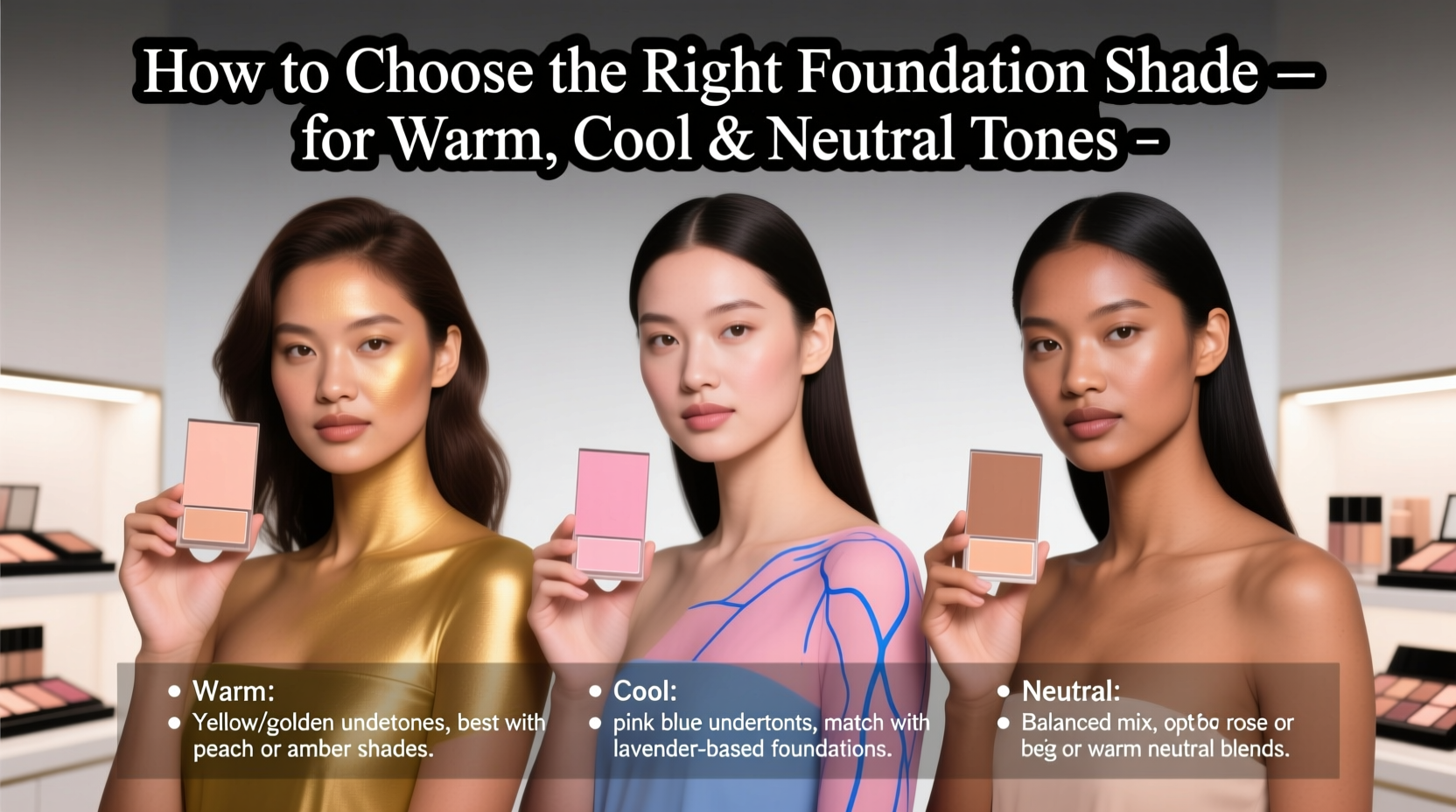
Your skin’s undertone is the subtle hue beneath the surface—distinct from your skin’s visible color (called “overtone” or “depth”). While depth can change with sun exposure, your undertone remains consistent. There are three primary categories:
- Warm: Yellow, golden, or olive undertones. Skin often tans easily and may have a peachy or honey-like cast.
- Cool: Pink, red, or blue-based undertones. Skin may burn before tanning and show rosy or bluish hues in veins.
- Neutral: A balance between warm and cool, or an undertone that shifts depending on lighting or season.
Misidentifying your undertone leads to mismatched foundation. A warm-toned person wearing a cool foundation may look sallow; someone with cool undertones using a warm foundation might appear unnaturally orange.
How to Determine Your Undertone: Practical Methods
Several reliable techniques can help you pinpoint your undertone without guesswork. Use more than one method for accuracy, as lighting and external factors can skew results.
The Vein Test
Look at the veins on the inside of your wrist under natural light:
- If they appear greenish, you likely have warm undertones.
- If they look blue or purple, you probably have cool undertones.
- If it's hard to tell—green-blue or neutral gray—you may have a neutral undertone.
The Jewelry Test
Observe which metal complements your skin best:
- Gold enhances your glow? You’re likely warm-toned.
- Silver flatters you more? Cool undertones are probable.
- Both look good? You may have a neutral base.
The White Paper Test
Hold a plain white sheet of paper next to your face in daylight. Compare how your skin looks against the stark white:
- If your skin appears yellow or golden, you’re warm.
- If it looks pink or rosy, you’re cool.
- If there’s no strong contrast, you could be neutral.
The Sun Reaction Test
Consider how your skin behaves in the sun:
- Burns easily, tans minimally → Cool.
- Tans quickly, rarely burns → Warm.
- Varies by season or situation → Possibly neutral.
“Undertone is the invisible blueprint of your complexion. Matching it correctly ensures your foundation disappears into your skin.” — Lena Torres, Celebrity Makeup Artist
Step-by-Step Guide to Choosing the Right Foundation Shade
Once you’ve identified your undertone, follow this structured approach to find your ideal foundation match.
- Identify your undertone using the methods above. Write it down: warm, cool, or neutral.
- Determine your depth—light, medium, tan, deep—by comparing your jawline to others in natural light.
- Research brands with diverse ranges. Look for labels that specify undertones (e.g., “N” for neutral, “W” for warm, “C” for cool).
- Test in natural light. Swatch two to three potential matches along your jawline—not your hand or wrist.
- Wait five minutes. Foundations oxidize and may darken slightly upon drying. Reassess after setting.
- Check indoor and outdoor lighting. A shade that looks right indoors may cast poorly outside.
- Evaluate blending. The right shade should disappear into your neck and chest without a visible line.
- Reassess seasonally. Your depth may shift with sun exposure; keep a summer and winter shade if needed.
Foundation Shade Matching: Do’s and Don’ts
| Do’s | Don’ts |
|---|---|
| Swatch on your jawline in natural light | Test on your hand or forearm |
| Choose brands that label undertones clearly | Assume all “medium beige” shades are the same across brands |
| Buy samples before committing to a full bottle | Purchase online without swatching first |
| Blend the swatch gently into the skin | Rub too hard, which can irritate skin and distort color |
| Reevaluate your match every 6–12 months | Stick with the same shade year-round regardless of sun exposure |
Real Example: Sarah’s Foundation Journey
Sarah, a 32-year-old office worker with medium-depth skin, had long struggled with her foundation looking “dirty” by midday. She favored a popular brand’s “Medium Beige,” but friends often commented she looked orange in photos. After learning about undertones, she revisited her jewelry preference—she always wore silver and felt washed out in gold. Her veins appeared blue, and in sunlight, her skin burned before tanning. These signs pointed to a cool undertone.
She switched to a “Cool Medium” shade in a different brand and tested it outdoors. The new foundation blended seamlessly, eliminating the orange cast. For the first time, her makeup looked natural in both artificial and daylight. Sarah now keeps two shades: a cooler one for winter and a slightly warmer, deeper option for summer when her skin tans lightly.
Choosing Foundation for Neutral Undertones
People with neutral undertones often find themselves between warm and cool categories. Some brands offer “neutral” or “olive” lines specifically for this group. However, not all neutrals are the same—some lean slightly warm (neutral-warm), others slightly cool (neutral-cool).
To refine your match:
- Use the vein and jewelry tests to detect a subtle lean.
- Try swatches labeled “NW” (neutral warm) or “NC” (neutral cool).
- Opt for buildable, sheer-to-medium coverage formulas that allow layering without heaviness.
Olive skin, often mistaken for neutral, typically has greenish undertones and requires specialized shades. If you have olive skin, look for foundations marked “O” or “olive”—these prevent the ashy or yellow-orange mismatches common in standard warm/cool systems.
Frequently Asked Questions
Can my undertone change over time?
No, your undertone is genetically determined and remains constant. However, factors like aging, hormonal shifts, or skin conditions (like rosacea or hyperpigmentation) can temporarily alter your skin’s appearance. Always assess undertone on clear, healthy skin.
Why does my foundation look different in photos?
Flash photography and certain lighting (especially fluorescent or LED) can emphasize warm or cool casts. A foundation that looks balanced in person may appear too yellow or pink in images. To avoid this, test under multiple light sources and choose a shade that performs well across environments.
Should I buy a darker shade for summer?
Only if your skin actually deepens. Instead of guessing, let your skin tan naturally, then retest foundation shades. Many find success with adjusting depth while keeping the same undertone. Alternatively, use a tinted moisturizer or bronzer over your regular foundation to simulate a sun-kissed look without changing your base.
Expert Tips for Long-Term Foundation Success
Even the best-matched foundation can fail if not maintained properly. Consider these final insights:
- Keep a swatch card: Save the packaging or tape a swatch to your mirror to simplify future purchases.
- Track seasonal shifts: Note when you start needing a different depth and plan to reassess accordingly.
- Use color correctors wisely: Green corrects redness (common in cool tones), peach counters darkness (helpful for deeper warm tones), and lavender brightens dullness. But don’t rely on them to fix a wrong foundation—use only for targeted correction.
- Invest in quality lighting: A daylight vanity mirror helps ensure accurate application and assessment.
“The best foundation doesn’t cover your skin—it becomes your skin. That only happens when undertone and depth align perfectly.” — Marcus Lee, Editorial Makeup Director
Final Checklist: Foundation Shade Selection
Before purchasing, go through this checklist to ensure confidence in your choice:
- ✅ I know my undertone: warm, cool, or neutral.
- ✅ I’ve tested the shade on my jawline in natural light.
- ✅ The foundation blends seamlessly into my neck and chest.
- ✅ I’ve waited 5 minutes to check for oxidation.
- ✅ The shade looks good both indoors and outdoors.
- ✅ I’ve considered seasonal variations in my skin tone.
- ✅ I’m buying from a brand with clear undertone labeling.
- ✅ I’ve tried a sample before committing to a full-size product.
Conclusion: Make Your Foundation Work for You
Choosing the right foundation shade isn’t a one-time decision—it’s an ongoing process of observation, testing, and refinement. By understanding your warm, cool, or neutral undertone and applying a systematic approach to selection, you eliminate guesswork and achieve a flawless, natural finish every time. Don’t settle for “close enough.” With the right knowledge, tools, and attention to detail, your foundation can enhance your features, boost your confidence, and become an effortless part of your daily routine.




 浙公网安备
33010002000092号
浙公网安备
33010002000092号 浙B2-20120091-4
Comments
No comments yet. Why don't you start the discussion?