
In open concept homes, where the kitchen, dining, and living areas flow seamlessly into one another, defining individual zones without walls becomes essential. Area rugs are one of the most effective tools for creating visual separation, adding warmth, and anchoring furniture groupings. However, choosing the right size rug in these expansive layouts is more complex than simply measuring floor space. Too small, and the rug looks like a lonely island; too large, and it overwhelms the room or disrupts traffic flow. The key lies in understanding spatial relationships, furniture placement, and proportion.
A well-chosen rug can unify a multi-functional space while enhancing comfort and style. But getting the size wrong can throw off the entire balance of your interior design. This guide breaks down the principles of rug sizing for open concept environments, offering actionable advice, real-world examples, and expert insights to help you make a confident decision.
Understand the Role of Rugs in Open Concept Design
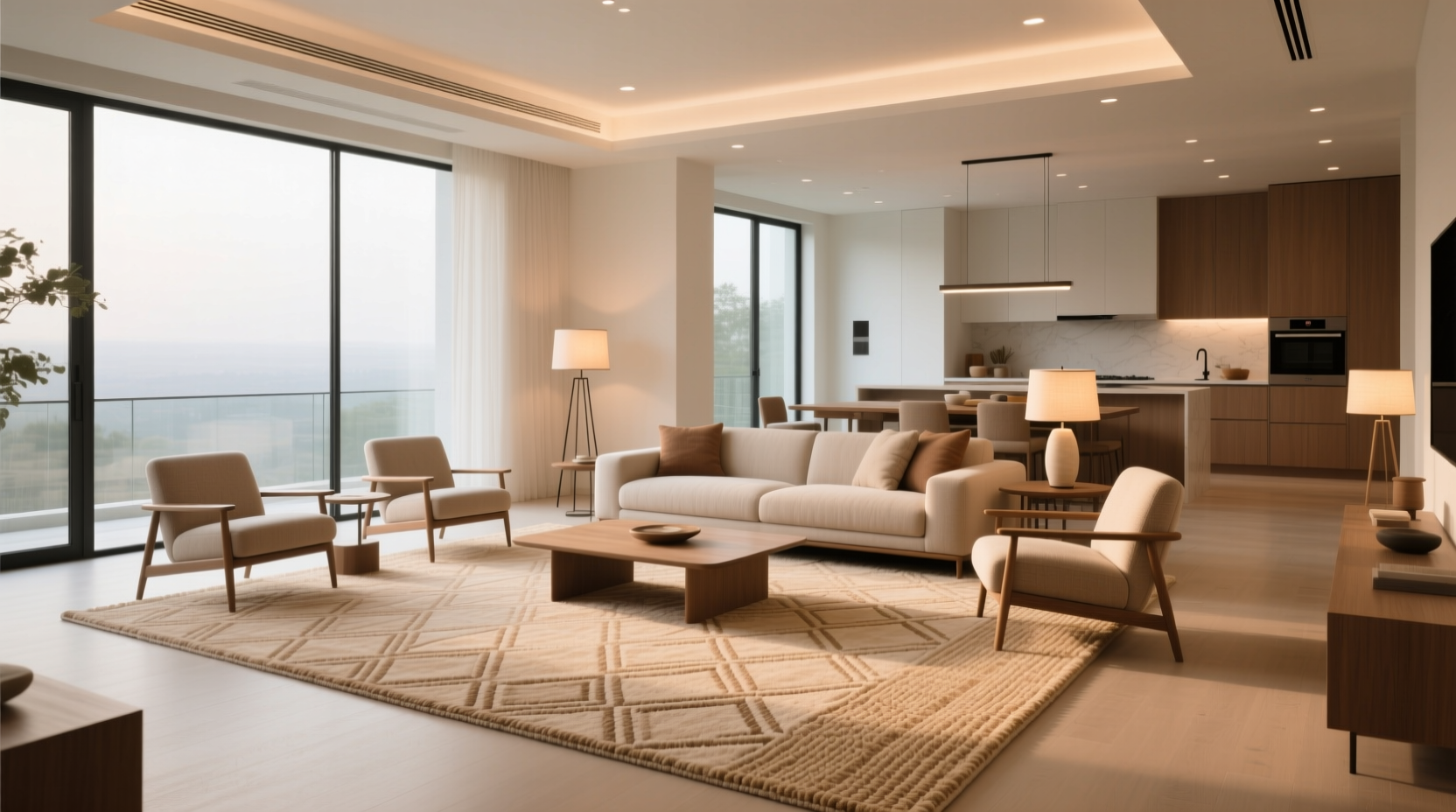
In traditional homes with defined rooms, rugs often serve decorative or textural purposes. In open floor plans, their function expands significantly. They act as visual boundaries that subtly separate living, dining, and kitchen areas without physical barriers. A strategically placed rug grounds a seating arrangement, absorbs sound, adds texture underfoot, and ties together color schemes across zones.
The challenge arises because open spaces lack natural edges. Without walls to dictate dimensions, many homeowners default to standard rug sizes—8x10 or 9x12—only to find they don’t align with their furniture layout. The solution isn't about fitting a pre-made size but about tailoring the rug to the function and footprint of each zone.
Interior designers emphasize that the rug should support the furniture, not the other way around. As Sarah Thompson, an award-winning residential designer based in Portland, explains:
“Rugs in open concept spaces aren’t just floor coverings—they’re spatial architects. They define where conversation happens, where meals are shared, and where relaxation begins.” — Sarah Thompson, Interior Designer & Author of *Flow: Designing Connected Living Spaces*
Measure Your Zones, Not Just the Room
Before selecting a rug, map out the functional zones within your open space. Common configurations include:
- Living area (sofa, chairs, coffee table)
- Dining area (table and chairs)
- Kitchen nook or breakfast bar
- Reading or work corner
Each zone has different spatial requirements. Start by measuring the footprint of the furniture in each area. For the living zone, measure the full width and depth of your sofa grouping. For dining, account for chair clearance—when chairs are pulled out, they should still rest on the rug.
Once you’ve mapped each zone, consider how much space should remain between them. A minimum of 30 inches between furniture groups ensures comfortable foot traffic. If your total open area measures 20 feet by 15 feet, and your living zone takes up 12x10 feet, your rug must fit within those constraints while leaving breathing room.
Rug Sizing Guidelines by Zone
Different areas require different rug rules. Applying universal standards prevents mismatched proportions.
Living Area Rug Rules
The living zone is typically the largest and most trafficked. To anchor it properly:
- All furniture legs should sit on the rug whenever possible.
- If the rug is too large for the space, ensure at least the front legs of sofas and chairs are on the rug.
- The rug should extend at least 12–18 inches beyond the sofa on all sides.
For example, if your sofa is 8 feet wide, the rug should be at least 9.5 to 10 feet wide to allow for overhang. A common mistake is using a 5x8 rug under an 8-foot sofa—this creates a floating effect that undermines cohesion.
Dining Area Rug Rules
The dining zone demands precision. When chairs are pulled out, their legs should remain on the rug to prevent tripping and maintain visual continuity.
- The rug should extend at least 24 inches beyond the table on all sides.
- For a 42-inch round table, choose a rug at least 84 inches in diameter.
- Avoid rectangular rugs narrower than the table length.
This buffer ensures seated guests have room to move without stepping off the edge.
Multi-Zone Considerations
In some open layouts, homeowners use a single large rug to unify multiple zones. This works best when:
- Zones are closely integrated (e.g., kitchen island adjacent to dining).
- Furniture styles and colors are cohesive.
- Traffic paths are clearly defined around, not through, the rug.
However, overlapping functions—like placing a dining table partially on a living area rug—can create confusion. In such cases, separate rugs with complementary patterns or textures may be more effective.
Step-by-Step Guide to Choosing the Right Size
Follow this sequence to determine the ideal rug size for your open concept space:
- Sketch your floor plan. Draw the layout of your open area, including walls, doorways, and fixed elements like islands or columns.
- Define functional zones. Label areas for living, dining, cooking, and any secondary uses (e.g., workspace).
- Measure furniture groupings. Record the outer dimensions of each seating or dining arrangement.
- Determine rug placement. Decide whether to use one large rug or multiple smaller ones. Prioritize zones that need anchoring.
- Add overhang allowances. For living areas, add 18 inches on each side of the sofa. For dining, add 24 inches beyond the table.
- Check traffic flow. Ensure at least 30 inches of bare floor between zones and along main walkways.
- Select size and shape. Match the rug shape to the furniture layout—rectangular for linear arrangements, round for compact spaces.
- Verify availability. Standard sizes include 8x10, 9x12, 10x14, and 8’ round. Custom options exist but cost more.
Do’s and Don’ts: Rug Sizing Comparison
| Scenario | Do | Don’t |
|---|---|---|
| Living area with large sectional | Use a 9x12 or 10x14 rug so all legs sit on fabric | Use a 5x8 rug that only covers the front legs |
| Dining table for six | Choose a rug at least 24” wider than the table on all sides | Place a narrow runner that only fits under the table |
| Open kitchen-living transition | Leave a clear path or use a small accent rug near the island | Run a large rug from stove to sofa, blocking movement |
| Multiple zones close together | Use coordinating rugs with similar tones or patterns | Mix clashing styles that compete visually |
| Low ceiling height | Opt for lighter-colored rugs to avoid heaviness | Use dark, oversized rugs that make space feel smaller |
Real Example: Transforming a 22x18-Foot Open Layout
Consider a modern townhouse with a 22-foot by 18-foot open space combining living, dining, and kitchen areas. The homeowner initially placed an 8x10 rug under the sofa, leaving the dining table on bare hardwood. The result felt disjointed—the living area looked isolated, and chairs scraped the floor when pulled out.
After consulting a designer, they replaced the single rug with two coordinated pieces:
- A 9x12 rug under the entire living set (sectional and ottoman), with all legs fully supported.
- A 9x9 square rug under the dining table (48” x 96”), allowing 24 inches of overhang on the shorter sides and 18 on the longer—just enough for chairs to stay on fabric.
The rugs were in neutral tones with subtle geometric patterns, linking the zones without overwhelming them. A 36-inch gap between the two rugs preserved easy movement. The transformation created distinct yet harmonious areas, improving both aesthetics and functionality.
Expert Insight: Proportion Over Perfection
While guidelines are helpful, flexibility matters. Maria Chen, principal at Studio Lumen Interiors, advises clients to prioritize proportion over rigid rules:
“It’s better to have a slightly imperfect fit with great material and color than a ‘perfectly sized’ rug that clashes with the room’s energy. Texture, pile height, and hue influence perception more than a few extra inches.” — Maria Chen, Interior Architect & Sustainable Design Advocate
She also notes that high-pile rugs appear larger due to their soft edges, while flatweaves feel more precise and contained. This optical effect should inform size choices, especially in tight spaces.
FAQ: Common Questions About Rug Sizing
Can I use two different rugs in an open concept space?
Yes, and often it’s the best solution. Using two rugs—one for living and one for dining—helps define zones clearly. Choose rugs with matching base colors or complementary patterns to maintain cohesion. Avoid contrasting shapes (e.g., round under dining, rectangular under living) unless intentionally designed for contrast.
What if my ideal rug size isn’t available?
Standard sizes cover most needs, but custom rugs are worth considering for irregular layouts. Alternatively, layer rugs—a large neutral base with a smaller patterned top—can mimic a custom size. Another option is to adjust furniture placement to fit a standard dimension, such as shifting a sofa closer to create compatibility with a 9x12 rug.
Should the rug go under all furniture legs?
In formal or dedicated rooms, yes. In open concept spaces, it depends. For living areas, aim to have all legs on the rug. If space is limited, at least the front legs should rest on it. For dining, all chair legs must stay on the rug when pulled out. In transitional zones, partial coverage is acceptable as long as it doesn’t create a tripping hazard.
Final Checklist Before You Buy
Before purchasing, verify the following:
- ✅ Measured the full footprint of your furniture grouping
- ✅ Added 18–24 inches of overhang for living and dining zones
- ✅ Confirmed 30+ inches of clearance between zones for walking
- ✅ Tested layout with painter’s tape on the floor
- ✅ Selected a shape that matches your furniture arrangement
- ✅ Checked for door swing clearance (rug shouldn’t block entryways)
- ✅ Ensured rug material suits traffic level (e.g., wool blend for durability)
Conclusion: Anchor Your Space with Confidence
Choosing the right size area rug for an open concept living space is less about exact measurements and more about intentionality. It’s about creating harmony between form and function, ensuring each zone feels grounded and purposeful. By measuring thoughtfully, respecting traffic flow, and aligning rug size with furniture scale, you transform an expansive, potentially chaotic space into a cohesive, inviting home.
The perfect rug doesn’t just cover the floor—it completes the room. Take the time to plan, test, and refine your choice. Whether you opt for one unifying piece or multiple coordinated rugs, the result will be a space that feels intentional, warm, and uniquely yours.




 浙公网安备
33010002000092号
浙公网安备
33010002000092号 浙B2-20120091-4
Comments
No comments yet. Why don't you start the discussion?