
Selecting the right harness for a puppy isn’t just about comfort—it’s about safety, proper development, and long-term usability. Puppies grow at unpredictable rates, and their bodies change dramatically in just a few months. Choosing a harness that fits now but won’t need replacing in three weeks requires foresight, accurate measurement, and understanding of growth patterns. Too tight, and the harness restricts movement or causes chafing; too loose, and your puppy risks slipping out during walks. The frustration of frequent returns due to ill-fitting gear is common among new pet owners. But with the right approach, you can minimize replacements and ensure your puppy stays secure, comfortable, and supported through every stage of growth.
Understanding Puppy Growth Patterns
Puppies don’t grow at a uniform rate. Small breeds like Chihuahuas or Shih Tzus may reach near-adult size by six months, while large breeds such as Labradors or German Shepherds continue developing well into their second year. This variability means a one-size-fits-all approach doesn’t work—especially when it comes to fitted gear like harnesses.
Growth typically follows a predictable curve: rapid expansion in the first 3–5 months, followed by slower, more structural development. During peak growth, a puppy can gain several pounds in a month. Their chest girth—the key measurement for harness fit—can increase by over an inch in just four weeks. This makes choosing a harness with room to grow essential, but not so much that it compromises safety.
It’s also important to recognize that different breeds develop at different paces. Toy breeds mature faster, while giant breeds grow steadily and require longer support. Understanding your puppy’s expected adult size helps anticipate how quickly they’ll outgrow gear.
Key Measurements for Harness Fit
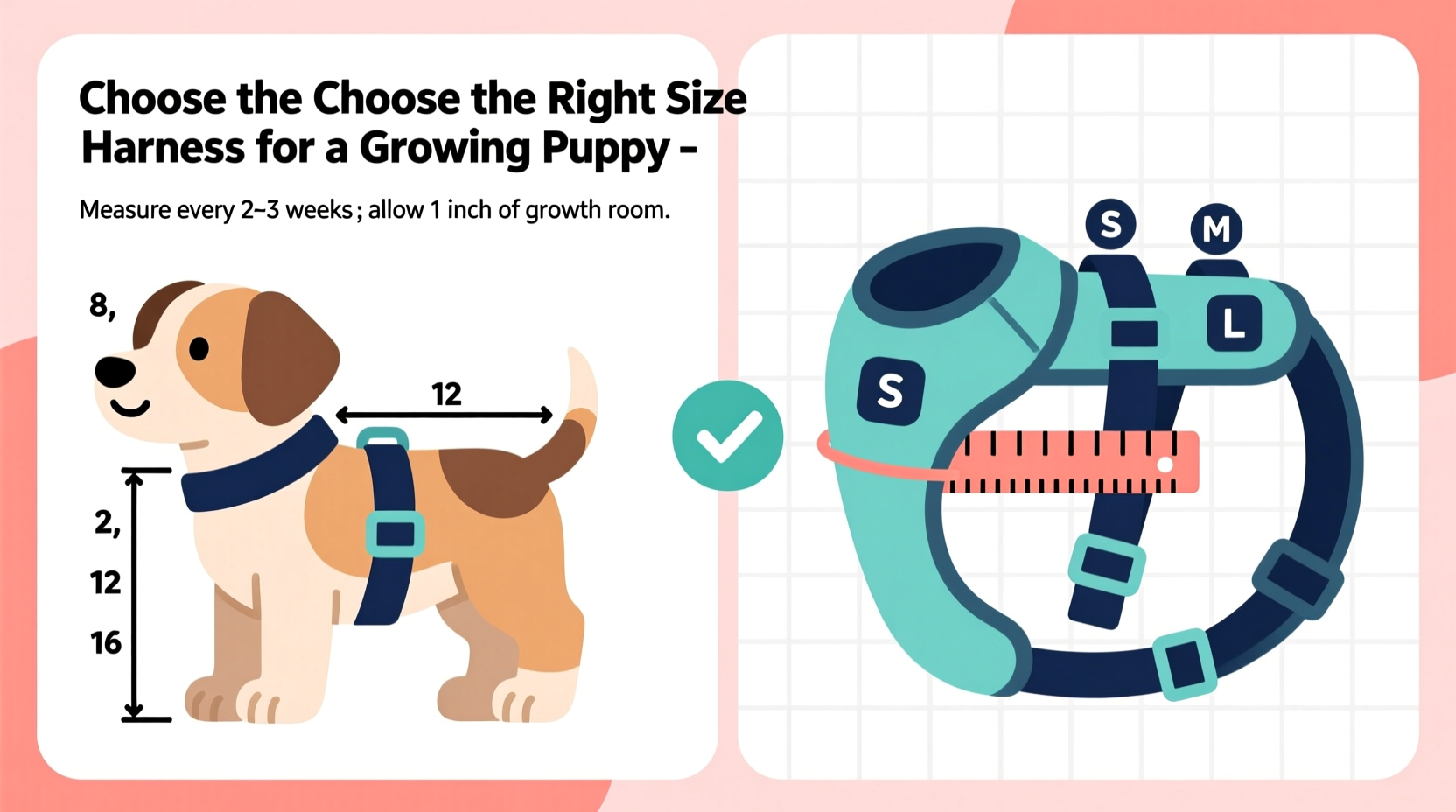
The most critical factor in selecting a harness is accurate measurement. Unlike collars, which primarily fit around the neck, harnesses distribute pressure across the chest, shoulders, and torso. A poorly measured harness can cause discomfort, reduce control, or even lead to injury.
Focus on three primary measurements:
- Neck girth: Measure just behind the ears, where the neck meets the shoulders. This ensures the harness opening isn’t too tight when putting it on.
- Chest girth: Wrap the tape around the widest part of the chest, just behind the front legs. This is the most crucial dimension, as it determines how snugly the harness fits around the body.
- Length from base of neck to shoulder blades: Helps determine if the harness will sit correctly and not ride up or slide forward.
Always measure with a soft cloth tape measure, and allow no more than two fingers’ width between the tape and the puppy’s body. Avoid guessing based on weight alone—two puppies of the same weight can have vastly different builds.
Once you have these numbers, compare them to the manufacturer’s size chart. Pay close attention to the “adjustable range” listed for each size. A harness labeled “medium” might fit chests from 14 to 18 inches, making it ideal for a puppy currently at 15 inches but growing toward 17.
Choosing Adjustable and Growth-Friendly Designs
The best strategy for avoiding constant returns is selecting a harness designed for growth. Not all harnesses are created equal—some offer minimal adjustability, while others feature multiple adjustment points and expandable panels.
Look for models with:
- Front and back adjustment straps
- Expandable side panels or stretch zones
- Four-point adjustment (neck, chest, both sides)
- Quick-release buckles that maintain tension after resizing
Ribbed or elastic sections in high-movement areas can accommodate subtle changes without requiring full readjustment. Some premium harnesses even include removable inserts or modular padding to customize fit as the puppy grows.
Avoid rigid or fixed-design harnesses, especially those made from stiff nylon or non-stretch materials. While durable, they offer little flexibility and often become obsolete within weeks on a fast-growing pup.
| Feature | Recommended for Growing Puppies | Not Recommended |
|---|---|---|
| Adjustable chest strap | Yes – allows incremental tightening | No – fixed circumference |
| Elastic side panels | Yes – accommodates quick growth spurts | No – inflexible structure |
| Multiple sizing holes | Yes – fine-tuned adjustments | No – only 1–2 adjustment points |
| Neck opening adjustability | Yes – adapts to neck thickening | No – static collar ring |
Step-by-Step Guide: Selecting the Right Harness Size
Follow this practical timeline to choose a harness that lasts through your puppy’s growth phases:
- Week 1: Measure accurately – Use a soft tape to record neck, chest, and back length. Repeat measurements weekly for the first month to track growth speed.
- Week 2: Research breed growth data – Consult veterinary resources or breeder insights to estimate adult weight and growth milestones.
- Week 3: Choose a harness with a 2–3 inch growth buffer – If your puppy’s chest is 15 inches, select a model adjustable up to 18 inches.
- Week 4: Prioritize adjustability over aesthetics – Focus on functional design rather than color or branding. Look for brands known for developmental fit, like PetSafe, Kurgo, or Rabbitgoo.
- Ongoing: Monitor fit monthly – Check that you can still fit two fingers under all straps. Watch for rubbing, slipping, or restricted movement.
This proactive process reduces guesswork and prevents premature purchases. By planning for growth, you invest once in a quality harness that evolves with your puppy.
“Choosing a harness isn’t just about current size—it’s about anticipating change. The best harnesses grow with the dog, not against it.” — Dr. Lena Torres, DVM, Canine Development Specialist
Real-World Example: Max the Labrador Retriever
When Sarah adopted Max, a male Labrador puppy, he weighed 12 pounds at eight weeks old. Excited to start walks, she bought a small harness based on his current size. Within five weeks, Max had grown to 28 pounds, and the harness was too tight across the chest, causing redness behind his front legs.
After returning the original harness, Sarah consulted her vet and researched growth charts. She learned that Labs typically reach 65–80 pounds and experience rapid chest development between 8 and 20 weeks. She then purchased an adjustable medium harness with a chest range of 16–22 inches. At the time, Max’s chest measured 17 inches—well within range.
The new harness featured side elastic panels and dual chest straps. Over the next four months, Sarah adjusted the fit weekly. The harness lasted until Max was ten months old, saving her three unnecessary purchases and reducing stress during training walks.
Her key takeaway: “Buying slightly bigger with room to grow worked far better than buying ‘perfect fit now’ gear that became useless in weeks.”
Common Mistakes to Avoid
Even well-intentioned owners make errors when sizing puppy harnesses. These missteps lead to discomfort, safety issues, and repeated spending.
- Guessing instead of measuring: Relying on age or weight alone ignores individual variation.
- Ignoring adjustability specs: Not all “adjustable” harnesses offer meaningful range. Always check exact dimensions.
- Prioritizing fashion over function: Decorative harnesses often sacrifice adjustability for appearance.
- Waiting until it’s too tight: Delaying adjustments can lead to skin irritation or behavioral resistance to wearing the harness.
- Assuming one brand fits all sizes the same: Sizing varies significantly between manufacturers. A medium in Brand A may be smaller than a small in Brand B.
Frequently Asked Questions
How do I know if the harness is too big?
If you can fit more than two fingers under the chest strap—or if the harness slips over the puppy’s head or shoulders—it’s too loose. A properly fitting harness should stay securely in place without restricting breathing or movement.
Can I use a harness that’s slightly too big with tighter adjustments?
Only if the harness is designed for downsizing. Some models allow tightening beyond the lower end of their range. However, if the neck opening remains overly wide, your puppy could back out. Always test fit in a safe, enclosed area before outdoor use.
When should I replace the harness?
Replace it when adjustments are maxed out and the chest strap can no longer tighten sufficiently. Also replace it if there’s visible wear, fraying, or if your puppy shows signs of discomfort, such as reluctance to walk or scratching at the harness.
Final Checklist Before Buying
Before finalizing your purchase, run through this checklist to ensure long-term usability:
- ✅ Accurate chest, neck, and back measurements taken
- ✅ Breed-specific growth pattern understood
- ✅ Harness has at least 2–3 inches of growth room in chest girth
- ✅ Multiple adjustment points (not just one strap)
- ✅ Manufacturer provides detailed size chart with ranges
- ✅ Return policy is clear in case fit isn’t right
- ✅ Material is durable yet flexible (e.g., neoprene-lined nylon)
Conclusion
Choosing the right harness for a growing puppy doesn’t have to mean endless returns or wasted money. With careful measurement, an understanding of developmental timelines, and a focus on adjustable, high-quality designs, you can select a harness that supports your puppy from their first steps to adolescence. Smart selection today leads to safer walks, better training experiences, and fewer trips back to the store. Invest time upfront to get the fit right—not just for now, but for the months ahead.




 浙公网安备
33010002000092号
浙公网安备
33010002000092号 浙B2-20120091-4
Comments
No comments yet. Why don't you start the discussion?