
Transforming your bedroom into a personal home theater is one of the most rewarding upgrades you can make for entertainment and relaxation. A projector offers a cinematic experience that flat-screen TVs simply can’t match—especially in a compact space like a bedroom. But the key to an immersive, comfortable viewing experience lies not just in the projector itself, but in selecting the right size projector screen. Too large, and the image overwhelms the room; too small, and you lose the impact of the big-screen effect. Getting this balance right requires understanding several interrelated factors: room dimensions, viewing distance, projector specifications, aspect ratio, and ambient lighting. This guide walks through each element with precision so you can confidently choose the ideal screen size for your bedroom setup.
Understand Viewing Distance and Screen Size Relationship
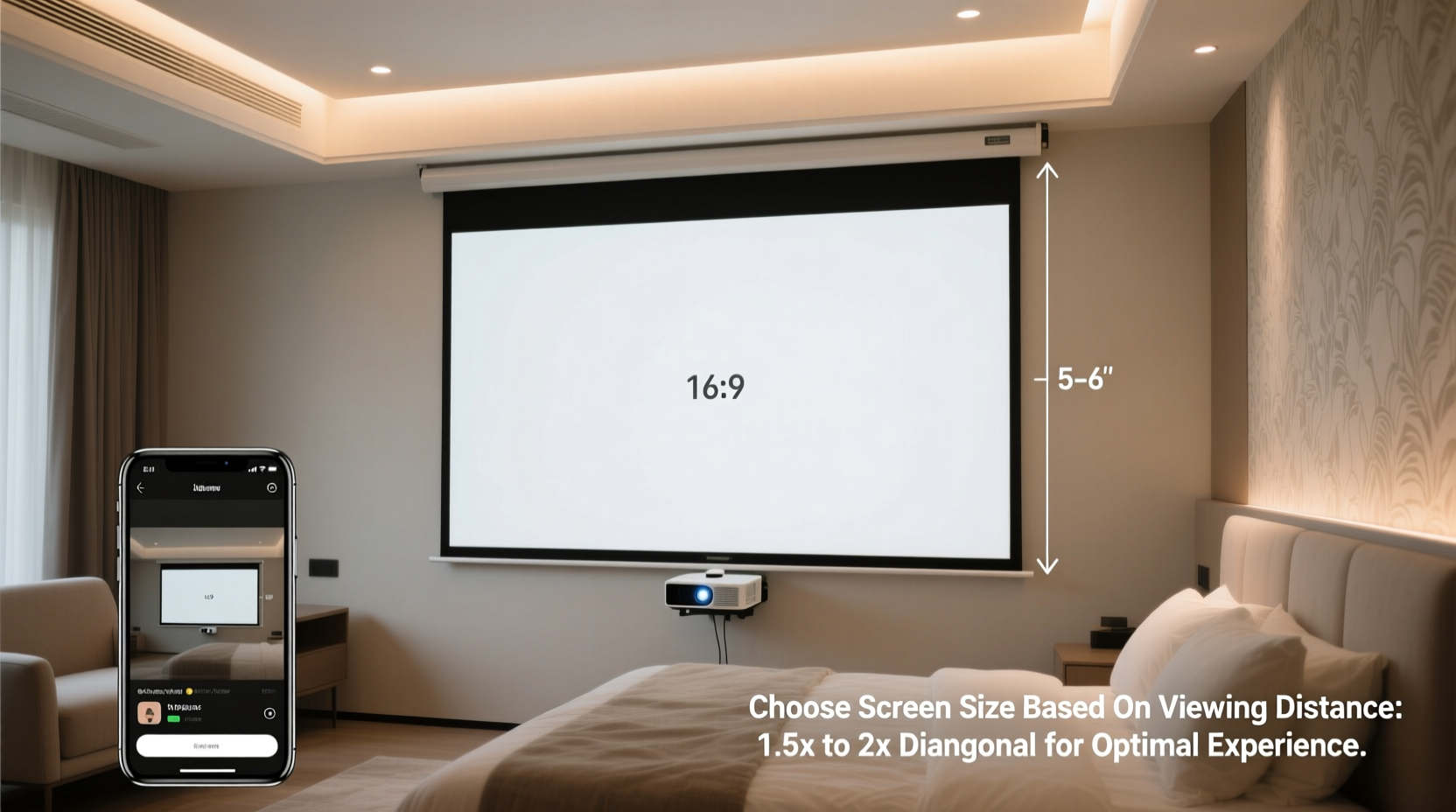
The distance between your bed or seating area and the projector screen plays a crucial role in determining the optimal screen size. If you're sitting too close to a large screen, the image will feel overwhelming and may cause eye strain. Conversely, if you're too far from a small screen, details become hard to discern, diminishing the immersive effect.
A widely accepted standard in home theater design is the Society of Motion Picture and Television Engineers (SMPTE) recommendation: the screen should occupy about 30 degrees of your field of view for a balanced cinematic experience. For practical purposes, this translates into simple rules of thumb based on diagonal screen size and viewing distance.
For example, if your bed is positioned 10 feet from the screen, a screen around 8.5 feet (about 102 inches) diagonally would fit comfortably within the recommended visual field. However, some enthusiasts prefer a more immersive experience and opt for wider angles up to 40 degrees, especially when watching action films or playing video games.
In smaller bedrooms where space is limited—say, a viewing distance of only 6 to 8 feet—a screen larger than 80–90 inches may be impractical. In such cases, prioritizing image sharpness and brightness becomes more important than sheer size.
Match Screen Size to Room Dimensions
Your bedroom’s physical layout dictates the upper limit of screen size. Before deciding on dimensions, measure the available wall or ceiling space where the screen will be mounted. Consider not only width and height but also clearance above, below, and beside the screen for mounting hardware and aesthetics.
Also, factor in furniture placement. Will the screen obstruct windows, doors, or built-in shelves? Can it be viewed clearly from all intended positions on the bed? These spatial constraints often eliminate otherwise appealing screen sizes from consideration.
Additionally, ceiling height affects screen positioning. Mounting a screen too high forces uncomfortable neck angles during prolonged viewing. Ideally, the center of the screen should align with eye level when seated or lying down—typically between 36 and 48 inches from the floor for a standard bed.
“Screen size must serve both visual comfort and architectural harmony. A well-integrated system enhances the room rather than dominating it.” — Daniel Park, Home Theater Integration Specialist
Aspect Ratio and Its Impact on Screen Selection
The aspect ratio determines the shape of the projected image and directly influences how much screen area is used. Most modern projectors support multiple ratios, but two dominate residential setups: 16:9 and 2.35:1.
- 16:9 – The standard HDTV and streaming format. Ideal for mixed use: movies, TV shows, gaming, and video calls.
- 2.35:1 (or 2.40:1) – Cinematic widescreen format used in many feature films. Offers a true theater-like experience but requires masking or letterboxing unless using a dedicated anamorphic lens.
In a bedroom setting, 16:9 is usually the more practical choice due to its versatility. Choosing a fixed 16:9 screen simplifies installation and ensures full utilization of the projector’s native resolution. Attempting to accommodate ultra-widescreen content on a 16:9 surface results in black bars top and bottom, which isn’t inherently bad—but reduces effective screen usage.
If you’re committed to a cinematic widescreen look, consider a motorized screen with adjustable masking. While more expensive, it allows dynamic adjustment of the visible screen area depending on content type.
Projector Throw Distance and Lens Type
Not all projectors can produce a large image from a short distance. The throw ratio—the distance from the screen divided by the screen width—determines how far back the projector needs to be placed to achieve a given image size.
In a typical bedroom, space behind the bed is limited. That’s why short-throw or ultra-short-throw (UST) projectors are increasingly popular for bedroom installations. UST models can project a 100-inch image from just 6 to 18 inches away from the wall, making them perfect for tight spaces.
Here's a simplified comparison:
| Projector Type | Throw Ratio | Min. Distance for 100\" Screen | Best For |
|---|---|---|---|
| Standard Throw | 1.5 – 2.0 | 12 – 16 ft | Larger rooms, ceiling mounts |
| Short Throw | 0.8 – 1.2 | 6 – 10 ft | Medium-sized bedrooms |
| Ultra-Short Throw (UST) | 0.2 – 0.5 | 6 – 18 in | Small bedrooms, floor placement |
If you have a standard throw projector, ensure there’s enough depth in the room to place the unit at the correct distance. Alternatively, ceiling-mounting the projector further back can solve space issues.
Step-by-Step Guide to Choosing Your Bedroom Projector Screen Size
Follow this systematic approach to determine the best screen size for your bedroom:
- Measure your viewing distance: From the primary seating position (e.g., pillow on your bed) to the intended screen location.
- Determine available wall space: Note width, height, and obstructions. Subtract 6–12 inches for safe margins.
- Select aspect ratio: Choose 16:9 for general use or plan for 2.35:1 with masking if focused on cinema.
- Check projector specs: Confirm throw ratio and native resolution (1080p or 4K). Use a throw calculator to see what screen sizes are feasible.
- Calculate ideal screen diagonal: Apply the 0.85x rule (viewing distance in feet × 0.85 = max screen size in feet).
- Adjust for brightness and ambient light: Larger screens spread light over more area, reducing perceived brightness. In rooms with some light leakage, favor moderate sizes (80”–100”) with higher-lumen projectors.
- Test with tape outline: Before purchasing, use painter’s tape to mark the proposed screen dimensions on the wall. View it from your bed at different times of day to assess comfort and visibility.
Real-World Example: Sarah’s Cozy Bedroom Upgrade
Sarah lives in a studio apartment with a sleeping area measuring 10 feet wide by 12 feet deep. Her bed sits flush against the left wall, 8 feet from the opposite wall where she plans to install the screen. She initially considered a 120-inch screen for maximum impact but quickly realized it would span nearly the entire wall, leaving no visual breathing room.
After measuring, she found her usable wall space was only 96 inches wide due to a window on the right. A 100-inch 16:9 screen fits perfectly within that space (width: ~87 inches). With an 8-foot viewing distance, the 0.85x rule suggested an ideal size of about 81 inches—so 100 inches was slightly larger than recommended, but acceptable given her preference for immersion.
To compensate for the increased size, she chose an ultra-short-throw projector that sits on a nightstand just 10 inches from the wall. This eliminated shadow interference and allowed unobstructed viewing. She also added blackout curtains to manage ambient light, preserving contrast on the larger screen.
The result? A seamless, theater-quality experience without compromising bedroom functionality.
Common Mistakes to Avoid
- Ignoring projector placement limitations: Assuming any projector can work in a small room without checking throw distance.
- Overlooking ambient light: Large screens in poorly controlled lighting environments appear washed out.
- Choosing size over resolution: A 120-inch screen with a low-resolution projector reveals pixelation and softens detail.
- Mounting the screen too high: Forces upward gaze, causing neck strain after 20–30 minutes.
- Forgetting audio integration: A large visual upgrade demands matching sound quality—don’t neglect speakers or soundbar placement.
FAQ
Can I use a 120-inch screen in a small bedroom?
It depends on your viewing distance and layout. If you’re sitting less than 9 feet away, a 120-inch screen may feel overwhelming and cause eye fatigue. Additionally, ensure your projector supports that size at your throw distance. Ultra-short-throw models are best suited for such setups in confined spaces.
What’s better: bigger screen or higher resolution?
Resolution takes priority when viewing distance is short. A 4K projector on a 100-inch screen delivers sharper, more detailed images than a 1080p projector on a 120-inch screen. If forced to choose, opt for higher resolution—especially in a bedroom where you’re likely closer to the screen than in a living room theater.
Do I need a special screen material for a bedroom?
Yes. In rooms with ambient light (e.g., streetlights or early morning sun), consider a gray screen or ambient light rejecting (ALR) material. These enhance contrast and maintain black levels. For completely dark rooms, a basic matte white screen suffices and provides the widest color accuracy.
Final Checklist Before Buying
- Room Measurements Confirmed?
- ✔ Wall space, ceiling height, viewing distance
- Projector Compatibility Verified?
- ✔ Throw ratio, resolution, zoom capability
- Aspect Ratio Aligned with Content?
- ✔ 16:9 for versatility, 2.35:1 for cinema-only
- Ambient Light Controlled?
- ✔ Blackout curtains, ALR screen if needed
- Screen Height Properly Positioned?
- ✔ Center of screen at or slightly below eye level when reclining
- Audio Setup Planned?
- ✔ Speakers or soundbar integrated to match visual scale
Conclusion
Choosing the right size projector screen for your bedroom isn’t about chasing the largest possible image—it’s about creating a harmonious, enjoyable viewing environment tailored to your space and habits. By balancing viewing distance, room dimensions, projector capabilities, and personal preferences, you can achieve a setup that feels both luxurious and natural. Whether you're unwinding after work, binge-watching a series, or enjoying a weekend movie marathon, the right screen size transforms your bedroom into a private sanctuary of sight and sound.




 浙公网安备
33010002000092号
浙公网安备
33010002000092号 浙B2-20120091-4
Comments
No comments yet. Why don't you start the discussion?