
Whether you're a content creator, remote worker, or someone who just wants to look their best in video calls and selfies, lighting plays a crucial role. Among the most popular tools for achieving soft, flattering illumination is the ring light. But not all ring lights are created equal—and choosing the wrong size can leave you with harsh shadows, uneven exposure, or an unflattering glow. The key lies in selecting the right size for your specific use case. This guide breaks down everything you need to know to make an informed decision based on your setup, space, and goals.
Understanding Ring Light Sizes and Their Impact
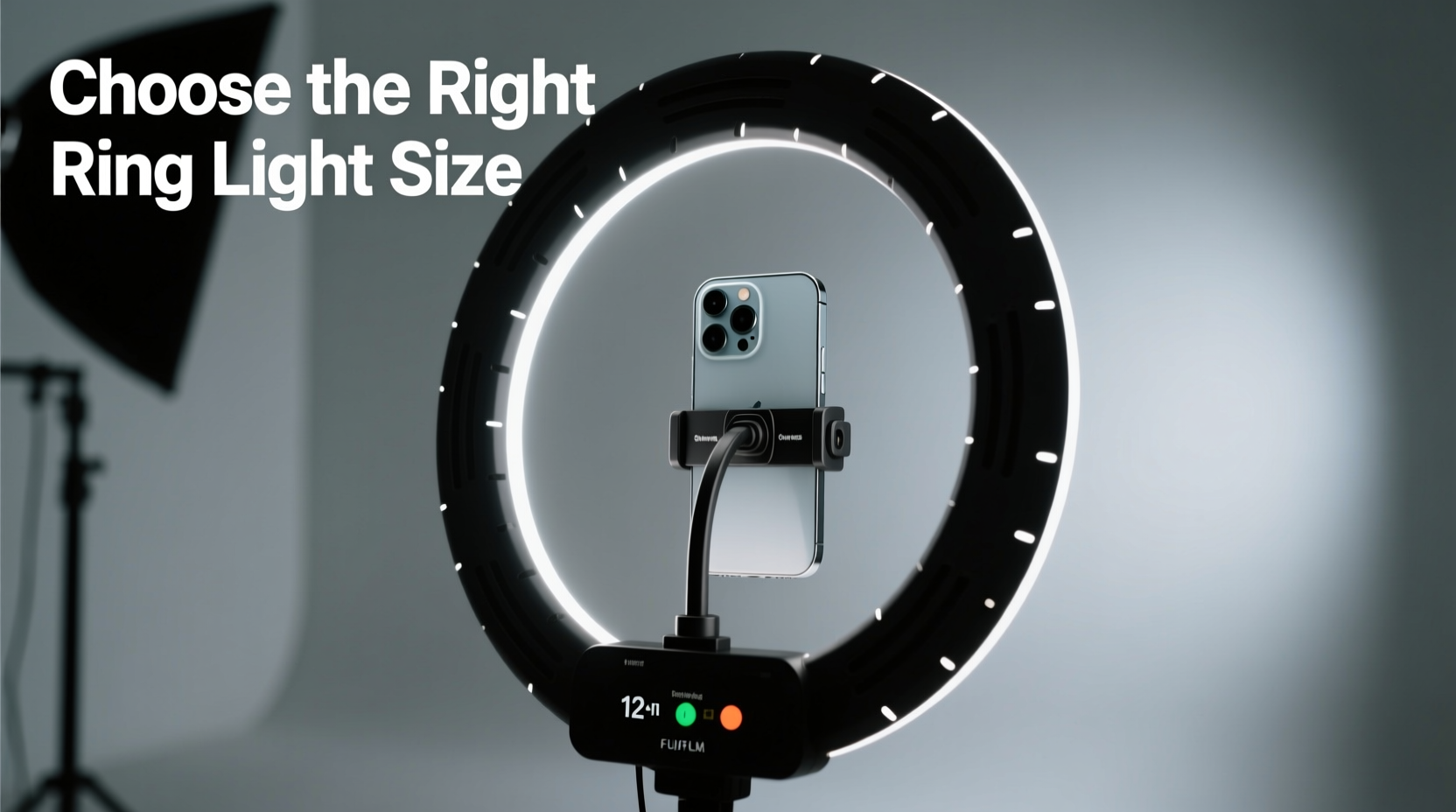
Ring lights typically range from 6 inches to 20 inches in diameter, with some professional models going even larger. Each size serves a different purpose and affects both the quality and coverage of light.
Smaller ring lights (6–10 inches) are compact and portable, making them ideal for close-up tasks like taking selfies, applying makeup, or doing quick video recordings on smartphones. They provide focused, intimate lighting but lack the spread needed for full-face or body shots.
Mid-sized ring lights (12–14 inches) strike a balance between portability and performance. These are the most common choices for streamers, YouTubers, and remote professionals. They offer enough coverage for head-and-shoulders framing while still being manageable on a desk or tripod.
Larger models (16–20+ inches) are designed for more serious setups. With broader light dispersion, they eliminate shadows more effectively and are better suited for three-quarter or full-body shots. However, they require more space and stable mounting solutions.
Matching Ring Light Size to Your Use Case
The ideal ring light size depends heavily on what you’re using it for. A one-size-fits-all approach rarely works when precision matters.
For Selfies and Mobile Content
If your main goal is taking well-lit selfies or creating short-form content for Instagram or TikTok, a smaller ring light (8–10 inches) mounted directly onto your phone or placed nearby is often adequate. These lights deliver concentrated, circular catchlights in the eyes—a signature look favored by influencers.
However, be cautious: small lights can create dramatic contrasts if not positioned correctly. Keep the light at eye level or slightly above, and avoid placing it too close to avoid overexposure.
For Streaming and Video Calls
Streaming requires consistency, clarity, and minimal post-processing effort. A 14-inch ring light is widely considered the sweet spot for desktop streaming setups. It provides ample facial illumination without overwhelming the background and integrates easily into dual-monitor workspaces.
For full-frame shots or standing streams (e.g., fitness instructors or presenters), consider a 16- or 18-inch model mounted on a floor stand. Larger diameters ensure even light distribution across the upper body and reduce the need for additional fill lights.
For Professional Photography or Studio Work
In studio environments, where control and quality are paramount, 18- to 20-inch ring lights are standard. These produce a broad, diffused glow that minimizes texture exaggeration—ideal for beauty photography or high-end product videos.
Keep in mind that large ring lights consume more power and may require external power sources rather than USB. They also benefit from diffusion filters to soften the light further and prevent hotspots.
“Choosing the wrong ring light size is like wearing glasses that don’t match your prescription—it distorts the intended outcome.” — Jordan Lee, Lighting Director at StreamWell Studios
Room Setup and Space Constraints
Your physical environment plays a major role in determining the optimal ring light size. Even the best light can underperform if your space doesn’t accommodate it properly.
A 20-inch ring light might seem impressive, but if your desk is cramped or your ceiling is low, it could obstruct your camera view or cast unwanted reflections on walls. Conversely, a tiny 6-inch light may get lost in a large room with ambient darkness, failing to lift shadows from your face.
Consider these spatial factors:
- Desk depth: Ensure there’s enough clearance behind your monitor for the ring light and mount.
- Ceiling height: Low ceilings limit vertical positioning options; floor stands may not extend fully.
- Background distance: If you're filming against a wall, a larger light may spill onto the backdrop, creating glare or washing out colors.
- Mobility needs: Frequent movers should prioritize compact, foldable designs over bulky models.
As a rule of thumb, allow at least 6–12 inches of clearance around the ring light for airflow and adjustment. Also, measure the distance between your seating position and the intended light placement—ideally 2 to 3 feet for mid-range models.
Light Output and Adjustability Features
Size isn’t the only factor—brightness (measured in lumens), color temperature (Kelvin), and dimming capabilities significantly affect usability.
Smaller ring lights often have lower lumen outputs (around 500–800 lumens), which may suffice in well-lit rooms but struggle in darker environments. Mid-to-large models typically offer 1,000–2,500 lumens, allowing greater flexibility across varying conditions.
Look for ring lights with adjustable color temperatures (usually 3000K–6500K). Warmer tones (3000K–4000K) are flattering for evening streams or cozy aesthetics, while daylight settings (5500K–6500K) enhance clarity and professionalism during daytime meetings.
Dimmable controls let you fine-tune brightness without altering your entire room’s lighting. Advanced models include app or remote control, preset modes, and RGB options for creative effects.
| Ring Light Size | Ideal Use Case | Min. Recommended Distance | Typical Lumen Range | Best For |
|---|---|---|---|---|
| 6–8 inches | Phone selfies, makeup application | 12–18 inches | 400–800 | Portability, travel |
| 10–12 inches | Close-up videos, mobile streaming | 18–24 inches | 800–1,200 | Content creators on budget |
| 14 inches | Desktop streaming, Zoom calls | 24–36 inches | 1,200–1,800 | Most home streamers |
| 16–18 inches | Full upper body, standing streams | 36–48 inches | 1,800–2,500 | Professional setups |
| 20+ inches | Studio photography, film production | 48+ inches | 2,500+ | High-end visual content |
Step-by-Step Guide: Choosing Your Ideal Ring Light
Follow this five-step process to identify the perfect ring light size and features for your needs:
- Define your primary use: Are you streaming, taking selfies, recording tutorials, or hosting virtual meetings? Write down your top three activities.
- Measure your workspace: Note desk dimensions, available wall/floor space, and typical shooting distance from camera to subject.
- Determine desired framing: Will you appear in close-up, head-and-shoulders, or full-body? Larger framing requires larger lights.
- Evaluate lighting conditions: Is your room naturally bright or dim? Darker spaces demand higher lumen output and possibly larger fixtures.
- Select size and features: Based on steps 1–4, choose a size range. Then prioritize adjustability, power source (USB vs. AC), and mounting options (tripod, clamp, stand).
Mini Case Study: From Grainy Streams to Crisp Clarity
Sophia, a Twitch streamer based in Chicago, initially used a 10-inch ring light clipped to her monitor. While affordable and easy to set up, viewers frequently commented that her face looked “flat” and “washed out” during evening sessions.
After researching lighting techniques, she upgraded to a 16-inch dimmable ring light on a floor stand, positioning it about 3 feet away at eye level. She adjusted the color temperature to 4500K and reduced brightness to 70% to avoid glare.
The difference was immediate. Her facial features became more defined, shadows under her jawline softened, and her overall image gained depth. Within two weeks, viewer retention increased by 22%, and several followers mentioned the improved visual quality in chat.
This real-world example shows that upgrading size alone isn’t enough—proper placement and settings are equally critical.
Common Mistakes to Avoid
Even experienced users fall into traps when selecting ring lights. Here are frequent errors and how to sidestep them:
- Buying the biggest model without measuring space: A 20-inch light won’t help if it blocks your camera or knocks into furniture.
- Ignoring power requirements: Large lights often need wall outlets. USB-powered models may not support high brightness consistently.
- Mounting too high or too low: Angling the light downward creates unflattering shadows. Keep it level with your eyes or slightly above.
- Overlooking diffusion: Some ring lights come with removable diffusion panels. Without them, LEDs can appear harsh and create hotspots on oily skin.
- Using only one light source: Ring lights are excellent key lights, but adding a subtle fill light or reflector prevents flatness.
Frequently Asked Questions
Can I use a small ring light for streaming?
You can, but with limitations. A small ring light (under 12 inches) may not illuminate your entire face evenly, especially if you move around. It’s acceptable for tight framing but not ideal for dynamic content or long sessions.
Do bigger ring lights always mean better quality?
Not necessarily. Larger lights offer broader coverage and softer shadows, but quality depends on LED density, color accuracy, and build materials. A poorly made 18-inch light can perform worse than a premium 14-inch model.
Is a ring light necessary for good selfie lighting?
No, but it’s highly effective. Alternatives include softbox lights, natural window light, or bounce cards. However, ring lights provide consistent, circular eye highlights that are hard to replicate and are particularly flattering for front-facing cameras.
Checklist: Choosing the Right Ring Light
- ✅ Identify primary use: streaming, selfies, video calls, etc.
- ✅ Measure available space and typical shooting distance
- ✅ Choose size based on framing needs (close-up vs. full-body)
- ✅ Verify lumen output and color temperature range
- ✅ Confirm power source compatibility (USB, AC adapter)
- ✅ Check mounting options (clamp, tripod, floor stand)
- ✅ Look for dimmable brightness and adjustable color settings
- ✅ Consider included accessories (diffuser, phone holder, remote)
- ✅ Read user reviews focusing on heat output and durability
- ✅ Test placement before finalizing setup
Final Thoughts
Selecting the right ring light isn’t just about buying the latest gadget—it’s about aligning technology with your environment and goals. The perfect size balances coverage, clarity, and convenience. Whether you're lighting up your face for a morning meeting or preparing for a live stream with thousands of viewers, investing time in choosing the appropriate ring light pays off in professionalism, engagement, and confidence.




 浙公网安备
33010002000092号
浙公网安备
33010002000092号 浙B2-20120091-4
Comments
No comments yet. Why don't you start the discussion?