
Every year, thousands of households experience the same holiday frustration: stringing up festive lights only to have the living room go dark mid-decorating. A tripped breaker isn’t just inconvenient—it’s a warning sign that your electrical load exceeds safe limits. Overloaded circuits pose real fire hazards, especially during extended holiday use when lights may run 6–12 hours daily. Yet most people choose lights based on aesthetics or price—not amperage ratings, circuit capacity, or cumulative wattage. This isn’t about guesswork or outdated rules of thumb. It’s about applying precise, code-aligned calculations so your tree sparkles safely, your mantel glows reliably, and your home’s wiring remains protected.
Why Wattage Matters More Than You Think
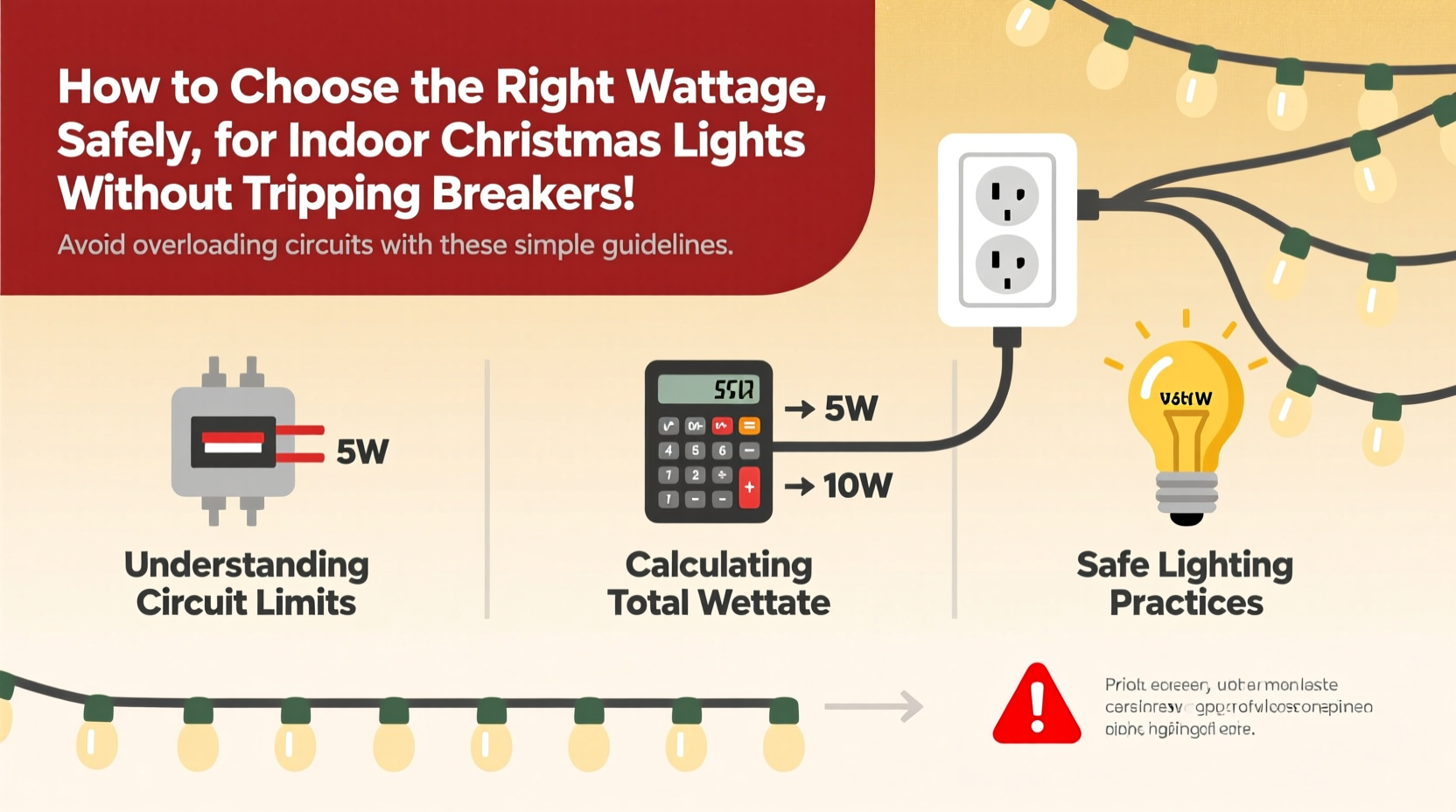
Wattage is the measure of electrical power a device consumes—and it directly determines how much current flows through your home’s wiring. Indoor circuits in North America are typically rated for 15 or 20 amps at 120 volts. That means a standard 15-amp circuit can handle a maximum of 1,800 watts (15 A × 120 V), while a 20-amp circuit supports up to 2,400 watts. But here’s the critical detail most overlook: the National Electrical Code (NEC) requires circuits to operate at no more than 80% of their rated capacity for continuous loads—and holiday lighting qualifies as continuous if used for more than three hours at a time. So the *safe, sustained* limit for a 15-amp circuit drops to 1,440 watts, and for a 20-amp circuit, it’s 1,920 watts.
This derating rule exists because prolonged overloading heats wires, degrades insulation, and increases fire risk. It’s not theoretical: the U.S. Fire Administration reports that between 2017 and 2021, an average of 790 home fires per year were caused by decorative lighting—nearly half involving overloaded outlets or extension cords.
How to Calculate Your Total Light Load—Step by Step
Accurate wattage calculation requires moving beyond package labels and understanding actual draw. Follow this verified sequence:
- Identify every light string you plan to use—including icicle lights, net lights, rope lights, and pre-lit garlands.
- Locate the label on each string’s plug or packaging. Look for “Watts,” “W,” or “VA” (volt-amperes). If only amps are listed, multiply by 120 V (e.g., 0.33 A × 120 V = 39.6 W).
- Add wattages cumulatively—but only for strings plugged into the same circuit. Do not sum across multiple outlets unless you’ve confirmed they share a breaker (more on verification below).
- Account for all connected devices on that circuit: TVs, gaming consoles, space heaters, coffee makers, and even smart speakers contribute to the load. Subtract their wattage from your available budget before adding lights.
- Apply the 80% rule: For a 15-amp circuit with 1,440 W max, subtract existing loads first. If your entertainment center draws 320 W, you have only 1,120 W remaining for lights.
This method eliminates surprises. It transforms decoration from a trial-and-error process into a predictable, safe activity.
LED vs. Incandescent: The Wattage Gap That Changes Everything
The shift to LED lighting has dramatically reduced typical household loads—but many still use legacy incandescent strings or mix technologies unknowingly. Understanding the difference is essential to accurate planning.
| Light Type | Typical Wattage per 100-Bulb String | Amperage Draw (120 V) | Max Strings on 15-Amp Circuit (80% Rule) |
|---|---|---|---|
| Incandescent Mini-Lights | 40–60 W | 0.33–0.5 A | 28–43 strings |
| Incandescent C7/C9 Bulbs | 150–250 W | 1.25–2.08 A | 5–11 strings |
| Warm-White LED Mini-Lights | 2.4–4.8 W | 0.02–0.04 A | 720–1,440 strings |
| Color-Changing LED Rope Lights (16 ft) | 12–18 W | 0.1–0.15 A | 960–1,440 strings |
| Pre-lit Artificial Tree (7 ft) | 25–45 W (LED) / 210–420 W (incandescent) | 0.21–0.375 A / 1.75–3.5 A | 38–68 LED trees / 4–8 incandescent trees |
Note: These figures reflect industry-standard UL-listed products. Unbranded or imported lights—especially those sold online without safety certification—often understate wattage or lack proper fusing. Always verify with a plug-in power meter if uncertain.
Mapping Your Home’s Circuits: The Essential First Step
You cannot manage wattage without knowing which outlets belong to which circuit. Many homeowners assume “all living room outlets are on one breaker”—but modern homes often split receptacles across multiple circuits for redundancy and safety. Here’s how to confirm your layout:
- Turn off one breaker at a time and test every outlet, switch, and light fixture in the rooms where you’ll decorate. Use a simple lamp or phone charger as your tester.
- Label each breaker clearly—not just “Living Room,” but “Living Room N. Wall Outlets + Fireplace Light.” Include ceiling fans, sump pumps, and garage door openers if they’re on shared circuits.
- Check for GFCI outlets—they may trip independently of breakers and cut power to downstream receptacles, creating false assumptions about circuit boundaries.
- Consult your panel’s directory if present, but verify it physically. Builders sometimes mislabel or omit updates after renovations.
Once mapped, assign decorations strategically. For example, plug high-wattage items (like a pre-lit tree and fireplace garland) into separate circuits—or better yet, dedicate one circuit solely to holiday lighting by temporarily relocating low-priority devices.
“Most residential breaker trips during the holidays aren’t caused by too many lights—they’re caused by too many lights on the *wrong* circuit. Knowing your home’s wiring map is the single most effective preventive step.” — Carlos Mendez, Licensed Master Electrician & NEC Code Trainer, IAEI
Real-World Example: The Johnson Family’s Near-Miss
The Johnsons live in a 1998-built suburban home with standard 15-amp circuits. In December 2023, they decorated their main living area with enthusiasm: a 7.5-ft pre-lit tree (incandescent, 320 W), two 20-ft strands of C9 bulbs (220 W each), 120 ft of incandescent mini-lights (48 W per 25 ft strand = 230 W), and a vintage ceramic Santa with internal lighting (65 W). All were plugged into four different outlets—but unbeknownst to them, every outlet fed back to the same 15-amp living room circuit.
Total calculated load: 320 + 440 + 230 + 65 = 1,055 W. On paper, that’s well under 1,440 W. But they’d forgotten the 180-W flat-screen TV, 45-W soundbar, and 120-W gaming console already running on that circuit. With those added, the load hit 1,650 W—exceeding the 80% limit by 210 W. The result? A tripped breaker every evening at 6:30 p.m., just as they turned on the lights and started dinner.
After mapping their circuits, they moved the TV and console to a bedroom circuit, replaced the incandescent tree with an LED version (38 W), and swapped the C9s for warm-white LEDs (24 W each). Their new total load: 38 + 48 + 230 + 65 = 381 W—just 26% of capacity. No more outages. No more stress.
Smart Extension Cord & Power Strip Practices
Extension cords and power strips are common points of failure—not because they’re inherently dangerous, but because they’re misused. Here’s what works and what doesn’t:
A quality power strip with individual switches and a 15-amp circuit breaker adds a vital layer of protection. But its rating must match or exceed the circuit’s capacity. A 10-amp-rated strip on a 15-amp circuit creates a bottleneck. Likewise, avoid “octopus” setups: plugging multiple high-draw devices (a tree, garland, and projector) into one strip—even if the strip is rated for 15 amps—because heat builds at the connection point.
Essential Holiday Lighting Safety Checklist
- ☑️ Verify your home’s circuit map before buying or hanging any lights
- ☑️ Replace all incandescent strings with UL-listed LED equivalents—prioritize warm-white for ambiance and energy savings
- ☑️ Calculate total wattage for *each circuit*, including non-light loads (TVs, chargers, appliances)
- ☑️ Stay at or below 80% of circuit capacity (1,440 W for 15 A; 1,920 W for 20 A)
- ☑️ Use only grounded (3-prong), polarized extension cords rated for indoor use and appropriate gauge (16 AWG minimum for runs under 50 ft)
- ☑️ Inspect every cord for cracks, fraying, or bent prongs—discard damaged sets immediately
- ☑️ Plug lights into GFCI-protected outlets where possible, especially near water sources (kitchens, bathrooms)
- ☑️ Set timers or smart plugs to limit daily runtime—reducing heat buildup and energy use
Frequently Asked Questions
Can I plug multiple light strings into one outlet using a basic 6-outlet power strip?
Yes—but only if the strip is UL-listed, rated for at least 15 amps (1,800 W), and the *total load across all six outlets* stays within your circuit’s 80% limit. Most inexpensive power strips are rated for 10 amps (1,200 W) and lack internal breakers. Using one risks overheating. Always check the strip’s label for its amp/watt rating before connecting lights.
My lights say “for indoor or outdoor use.” Does that mean they’re safer?
No. “Indoor/outdoor” refers only to weather resistance—not electrical safety or wattage efficiency. Outdoor-rated lights often draw *more* power (to compensate for cold-temperature efficiency loss) and may include heavier-gauge wiring. They’re not inherently safer indoors—and may be overkill for interior use. Prioritize UL listing and verified wattage over marketing labels.
How do I know if my home has 15-amp or 20-amp circuits?
Check your breaker panel: breakers are labeled with their amperage (e.g., “15” or “20”). Standard bedroom and living room circuits are usually 15-amp; kitchens, laundry rooms, and garages often use 20-amp. If breakers are unlabeled, turn off one and test outlets—or consult a licensed electrician. Never assume; guessing incorrectly could lead to unsafe overloading.
Conclusion
Choosing the right wattage for indoor Christmas lights isn’t about limiting joy—it’s about enabling it sustainably and safely. When you understand your circuit’s true capacity, calculate loads accurately, and select efficient LED technology, your holiday display becomes a reflection of thoughtful preparation rather than last-minute panic. You gain peace of mind knowing your family won’t face darkness mid-celebration—or worse, an electrical hazard. You reclaim control over your home’s infrastructure instead of letting outdated assumptions dictate your decor. And you join the growing number of informed homeowners who treat holiday lighting not as seasonal clutter, but as a deliberate, responsible expression of warmth and welcome.
This season, don’t just hang lights—engineer your glow. Map your circuits. Swap incandescents for LEDs. Calculate twice, plug once. Your breakers—and your peace of mind—will thank you.




 浙公网安备
33010002000092号
浙公网安备
33010002000092号 浙B2-20120091-4
Comments
No comments yet. Why don't you start the discussion?