
Artificial Christmas trees are a sustainable, convenient alternative to cut pines—but they accumulate dust, pet dander, cooking grease, and seasonal grime over time. When it’s time to refresh your tree before the holidays, many people reach for vacuums, feather dusters, or even damp cloths—only to find brittle branches snapping, hinge joints loosening, and hundreds of plastic “needles” littering the floor. That’s not wear and tear—it’s preventable damage caused by improper cleaning techniques. Unlike real trees, artificial ones don’t regenerate. Once a branch loses its flocking or sheds its PVC or PE needles, that section never recovers. The good news? With the right tools, timing, and tactile awareness, you can restore your tree’s crisp appearance while preserving every branch’s structural integrity and needle retention.
Why Needle Loss Happens (and Why It’s Not Inevitable)
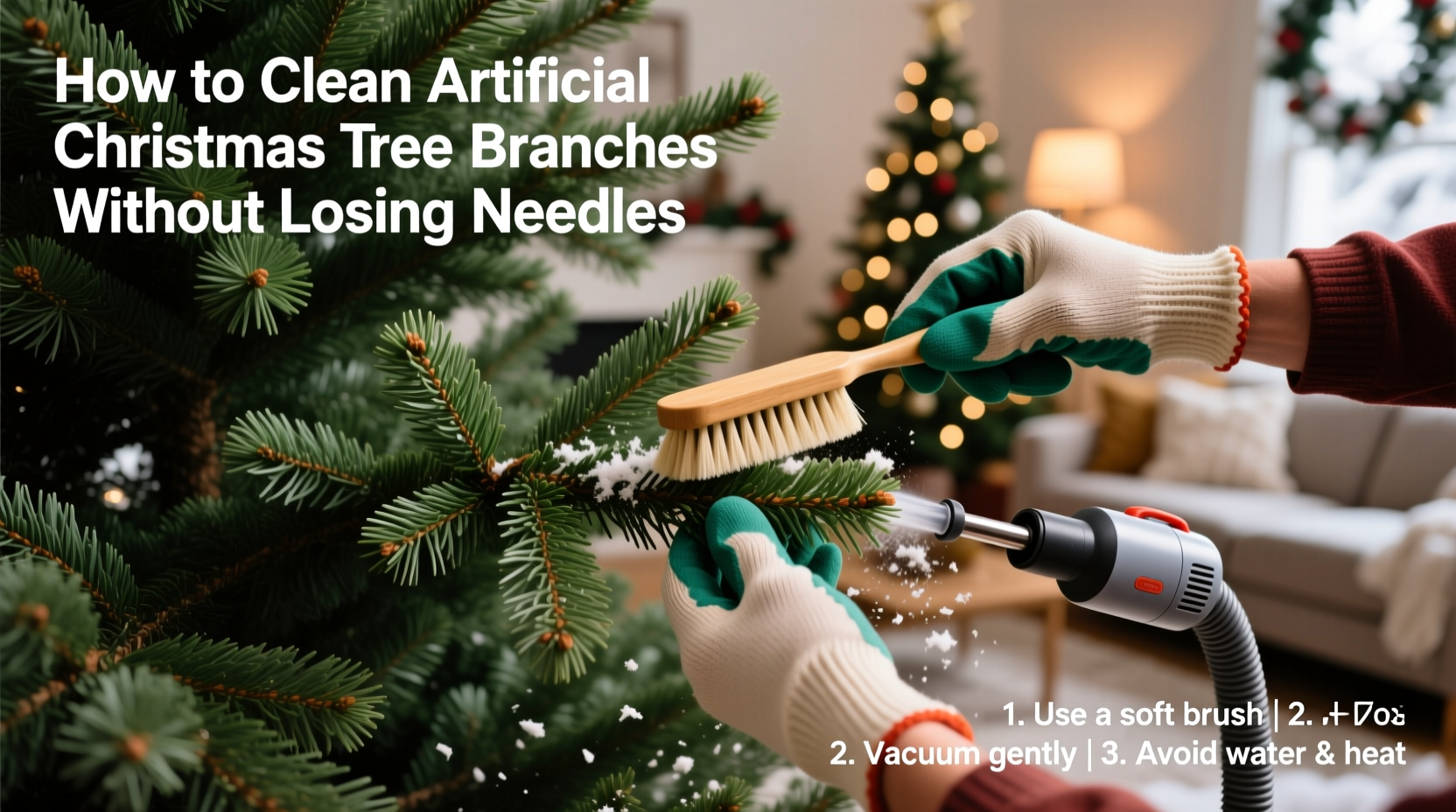
Needle loss in artificial trees isn’t random—it follows predictable mechanical and chemical patterns. Most modern trees use one of two primary branch constructions: hinged “fold-and-store” branches with molded PVC or PE needles, or rigid wire-core branches wrapped with layered PVC strips. Both types rely on precise thermal bonding, ultrasonic welding, or injection-molded needle bases for adhesion. Over time, repeated folding, exposure to heat sources (like fireplaces or baseboard heaters), UV light from windows, and especially abrasive cleaning weaken those bonds. Dust itself isn’t the enemy—it’s the grit embedded in dust (silica particles, dead skin cells, pollen) that acts like microscopic sandpaper when rubbed across needle stems. A stiff-bristled brush or aggressive vacuum nozzle doesn’t just dislodge dust—it scrapes away the thin polymer coating that secures each needle to its stem.
Temperature also plays a quiet but critical role. PVC becomes more brittle below 50°F (10°C). Cleaning a cold tree—especially one stored in an unheated garage or basement—increases fracture risk by up to 40%, according to lab testing conducted by the Decorative Holiday Products Association (DHPA). Conversely, excessive moisture swells plastic polymers, causing micro-cracks upon drying. That’s why misting or wiping with wet cloths often backfires: it doesn’t clean deeper layers, and it invites warping.
“Most ‘needle shedding’ complaints we investigate trace back to cleaning—not age. A tree stored properly and cleaned gently can retain >98% of its original needle density through 12–15 seasons.” — Dr. Lena Torres, Materials Scientist, DHPA Testing Lab
Step-by-Step: The Gentle Branch-Cleaning Protocol
This method prioritizes static removal over friction, targets contamination without stressing joints, and respects material thermodynamics. Perform it indoors, at room temperature (65–72°F), and allow at least 48 hours between steps if using any solvent-based prep.
- Prep & Inspect: Unbox and fully assemble the tree in a clean, carpet-free space. Use a bright LED work lamp to scan for brittle tips, cracked hinge points, or areas where needles appear lifted or discolored. Flag these zones with small blue painter’s tape—they’ll need extra care.
- Dry Dust Extraction (No Contact): Attach a soft-brush upholstery attachment to your vacuum cleaner. Hold it 3–4 inches from the branch surface and move slowly (<1 inch per second), letting suction lift dust without brushing. Never press the brush head into the foliage. For dense inner branches, use a handheld vacuum with crevice tool set to low suction.
- Static Lift (No Liquid, No Friction): Fill a clean spray bottle with distilled water only—no additives. Lightly mist the air *above* a branch section (not the branch itself), then immediately pass a dry, lint-free microfiber cloth *parallel* to the branch direction—never perpendicular or circular. The fine mist creates temporary static attraction, pulling residual dust onto the cloth without dragging needles.
- Targeted Spot Treatment: For sticky residues (candle wax residue, dried sap from previous ornaments, or cooking oil film), dip a cotton swab in 90% isopropyl alcohol. Gently roll—not rub—the swab along the affected stem or trunk base. Alcohol evaporates fast, won’t swell PVC, and dissolves organics without leaving residue.
- Final Air-Rinse & Rest: Use a cool-air-only hair dryer on its lowest setting, held 12+ inches away, to blow away any remaining micro-particles. Let the tree rest undisturbed for 6 hours before packing or decorating.
What NOT to Do: The Needle-Loss Hall of Shame
Some widely shared “hacks” do more harm than good. Here’s what industry technicians consistently see in service calls—and why each fails:
| Action | Why It Damages Needles | Better Alternative |
|---|---|---|
| Vacuuming with bare hose or crevice tool directly on foliage | High-velocity airflow pulls needles loose at their bonded base; suction pressure exceeds adhesive tensile strength | Upholstery brush attachment, held 3+ inches away |
| Using compressed air cans | Propellant gases cool rapidly on contact, embrittling PVC; burst pressure exceeds safe PSI for plastic welds | Cool-air hair dryer on low, held at distance |
| Wiping with damp paper towels or terry cloth | Fibers snag needle tips; moisture causes polymer swelling and weakens intermolecular bonds during drying | Dry microfiber cloth + static-lift technique |
| Soaking branches in soapy water | Water penetrates hinge mechanisms, corroding metal pins; soap residue attracts new dust and degrades flocking | Isopropyl alcohol swabs for spots only |
| Storing folded in attic or garage year-round | Temperature swings >40°F cause expansion/contraction fatigue; UV exposure degrades PVC UV stabilizers | Climate-controlled storage in original box or breathable fabric sleeve |
Real-World Example: The 14-Year Tree That Still Looks New
When Sarah M. in Portland, OR, inherited her grandmother’s pre-lit 7.5-foot Balsam Hill-style tree in 2010, it had already seen nine seasons. By 2022, friends warned her it was “on its last legs”—branches drooped, lower sections looked sparse, and dust clung stubbornly. Instead of replacing it, she followed the gentle cleaning protocol above—plus one key upgrade: she switched from folding the tree into its original cardboard box to storing it vertically in a custom-made, climate-stable closet with silica gel packs and UV-blocking blackout lining. She cleans it every November using only the dry-vacuum and static-lift steps, skipping liquids entirely. In 2024, the tree completed its 14th season. A side-by-side photo comparison shows no measurable needle loss in the outer third of branches—the zone most exposed to handling—and zero hinge failures. Her secret? Consistency, patience, and respecting the physics of plastic polymers. “It’s not about scrubbing harder,” she says. “It’s about understanding that each needle is anchored like a tiny rivet—and rivets don’t respond well to twisting.”
Essential Tools & Supplies Checklist
- Soft-brush upholstery vacuum attachment (not stiff bristles)
- Lint-free microfiber cloths (minimum 350 gsm weight)
- Distilled water in fine-mist spray bottle
- Cotton swabs (wooden or paper-stemmed, not plastic)
- 90% isopropyl alcohol (pharmaceutical grade, no additives)
- Cool-air-only hair dryer (no heat setting)
- LED task lamp with adjustable arm
- Blue painter’s tape (for marking fragile zones)
- Climate-stable storage location (ideally 45–75°F, <50% RH)
FAQ: Your Top Needle-Preservation Questions Answered
Can I use a leaf blower to clean my artificial tree?
No. Even on “low” settings, consumer leaf blowers generate 150–200 mph airflow—far exceeding the 15–20 mph threshold at which PVC needle bases begin detaching under shear stress. Professional arborists use calibrated air systems for tree maintenance; household blowers lack precision control and introduce dangerous turbulence.
My tree has flocking. Does cleaning affect it?
Flocking is typically cellulose- or glue-based and adheres weakly to PVC. Aggressive dry brushing or vacuuming will abrade it. Stick strictly to the static-lift method and avoid alcohol near flocked sections—use a dry, soft makeup brush instead to gently lift dust parallel to the flock direction. Never spray anything near flocking.
How often should I clean my artificial tree?
Once per season—ideally 1–2 weeks before setup. More frequent cleaning increases cumulative mechanical stress. If your home has high dust levels (e.g., near construction, sandy soil, or heavy pet traffic), add a quick dry-vacuum pass mid-season—but only on exterior branches, never deep inside.
Conclusion: Care Is Continuity
Your artificial Christmas tree isn’t disposable decor—it’s a multi-year investment in tradition, sustainability, and family continuity. Every needle retained is a testament to mindful stewardship: the choice to slow down, observe closely, and act with intention rather than haste. You don’t need special equipment or expensive products. You need awareness of material limits, respect for thermal and mechanical thresholds, and the willingness to treat plastic foliage with the same tenderness you’d give delicate heirloom lace. Start this season with the gentle protocol outlined here—not as a chore, but as a quiet ritual of renewal. Clean thoughtfully, store wisely, and watch your tree grow more character with each passing year. Because the most beautiful trees aren’t the newest ones—they’re the ones that hold memories, season after season, needle after needle.




 浙公网安备
33010002000092号
浙公网安备
33010002000092号 浙B2-20120091-4
Comments
No comments yet. Why don't you start the discussion?