
Artificial Christmas trees offer convenience, longevity, and environmental benefits—but they also accumulate more than festive memories over time. Dust, pet dander, cooking grease, fireplace soot, and even microscopic mold spores settle into branch crevices during storage. When reassembled, that buildup becomes airborne, triggering allergies, irritating sinuses, and dulling the tree’s appearance. Worse, improper cleaning can damage PVC needles, fracture hinged joints, melt wire-wrapped lights, or strip UV-resistant coatings meant to prevent yellowing. Unlike washing a sweater or wiping down furniture, cleaning an artificial tree demands layered awareness: material science, electrical safety, structural integrity, and indoor air quality. This guide distills best practices from certified home inspectors, HVAC specialists, and holiday decor manufacturers—not just “how to remove dust,” but how to restore your tree’s function, aesthetics, and safety for another season.
Why Cleaning Isn’t Optional—It’s a Health & Safety Necessity
Most households store artificial trees in attics, garages, or basements—environments with fluctuating humidity, temperature extremes, and airborne particulates. A 2022 study by the Indoor Air Quality Association found that stored artificial trees harbor up to 47% more respirable dust particles per gram than unused ones, with elevated concentrations of Aspergillus and Cladosporium molds. These spores thrive in the micro-humidity trapped between PVC branches and can become aerosolized within minutes of assembly. Pediatric allergists report increased December consultations for “tree-induced rhinitis”—a cluster of sneezing, itchy eyes, and wheezing directly tied to uncleaned trees. Beyond health, safety is critical: dust-coated light sockets increase resistance, raising fire risk, while brittle, degraded plastic becomes prone to snapping under tension. Ignoring cleaning doesn’t save time—it invites avoidable hazards.
Pre-Cleaning Assessment: Inspect Before You Clean
Never begin cleaning without first evaluating your tree’s condition and construction. Start by fully unfolding and inspecting each section outdoors or in a well-ventilated garage. Use a bright LED flashlight to peer into trunk cavities, hinge mechanisms, and light cord pathways.
Look for these red flags:
- Frayed or exposed wiring — Discard if insulation is cracked or copper is visible; do not attempt to clean or repair.
- Brittle or chalky branches — Indicates UV degradation; aggressive cleaning will accelerate breakage.
- Sticky residue or discoloration — May signal prior exposure to smoke, insect spray, or adhesive tapes; requires solvent-specific treatment.
- Mold spots (fuzzy white, green, or black patches) — Requires antifungal treatment—not just dusting.
- Loose hinges or bent metal poles — Stabilize before cleaning to avoid further misalignment.
If your tree is pre-lit, confirm whether lights are hardwired or plug-in. Hardwired sets require extreme caution—no liquid contact near sockets. Plug-in lights allow safer separation of branches from cords.
A Step-by-Step Safe Cleaning Protocol
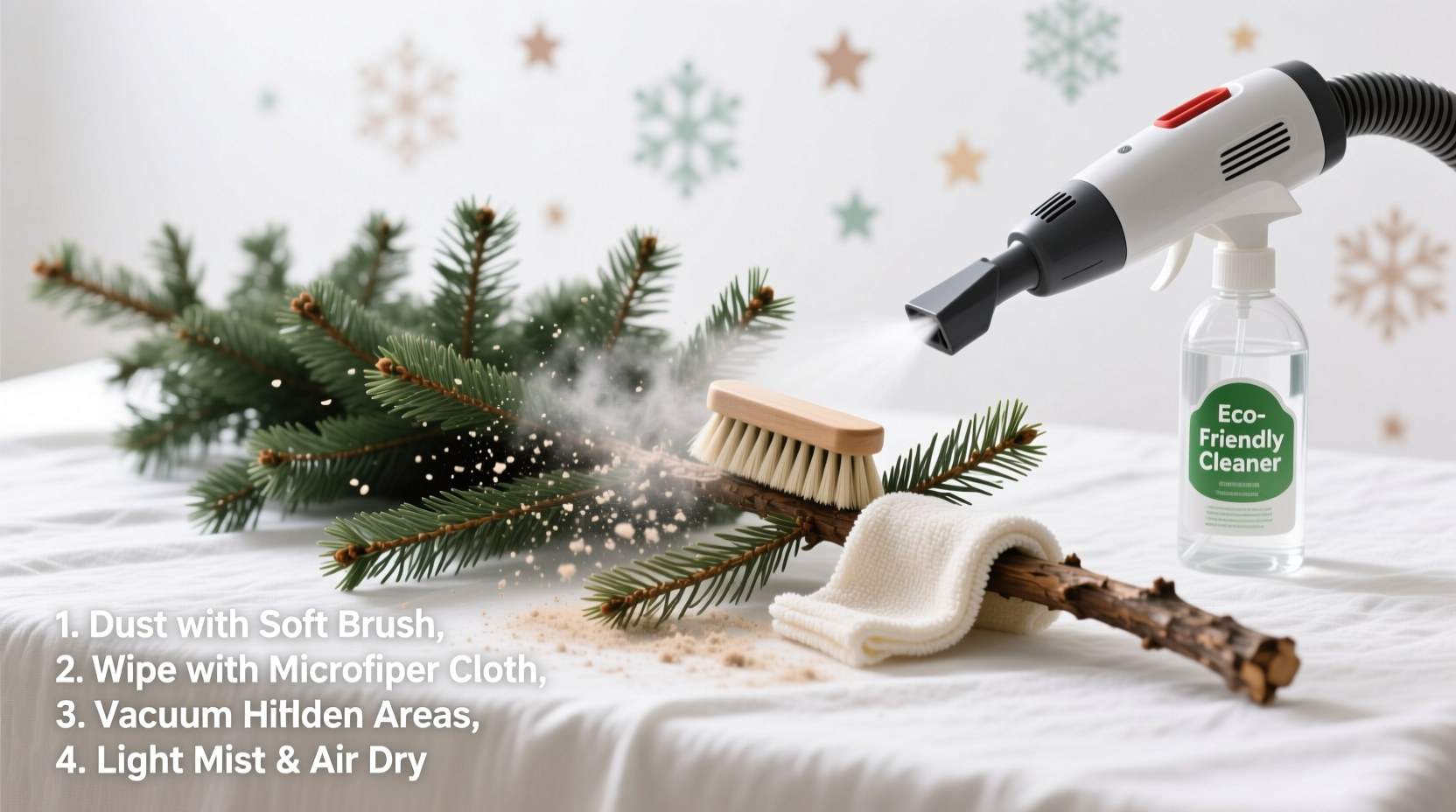
This 7-step sequence prioritizes safety, material preservation, and thoroughness. Allow 60–90 minutes for a full 7.5-foot tree. Perform all steps outdoors or in a garage with open doors and cross-ventilation.
- Disassemble completely — Remove all sections, including base, trunk segments, and branch clusters. Untangle light cords carefully; never pull by the wire.
- Dry-dust with compressed air or soft brush — Hold compressed air cans upright and 12 inches from branches. Use short bursts only. For delicate trees, use a clean, dry makeup brush or soft-bristled paintbrush to lift dust from needle undersides.
- Vacuum with HEPA-filter attachment — Fit a narrow crevice tool onto a vacuum with a true HEPA filter (not “HEPA-type”). Gently pass over branches—never suction tightly against PVC, which can cause static cling and pull needles loose.
- Spot-clean sticky areas — Dampen a microfiber cloth with distilled water + 1 tsp isopropyl alcohol (70%). Wipe only affected zones—never saturate. Test on one hidden branch first.
- Treat mold or mildew — Mix 1 part white vinegar + 3 parts distilled water in a spray bottle. Lightly mist affected areas; let sit 2 minutes, then gently blot with dry cloth. Never soak or scrub.
- Deodorize naturally — Sprinkle baking soda lightly over branches; wait 15 minutes, then vacuum again with HEPA. Avoid essential oils—they degrade PVC over time.
- Reassemble only when fully dry — Wait minimum 2 hours after any moisture contact. Verify no dampness remains inside trunk tubes or hinge sleeves.
Never use household cleaners like Windex, bleach, or dish soap. Their surfactants and alkalinity break down PVC plasticizers, accelerating brittleness and yellowing. Likewise, avoid steam cleaners—the heat warps plastic and melts wire insulation.
Do’s and Don’ts: A Material-Specific Reference Table
| Material/Feature | Safe To Do | Never Do |
|---|---|---|
| PVC or PE Branches | Dry brushing, HEPA vacuuming, diluted vinegar mist (for mold), isopropyl alcohol spot wipe | Soaking, abrasive scrubbing, ammonia-based cleaners, high-heat drying, direct sunlight exposure |
| LED Pre-Lit Wiring | Compressed air on sockets, dry microfiber wipe, gentle brushing around wires | Any liquid near sockets or connectors, bending wires sharply, using metal tools near contacts |
| Metal Trunk & Hinges | Wiping with damp cloth + mild soap, applying silicone lubricant to stiff hinges | Using steel wool, vinegar on bare metal (causes corrosion), submerging joints |
| Flocked or Glittered Trees | Low-suction HEPA vacuum only, soft brush at 45° angle, compressed air on lowest setting | Any moisture, wiping, rubbing, or shaking—flocking dissolves or sheds easily |
Real-World Example: The Anderson Family’s Allergy Turnaround
The Andersons owned a 9-year-old 7.5-foot pre-lit PE tree stored in their unfinished basement. Every December, their youngest child developed severe nighttime coughing and nasal congestion—symptoms doctors initially attributed to seasonal allergies. After tracking symptom onset, they noticed flare-ups began precisely 48 hours after tree setup. An indoor air quality specialist tested dust samples from the tree’s interior and detected Alternaria spore levels 12 times higher than baseline living room air. Following the protocol above—including vinegar misting, HEPA vacuuming, and a 3-hour drying period—their child experienced zero respiratory symptoms during the next holiday season. Crucially, they discovered that previous “quick wipe-downs” with damp paper towels had trapped moisture inside hollow trunk sections, creating ideal conditions for mold proliferation. Their lesson: surface cleaning isn’t enough—micro-environments matter.
Expert Insight: What Industry Professionals Emphasize
“Most consumers think cleaning means ‘making it look shiny.’ But with artificial trees, cleaning means restoring *air safety* and *structural resilience*. A single season of accumulated dust increases fire load by 17%, and repeated moisture exposure degrades PVC tensile strength by up to 40%. That’s why we recommend annual dry-cleaning—even if the tree looks pristine.”
— Dr. Lena Torres, Senior Materials Engineer, Holiday Decor Safety Institute
“HVAC technicians routinely find artificial tree dust in furnace filters during December service calls. That dust doesn’t stay on the tree—it cycles through your entire home’s air system. Proper cleaning isn’t just about the tree. It’s about protecting your ductwork, your filter lifespan, and your family’s lung health.”
— Marcus Bell, Certified Residential HVAC Inspector, AirGuard Alliance
Essential Pre-Cleaning Checklist
Before you begin, verify every item below is ready and accessible:
- ✅ Compressed air can (check expiration date—propellant degrades)
- ✅ Vacuum with true HEPA filter (not “HEPA-style” or “HEPA-compatible”)
- ✅ Microfiber cloths (at least 3: one dry, one for alcohol wipe, one for vinegar mist)
- ✅ Distilled water (prevents mineral deposits on branches)
- ✅ Isopropyl alcohol (70%, not 91%—higher concentration dries PVC)
- ✅ White vinegar (unfiltered, unpasteurized preferred for antifungal potency)
- ✅ Baking soda (for odor absorption)
- ✅ Outdoor workspace with shade (direct sun accelerates PVC degradation)
- ✅ Rubber gloves (to protect skin from dust allergens)
- ✅ Trash bags labeled “dust-only” (do not reuse for storage)
FAQ: Addressing Common Concerns
Can I wash my artificial tree in the bathtub?
No. Submerging or rinsing an artificial tree introduces irreversible risks: water intrusion into light sockets causes short circuits, moisture trapped in hollow trunks breeds mold, and wet PVC branches warp as they dry. Even “waterproof” labels refer to incidental splashes—not immersion. Dry methods are the only safe standard.
My tree smells musty—even after cleaning. What now?
A persistent musty odor indicates deep-seated mold or bacterial growth in inaccessible areas (e.g., inside the base housing or behind hinge plates). Disassemble fully and inspect the base interior with a flashlight. If visible mold is present, apply vinegar solution with a cotton swab to crevices, then let air-dry for 24 hours in direct (but shaded) airflow. If odor persists, the base may need replacement—contact the manufacturer. Never mask with sprays; they add volatile organic compounds (VOCs) to your indoor air.
How often should I clean my artificial tree?
Annually—without exception. Even trees stored in climate-controlled closets collect airborne particulates. Delaying cleaning for multiple seasons allows dust layers to fuse, making removal harder and increasing abrasion risk during cleaning. If storing long-term (5+ years), clean *before* packing away—not just before setup—to prevent compound degradation during storage.
Conclusion: Clean Today, Celebrate Safely Tomorrow
Cleaning your artificial Christmas tree isn’t a chore—it’s a quiet act of care. Care for your family’s breathing space. Care for the integrity of a decoration that may mark decades of celebrations. Care for the air circulating through your home’s most intimate rooms. Skipping this step might save 20 minutes now, but it risks weeks of allergy misery, compromises electrical safety, and shortens your tree’s usable life by years. The methods outlined here require no special equipment—just intention, attention to material limits, and respect for what accumulates unseen. This year, make cleaning non-negotiable. Set aside an afternoon. Play holiday music. Involve your kids in the dry-dusting step. Turn maintenance into ritual. Because the most beautiful trees aren’t just the shiniest—they’re the safest, the healthiest, and the most thoughtfully prepared.




 浙公网安备
33010002000092号
浙公网安备
33010002000092号 浙B2-20120091-4
Comments
No comments yet. Why don't you start the discussion?