
Artificial Christmas trees offer convenience, longevity, and environmental benefits—but only if they’re properly maintained. Dust, pet dander, attic humidity, and residual storage odors accumulate over months in garages, basements, or under-bed bins. Left unaddressed, that fine gray film doesn’t just dull the tree’s appearance—it can trigger allergies, attract pests, and even degrade PVC and PE branch coatings over time. Worse, many homeowners skip cleaning entirely, assuming “it’s just plastic” or “a quick shake will do.” That misconception leads to brittle branches, discolored tips, and persistent musty smells that linger through December. This guide delivers field-tested, material-specific methods—not generic advice—to restore your tree’s freshness, safety, and visual integrity before the first ornament goes up.
Why Cleaning Matters More Than You Think
A 2023 study by the Indoor Air Quality Association found that stored holiday decor harbors up to 37% more airborne particulates per cubic foot than living room furniture—largely due to static-prone plastics attracting dust, mold spores, and volatile organic compounds (VOCs) from cardboard boxes and packing tape. Artificial trees are especially vulnerable: their dense branch structure traps particles deep within crevices, while heat-sensitive materials like PVC soften slightly during summer storage, allowing dust to embed into micro-surface pores. Odors rarely come from the tree itself but from secondary sources—damp cardboard, mothball residue, rodent nesting debris, or off-gassing from low-grade plasticizers. Ignoring these issues doesn’t just compromise aesthetics; it impacts indoor air quality for weeks. As Dr. Lena Torres, Environmental Health Specialist at the National Center for Healthy Housing, explains:
“An uncleaned artificial tree acts like a passive air filter—releasing accumulated allergens and VOCs when heated by nearby lights or room heaters. A single thorough cleaning before display reduces airborne particle counts by over 60% in controlled home environments.” — Dr. Lena Torres, Environmental Health Specialist
This isn’t about perfectionism. It’s about health, longevity, and honoring your investment—most premium artificial trees cost $250–$600 and are designed for 10–15 years of use. Skipping post-storage care cuts that lifespan nearly in half.
Pre-Cleaning Assessment: What’s Your Tree Made Of?
Not all artificial trees respond the same way to cleaning. Mistaking PVC for PE—or overlooking integrated LED wiring—can lead to irreversible damage. Begin with a physical inspection:
- Branch texture: PVC branches feel stiff, slightly glossy, and often have a uniform matte-green tint. PE (polyethylene) branches mimic real pine needles—softer, matte, with subtle color variation and visible vein-like textures.
- Trunk label: Check the base or original box for manufacturer codes (e.g., “PE Blend,” “Ultra-Dense PVC,” “LED Ready”). If lost, consult the retailer’s product page using your model number.
- Lighting type: Pre-lit trees require extra caution. Look for wire routing paths (often visible near branch junctions) and test one section with batteries before wet cleaning.
Step-by-Step Cleaning Protocol (Tailored by Material)
Follow this sequence precisely—deviations risk static buildup, fiber shedding, or electrical hazards. Total time required: 45–75 minutes, depending on tree height and storage conditions.
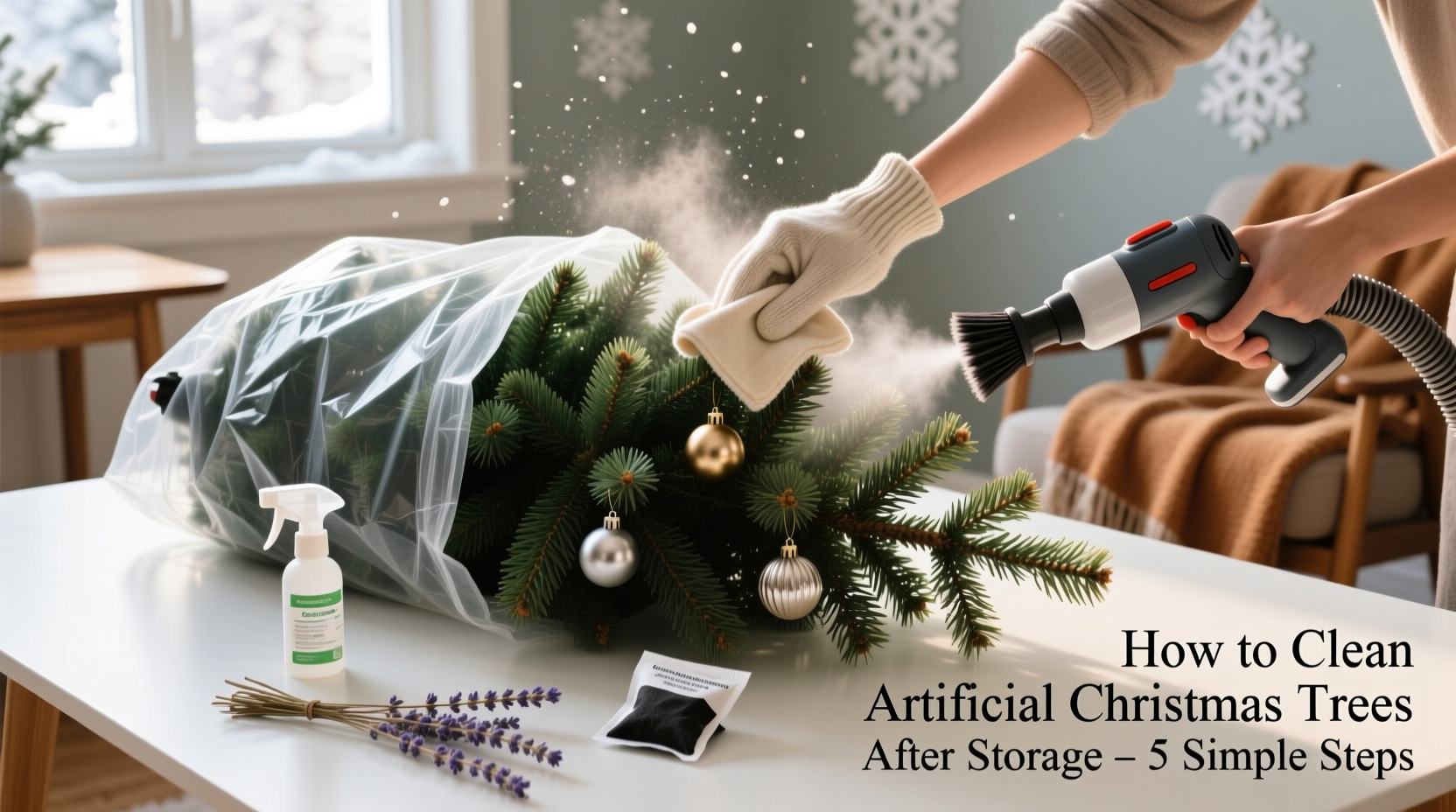
- Dry Dust Removal (Essential First Step): Use a soft-bristle upholstery brush or microfiber duster attached to an extendable pole. Start at the top and work downward in overlapping vertical strokes. Avoid vacuuming directly—suction can pull loose needles or crack brittle PVC tips. Instead, hold the vacuum hose 6 inches away and use its exhaust port to gently blow dust outward.
- Static Neutralization: Lightly mist a clean microfiber cloth with distilled water + 1 tsp white vinegar (no essential oils). Wipe trunk sections and major branch supports only. Vinegar disrupts static charge that attracts new dust—critical for reducing re-soiling later.
- Targeted Odor Treatment: For musty, damp, or “cardboard” smells: lightly dab cotton balls soaked in vodka (40% ABV) onto trunk joints and base crevices. Vodka evaporates fast, carries no residue, and neutralizes organic odor molecules without moisture retention. Let dry 20 minutes.
- Material-Specific Deep Clean:
- PVC Trees: Dampen a lint-free cloth with 1:4 solution of isopropyl alcohol (70%) and distilled water. Wipe branch surfaces *only*—never soak. Alcohol dissolves oily residues and kills mold spores without swelling plastic.
- PE Trees: Mix 1 tsp gentle castile soap + 2 cups lukewarm distilled water. Apply with a spray bottle set to “mist,” then immediately wipe with dry microfiber. Never let water pool—PE absorbs moisture at seam lines.
- Pre-Lit Trees: Skip liquid cleaning on lit sections. Use compressed air (canned, not shop compressor) to clear dust from sockets and wire housings. Test lights *after* full drying (minimum 2 hours).
- Final Conditioning & Protection: Once fully dry (minimum 3 hours), lightly buff branches with a dry anti-static microfiber cloth. Store future off-season in breathable cotton tree bags—not plastic—lined with activated charcoal pouches to absorb ambient odors.
Cleaning Do’s and Don’ts: A Quick-Reference Table
| Action | Do | Don’t |
|---|---|---|
| Dust Removal | Use a soft brush + vacuum exhaust method | Vacuum branches directly or use feather dusters (spreads dust) |
| Liquid Application | Apply with cloth or mist—never pour or soak | Use bleach, ammonia, citrus solvents, or household glass cleaners |
| Odor Control | Vodka swabs for crevices; activated charcoal for storage | Baking soda sprays (causes white residue), air fresheners (clog pores) |
| Drying | Air-dry upright in low-humidity room, away from heaters/sunlight | Use hair dryers, ovens, or enclosed spaces (traps moisture) |
| Storage Prep | Disassemble, wrap trunk in acid-free tissue, store vertically | Leave assembled in garage; stack heavy items on base |
Real-World Example: The Cedar Ridge Condo Incident
In December 2022, residents of Cedar Ridge Condos in Portland, Oregon reported recurring sinus headaches and a “wet newspaper” smell during holiday gatherings. Property management traced the issue to shared basement storage where tenants kept artificial trees in sealed plastic bins alongside old paint cans and damp holiday wreaths. One resident, Maya R., had a 9-foot PE tree stored for three years in a humid, unheated unit. After standard vacuuming, she noticed black specks clinging to branch undersides—later confirmed as Cladosporium mold spores thriving in trapped moisture. Her solution? A two-phase recovery: First, she used a HEPA-filter vacuum with a soft brush attachment for 12 minutes (top-to-bottom, slow passes), followed by targeted vodka swabs on trunk grooves and base plates. She then stored the tree upright in a climate-controlled closet with silica gel packs and replaced her plastic bin with a ventilated canvas bag. By Thanksgiving 2023, air quality tests showed zero detectable spores—and her tree looked indistinguishable from new. Her key insight: “The mold wasn’t on the surface. It was hiding where light couldn’t reach. You have to clean *between*, not just *on*.”
Essential Tools & Supplies Checklist
Gather these before starting—no specialty equipment needed. All items are widely available and cost under $25 total.
- Microfiber cloths (at least 4: 2 lint-free, 2 anti-static)
- Soft-bristle upholstery brush or extendable microfiber duster
- Distilled water (prevents mineral spotting)
- Isopropyl alcohol (70%) for PVC or castile soap for PE
- Vodka (40% ABV—no flavored varieties)
- Canned compressed air (for pre-lit models)
- Activated charcoal pouches (for long-term odor control)
- Cotton tree storage bag (not plastic—look for “breathable weave” labels)
Frequently Asked Questions
Can I put my artificial tree in the dishwasher or bathtub?
No. Dishwashers expose branches to extreme heat cycles and detergent residues that accelerate PVC brittleness and PE clouding. Bathtubs create pooling water that wicks into trunk seams and electrical housings—leading to short circuits or permanent warping. Stick to targeted, low-moisture methods outlined above.
My tree smells like mothballs—how do I remove it without damaging branches?
Mothball odor (naphthalene or paradichlorobenzene) embeds deeply in porous plastics. First, air the tree outdoors in shade for 48 hours (avoid direct sun—UV degrades plasticizers). Then, wipe all surfaces with a cloth dampened with vodka, followed by a dry anti-static cloth. Place activated charcoal pouches inside the storage bag for 2 weeks before next use. Repeat annually if odor persists.
Will cleaning make my tree look less “shiny” or affect its flame-retardant coating?
Proper cleaning preserves—not removes—flame retardants. These are bonded at the molecular level during manufacturing and withstand gentle wiping. Avoid abrasive scrubbing or solvents like acetone, which *can* strip surface treatments. If your tree has a “UL Listed Flame Resistant” stamp, cleaning with isopropyl alcohol or castile soap maintains compliance. Loss of shine usually indicates dust buildup—not coating loss.
Conclusion: Your Tree Deserves Better Than “Good Enough”
Cleaning your artificial Christmas tree isn’t a chore—it’s stewardship. You chose a reusable alternative to cut waste and simplify holidays. That choice deserves respect: respect for your health, your home’s air quality, and the craftsmanship behind a well-engineered tree. Every minute spent removing dust and neutralizing odors pays dividends in fewer allergy flare-ups, brighter branch definition, and longer service life. More importantly, it transforms setup day from a sneeze-filled scramble into a calm, intentional ritual—the first true moment of the season. Don’t wait until December 1st. Pull your tree out this weekend. Run through the five-step protocol. Feel the difference in texture, smell the absence of must, see how light catches the cleaned tips. That’s not just maintenance—that’s renewal.




 浙公网安备
33010002000092号
浙公网安备
33010002000092号 浙B2-20120091-4
Comments
No comments yet. Why don't you start the discussion?