
Vintage mercury glass ornaments are treasured holiday heirlooms, admired for their luminous, mirrored interiors and handcrafted elegance. First popularized in the 19th century, these double-walled glass pieces were created by coating the inner surface of a blown-glass form with a reflective solution—historically containing silver nitrate and mercury, hence the name. Though modern reproductions avoid toxic elements, many antique ornaments still contain original silvering that is highly sensitive to moisture, abrasion, and chemical exposure.
Over time, dust, grime, and environmental pollutants settle on the surface, dulling their shine and obscuring their intricate detailing. Cleaning them improperly—especially with water, alcohol, or harsh cleaners—can dissolve or delaminate the fragile silver backing, leaving cloudy patches or complete loss of reflectivity. Once damaged, this layer cannot be restored outside of professional conservation.
This guide provides a comprehensive, damage-free approach to cleaning vintage mercury glass ornaments while preserving their irreplaceable finish. From identifying your ornament’s condition to executing gentle cleaning techniques, every step prioritizes longevity over immediate brilliance.
Understanding Mercury Glass Construction and Vulnerabilities
Mercy glass, also known as silvered glass or “double glass,” consists of two concentric layers: an outer decorative shell and an inner sealed chamber coated with a reflective metal solution. The space between the layers is typically sealed at the base, trapping the silvering and preventing air or moisture from entering. This seal is critical—if compromised, oxidation begins immediately, leading to darkening, flaking, or hazing of the interior mirror.
The original silvering process involved pouring a mixture of silver nitrate and reducing agents into the inner bulb, swirling it to coat the walls, then draining and sealing. While effective, this method produced a thin, chemically bonded film that degrades when exposed to acids, bases, solvents, or prolonged humidity.
Modern imitations often use aluminum vapor deposition, which is more stable, but true antiques—especially those made before the 1940s—are far more delicate. Identifying whether you have authentic vintage mercury glass helps determine appropriate care.
Step-by-Step Guide to Safe Surface Cleaning
Cleaning vintage mercury glass requires patience, precision, and non-invasive tools. The goal is not sterilization, but gentle dust removal that preserves structural integrity. Follow this sequence carefully:
- Inspect under bright, diffused light: Examine the ornament for cracks, chips, loose caps, or signs of internal clouding. If the silvering appears patchy or blackened inside, avoid any external moisture. These are signs of prior seal failure.
- Work in a controlled environment: Choose a clean, dry room with low humidity (ideally below 50%). Avoid kitchens or bathrooms where steam or condensation may occur during cleaning.
- Use compressed air (optional): For loose dust on crevices or textured surfaces, use a can of electronics-grade compressed air. Hold the can upright and spray in short bursts from at least six inches away. Do not shake the can, as propellant residue can spray onto the surface.
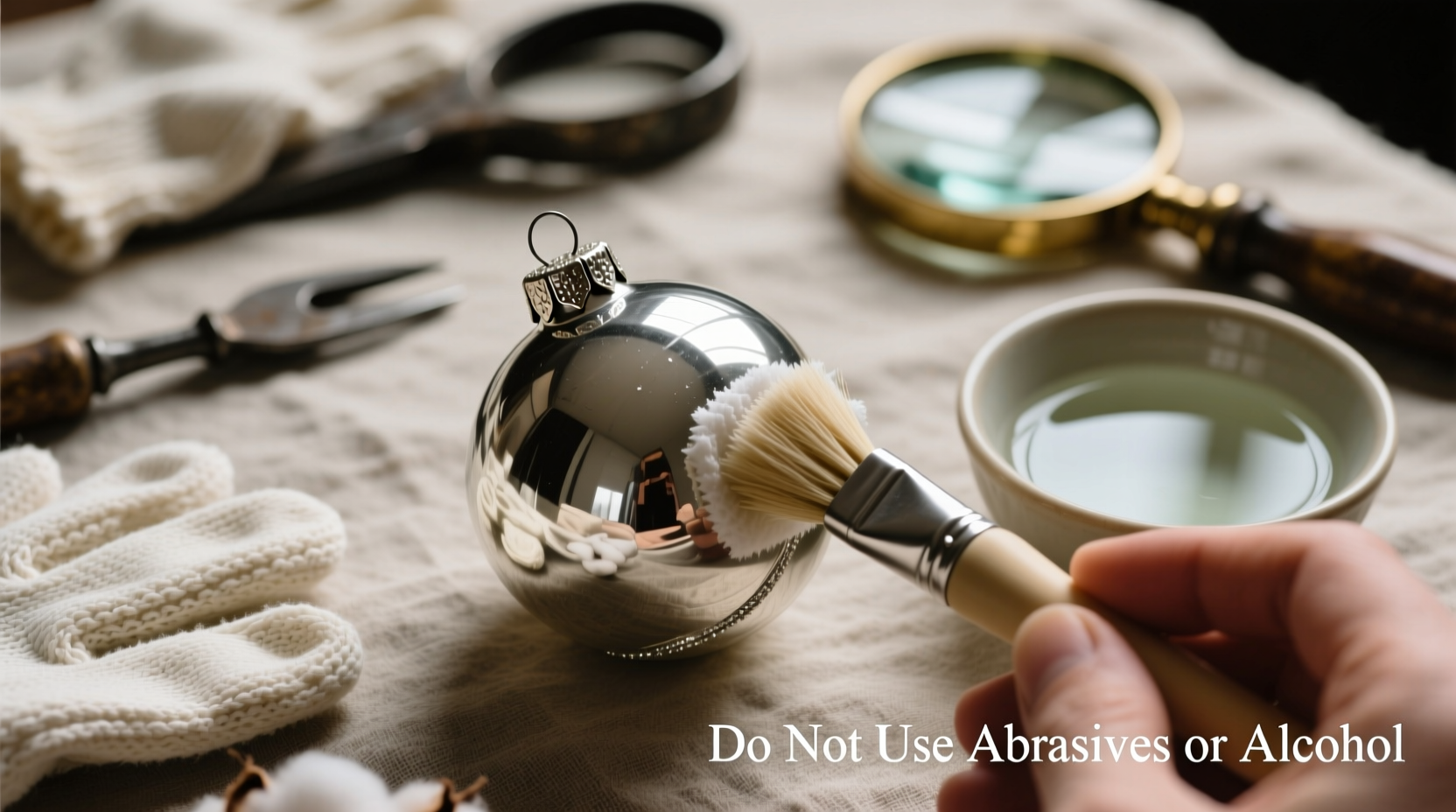
- Employ a soft brush technique: Use a clean, natural-bristle artist’s brush (size 4–8) or a makeup brush designated solely for conservation. Gently sweep along the contours of the ornament, starting from the top and working downward. Rotate the piece slowly to access all angles.
- Dab stubborn spots with a dry microfiber pad: For areas where dust has compacted into a film, lightly press and lift with a corner of a lint-free microfiber cloth. Do not rub—this creates friction that can scratch or dislodge weakened silvering near edges.
- Avoid contact with the cap or stem: These parts are often glued or crimped. Moisture or pressure here can loosen the seal, allowing air into the interlayer space.
- Allow to rest post-cleaning: After cleaning, place the ornament upright on a padded surface for 24 hours to ensure no residual particles shift.
No liquid should touch the glass unless absolutely necessary—and even then, only under strict conditions outlined later.
Do’s and Don’ts When Handling Vintage Mercury Glass
| Do | Don’t |
|---|---|
| Handle with clean cotton gloves to prevent oil transfer | Touch the glass with bare hands, especially after using lotion or hand sanitizer |
| Store upright in individual tissue-lined boxes | Stack ornaments or wrap them together in plastic |
| Clean only in dry conditions with stable temperature | Clean during rainy seasons or high-humidity days |
| Use a magnifier to inspect for micro-damage before cleaning | Assume all old glass is equally durable—age varies greatly in fragility |
| Label storage containers with year and origin if known | Expose to direct sunlight or fluorescent lighting for long periods |
When Light Soiling Requires Minimal Moisture
In rare cases, surface grime—such as nicotine residue from older homes or sticky fingerprints—cannot be removed with dry methods alone. A minimal-moisture intervention may be justified, but only if the ornament shows no signs of prior seal compromise.
If proceeding, follow this protocol strictly:
- Moisten a cotton swab with distilled water only—no detergents, vinegar, or alcohol.
- Wring the swab thoroughly so it is barely damp, not wet.
- Gently dab (do not wipe) the affected area for no more than 3 seconds.
- Immediately blot with a folded edge of a dry microfiber cloth.
- Allow the area to air-dry completely in a warm, ventilated room for at least two hours.
Never apply moisture near the base, stem, or any joint where the glass meets the metal cap. Capillary action can draw water into the interlayer space, initiating oxidation within days.
“With mercury glass, less is always more. I’ve seen collectors ruin decades-old pieces with a single swipe of a damp paper towel. The risk far outweighs the reward.” — Dr. Lillian Cho, Museum Conservator, Winterthur Decorative Arts Program
Mini Case Study: Reviving a 1920s Czechoslovakian Ornament
A collector in Vermont inherited a set of five mercury glass figural ornaments from her grandmother, including a bell-shaped sleigh dated circa 1925. Stored in an attic for over 30 years, the pieces were heavily dust-laden and one showed slight internal haze.
She began by photographing each ornament and noting imperfections. Using a sable-tipped drafting brush, she gently swept dust from raised details. On the sleigh’s runners, where grime had hardened, she used a single pass of a barely-damp swab, followed by immediate blotting.
After cleaning, she wrapped each in acid-free tissue and placed them in compartmentalized archival boxes with silica gel packs to regulate humidity. Over the next year, she monitored them monthly. The internally hazy piece did not worsen—indicating the seal remained stable—and the others retained full reflectivity.
Her success lay in restraint: avoiding immersion, resisting the urge to polish for extra shine, and prioritizing preservation over perfection.
Storage Solutions to Prevent Future Dust Accumulation
Proper storage is the most effective way to reduce future cleaning needs. Frequent handling increases the risk of micro-abrasions and accidental drops. Ideal storage includes:
- Individual wrapping: Use unbleached, acid-free tissue paper—never newspaper or colored paper, which can transfer ink or acidity.
- Compartmentalized containers: Use divided cardboard boxes or plastic cases with inserts that prevent rolling or contact.
- Climate control: Store in a room with stable temperature (60–70°F) and relative humidity between 40–50%. Avoid basements and attics.
- Upright positioning: Always store ornaments standing on their base. Laying them sideways can stress weak points and encourage dust to settle in crevices.
- Desiccants: Include replaceable silica gel packets in storage boxes to absorb ambient moisture. Replace or recharge every 3–6 months.
Frequently Asked Questions
Can I use glass cleaner like Windex on mercury glass?
No. Commercial glass cleaners contain ammonia, alcohol, and surfactants that can penetrate microscopic flaws in the glass or cap seal, attacking the silver layer from behind. Even fumes in a poorly ventilated space can contribute to degradation over time.
What if my ornament already has black spots inside?
Black or gray patches between the glass layers indicate oxidation due to seal failure. No external treatment can reverse this. The best course is careful storage to prevent further deterioration. Do not attempt to open or re-silver the piece unless consulting a professional conservator.
Are reproduction mercury glass ornaments safer to clean?
Yes. Modern versions often use aluminum coatings and improved sealing techniques, making them more resistant to moisture and mild cleaning. However, always assume fragility unless confirmed otherwise by the manufacturer.
Cleaning Checklist
- Check for cracks, haze, or loose stems
- Ensure workspace is dry and well-lit
- Wear clean cotton gloves
- Natural bristle brush or makeup brush
- Lint-free microfiber cloths
- Compressed air (electronics grade)
- Cotton swabs (unused)
- Use compressed air for loose dust
- Brush gently in downward strokes
- Dab stubborn spots with dry cloth corner
- Rest ornament for 24 hours
- Wrap in acid-free tissue
- Store upright in labeled container
Conclusion: Honor the Fragility, Preserve the Beauty
Vintage mercury glass ornaments are not merely decorations—they are artifacts of craftsmanship and memory. Each piece carries the weight of seasonal traditions, family histories, and artistic heritage. Their survival depends not on aggressive restoration, but on thoughtful stewardship.
Cleaning should never aim to make them look “brand new.” Instead, focus on stabilizing their current state, removing only what threatens further damage. By adopting conservative methods, respecting material limits, and storing with care, you ensure these shimmering treasures endure for generations.




 浙公网安备
33010002000092号
浙公网安备
33010002000092号 浙B2-20120091-4
Comments
No comments yet. Why don't you start the discussion?