
Stringing together Christmas lights is one of the most joyful parts of holiday decorating. But as the number of strands grows, so does the risk of tripping a breaker or, worse, creating a fire hazard. Many homeowners assume that if a strand of lights plugs in, it’s safe to daisy-chain more onto the same outlet. That’s not always true. Understanding electrical load limits, wire ratings, and proper connection methods is essential to keeping your holiday display both dazzling and safe.
This guide walks you through the science behind connecting multiple light strands, explains how to calculate total wattage, and provides real-world strategies for expanding your display without overburdening circuits.
Understanding Electrical Load and Circuit Limits
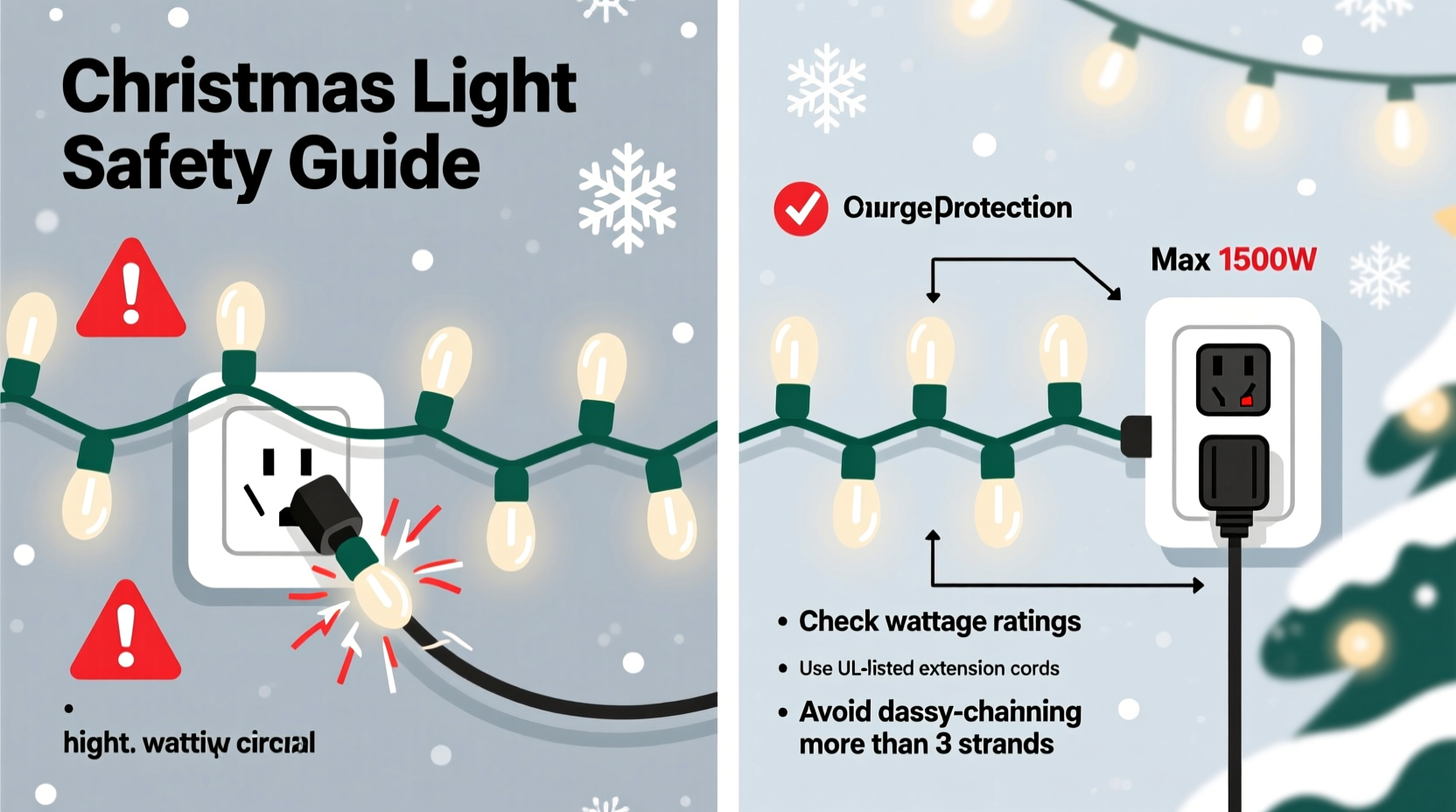
Every household circuit has a maximum capacity, typically measured in amperes (amps). Most standard circuits in homes are 15 or 20 amps and operate at 120 volts. To determine how much power you can safely draw from an outlet, use the formula:
Watts = Volts × Amps
For a 15-amp circuit: 120V × 15A = 1,800 watts
For a 20-amp circuit: 120V × 20A = 2,400 watts
However, electrical codes recommend using only 80% of a circuit’s capacity for continuous loads—those running three hours or more, like holiday lights. This means:
- Safe load on a 15-amp circuit: 1,440 watts
- Safe load on a 20-amp circuit: 1,920 watts
Each string of lights adds to this total. Exceeding these limits can cause overheating, blown fuses, or even electrical fires. The key is knowing how many watts each strand consumes and how many you can link together before reaching the safe threshold.
“Overloading a circuit with too many light strings is one of the top causes of holiday electrical incidents. Always check manufacturer labels and never assume all ‘mini’ lights are created equal.” — James Ralston, Certified Electrician and NFPA Safety Advisor
How Many Light Strands Can You Connect Together?
The number of strands you can connect depends on two factors: the type of lights and the manufacturer’s “maximum run” specification. Not all lights are designed to be daisy-chained indefinitely.
Traditional incandescent mini lights typically consume 40–50 watts per 100-light strand. LED versions, however, use only 4–10 watts for the same length, making them far more efficient and safer for long runs.
Here’s a comparison of common light types and their typical daisy-chain limits:
| Light Type | Watts per Strand (approx.) | Max Strands Daisy-Chained | Total Watt Limit |
|---|---|---|---|
| Incandescent Mini (100 lights) | 40–50W | 3–5 | 210W |
| LED Mini (100 lights) | 4–7W | 40–50 | 420W |
| C7 Incandescent | 5–7W per bulb | Varies (often 500W max) | Depends on bulb count |
| C9 LED | 0.4–1W per bulb | Up to 200 bulbs | ~200W |
These numbers are general guidelines. Always refer to the manufacturer's specifications printed on the product or its packaging. For example, some LED brands allow up to 80 strands to be connected, while others cap it at 25—even within the same product line.
Step-by-Step Guide to Connecting Multiple Strands Safely
Follow this logical sequence to expand your lighting display without compromising safety:
- Determine your circuit’s capacity. Identify which circuit powers the outlet you plan to use. Check your home’s electrical panel and note whether it’s 15 or 20 amps.
- Calculate available wattage. Multiply volts by amps, then apply the 80% rule. For a 15-amp circuit: 1,800 × 0.8 = 1,440 watts usable.
- Check the wattage of one light strand. Look at the label on the plug or packaging. If it lists amps instead, convert: Watts = Volts × Amps (e.g., 0.25A × 120V = 30W).
- Divide total available wattage by per-strand wattage. Example: 1,440W ÷ 6W per LED strand = 240 strands possible—but verify manufacturer limits first.
- Respect daisy-chain limits. Even if math allows 240 strands, if the manufacturer says “max 40,” do not exceed that number on a single run.
- Use multiple outlets or power strips on separate circuits. Distribute the load across different rooms or walls to avoid concentrating demand on one circuit.
- Plug into GFCI outlets when possible. Especially important for outdoor displays, as they shut off power during ground faults.
- Inspect cords and connections. Frayed wires, cracked sockets, or corroded connectors increase resistance and fire risk. Replace damaged strands immediately.
By following these steps, you ensure that your festive setup remains both visually impressive and electrically sound.
Smart Strategies for Expanding Your Display
Sometimes, even with LEDs, you’ll hit physical or electrical limits. Here are proven techniques to work around them:
Use a Power Distribution Hub
Instead of daisy-chaining dozens of strands, consider using a central power strip or distribution box plugged directly into a wall outlet. Then, connect individual light strings to the hub. This reduces strain on individual connectors and avoids exceeding the maximum run length.
Segment Your Lighting Zones
Divide your house into zones—front porch, roofline, trees, walkway—and assign each to a different circuit. This prevents any single circuit from being overloaded and makes troubleshooting easier if a problem arises.
Switch to Smart Plugs and Timers
Using smart outlets lets you control when lights turn on and off remotely. More importantly, they often include overload protection and energy monitoring. Some models will alert you via app if current draw exceeds safe levels.
Upgrade Wiring for Heavy Displays
If you regularly install large displays, consider installing dedicated outdoor circuits. A licensed electrician can add a 20-amp GFCI-protected circuit to your porch or garage, giving you reliable power without competing with indoor appliances.
Mini Case Study: The Overloaded Porch Display
In suburban Chicago, homeowner Maria L. wanted to create a jaw-dropping front yard display for her neighborhood’s annual holiday tour. She planned to wrap four trees, outline her roof, and illuminate walkways—totaling over 300 feet of lights.
Initially, she connected everything into a single outdoor outlet using multiple daisy chains of older incandescent mini-lights. Within two hours of turning them on, the circuit tripped. After resetting the breaker twice, she called an electrician.
The assessment revealed she was drawing nearly 1,900 watts—well above the 1,440-watt safe limit for her 15-amp circuit. Worse, several extension cords were undersized (18-gauge), causing excessive heat buildup.
The solution? The electrician recommended replacing all incandescent strings with LED equivalents (cutting total draw to 210 watts), using three separate circuits, and installing a weatherproof power distribution box. The new setup ran flawlessly throughout the season, used 85% less electricity, and passed a city safety inspection.
Maria’s experience underscores a critical point: planning beats improvisation when it comes to holiday lighting.
Essential Checklist Before Connecting Lights
Use this checklist every time you set up holiday lights to prevent overloads and hazards:
- ✅ Confirm the circuit rating (15A or 20A) powering your outlet
- ✅ Calculate total wattage of all planned light strands
- ✅ Verify manufacturer’s maximum daisy-chain limit
- ✅ Use only UL-listed lights and extension cords
- ✅ Match cord gauge to load: 16-gauge for short runs, 14-gauge or lower for heavy loads or long distances
- ✅ Avoid plugging high-draw devices (heaters, blowers) into the same circuit
- ✅ Test GFCI outlets before use (press “Test” and “Reset”)
- ✅ Inspect all cords for damage—discard cracked or frayed ones
- ✅ Install timers or smart plugs to manage runtime
- ✅ Keep connections off the ground and away from water
Frequently Asked Questions
Can I mix LED and incandescent lights on the same circuit?
Yes, but not within the same daisy chain. Mixing types can cause uneven voltage distribution and may void manufacturer warranties. It’s safer to group similar types together and connect them separately to a power strip or outlet.
Why did my lights stop working after adding one more strand?
You likely exceeded the maximum allowable load for that series. Many light strings have built-in fuses that blow when overloaded. Check the end plug for a removable panel containing small glass fuses. Replace only with identical-rated fuses (usually 3A or 5A). If the problem persists, reduce the number of connected strands.
Is it safe to use an extension cord for Christmas lights?
Yes—if you use the right kind. Never use indoor extension cords outdoors. Choose outdoor-rated, grounded (three-prong) cords labeled for the distance and wattage. For runs over 25 feet or high-wattage displays, use 14-gauge or 12-gauge cords to minimize voltage drop and heat buildup.
Conclusion: Illuminate Safely, Celebrate Fully
Connecting multiple strands of Christmas lights doesn’t have to be risky. With a clear understanding of electrical limits, careful planning, and the right tools, you can create a stunning display that’s as safe as it is festive. Prioritize LED lights for efficiency, respect manufacturer guidelines, and distribute loads wisely across circuits.
The holidays are about joy, warmth, and shared memories—not emergency electricians or fire hazards. By applying these best practices, you protect your home, your family, and your peace of mind.




 浙公网安备
33010002000092号
浙公网安备
33010002000092号 浙B2-20120091-4
Comments
No comments yet. Why don't you start the discussion?