
In professional correspondence, shipping logistics, and official documentation, accurate address formatting is essential. One common source of confusion involves the use of the pound sign (#) when denoting apartment or suite numbers. While widely used in informal contexts, the # symbol is not recommended by major postal authorities like the United States Postal Service (USPS). In fact, its use can interfere with automated sorting systems and lead to delivery delays. Understanding how to properly format building numbers—without relying on the pound sign—is a small but critical step toward ensuring mail reaches its destination efficiently.
Why Avoid the Pound Sign in Addresses?
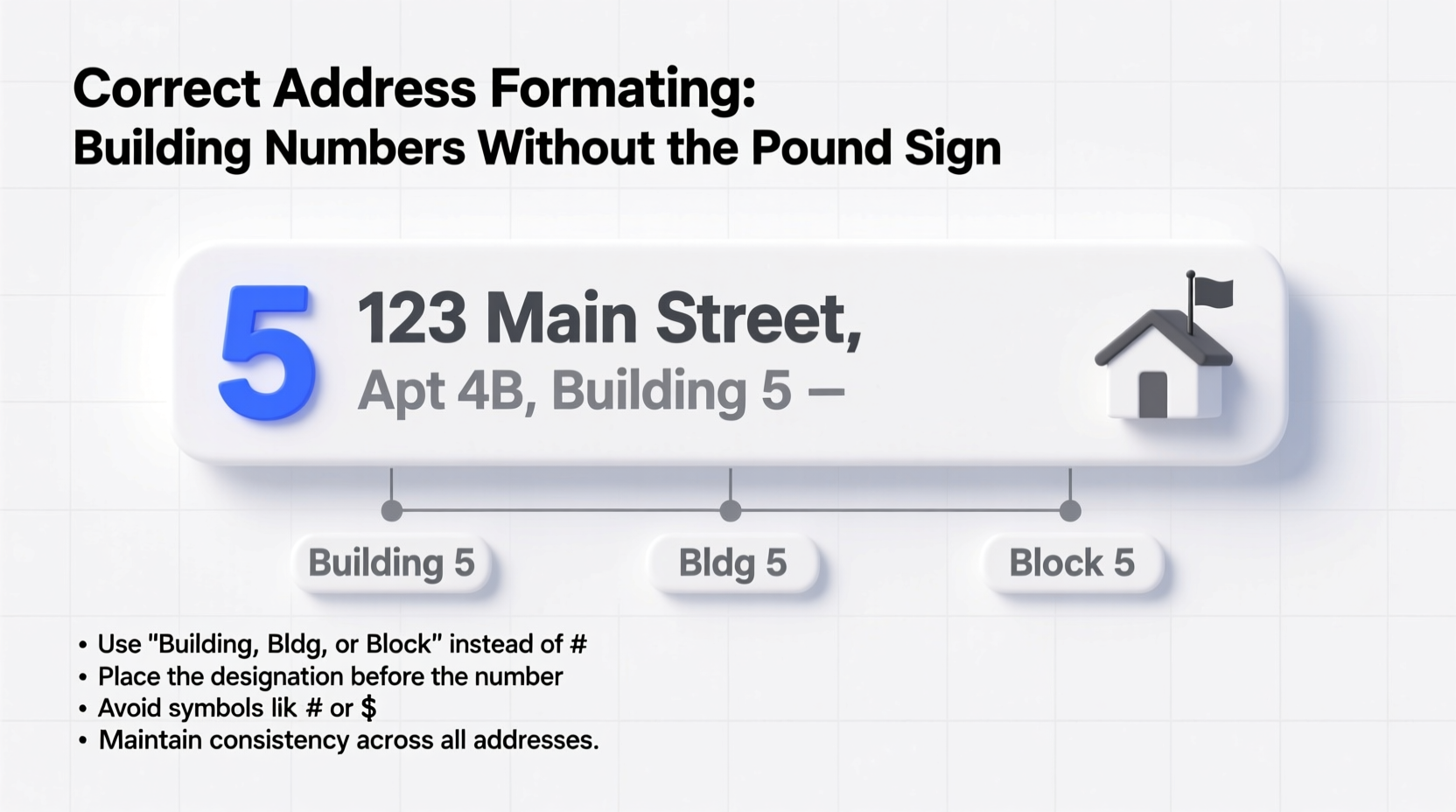
The # symbol, often referred to as the \"hash\" or \"number sign,\" has no standardized role in formal address formatting. The USPS and other international postal services discourage its use because it may be misinterpreted by optical character recognition (OCR) systems used in mail processing centers. These systems are designed to read alphanumeric characters and standard punctuation such as commas, periods, and hyphens. Symbols like #, @, or * can cause errors or require manual intervention, slowing down delivery.
Moreover, in digital forms and databases, the pound sign can trigger unintended functions. For example, in programming languages or CSV files, # might denote comments or be stripped out during data parsing, leading to incomplete or incorrect address records.
“Using non-standard symbols in addresses increases the risk of misrouting. Stick to letters, numbers, and approved punctuation.” — David Reynolds, Senior Logistics Analyst at National Postal Consulting Group
Standard Address Format Guidelines
The USPS provides clear recommendations for formatting addresses to ensure maximum deliverability. A complete mailing address should follow this structure:
- Recipient Name
- Street Number and Street Name
- Secondary Unit Designator (e.g., Apartment, Suite, Building)
- City, State, ZIP Code
The key lies in the third line: how you indicate the secondary unit. Instead of writing “#3B” or “Apt #5,” use standardized abbreviations followed by the unit number—with no punctuation.
Approved Secondary Unit Designators
The USPS maintains a list of preferred two-letter abbreviations for secondary units. Using these ensures consistency and compatibility with automated systems.
| Full Term | Preferred Abbreviation | Example Usage |
|---|---|---|
| Apartment | APT | 123 Main St APT 4B |
| Suite | STE | 456 Oak Ave STE 200 |
| Floor | FL | 789 Pine Rd FL 3 |
| Building | BLDG | 321 Elm St BLDG C |
| Room | RM | 654 Cedar Ln RM 105 |
| Unit | UNIT | 987 Maple Dr UNIT 12 |
Step-by-Step Guide to Formatting Addresses Correctly
Follow this sequence to format any U.S. address without using the pound sign:
- Start with the recipient’s full name on the first line.
- Write the street number and name on the second line.
- Add the secondary unit immediately after the street address, separated by a single space. Use the correct abbreviation (e.g., APT, STE).
- Capitalize all letters—this improves machine readability.
- Include city, state, and ZIP code on the final line, also in uppercase.
For example:
JANE DOE
123 OAK STREET APT 4B
SAN FRANCISCO CA 94107
Common Mistakes and How to Avoid Them
Even experienced professionals sometimes slip into outdated or informal habits. Here are frequent errors and their corrections:
- Mistake: 123 Main St #5C
Correction: 123 Main St APT 5C - Mistake: Suite #200, 456 Market Pl
Correction: 456 Market Pl STE 200 - Mistake: Unit B-3 (using hyphen)
Correction: UNIT B3 (use space separation only if needed; avoid special characters) - Mistake: Writing secondary unit on a new line unnecessarily
Correction: Keep street and unit on the same line unless space constraints apply (e.g., very long names).
Real-World Example: Resolving Delivery Issues
A small business in Austin, Texas, reported consistent delays in receiving supplier shipments. After investigation, they discovered that their warehouse address was being entered as:
ACME Supplies
789 Industrial Loop #B12
Austin TX 78753
Their vendors were using the # symbol in purchase orders and shipping labels. Upon switching to the standardized format:
ACME Supplies
789 Industrial Loop BLDG B12
Austin TX 78753
delivery times improved within two weeks. The company also updated their letterhead, website contact page, and procurement templates to reflect the change, reducing future errors.
Checklist: Ensuring Proper Address Formatting
Use this checklist whenever creating or verifying an address:
- ☐ Recipient name is on the first line
- ☐ Street number and name are complete and capitalized
- ☐ Secondary unit uses approved abbreviation (APT, STE, FL, etc.)
- ☐ No symbols such as #, @, *, or & are present
- ☐ Unit number follows the abbreviation directly, with no punctuation
- ☐ City, state, and ZIP are on the last line, properly spaced
- ☐ Entire address is in uppercase letters (recommended for mail)
Frequently Asked Questions
Can I use \"No.\" instead of \"#\" for apartment numbers?
No. While \"No.\" stands for \"Number,\" it is not used in USPS address formatting. It may confuse sorting systems and is not part of the standard. Use \"APT\" or another approved designator instead.
What should I do if my building doesn’t have a standard unit designation?
If your location uses non-traditional identifiers (e.g., “Wing D” or “Tower 2”), include them after the street address using clear, simple terms. For example: 101 Skyline Blvd TOWER 2. Avoid inventing abbreviations—clarity is more important than brevity.
Does this apply to international addresses?
While this guide focuses on U.S. standards, many countries have similar guidelines. In Canada, for instance, use \"Unit\" or \"Suite\" without symbols. In the UK, flat numbers are typically written as \"Flat 5, 123 High Road.\" Always check local postal authority recommendations when sending international mail.
Final Recommendations for Consistent Accuracy
Formatting building numbers correctly isn’t just about following rules—it’s about enabling efficiency, reducing errors, and maintaining professionalism. Whether you're managing customer data, printing invoices, or shipping products, adopting standardized address formatting pays off in reliability and trust.
Organizations should train staff, update templates, and audit address databases regularly. Individuals should double-check their own information on forms, websites, and shipping labels. Small changes in how we write addresses can lead to significant improvements in delivery performance and data integrity.
“Address accuracy starts with attention to detail. Eliminating the pound sign is one of the easiest wins in improving mail deliverability.” — Lisa Tran, USPS Certified Address Quality Specialist
Take Action Today
Review your current address entries—on business cards, email signatures, shipping software, and customer records. Replace every # with the appropriate unit abbreviation. Share this knowledge with colleagues, clients, or tenants who may still be using outdated formats. By making this simple shift, you contribute to a smoother, faster, and more reliable postal system for everyone.




 浙公网安备
33010002000092号
浙公网安备
33010002000092号 浙B2-20120091-4
Comments
No comments yet. Why don't you start the discussion?