
The word \"pixelated\" appears frequently in digital discussions—from photo editing to gaming aesthetics—but it's often misspelled or misused. Whether you're a writer, designer, or casual internet user, understanding the correct spelling, pronunciation, and contextual usage of \"pixelated\" ensures clarity and professionalism. This guide breaks down everything you need to know: from basic spelling rules to advanced applications in visual media.
Understanding the Correct Spelling: Pixelated vs. Common Errors
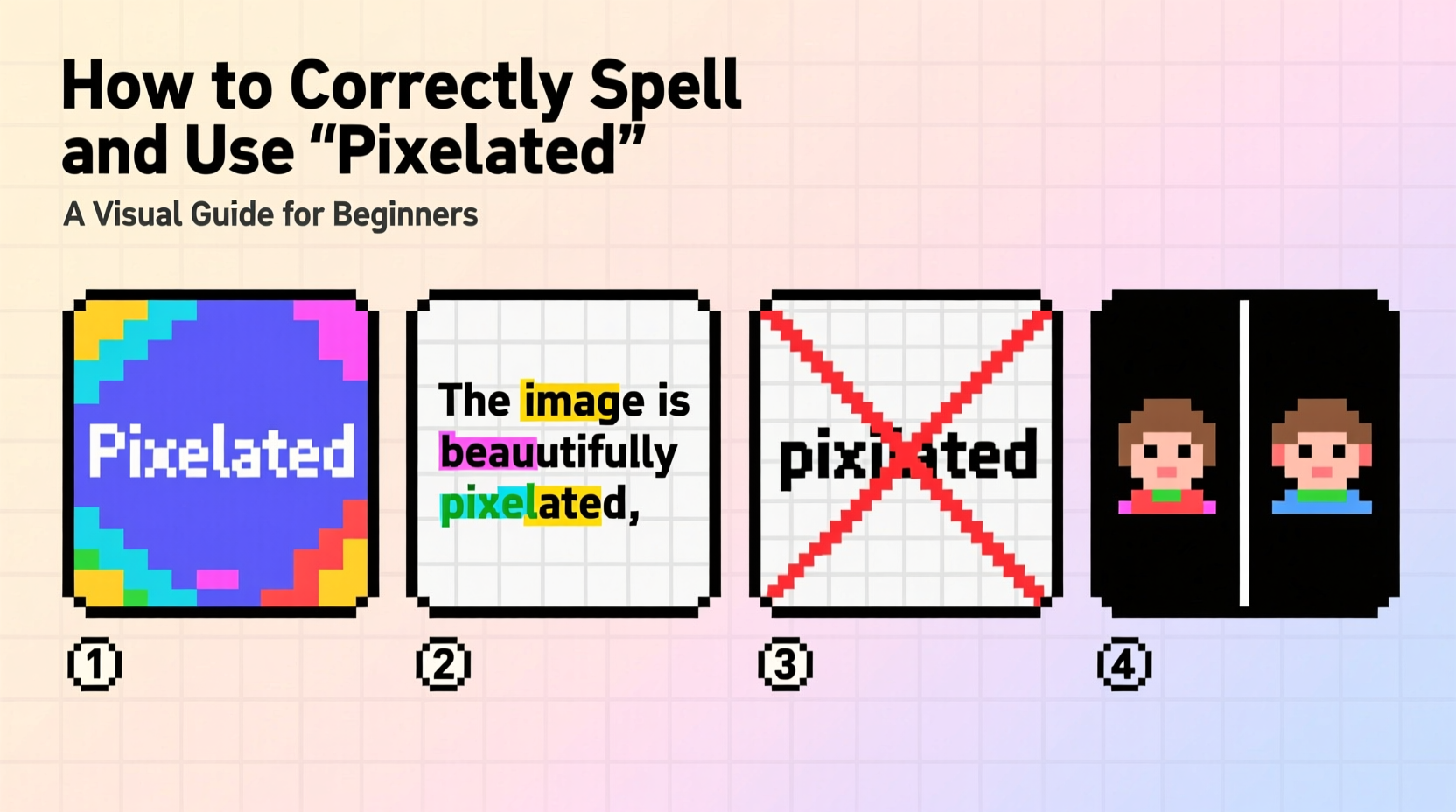
The correct spelling is pixelated. It derives from \"pixel,\" short for \"picture element,\" combined with the suffix \"-ated,\" which forms adjectives indicating a state or condition. Despite its straightforward construction, several common misspellings persist:
- Pixilated – Often confused due to homophony; however, this is an outdated term historically associated with being drunk or mentally agitated.
- Pixellated – A frequent typo where an extra \"l\" is added, likely influenced by words like \"traveled\" (American) vs. \"travelled\" (British).
- Pixillated – A double-consonant error that adds unnecessary letters.
“Accuracy in terminology starts with spelling. In digital fields, using ‘pixelated’ correctly signals technical literacy.” — Dr. Lena Torres, Digital Media Linguist
When and How to Use “Pixelated” Correctly
The term \"pixelated\" functions primarily as an adjective describing an image composed of visible square pixels, especially when those pixels are large enough to distort clarity. Its usage spans multiple domains:
In Photography and Image Editing
An image becomes pixelated when enlarged beyond its resolution limit. Each pixel expands, creating a blocky appearance. For example:
- “The surveillance footage was so pixelated that facial features were unrecognizable.”
- “Avoid over-enlarging low-resolution images to prevent them from becoming pixelated.”
In Video Games and Art Design
Here, pixelation is sometimes intentional. Retro-style games embrace pixelated graphics as part of their aesthetic:
- “Minecraft uses intentionally pixelated textures to evoke a nostalgic, blocky world.”
- “The artist created a pixelated portrait using only 16x16 color blocks.”
In Surveillance and Security Contexts
Blurring faces in videos is often referred to as “pixelating,” though technically it involves overlaying pixel blocks rather than true upscaling:
- “The suspect’s face was pixelated to protect privacy during broadcast.”
Do’s and Don’ts of Using “Pixelated”
| Do | Don't |
|---|---|
| Use “pixelated” to describe low-resolution digital images. | Use “pixilated” unless discussing old psychological terms. |
| Apply it when discussing retro video game visuals. | Mistake pixelation for compression artifacts (e.g., JPEG blocking). |
| Say “the image was pixelated on purpose for artistic effect.” | Assume all blurry images are pixelated—many are simply out of focus. |
| Spell it with one “l” and one “x”: pixelated. | Add extra consonants like “pixellated” or “pixillated.” |
Step-by-Step Guide to Avoiding Pixelation in Images
If you’re working with digital media and want to prevent unwanted pixelation, follow this sequence:
- Start with high-resolution source files. Aim for at least 300 PPI (pixels per inch) for print, 72–150 PPI for web.
- Avoid excessive scaling. Never enlarge an image more than 10–20% beyond its original dimensions without resampling tools.
- Use vector formats when possible. Vector graphics (SVG, AI) scale infinitely without pixelation.
- Apply anti-aliasing in design software. This smooths jagged edges between pixels, reducing harshness.
- Export wisely. Choose appropriate file types: PNG for transparency, JPEG for photos, WebP for modern web efficiency.
“Most pixelation issues stem from poor asset management early in the design process.” — Marcus Reed, Senior UX Designer at Nova Interactive
Real Example: The Viral Mugshot Incident
In 2021, a local news outlet published a police mugshot online without proper resolution checks. When shared widely on social media, users zoomed in—and the image became severely pixelated. Critics mocked the blurriness, accusing the outlet of using fake evidence. The station later clarified that the original file was low-res but admitted they should have labeled it as such or avoided publication altogether.
This case underscores two key points: first, public perception hinges on image quality; second, knowing when something is pixelated—and why—helps avoid credibility loss. Had the team understood resolution limits, they could have made a better editorial decision.
Checklist: Ensuring Proper Use of “Pixelated”
Before using the word in your next article, design brief, or presentation, run through this checklist:
- ✅ Am I spelling it as pixelated, not pixilated or pixellated?
- ✅ Does the context involve visible square pixels due to low resolution or intentional design?
- ✅ Am I distinguishing between pixelation and other distortions (blur, noise, compression)?
- ✅ If describing an action, am I saying “the face was pixelated” instead of “we pixilated the face”?
- ✅ Is the audience likely to understand the term? If not, consider adding a brief explanation.
Frequently Asked Questions
Is “pixelated” a real word?
Yes, “pixelated” is a legitimate English word recognized by major dictionaries including Merriam-Webster and Oxford. It describes an image broken into visible pixels, either unintentionally (due to low resolution) or intentionally (for stylistic reasons).
Can something be both blurred and pixelated?
Rarely. While both reduce clarity, they are visually distinct. Blurring softens edges uniformly, while pixelation creates sharp, blocky squares. Some video filters combine both effects, but technically they are separate phenomena.
Why do people say “pixilated” instead of “pixelated”?
“Pixilated” was historically used to mean “slightly crazy” or “possessed by pixies,” dating back to the 1800s. Due to similar pronunciation, some mistakenly use it in place of “pixelated.” However, the meanings are unrelated, and in modern usage, “pixilated” is largely obsolete outside of literary contexts.
Conclusion: Clarity Starts with Correct Usage
Mastering the correct spelling and application of “pixelated” enhances communication across digital platforms. Whether you're editing a photo, writing a tech blog, or designing a retro-inspired game, precision matters. Misusing terms like “pixelated” can confuse readers or undermine your expertise. By following the guidelines above—checking spelling, understanding context, and avoiding common pitfalls—you ensure your message remains sharp, just like a high-resolution image.




 浙公网安备
33010002000092号
浙公网安备
33010002000092号 浙B2-20120091-4
Comments
No comments yet. Why don't you start the discussion?