
The word \"ultimatum\" carries weight. It signals a final demand, often with consequences if unmet. Whether you're negotiating a contract, setting boundaries in a relationship, or writing a formal letter, using \"ultimatum\" correctly—both in spelling and context—is essential for clarity and credibility. Yet, it's frequently misspelled as \"ultimatumm,\" \"ultimatium,\" or even \"ultamatum.\" Misuse can undermine your message. This guide breaks down how to spell \"ultimatum\" flawlessly, apply it accurately in sentences, and wield it effectively in real-world scenarios.
Understanding the Correct Spelling: Why “Ultimatum” Is Not Optional
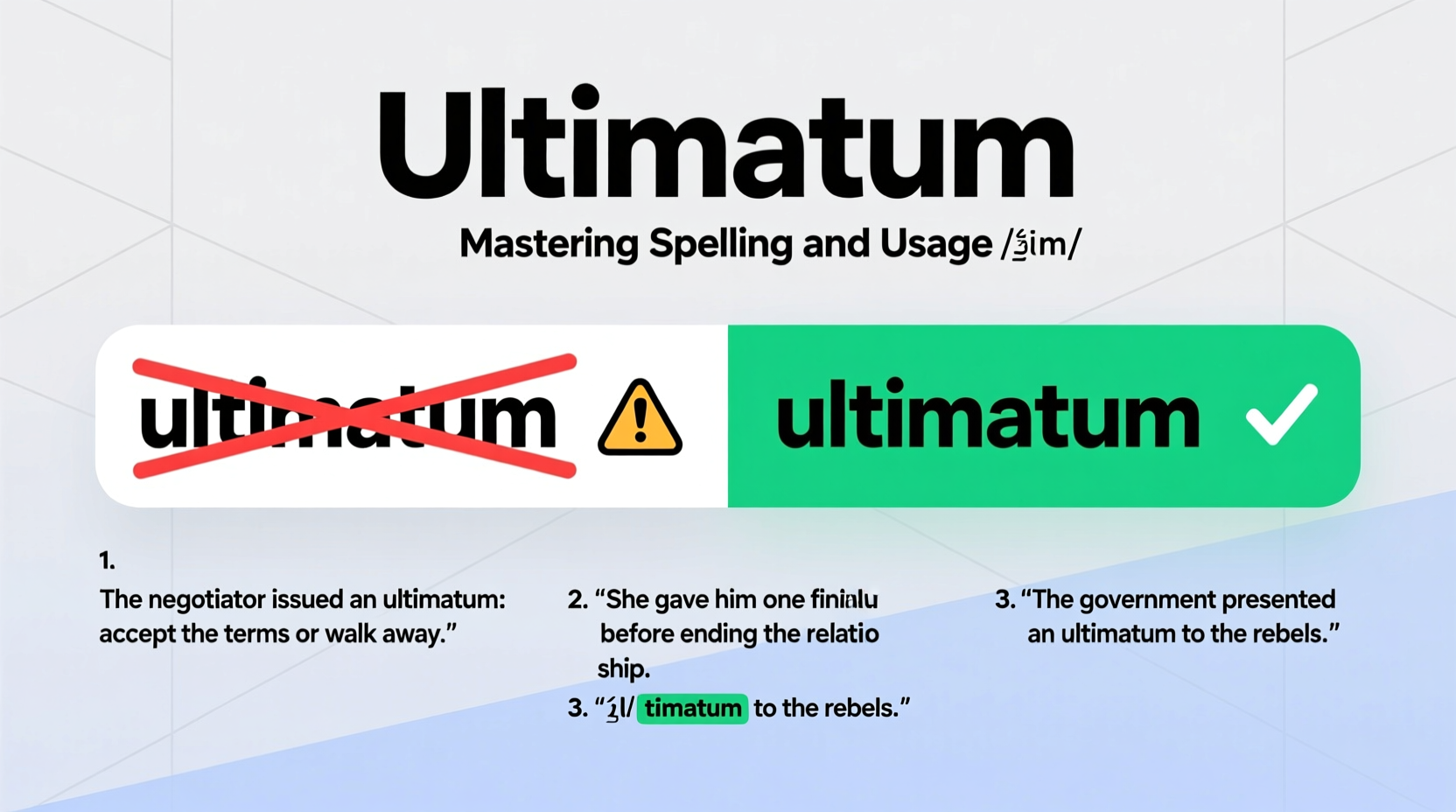
The correct spelling is u-l-t-i-m-a-t-u-m. No extra letters, no substitutions. It follows Latin roots—specifically from the neuter form of *ultimatus*, meaning \"finalized\" or \"concluded.\" Despite its foreign origin, English has adopted it without alteration. Common errors include doubling the 'm' at the end or inserting an extra vowel, such as “ultimaitum” or “ultimatuum.” These are incorrect.
One reason for confusion lies in pronunciation. The word ends with a soft \"-um\" sound, which some speakers interpret as requiring a double consonant. But unlike words like \"bacterium\" or \"medium,\" where the root may suggest variation, \"ultimatum\" remains consistent across dictionaries and style guides.
Proper Usage: When and How to Use “Ultimatum” Effectively
An ultimatum isn’t just any request—it’s a decisive statement with implied consequences. It should be reserved for situations where compromise is no longer on the table. Using it casually dilutes its impact and may make you appear unreasonable.
In diplomatic contexts, an ultimatum is issued by one nation to another before hostilities begin. In personal relationships, it might take the form of, “If you don’t seek counseling, I will leave.” In business, a manager might say, “Submit the report by Friday, or your position will be reassessed.”
The structure typically includes three elements: a demand, a deadline, and a consequence. Without all three, it risks being perceived as a warning rather than a true ultimatum.
“An ultimatum gains its power not from aggression, but from clarity. Vagueness undermines authority.” — Dr. Lena Peters, Conflict Resolution Specialist
Common Mistakes and How to Avoid Them
Misusing \"ultimatum\" can lead to miscommunication or unintended escalation. Below are frequent pitfalls and corrections:
- Using it too early: Issuing an ultimatum before exhausting dialogue suggests impatience. Save it for when negotiations stall.
- Vague phrasing: Saying “Fix this or else” lacks specificity. Define the action required and the exact outcome if ignored.
- Overuse: Repeated ultimatums erode trust. They become background noise rather than meaningful turning points.
- Emotional delivery: Anger or sarcasm weakens the message. Deliver an ultimatum calmly and factually.
| Mistake | Correct Approach |
|---|---|
| \"You need to change, or we’re done.\" | \"I’ve asked repeatedly for help with household responsibilities. If there’s no shared effort by next week, I’ll begin planning separate living arrangements.\" |
| \"Get this done now or you're fired!\" (shouted) | \"The project must be submitted by 5 PM today. Failure to meet this deadline will result in a formal performance review.\" |
| Texting an ultimatum without prior discussion | Delivering the ultimatum in person after documented attempts to resolve the issue |
Step-by-Step Guide to Constructing a Valid Ultimatum
Not every confrontation requires an ultimatum, but when one is necessary, follow these steps to ensure it’s both ethical and effective:
- Assess necessity: Have all other options been explored? Is this truly the last step?
- Clarify the demand: Be specific about what behavior must change or action must be taken.
- Set a reasonable deadline: Allow enough time for compliance, unless urgency dictates otherwise.
- Define consequences clearly: State exactly what will happen if the demand isn't met.
- Document and deliver formally: Prefer written communication in professional settings; face-to-face in personal ones.
- Follow through: If the condition isn’t met, enact the stated consequence without delay.
Real-World Example: A Workplace Ultimatum Done Right
Sarah, a team leader at a marketing firm, had repeatedly addressed poor attendance by a senior designer. Verbal reminders, written warnings, and schedule adjustments failed. After consulting HR, she issued the following:
“This is my final notice regarding your attendance. You have missed eight shifts in the past six weeks without approval. If you are absent again without prior notification and valid documentation by May 30, your employment will be terminated in accordance with company policy.”
The employee attended all scheduled shifts thereafter. Sarah avoided emotional language, cited documented history, and aligned her ultimatum with existing policy. As a result, the message was respected—not resented.
Do’s and Don’ts of Using “Ultimatum” in Writing and Speech
| Do’s | Don’ts |
|---|---|
| Use precise language | Use threats disguised as ultimatums (“I’ll make your life hell”) |
| Reference prior efforts to resolve the issue | Issue multiple ultimatums on the same topic |
| Align consequences with policies or mutual agreements | Make unrealistic or unenforceable demands |
| Remain calm and professional in tone | Deliver via passive-aggressive messages or social media |
Frequently Asked Questions
Is “ultimatum” always negative?
No. While often associated with conflict, an ultimatum can protect boundaries and promote accountability. For example, “I love you, but I need commitment. If we’re not engaged by year-end, I’ll move forward with my life” sets a healthy limit.
Can you retract an ultimatum?
You can, but doing so reduces future credibility. If new information emerges or reconciliation occurs, retraction is possible—but expect diminished influence next time.
What’s the plural of “ultimatum”?
The plural is “ultimatums.” Though it originates from Latin, English treats it as a regular noun. “Ultimata” is technically correct in classical Latin but rarely used and often misunderstood in modern English.
Final Thoughts: Speak with Clarity, Not Just Finality
Spelling “ultimatum” correctly is the first step. Using it wisely is far more important. This word is not a tool for control, but a mechanism for resolution when dialogue fails. When constructed with care, delivered with composure, and backed by consistency, an ultimatum can bring closure, enforce standards, or catalyze change.
Mastering its use means understanding not just grammar, but human dynamics. Choose it sparingly. Frame it fairly. Follow through firmly. And always remember: the goal isn’t to win a battle, but to restore or redefine a relationship—on sustainable terms.




 浙公网安备
33010002000092号
浙公网安备
33010002000092号 浙B2-20120091-4
Comments
No comments yet. Why don't you start the discussion?