
Advent is more than counting down to Christmas—it’s an invitation to presence, reflection, and gentle ritual in a season often defined by noise and haste. A personalized Advent calendar tied to daily light animations transforms this ancient practice into a tactile, sensory, and deeply intentional experience. Unlike mass-produced versions filled with chocolates or generic trinkets, this approach merges physical craftsmanship, programmable lighting, and personal meaning. It invites participants—not just children, but adults, elders, couples, or small communities—to engage with light as metaphor and medium: warmth, clarity, hope, memory, and renewal. This isn’t about complexity for its own sake. It’s about designing a tool that meets you where you are—whether you’re a maker with soldering iron in hand, a teacher seeking classroom resonance, or someone grieving, healing, or simply craving slowness. What follows is a field-tested framework grounded in design thinking, accessible electronics, and human-centered ritual.
Why Light—and Why Personalized?
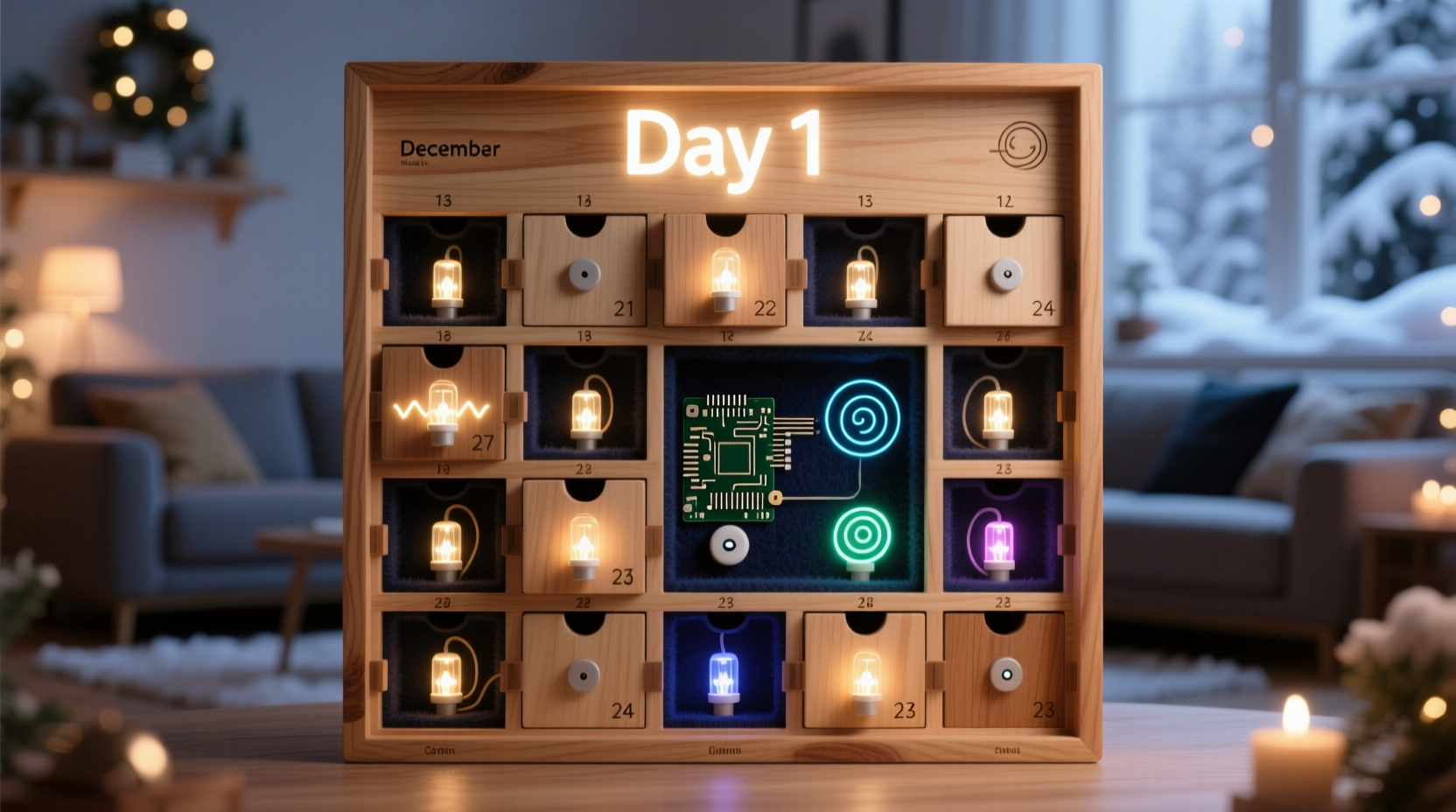
Light has anchored spiritual and seasonal practices across cultures for millennia: the Hanukkah menorah, Diwali diyas, Yule candles, Kwanzaa kinara. Neuroscience confirms what tradition has long known: rhythmic, warm-toned light exposure at consistent times supports circadian alignment, reduces seasonal affective symptoms, and enhances emotional regulation. But when light is decoupled from commercial packaging and pre-scripted messages—and instead rooted in your values, memories, or aspirations—it becomes generative rather than consumptive.
Personalization shifts the focus from acquisition to attunement. A child might open a drawer revealing a handwritten note about kindness, while overhead LEDs shift from cool blue to amber—mirroring the transition from morning awareness to evening gratitude. An elder might receive a small wooden box engraved with a family date; pressing it triggers a soft pulse of gold light and plays a 12-second voice memo from a grandchild. The animation isn’t spectacle—it’s punctuation. It marks time with meaning.
“Technology becomes sacred not when it’s hidden, but when it serves silence. A well-designed light ritual doesn’t distract—it deepens attention to what’s already present.” — Dr. Lena Torres, Human-Computer Interaction Researcher & Liturgical Designer, MIT Media Lab
Core Components: What You’ll Actually Need
A successful implementation rests on three interlocking layers: the physical calendar structure, the lighting system, and the narrative or experiential content. None requires professional expertise—but each demands thoughtful integration.
| Layer | Key Elements | Accessibility Notes |
|---|---|---|
| Physical Structure | Wooden box with 24 compartments; fabric pockets sewn onto a wall hanging; repurposed book with hollowed pages; ceramic tiles mounted on corkboard | No soldering or coding needed at this stage. Focus on durability, tactile quality, and ease of daily interaction (e.g., low-height drawers for children or mobility aids). |
| Light System | WS2812B addressable LED strip (or individual NeoPixels); microcontroller (Arduino Nano, Raspberry Pi Pico, or ESP32); power supply (5V, 2–3A minimum); optional motion sensor or capacitive touch pad | Pre-soldered development boards (like Adafruit ItsyBitsy) eliminate soldering. Drag-and-drop coding platforms (MakeCode, CircuitPython Thonny) support beginners. Battery operation possible for portability. |
| Narrative Layer | Daily prompts (questions, quotes, memories), small objects (a seashell from a summer trip, a pressed flower), audio clips (<5 sec), tactile tokens (smooth stone, textured fabric swatch) | Content must be co-created—not assigned. Include multilingual options, braille labels, or audio-only pathways for neurodiverse or visually impaired participants. |
A Step-by-Step Implementation Timeline
Build this over six weeks—not as a sprint, but as part of the Advent preparation itself. Each phase mirrors the reflective arc of the season.
- Week 1: Intention & Inventory
Define your “why”: Is this for grief processing? Family connection? Classroom mindfulness? List 3–5 core themes (e.g., “gratitude,” “resilience,” “listening”). Gather physical materials you already own—no new purchases yet. - Week 2: Structure Design
Sketch your calendar layout. Will doors open left-to-right? Will compartments be accessed vertically or horizontally? Ensure ergonomics: door pulls at comfortable height, clear visual hierarchy, intuitive numbering. Prototype one compartment using cardboard and tape. - Week 3: Light Integration
Solder or plug in one LED to your microcontroller. Write code that cycles through three colors for five seconds each. Then modify it to hold amber for 10 seconds when triggered by a button press. This is your foundational script—everything else extends from here. - Week 4: Content Curation
Write or select your first 7 daily entries. For each, define: (a) the physical item or prompt, (b) the target light behavior (e.g., “pulse 3x in soft white, then fade to candle-gold”), and (c) the emotional intention (“to evoke safety”). Read them aloud. Discard any that feel performative rather than inviting. - Week 5: Assembly & Calibration
Mount LEDs behind translucent panels (rice paper, frosted acrylic, thin linen). Test brightness levels in ambient room light—avoid glare. Calibrate timing so animations last no longer than 12 seconds. Record audio clips at consistent volume and tone. - Week 6: Dry Run & Refinement
Simulate December 1–7. Note friction points: Is the button hard to press? Does the light color misalign with the prompt’s mood? Does the object feel too fragile? Adjust *before* December 1. Ritual only sustains when friction is minimized.
Real Example: The “Memory Lantern” Calendar for Grieving Families
In late 2022, Maria—a hospice social worker in Portland—designed a calendar for families supporting loved ones nearing end-of-life. She named it the “Memory Lantern.” Rather than countdown to Christmas, it counted down to a family’s chosen “light day”—a date marking a milestone in their grief journey (e.g., six months since diagnosis, the anniversary of a first joyful outing post-diagnosis).
The physical structure was a walnut box with 24 sliding bamboo panels. Behind each panel sat a small LED ring and a compartment holding one tactile memory: a sprig of lavender from the garden they’d planted together, a fragment of a favorite recipe card, a smoothed river stone collected on a shared walk. When a panel slid open, the ring lit in a hue corresponding to the memory’s emotional texture—lavender for calm, terracotta for warmth, slate gray for honest sorrow. The light didn’t “fix” grief; it witnessed it. Families reported that the predictable, gentle animation created psychological safety: “Knowing the light would come—soft, never harsh—made opening the panel feel like breathing, not bracing.”
Maria embedded no timers or auto-advances. Each light sequence lasted exactly 11 seconds—the average length of a conscious breath cycle—reinforcing somatic grounding. Her only technical modification? Replacing standard resistors with ones calibrated for lower voltage, ensuring the light remained warm even after hours of use.
Essential Tips for Meaningful Integration
- Match light temperature to intention: Use 1800K–2200K (candle-like) for reflection or comfort; 2700K–3000K (warm white) for energy or celebration; avoid >4000K (cool white) unless deliberately evoking clarity or alertness.
- Design for silence first: Let the physical object or prompt land for 3 full seconds *before* the light activates. This pause honors anticipation—the heart of Advent.
- Embrace imperfection: If a light flickers or a panel sticks, name it aloud: “Today’s light reminds us that even steady things waver—and that’s part of being human.” Authenticity deepens resonance more than polish.
- Decouple from screens: Avoid Bluetooth apps or smartphone dependencies. Use physical buttons, pull cords, or proximity sensors. The ritual should live in the body, not the device.
- Plan for aftermath: Include a “25th door” containing instructions for dismantling: how to reuse LEDs, compost natural materials, or archive audio files. Rituals gain weight when they honor their own ending.
FAQ: Practical Questions Answered
Do I need coding experience to build this?
No. Modern microcontrollers support visual programming (MakeCode), drag-and-drop blocks (Arduino Create), or simple Python scripts (CircuitPython). A functional light sequence—triggered by a button, cycling through two colors—requires under 15 lines of code. Libraries like neopixel handle complex timing automatically. Start with Adafruit’s “CircuitPython for Absolute Beginners” guide—it takes under 90 minutes.
What if I want sound *and* light—but don’t want speakers everywhere?
Use bone-conduction transducers. These small, flat devices attach directly to wood or ceramic surfaces and turn the material itself into a speaker. Mounted discreetly inside a calendar compartment, they emit subtle, localized audio—just enough for a whispered quote or chime—without external hardware. They draw minimal power and integrate cleanly with the same microcontroller managing your lights.
Can this work in a classroom with 30 students?
Absolutely—with distributed design. Assign small groups to co-create one day each: research a historical light tradition (Diwali, St. Lucia), write a 20-word reflection, and design a 5-second light pattern (e.g., “three quick pulses like a lighthouse”). Mount all 24 patterns on a single large board with shared wiring. Students activate their day’s light via a communal button. Ownership multiplies impact.
Conclusion: Your Light Is Already Waiting
You don’t need permission to begin. You don’t need flawless execution. You don’t need to wait for December—or even for Advent—to start shaping a practice that honors your inner rhythm. The most powerful light animations aren’t those with the most pixels or the fastest transitions. They’re the ones that meet a quiet need: the child who needs to *see* kindness made visible; the caregiver who needs 12 seconds of amber light to remember her own worth; the community gathering in a dim room, watching 24 small glows awaken one by one, not as decoration, but as affirmation.
This calendar isn’t built to be perfect. It’s built to be *lived in*. To gather fingerprints on wood, to soften fabric edges with repeated handling, to hold the slight variation in how light falls on a surface each day as the sun shifts. Its value compounds not in technical precision, but in accumulated attention—in the way a simple pulse of light, paired with a single word or object, can recalibrate an entire day.
So choose one step. Not all of them. Sketch the shape of one compartment. Write one sentence that matters to you right now. Wire one LED. Let that be enough—for today. Because Advent, at its core, is the practice of showing up, imperfectly and faithfully, to the light that’s already within reach.




 浙公网安备
33010002000092号
浙公网安备
33010002000092号 浙B2-20120091-4
Comments
No comments yet. Why don't you start the discussion?