
Christmas trees are iconic symbols of the season—but their environmental cost is rarely acknowledged. Over 35 million real trees are cut down annually in the U.S. alone, many ending up in landfills where they emit methane as they decompose. Artificial trees, while reusable, are typically made from non-recyclable PVC and petroleum-based plastics, with an average lifespan of just six years before disposal. Meanwhile, shipping, packaging, and end-of-life waste compound the footprint.
A zero-waste Christmas tree isn’t about sacrifice—it’s about intentionality, creativity, and reclaiming tradition through resourcefulness. It’s possible to build a stunning, structurally sound, and warmly lit tree that generates no landfill-bound waste, uses only reclaimed or compostable materials, and carries personal resonance far beyond mass-produced alternatives. This approach aligns with circular design principles: nothing is discarded; everything is repurposed, reused, or returned safely to the earth.
Why Zero-Waste Trees Matter Beyond Sustainability
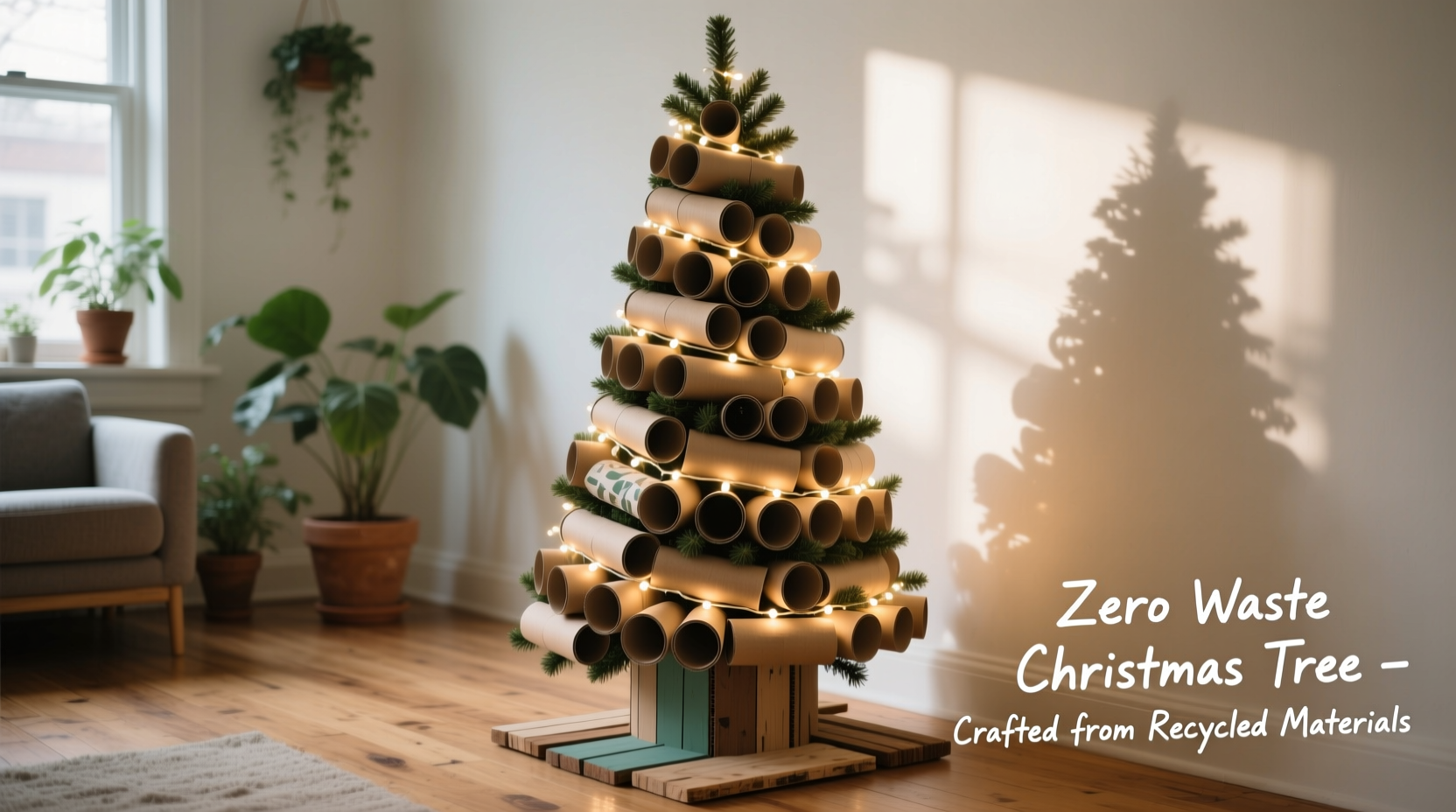
A zero-waste tree shifts the focus from consumption to curation. It invites reflection on what celebration truly means—not accumulation, but presence; not perfection, but participation. When families gather to assemble a tree from old books, wine corks, or scrap wood, the act becomes collaborative storytelling. Children learn material literacy early: how paper fibers hold shape, how copper wire conducts light, how cardboard layers can mimic pine boughs when scored and curled.
It also challenges the seasonal disposability mindset. According to the Ellen MacArthur Foundation, 95% of Christmas-related packaging and décor is used once and discarded. A zero-waste tree breaks that cycle by design—its components either return to nature (like untreated willow or dried citrus slices) or re-enter circulation (like salvaged copper wire or vintage glass bulbs). As sustainability researcher Dr. Lena Torres notes:
“Zero-waste holiday practices don’t just reduce emissions—they rebuild cultural muscle for stewardship. When people invest time in making rather than buying, they develop emotional ownership over sustainability—not as obligation, but as identity.” — Dr. Lena Torres, Circular Design Lead, Stockholm Resilience Centre
Core Principles of Zero-Waste Tree Construction
Before gathering materials, anchor your project in three non-negotiable principles:
- Material Integrity: Every component must be either post-consumer recycled, salvaged, naturally compostable, or indefinitely reusable. No virgin plastic, no single-use adhesives, no laminated paper.
- Energy Consciousness: Lighting must draw under 5 watts total and operate on low-voltage DC power (e.g., USB-powered LED strings or solar-charged batteries). Avoid AC transformers that leak energy when idle.
- End-of-Life Clarity: At dismantling time, every part must have a defined next life: backyard compost bin, local metal recycler, community art studio donation, or storage for next year’s reuse.
Step-by-Step Build Guide: The Recycled Cardboard & Cork Tree
This scalable, modular design stands 5–6 feet tall, requires no power tools, and can be assembled in under four hours. It uses only two primary materials—cardboard and wine corks—with optional natural accents.
- Gather & Prep Materials (30 min): Collect 12–15 clean corrugated cardboard boxes (shipping boxes work best—avoid waxed or glossy coatings). Remove all tape and staples. Soak 80–100 natural-cork wine stoppers (not synthetic composites) in warm water for 20 minutes to soften.
- Cut Trunk & Branches (60 min): Cut one 6-inch-diameter cylinder (height = desired trunk height minus 6 inches) from thick cardboard. For branches, cut 24–30 identical isosceles triangles (base = 10 inches, height = 18 inches). Score each triangle along its centerline at 1/4-inch intervals—this creates natural “bough” texture when bent.
- Assemble Structure (45 min): Stack and glue triangles in alternating directions (point-up, point-down) around the trunk using wheat paste (flour + water, cooked to 160°F) or hide glue. Secure with biodegradable twine while drying. Let cure overnight.
- Attach Corks (40 min): Pierce each softened cork with a blunt needle or skewer. Thread onto thin, uncoated copper wire (salvaged from old electronics or lamp cords). Wrap cork strands tightly around branch tips, securing ends with a drop of plant-based glue. Corks add weight, texture, and subtle reflectivity.
- Install Lights (25 min): Use a single strand of 20 micro-LEDs (USB-rechargeable, 0.05W per bulb). Weave the wire through cork clusters and behind cardboard folds, hiding the cord. Power via a solar-charged 5V power bank stored discreetly in the base.
The result is a sculptural, tactile tree with organic asymmetry—no two branches identical, no two cork patterns repeating. Its warmth comes not from wattage, but from visible human care.
Material Comparison & Sourcing Guide
Not all recycled materials perform equally well. This table compares common options by structural integrity, fire resistance, light compatibility, and end-of-life pathway:
| Material | Best Use Case | Fire Resistance | Light Compatibility | End-of-Life Pathway |
|---|---|---|---|---|
| Corrugated cardboard (uncoated) | Trunk, branches, base | Moderate (treat with borax solution if needed) | Excellent—diffuses light softly | Home compost (shredded) or recycling |
| Natural wine corks | Ornamental clusters, branch tips | High (self-extinguishing) | Good—translucent when backlit | Compost (takes 3–5 years) or reuse indefinitely |
| Salvaged copper wire | Lighting circuits, structural binding | Non-combustible | Ideal—conductive, malleable, timeless | Recyclable infinitely without degradation |
| Dried citrus slices | Hanging ornaments | Low (remove before lighting) | Poor (heat-sensitive) | Compost or garden mulch |
| Old sheet music or book pages | Origami ornaments, garlands | Low (treat with alum spray) | Fair—thin paper glows gently | Compost (ink-free paper only) |
Real Example: The “Library Tree” in Portland, OR
In December 2023, librarian Maya Chen transformed her neighborhood branch’s annual tree into a community artifact. She invited patrons to donate damaged library books—those with torn covers or water stains deemed unfit for circulation. Volunteers removed spines, flattened pages, and rolled them into tight cones resembling pinecones. These were wired onto a frame built from reclaimed maple shelving. Instead of tinsel, they strung donated brass keys (from local locksmiths’ surplus) and threaded them with salvaged filament from broken incandescent bulbs—creating tiny amber lanterns when lit.
The tree stood in the children’s section for six weeks. After the holidays, every component was sorted: paper cones composted onsite, brass keys returned to the locksmith for reuse, copper wiring sent to a metal recycler, and the maple frame disassembled for future furniture repair workshops. “People didn’t just look at it,” Maya shared. “They touched the pages, recognized titles they’d checked out years ago, and told stories about the books. That’s the magic—waste becomes memory.”
Essential Zero-Waste Tree Checklist
- ☐ All cardboard is uncoated, unstapled, and free of plastic lamination
- ☐ Lights draw ≤5W total and use DC power (no wall-wart transformers)
- ☐ Adhesives are plant-based (wheat paste, casein, or hide glue)—no PVA or hot glue
- ☐ Decorations are either compostable (dried fruit, pinecones), reusable (glass beads, metal charms), or recyclable (copper, aluminum)
- ☐ Base is weighted with reclaimed sandbags, river stones, or cast-off concrete chunks—not new plastic weights
- ☐ A written “deconstruction plan” exists—listing where each material goes post-holiday
FAQ: Practical Questions Answered
Can I use old Christmas lights—or do I need new ones?
Only if they’re LED and rated for indoor decorative use. Incandescent strands generate excessive heat (a fire risk near dry cardboard or paper) and consume 8–10× more energy. If you have working LED lights from past years, test each bulb and replace faulty ones with compatible LEDs—never mix technologies. Discard burnt-out incandescents responsibly at an e-waste facility.
What if I don’t drink wine—where do I get natural corks?
Many local restaurants, breweries, and wine shops save corks for recycling programs like ReCork or Cork Forest Conservation Alliance. Call ahead and ask if they’ll set aside natural corks (not synthetic “neo-corks”) for pickup. Alternatively, order bulk natural corks online—look for FSC-certified suppliers who ship in recycled paper packaging with no plastic wrap.
How do I keep the tree stable without a plastic stand?
Build a base from two interlocking cardboard rings (12-inch and 14-inch diameter), glued with wheat paste and reinforced with cross-bracing strips. Fill the inner ring with smooth river stones (collected locally, not purchased) or repurposed concrete rubble from home renovations. Insert the trunk into a pre-cut slot in the top ring. The weight and friction hold it upright—no screws, no plastic, no assembly required.
Expanding the Practice: From Tree to Tradition
A zero-waste tree isn’t a one-off project—it’s the first node in a resilient, values-aligned holiday practice. Once mastered, extend the ethos: make ornaments from fabric scraps and fallen branches; wrap gifts in reused maps, scarves, or cloth produce bags tied with jute twine; bake cookies using composted citrus peels from your tree decorations; host a “repair café” instead of a gift exchange, mending toys, lamps, and textiles together.
This isn’t austerity. It’s abundance of a different kind—the richness of attention, the satisfaction of skill, the quiet pride in knowing your celebration leaves no trace but goodwill. As artist and zero-waste advocate Javier Ruiz reminds us:
“The most sustainable object is the one already in your hands. The most meaningful decoration is the one you made with someone you love. The greenest tree grows not in the forest—but in your living room, built from yesterday’s ‘waste’ and lit by tomorrow’s intention.” — Javier Ruiz, Founder, Material Makers Collective
Conclusion: Your Tree Is Already Growing
You don’t need special tools, rare materials, or artistic training to begin. You need only a cardboard box, a handful of corks, a few feet of copper wire, and the willingness to see potential where others see refuse. This tree won’t arrive wrapped in plastic on a pallet—it will emerge slowly, thoughtfully, alongside conversations with family, neighbors, or yourself. Its branches will hold not just lights, but stories: of the book whose pages became a cone, the bottle whose cork now catches the glow, the afternoon spent measuring, cutting, and connecting.
Start small this year—even a tabletop version made from stacked vintage encyclopedias and fairy lights powered by a bicycle dynamo counts. Document your process. Share your deconstruction plan. Tag local makerspaces or libraries—they’ll want to replicate it. And when December arrives again, you’ll find your tree isn’t something you buy or cut. It’s something you grow—rooted in care, branching outward in generosity, and always returning, gratefully, to the earth.




 浙公网安备
33010002000092号
浙公网安备
33010002000092号 浙B2-20120091-4
Comments
No comments yet. Why don't you start the discussion?