
Large Christmas trees—those towering evergreens standing over 8 feet tall—demand more than just stringing lights from top to bottom. When done poorly, the result can be glaring in some spots and dark in others, undermining the grandeur these trees are meant to convey. A balanced lighting layout ensures even glow, depth, and visual harmony, transforming your tree into a radiant centerpiece. Achieving this balance requires thoughtful planning, proper materials, and an understanding of light distribution principles tailored to scale.
Unlike smaller trees that can rely on a single strand or two, oversized trees need strategic layering, careful spacing, and attention to wattage, color temperature, and circuit load. This guide walks through the essential steps, tools, and techniques professionals use to illuminate large trees without overwhelming interiors or risking electrical issues.
Understanding Light Distribution on Tall Trees
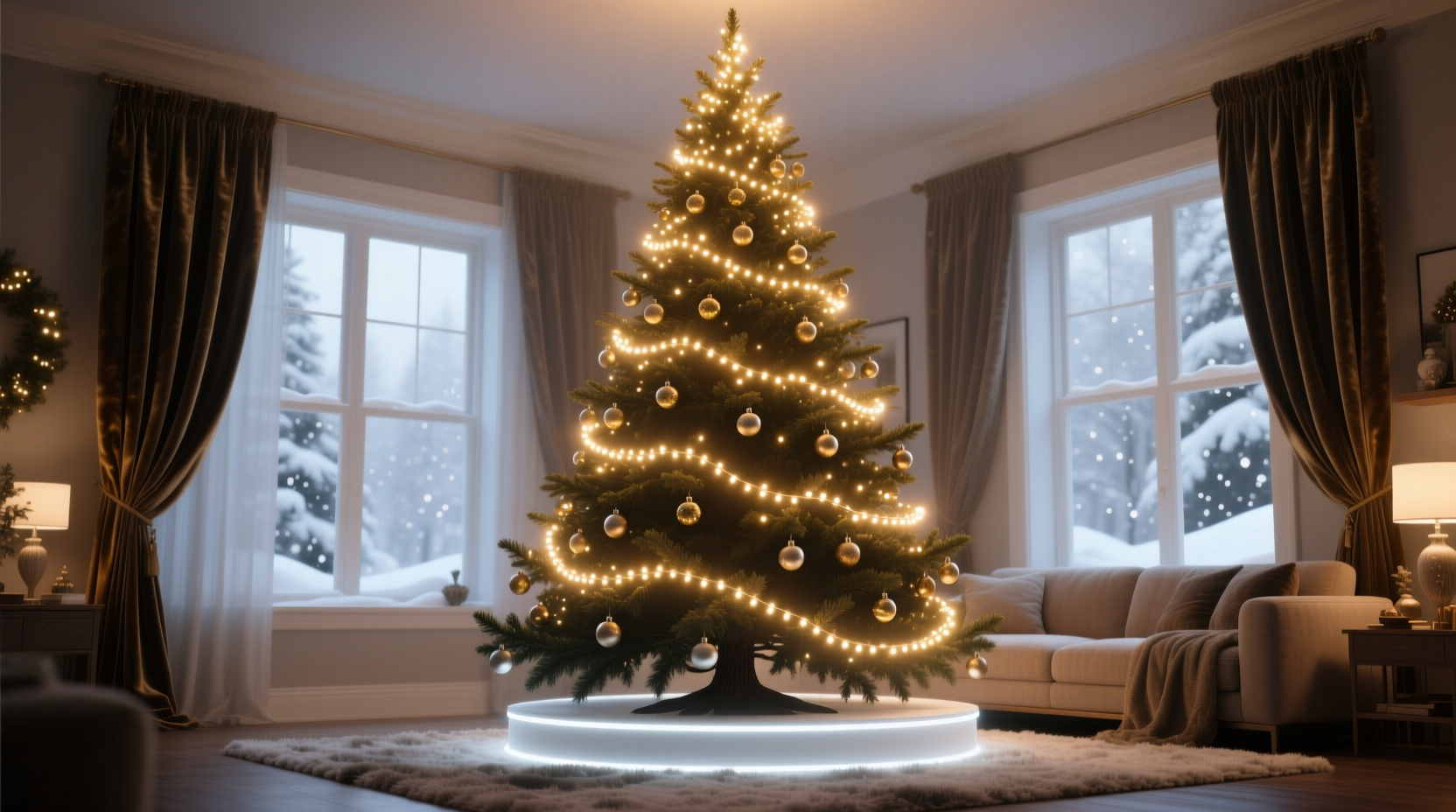
A tree exceeding 8 feet has significantly more surface area and volume than standard models. The average 7-foot tree might require 500–700 lights, but larger versions often need 1,000 to 2,000 or more. However, quantity alone doesn’t guarantee quality. The key is not how many lights you use, but how they are distributed across the tree’s three-dimensional structure.
Light should appear to emanate from within the tree, not just cling to its outer shell. This effect is achieved by placing lights at multiple depths—near the trunk, mid-branch, and outer tips—creating layers of illumination. Without this approach, the tree may look flat or patchy when viewed from different angles.
The shape of the tree also influences lighting strategy. Full-bodied firs and spruces hold lights well due to dense branching, while slender or sparse varieties may require denser wiring to avoid visible gaps. Always assess your tree’s silhouette before purchasing lights.
Step-by-Step Guide to Installing Lights on Oversized Trees
Installing lights on a large tree is a process best approached systematically. Rushing leads to uneven coverage and tangled cords. Follow this timeline-tested method to ensure consistent brightness from base to tip.
- Inspect and prep the tree: For artificial trees, assemble all sections and fluff branches thoroughly. For live trees, secure the stand and allow the tree to settle for a few hours before decorating.
- Determine total light count: Use the rule of thumb—100 lights per vertical foot. An 8-foot tree needs at least 800, but 1,000+ is recommended for fullness. Adjust based on tree density.
- Select compatible strands: Choose LED mini lights with end-to-end connectors so you can daisy-chain them safely. Ensure all strands are rated for indoor use and have UL certification.
- Divide the tree into zones: Mentally split the tree into thirds—bottom, middle, and top. Assign a specific number of strands to each section to maintain proportional brightness.
- Begin at the base, work inward: Start near the trunk at the bottom and wrap lights deep into the branches, spiraling upward. This creates internal illumination and prevents a hollow appearance.
- Layer outward gradually: After securing inner layers, add secondary strands closer to the tips. Overlap slightly with previous rows to eliminate dark pockets.
- Test frequently: Plug in each set of strands after installation to catch dead bulbs or connection issues early.
- Adjust for symmetry: Step back every few minutes and view the tree from multiple angles. Reposition any clusters that appear too bright or sparse.
This methodical approach prevents overcrowding at the bottom—a common mistake where decorators run out of lights before reaching the top. By allocating strands in advance and working progressively, you ensure uniform coverage.
Choosing the Right Lighting Materials
Not all Christmas lights are suitable for large trees. The wrong choice can lead to overheating, excessive energy use, or fragile connections prone to failure. Here’s what to prioritize:
- LED vs. Incandescent: LEDs consume up to 90% less energy, generate minimal heat, and last significantly longer—critical for extended holiday displays.
- Bulb spacing: Opt for strands with 4- to 6-inch spacing. Closer spacing works better on dense trees; wider spacing suits open-branch designs.
- Wire color: Green wire blends with artificial trees; white or clear wire works best on real trees with lighter bark.
- Shatterproof bulbs: Essential if children or pets are nearby, especially on lower sections.
- Dimmable options: Allow flexibility in ambiance, letting you tone down brightness in smaller rooms or during daytime viewing.
| Feature | Recommended | Avoid |
|---|---|---|
| Wattage per strand | < 4 watts (LED) | > 20 watts (incandescent) |
| Max daisy-chain length | Up to 100 sets (check label) | Exceeding manufacturer limit |
| Connector type | Stackable, tight-fit plugs | Loose or exposed metal contacts |
| Outdoor-rated? | No (unless near windows/doors) | Using outdoors indoors due to durability myths |
Investing in high-quality, commercial-grade strands pays off in reliability and safety. Cheap lights often fail mid-season and pose fire risks when overloaded.
Real Example: Lighting a 10-Foot Fraser Fir in a Two-Story Foyer
Jamie Rivera, a residential stylist in Vermont, was tasked with illuminating a 10-foot Fraser fir placed beneath a cathedral ceiling. The space received ample natural light during the day, making evening contrast critical. Her challenge: achieve a luminous yet balanced effect visible from both ground level and a second-floor balcony.
She began by calculating 1,200 warm white LED mini lights—12 strands of 100 bulbs each. She divided them equally among three levels: four strands layered deeply in the lower third, four in the middle, and four concentrated toward the upper crown. To enhance depth, she used two additional strands of twinkle lights, interspersed sparingly along interior branches for subtle movement.
Each strand was tested before installation. She wrapped lights starting at the trunk, moving outward in a corkscrew pattern, ensuring no bare trunks were visible. After completion, she evaluated the tree at dusk from five vantage points: front, side, balcony, corner, and adjacent hallway. Minor adjustments were made to two clusters on the north-facing side, which initially appeared dimmer due to ambient light from a nearby window.
The final result was a tree that glowed evenly from every angle, with no harsh hotspots or shadowed zones. Homeowners reported it became the focal point of their holiday gatherings, with guests frequently commenting on its professional finish.
“Large trees aren’t just taller—they’re volumetric. You have to think in layers, not lines.” — Lena Torres, Professional Holiday Lighting Designer
Common Mistakes and How to Avoid Them
Even experienced decorators make errors when scaling up. These pitfalls are especially noticeable on tall trees:
- Overloading circuits: Plugging too many strands into one outlet can trip breakers or create fire hazards. Spread loads across multiple circuits and use power strips with surge protection.
- Hanging lights like garlands: Draping strings loosely over branches creates sagging lines and uneven spacing. Wrap, don’t drape.
- Neglecting the backside: Many focus only on the front. Rotate the tree as you work to ensure 360-degree coverage, especially in open-floor plans.
- Using mismatched colors or bulb types: Mixing cool white with warm white or C9s with mini lights breaks visual continuity. Stick to one color temperature and style.
- Starting from the top: Gravity makes it harder to control tension and placement when descending. Begin low and spiral upward for better control.
Checklist: Balanced Lighting Layout for Large Trees
Use this checklist before, during, and after installation to ensure optimal results:
- ☐ Measure tree height and calculate required number of lights (100 per foot minimum)
- ☐ Choose energy-efficient, UL-listed LED strands with consistent color temperature
- ☐ Test all strands for burnt-out bulbs or faulty connectors
- ☐ Fluff tree fully to reveal branch structure and hiding spots
- ☐ Divide lights into thirds for proportional distribution
- ☐ Begin wrapping at the trunk, working inward to outward
- ☐ Spiral upward in a consistent pattern (clockwise or counterclockwise)
- ☐ Plug in and test each section as you go
- ☐ View from multiple angles and adjust clusters as needed
- ☐ Secure loose wires with twist ties or floral pins (avoid sharp objects)
- ☐ Connect to timers or smart outlets for automated operation
- ☐ Store strands on reels or cardboard spools after removal to prevent tangles next year
Frequently Asked Questions
How many lights do I really need for a 9-foot tree?
While the basic guideline is 100 lights per foot, a 9-foot tree benefits from 1,000 to 1,500 bulbs depending on fullness. Dense trees can handle more; sparse ones may need fewer but strategically placed strands to avoid clutter.
Can I mix colored and white lights on a large tree?
Yes, but do so intentionally. Use white lights as the base layer for even illumination, then add colored lights as accents—on tips, around ornaments, or in themed sections. Avoid alternating colors randomly, which can create a carnival-like effect.
Is it safe to leave large-lighted trees on overnight?
With modern LED lights and proper setup, yes—provided you use surge-protected outlets, check connections regularly, and turn them off when leaving home or sleeping. Never leave incandescent-lit trees unattended for long periods due to heat risk.
Final Thoughts and Next Steps
A well-lit large Christmas tree does more than decorate a room—it sets a mood, draws people together, and becomes a lasting memory. The effort invested in creating a balanced lighting layout pays dividends in beauty, safety, and seasonal joy. With the right tools, technique, and attention to detail, even the tallest tree can shine with professional elegance.
Don’t settle for haphazard strands or uneven glows. Apply these strategies this holiday season to transform your oversized tree into a luminous masterpiece. Whether you're styling a home foyer, community center, or retail display, balanced lighting makes all the difference.




 浙公网安备
33010002000092号
浙公网安备
33010002000092号 浙B2-20120091-4
Comments
No comments yet. Why don't you start the discussion?