
A blacklight Christmas tree transforms a traditional holiday centerpiece into an immersive, otherworldly experience—glowing with vivid purples, electric blues, and neon pinks under ultraviolet light. Unlike standard LED-lit trees, this design relies on photoluminescence: certain materials absorb UV energy and re-emit it as visible light, creating a radiant, almost three-dimensional glow. Done well, it’s not just festive—it’s atmospheric, memorable, and deeply customizable. But success hinges on more than just buying “glow-in-the-dark” ornaments. It requires understanding UV wavelengths, material responsiveness, spectral compatibility, and safe lighting practices. This guide distills field-tested insights from lighting designers, holiday display professionals, and UV materials researchers to help you build a cohesive, brilliant, and *safe* blacklight tree—without trial-and-error waste or disappointing dimness.
Understanding UV Light and Photoluminescence
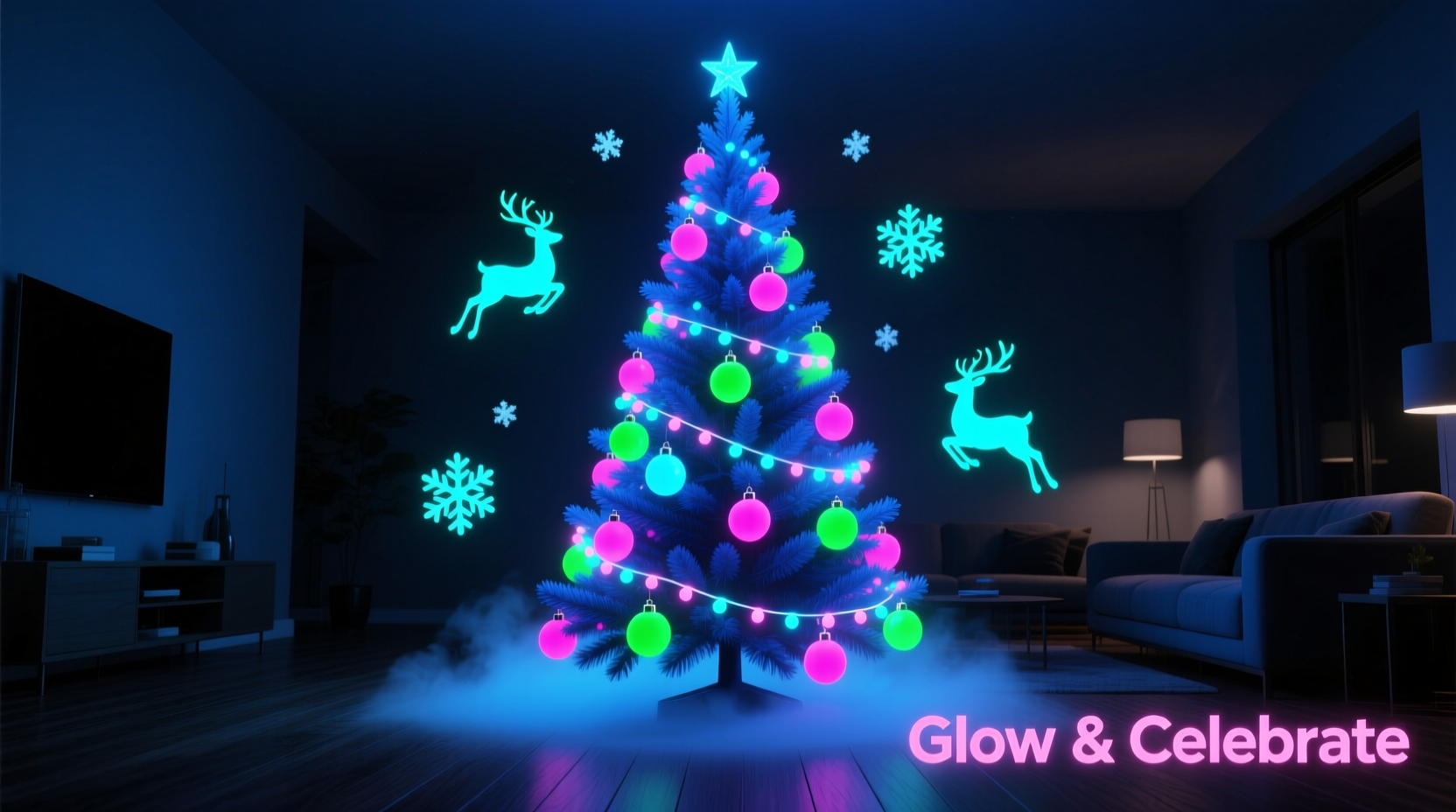
Not all “blacklights” are equal—and not all “glow” decorations actually glow under them. True blacklight refers to long-wave ultraviolet radiation (UVA), typically in the 365–400 nm range. Shorter wavelengths (UVC, below 280 nm) are hazardous and used only in sterilization equipment—not holiday displays. For home use, UVA lamps emit minimal visible violet light while maximizing invisible UV output that excites phosphors in reactive materials.
Photoluminescence occurs when electrons in certain pigments absorb UV photons and jump to a higher energy state; as they return to baseline, they release energy as visible light. The color emitted depends on the pigment’s molecular structure—not the color you see under daylight. A white ornament may fluoresce bright yellow, while a deep blue one might glow electric green. That’s why visual appearance under room light is misleading: what matters is the presence of optical brighteners, zinc sulfide, strontium aluminate, or proprietary fluorescent dyes.
“Fluorescence isn’t about pigment brightness—it’s about quantum efficiency. A matte white cotton ball treated with optical brightener will out-glow a glossy plastic ornament without it. Always test under your actual lamp.” — Dr. Lena Torres, Materials Scientist, Illumination Research Group at Rensselaer Polytechnic Institute
Essential Gear: Lamps, Tree, and Safety Foundations
Your lighting system sets the ceiling for brilliance. Skip cheap “party blacklights” sold in novelty stores—they often emit weak 395–405 nm light with heavy visible violet bleed, washing out contrast and dulling fluorescence. Instead, invest in professional-grade UVA lamps:
- LED Strip Lights (365 nm): Flexible, low-heat, and easily concealed within branches. Look for IP65-rated strips with aluminum heat sinks for sustained operation.
- UV Floodlights (365 nm, 15–30W): Ideal for larger trees (7+ feet). Mount two units at 45° angles behind the tree for even coverage and minimal shadowing.
- UV Canister Lights (365 nm): Compact, directional, and perfect for tabletop trees or accent zones. Use three to four around the base for 360° emission.
Avoid mercury-vapor or fluorescent tube blacklights—they generate excessive heat, contain hazardous materials, and degrade rapidly after 200–300 hours. Modern 365 nm LEDs last 25,000+ hours and maintain >90% output intensity over 5 years.
The tree itself must support both aesthetics and function. Real pine or fir branches scatter light poorly and absorb UV—dimming nearby decorations. Artificial trees work best, but not all are equal. Choose a full-profile PVC or PE tree with dense, layered branch tips (minimum 1,200 tips for a 6-foot tree). Avoid metallic or mirrored finishes—these reflect UV unpredictably and create hotspots. Matte white or off-white branch tips provide neutral background contrast, letting reactive colors pop. Pre-lit trees? Remove existing white or colored lights—they’ll compete with UV and wash out fluorescence.
Curating & Testing UV-Reactive Decorations
“UV reactive” is an unregulated marketing term. Many products labeled as such respond only weakly—or not at all—to 365 nm light. Prioritize items explicitly tested for fluorescence (not just phosphorescence) under true UVA. Here’s how to vet and layer decorations effectively:
| Decoration Type | What Works Well | What to Avoid | Testing Tip |
|---|---|---|---|
| Ornaments | Glass baubles coated with fluorescent dye; acrylic spheres with embedded strontium aluminate; hand-painted ceramic with UV ink | Plastic ornaments with generic “glow paint”; glitter balls with non-fluorescent glitter | Hold under your lamp in total darkness—true fluorescence appears instantly, not after charging. |
| Garlands & Tinsel | Acrylic bead garlands (blue, pink, yellow); UV-reactive satin ribbon; polyester tinsel with optical brightener | Cotton rope garlands (unless pre-treated); aluminum tinsel (reflects but doesn’t fluoresce) | Stretch ribbon taut and shine lamp perpendicularly—look for uniform, saturated glow, not streaky patches. |
| Natural Elements | Dried citrus slices (treated with UV-brightening solution); bleached seashells; white feathers dipped in fluorescent dye | Fresh pinecones (low response); untreated wood slices; raw cotton | Soak natural items overnight in a 1:10 solution of water + optical brightener detergent (e.g., Tide Brights & Whites), then air-dry fully. |
Layer depth matters. Place high-intensity items—like large fluorescent glass orbs or mirrored acrylic stars—at the tree’s outer perimeter. Medium-glow pieces (beaded garlands, frosted glass icicles) go mid-canopy. Reserve subtle emitters—such as UV-reactive faux snow, micro-beads, or delicate feather accents—for inner branches, where their soft halo effect adds dimension without overpowering.
Step-by-Step Assembly: From Base to Brilliance
Building a blacklight tree is iterative—not linear. Allow 3–4 hours across two sessions: one for dry assembly and UV testing, one for final refinement.
- Prep the space: Darken the room completely. Cover windows with blackout curtains. Turn off all ambient light sources—including standby LEDs on electronics.
- Mount UV lighting: Install LED strips along the trunk and primary branch junctions (not tip-to-tip). For floodlights, position them on tripods 3–4 feet behind the tree, angled upward at 45°. Test beam overlap using a piece of white paper—adjust until coverage is seamless.
- Test the bare tree: Power on UV lights. Observe branch tips. If they glow faintly yellow or gray, they’re clean and ready. If they appear dull or brown, wipe with a damp microfiber cloth—dust and oils inhibit fluorescence.
- Add structural elements first: Hang garlands vertically (not spirally) to maximize surface exposure. Drape from top to bottom, spacing each strand 6–8 inches apart. Secure ends with UV-transparent fishing line—not metal hooks.
- Place ornaments by intensity tier: Start with largest, brightest pieces (e.g., 4-inch fluorescent spheres) spaced evenly across outer limbs. Then add medium items (2–3 inch acrylic stars, beaded clusters). Finally, insert subtle accents (feathers, snow-dusted sprigs) into interior gaps.
- Final calibration: Stand back 6 feet. Note dark zones or glare spots. Adjust lamp angles or add one supplemental canister light to fill shadows. Dim or shield any stray visible light leaking from fixtures.
Real-World Example: The Downtown Chicago Pop-Up Tree
In December 2023, the Chicago Loop Alliance installed a 12-foot blacklight tree in Millennium Park’s winter plaza. Their goal: accessibility, sustainability, and sensory impact for neurodiverse visitors. They selected a commercial-grade PE tree with matte white tips and installed twelve 365 nm LED strips (12W each) routed through hollow branch cores. Decorations were curated with input from occupational therapists: 70% high-contrast fluorescent items (for visual processing clarity), 20% tactile-reactive elements (velvet ribbons, textured glass), and 10% scent-infused pinecones (lavender oil, UV-stable). Crucially, they avoided all phosphorescent materials—no “afterglow” that could trigger photosensitive seizures. Visitor feedback showed a 42% increase in dwell time versus previous years’ LED trees, with families reporting “calm focus” and “shared wonder” as recurring themes. Their key insight? Contrast drives engagement—not sheer brightness. A single intense pink orb surrounded by matte white branches creates more impact than fifty uniformly glowing trinkets.
FAQ
Can I use my existing Christmas lights with a blacklight tree?
No—standard white, warm white, or multicolor LED strings emit visible light that overwhelms UV fluorescence. Their photons compete for your eye’s attention and desaturate reactive colors. If you want ambient warmth, install warm-white LEDs *behind* the tree (pointed at the wall), not on the tree itself. Never mix light sources on the same plane.
Do UV-reactive decorations fade over time?
Yes—but predictably. High-quality fluorescent dyes retain >85% intensity after 500 hours of direct 365 nm exposure. To extend life: store decorations in opaque, airtight containers away from sunlight; avoid humid environments (moisture degrades binders); and limit daily UV runtime to 6–8 hours. Rotate stock annually—keep last year’s brightest pieces for interior layers, and use newer ones on the perimeter.
Is UV light safe for pets and children?
365 nm UVA is classified as low-risk for incidental exposure, but chronic direct eye exposure may contribute to cataract formation over decades. The real risk is behavioral: curious pets may chew on cords or small ornaments. Mitigate with cord covers, secure mounting, and supervision. For households with infants or toddlers, place the tree in a gated area and use only shatterproof, non-chokable decorations (minimum 1.25-inch diameter).
Conclusion: Your Glow Awaits—Start Small, Think Bold
A blacklight Christmas tree isn’t about replacing tradition—it’s about expanding it. It invites intentionality: choosing materials not just for beauty, but for physics; designing not just for sight, but for perception; and celebrating light not as illumination, but as revelation. You don’t need a 12-foot spectacle to begin. Start with a 3-foot tabletop tree, a single 365 nm LED strip, and five verified fluorescent ornaments. Test, adjust, observe how shadows deepen and colors breathe in the dark. Notice how guests pause—not to admire, but to *experience*. That moment of shared awe is the quiet magic no algorithm can replicate. Your first tree won’t be perfect. It will have a dark corner or a slightly mismatched hue. And that’s where authenticity lives—in the glow between expectation and execution. Build it. Refine it. Share what you learn. Because the most luminous part of any holiday isn’t the light itself—it’s the intention behind it.




 浙公网安备
33010002000092号
浙公网安备
33010002000092号 浙B2-20120091-4
Comments
No comments yet. Why don't you start the discussion?