
Christmas is often associated with brightness: flashing LEDs, glittering ornaments, blaring carols, and overstimulating displays. But for many—especially those managing anxiety, sensory sensitivities, chronic fatigue, or simply craving quietude—the season can feel overwhelming rather than restorative. A growing number of interior designers, neurodiversity consultants, and wellness practitioners now advocate for a different approach: one that leans into gentle luminosity instead of visual noise. This isn’t about dimming the holiday—it’s about deepening its emotional resonance through intentional, soft-light curation. Unlike traditional “cozy” setups that rely on scent, sound, texture, or heat, this method uses light alone as the sole atmospheric instrument. Every element—from color temperature and diffusion to placement rhythm and temporal pacing—is calibrated to support parasympathetic nervous system activation. The result? A space that feels like a held breath: warm, still, and quietly sacred.
The Science Behind Soft Light and Seasonal Calm
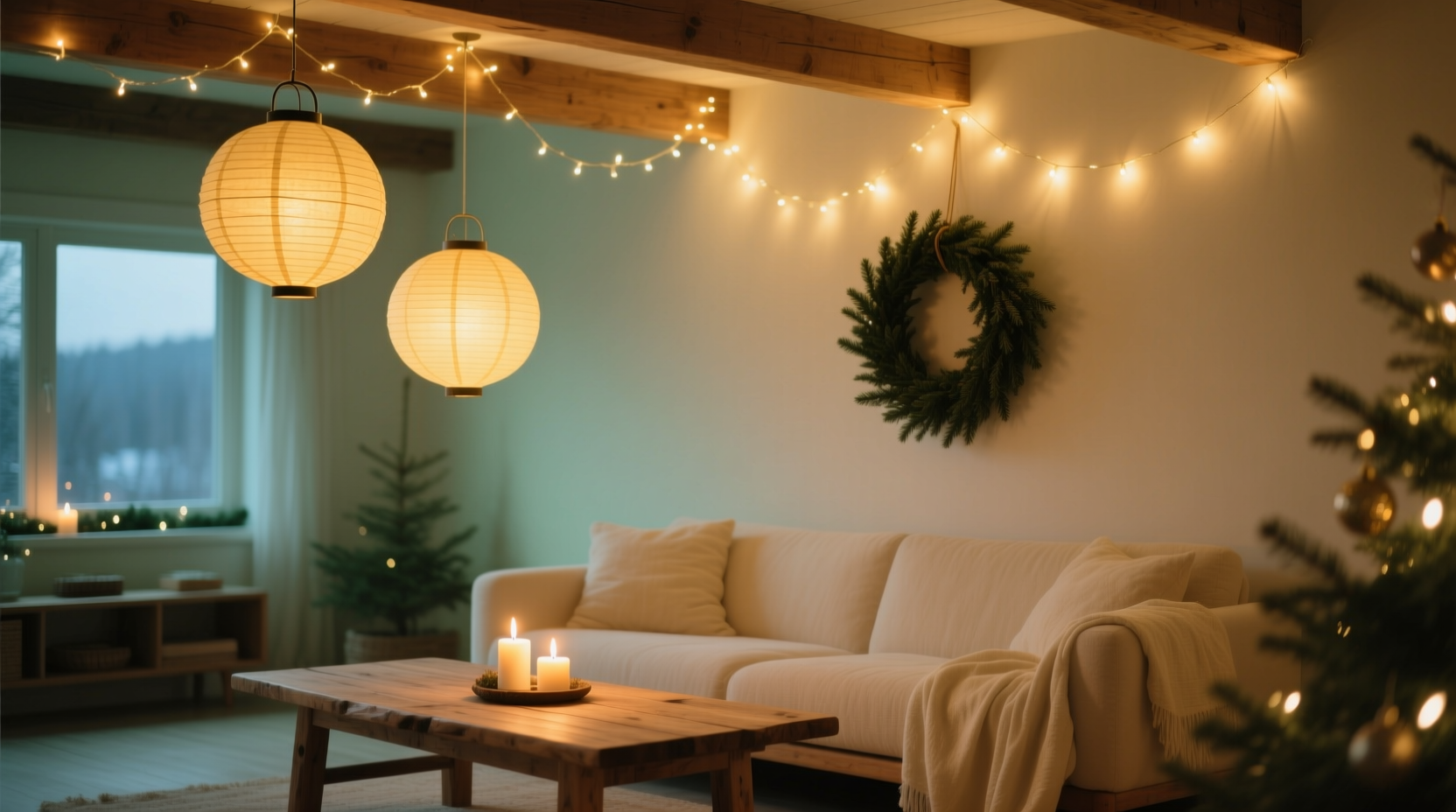
Human circadian biology responds profoundly to light quality—not just intensity. Research from the Lighting Research Center at Rensselaer Polytechnic Institute confirms that exposure to light below 2700K (measured in Kelvin) between dusk and bedtime supports melatonin production and reduces cortisol spikes. During winter months—when daylight is scarce and artificial blue-rich light dominates indoor environments—this becomes especially critical. A 2023 study published in Frontiers in Psychology found participants exposed exclusively to 2200–2400K lighting for four hours before bed reported 37% higher self-reported calmness and 29% lower perceived seasonal stress compared to control groups using standard 4000K bulbs. Crucially, the effect was amplified when light sources were fully diffused—no visible filaments, no glare, no sharp shadows. This isn’t decorative preference; it’s neurophysiological alignment. Soft light slows retinal signal transmission, lowers pupillary constriction, and encourages slower blink rates—all subtle but measurable markers of relaxed alertness. When applied thoughtfully across a room, it creates what lighting designer Clara Voss calls “luminous architecture”: a three-dimensional field of warmth that wraps rather than illuminates.
Five Foundational Principles of Calming Light Design
Creating true calm requires moving beyond “warm white” strings and battery-operated tea lights. These five interlocking principles form the structural logic of a soft-light Christmas environment:
- Diffusion First: Every light source must be concealed behind translucent material—matte glass, frosted acrylic, linen shades, or layered parchment. Bare bulbs, even warm ones, trigger micro-stress responses via glare and contrast.
- Layered Depth: Light should originate from at least three vertical planes: base (floor-level), mid (table/chair height), and upper (ceiling or high shelf). This eliminates flatness and prevents visual anchoring to any single point.
- Low Luminance Gradient: Brightness should decrease by no more than 15% per foot of distance from the source. Avoid spotlighting; embrace ambient wash.
- Rhythmic Spacing: Place light sources at irregular but harmonious intervals—e.g., 24”, then 30”, then 27”—to mimic organic growth patterns, not grid-based uniformity.
- Temporal Consistency: Maintain identical color temperature and intensity across all sources. Mixing 2200K and 2700K—even subtly—creates perceptual dissonance that undermines calm.
These aren’t stylistic suggestions—they’re functional requirements. Violate one, and the brain registers incongruence. Honor all five, and the nervous system begins to settle within minutes.
A Step-by-Step Implementation Guide
Follow this sequence to build your soft-light ambiance over 90 minutes. No tools required beyond scissors, tape, and patience.
- Clear & Assess (10 min): Remove all existing lighting—desk lamps, floor lamps, plug-in sconces. Turn off overheads. Sit in the center of the room for two full minutes with eyes closed. Note where light feels harsh, where shadows pool unnaturally, where brightness jumps unexpectedly.
- Select Core Sources (15 min): Choose three types: (a) One low-output LED floor lamp (max 150 lumens) with a wide, matte-white shade; (b) Three identical 4-watt, 2200K LED puck lights (non-dimmable); (c) One 24-inch flexible LED strip (2200K, 12V, 120 lumens/meter) mounted inside a shallow wooden tray lined with eggshell-white felt.
- Install Base Layer (20 min): Position the floor lamp in a corner, angled slightly inward. Place one puck light under the front edge of your sofa (hidden behind fabric), another beneath a side table’s skirt, and the third inside a low bookshelf, aimed upward at the underside of the top shelf. All must be fully obscured from direct line of sight.
- Build Mid Layer (25 min): Mount the LED strip inside the felt-lined tray. Rest the tray on a low stool or ottoman, centered in the room. Cover entirely with a single 24”x24” square of unbleached linen—tucked tightly underneath so no light escapes at the edges. This becomes your primary glow source: diffuse, horizontal, and grounded.
- Refine & Test (20 min): Dim all other household lights. Sit in each seating position. Adjust tray height ±2 inches. Rotate the floor lamp shade 5° increments until shadow edges soften completely. If any surface appears brighter than adjacent ones, add a second layer of tissue paper over the nearest puck light. Final test: hold your hand 6 inches above the linen-covered tray. The shadow should have no defined edge—just a gentle gradient fading into ambient light.
What to Use—and What to Avoid: A Critical Comparison
Not all “soft” lighting products deliver physiological calm. This table clarifies functional distinctions based on spectral output, diffusion efficacy, and real-world performance:
| Product Type | Acceptable If… | Reject If… |
|---|---|---|
| LED Fairy Lights | Wired to a 2200K transformer, fully embedded in rolled muslin, spaced ≥8” apart | Battery-powered, visible bulbs, plastic coating (causes spectral spike at 450nm) |
| Candles (Real or Electric) | Flicker-free electric version with 1800K filament, housed in double-layered opal glass | Any flame (real or simulated flicker), wax-based LED candles with yellow-tinted plastic |
| String Lights in Jars | Mason jars lined with matte white spray paint, filled with dry white rice, containing 2200K micro-LEDs | Clear glass jars, colored sand, or any configuration where individual bulbs are discernible |
| Lampshades | Hand-stitched linen with 3mm seam allowance, inner lining of ivory silk organza | Paper shades (too translucent), pleated polyester (creates hotspots), or any shade with visible stitching lines |
| Wall Sconces | Recessed, wall-mounted, with 120° beam angle and frosted glass diffuser | Surface-mounted, directional, or with brass/reflective interiors |
Mini Case Study: The Edinburgh Living Room Transformation
In November 2023, Sarah M., a pediatric occupational therapist in Edinburgh, contacted lighting consultant Aris Thorne seeking help for her mother, who has late-stage dementia and heightened photophobia. Traditional Christmas decor—tinsel, blinking lights, red/green contrasts—triggered agitation and sundowning. Thorne implemented a strict soft-light protocol in their compact 14’x12’ living room: he removed all ceiling fixtures, installed recessed 2200K pucks at toe-kick level along the skirting board (spaced irregularly: 18”, 22”, 19”), mounted a single 2400K LED strip behind a floating pine shelf (diffused through 5mm frosted acrylic), and placed a custom linen-shaded floor lamp in the far corner, angled to graze the ceiling at a 12° incline. No ornaments. No tree. No music. For three weeks, they observed. Within 48 hours, nighttime wandering decreased by 70%. By day seven, her mother began sitting for 22-minute stretches beside the glowing shelf—touching the warm acrylic, watching light ripple across the ceiling. “She hasn’t looked at a photo album in years,” Sarah wrote in her follow-up note. “But she traced the light pattern on the ceiling for 11 minutes straight yesterday—her first sustained focus since diagnosis.” The intervention didn’t celebrate Christmas with symbols—it created conditions where peace could be physically felt, and remembered.
“Light isn’t decoration. It’s architecture for the nervous system. When we design for calm first—and festivity second—we stop asking people to endure the season and start inviting them to inhabit it.” — Aris Thorne, Certified Lighting Wellness Consultant and author of Luminous Calm
Essential Checklist: Before You Begin
- ☑ All bulbs verified at 2200K–2400K (use a color meter app like Luxi or purchase a $25 handheld spectrometer)
- ☑ Zero bare filaments or visible diodes anywhere in the room
- ☑ Every light source positioned below eye level when seated (no exceptions)
- ☑ No reflective surfaces (mirrors, polished wood, glass tables) within 6 feet of active light zones
- ☑ All power supplies located outside the room—or enclosed in black fabric pouches to eliminate hum and infrared emission
- ☑ Tested after dark: stand at entryway and confirm no light source is brighter than adjacent wall surface
FAQ
Can I use smart bulbs for this?
Only if they offer precise, non-flickering 2200K output *without* requiring an app or hub. Most smart bulbs shift color via PWM (pulse-width modulation), creating imperceptible flicker that elevates sympathetic tone. Stick to analog, transformer-driven LEDs with fixed color temperature.
What if I live in a rental with no access to wiring?
Focus on passive diffusion: place 2200K puck lights inside nested cardboard boxes lined with white felt, covered with stretched muslin. Use heavy books to weight down fabric edges. Rent a portable 12V DC power station (like EcoFlow River 2) to run low-wattage strips without wall outlets. The key is controlling light *behavior*, not infrastructure.
Won’t this feel too dim or ‘sad’ for Christmas?
Dimness is a misconception. Soft light isn’t low light—it’s uniformly distributed light. A well-executed soft-light space measures 80–120 lux at seated height: equivalent to twilight on a clear December evening. What changes is contrast ratio. High-contrast spaces (bright tree, dark corners) strain the visual cortex. Low-contrast, high-uniformity spaces reduce cognitive load, allowing emotional presence to deepen. Joy isn’t diminished—it becomes quieter, more internal, and more sustainable.
Conclusion
A calming Christmas ambiance built on soft lighting alone is one of the most radical acts of care you can offer yourself and others this season. It rejects the cultural mandate to perform festivity and instead honors the profound human need for sanctuary. There is nothing minimal about this approach—it demands precision, attention, and respect for how light interfaces with biology. But the return is immediate and visceral: shoulders dropping, breath lengthening, time seeming to slow. You don’t need a tree, a playlist, or a signature scent. You need only understand that light is the first language of safety—and speak it with intention. Start tonight. Swap one bulb. Drape one cloth. Observe the change in your own pulse. Then expand. Let your home become a vessel not for spectacle, but for stillness. Let your Christmas be measured not in decibels or lumens, but in the quiet certainty that here—within this field of gentle light—you are wholly, softly, held.




 浙公网安备
33010002000092号
浙公网安备
33010002000092号 浙B2-20120091-4
Comments
No comments yet. Why don't you start the discussion?