
Christmas lighting has long been associated with exuberance: flashing reds, blinking blues, cascading rainbows. But a quiet shift is underway—one rooted not in spectacle, but in stillness. More homeowners, interior designers, and wellness-focused decorators are choosing restraint over revelry, embracing warm white lighting as the cornerstone of a restorative holiday atmosphere. Unlike multicolored schemes that stimulate the nervous system, a thoughtfully layered warm white palette supports circadian rhythm alignment, reduces visual clutter, and evokes the soft glow of candlelight—without the fire hazard or maintenance. This isn’t about minimalism for its own sake. It’s about intentionality: selecting light temperature, scale, rhythm, and placement to cultivate peace, not pageantry.
Why Warm Whites—Not Just “White”—Matter
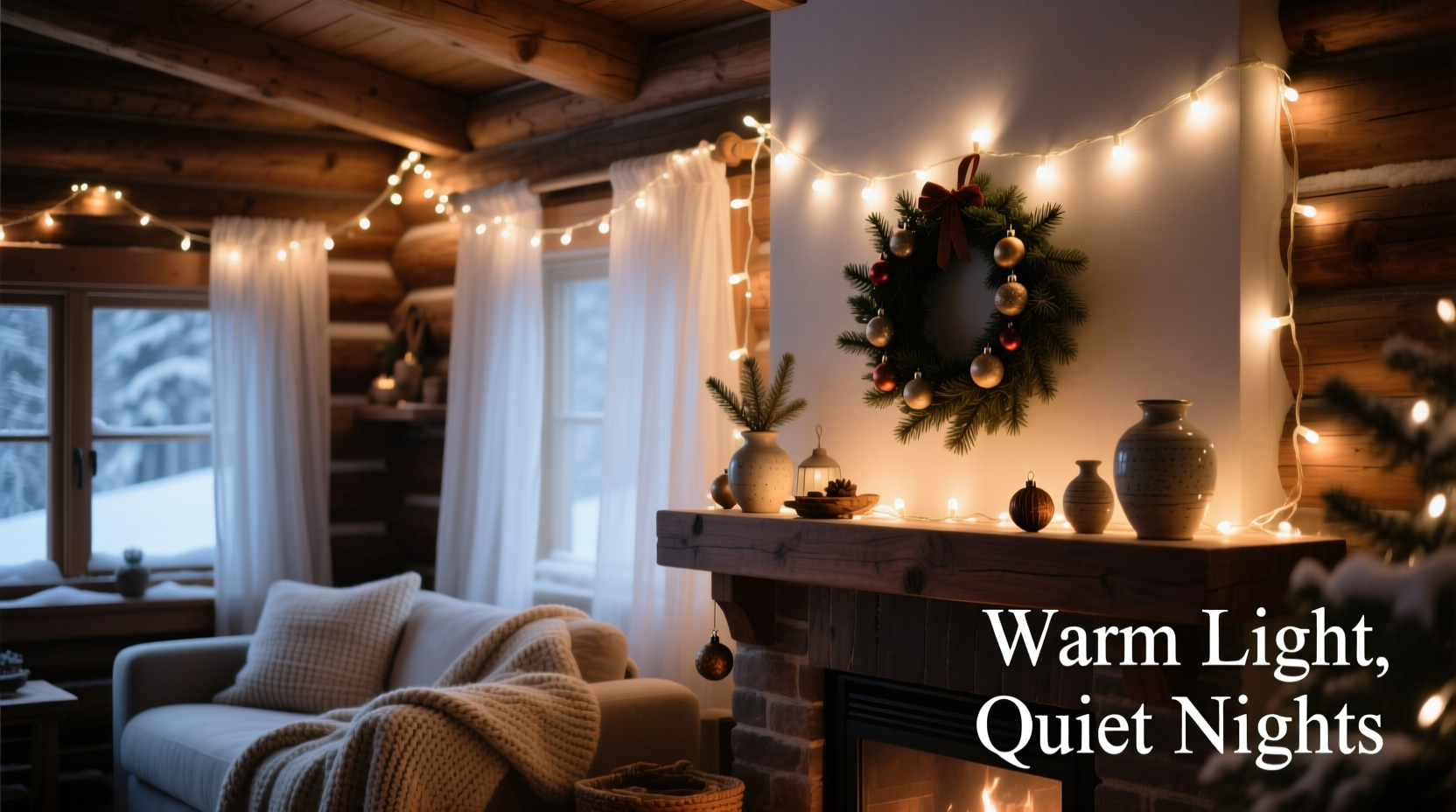
The term “white” is misleading. All white light exists on a spectrum measured in Kelvin (K). Cool whites (5000K–6500K) mimic midday sun—crisp, energizing, even clinical. Daylight bulbs at 4000K feel alerting; they’re ideal for garages or offices, but disruptive in evening living spaces. Warm whites sit between 2200K and 3000K—the range of vintage Edison bulbs, beeswax candles, and sunset embers. At 2700K, light carries a gentle amber undertone; at 2200K, it verges on honeyed gold. Neuroscience confirms this matters: exposure to light above 4000K after dusk suppresses melatonin production by up to 50%, delaying sleep onset and increasing cortisol. A 2023 study published in Lighting Research & Technology found participants exposed to 2700K holiday lighting reported 37% lower self-rated stress and 22% higher feelings of “cozy safety” compared to those in rooms lit with 4500K strings.
This physiological response is why warm whites form the foundation of a calming scheme—they don’t compete with the room’s ambient light; they harmonize with it. They soften architectural edges, deepen wood grain, and reflect warmly off neutral textiles without glare. Crucially, they eliminate chromatic noise. No jarring transitions from green to purple to blue. No unintended “disco effect” from mismatched hues. Just a unified, breathing luminance.
The Four-Layer Lighting Framework
A calming scheme avoids flat, uniform brightness. Instead, it builds depth through intentional layering—each stratum serving a distinct psychological function. Think of it as composing light like music: bass, harmony, melody, and accent.
- Foundation Layer (20–30% of total lights): Low-intensity, diffused illumination that sets the ambient tone. Use wide-angle LED fairy lights tucked behind sheer curtains, woven into bookshelves, or wrapped loosely around stair railings. Opt for non-dimmable strings with built-in micro-flicker (mimicking candle breath) at 2200K.
- Architectural Layer (40–50%): Defines structure and guides the eye. Wrap 2700K mini LED cords (with 6–8 inch spacing) evenly around door frames, window perimeters, and mantelpieces. Keep voltage consistent—use one transformer per 50 feet to prevent dimming at the far end.
- Textural Layer (15–20%): Adds tactile warmth and visual interest. Drape flexible, bendable 2700K copper wire lights through dried eucalyptus garlands, pinecones, or linen-wrapped pillar candles. The fine-gauge wire casts delicate shadows, enhancing dimension without brightness.
- Focus Layer (5–10%): Creates gentle hierarchy and pause points. Place three to five 2700K LED tea lights inside clear glass cloches on side tables, or mount a single 2400K filament bulb inside a vintage brass sconce beside the sofa. These should be the only elements with visible bulbs—everything else remains hidden or diffused.
This framework prevents sensory overload. Each layer operates at a different intensity and purpose, allowing the eye—and mind—to rest rather than scan for contrast.
Material & Placement Principles for Serenity
How light interacts with surfaces determines its emotional impact. Warm white LEDs behave differently on matte vs. glossy, porous vs. reflective materials. Placement height, density, and directionality also shape perception.
| Element | Recommended Approach | Why It Works |
|---|---|---|
| Windows | String lights vertically along inner frame edges only—not across the glass. Use 2200K micro-LEDs spaced 4 inches apart. | Creates a subtle “halo” effect without competing with outdoor darkness. Avoids glare reflections that disrupt indoor calm. |
| Mantel | Wrap lights *behind* greenery, not over it. Embed 2700K stringers within bundled cedar boughs, leaving tips unlit. | Softens light diffusion and prevents “hot spots.” Mimics natural bioluminescence—gentle, organic, non-directional. |
| Tree | Start at the trunk and spiral upward with 2700K lights at 6-inch intervals. Use 100 lights per foot of tree height. Hide all wires under branches. | Builds luminous depth from core outward—psychologically grounding. Eliminates chaotic “twinkling” by ensuring even distribution. |
| Floors & Stairs | Embed low-voltage 2400K LED strip lights (IP65 rated) into baseboard grooves or under stair nosings. Max 2 lumens per linear inch. | Provides safe, subconscious wayfinding without drawing attention. Feels like light rising from the earth—not imposed from above. |
| Tabletops | Cluster three 2200K LED pillar candles (battery-operated, with realistic flicker) on a travertine or raw oak surface. No additional lighting nearby. | Creates an intimate, hearth-like focal point. The ultra-low CCT (2200K) signals “rest time” to the brain’s suprachiasmatic nucleus. |
Notice the consistency: no element exceeds 2700K. Even the “brightest” layer—the architectural wrap—uses the same CCT as the softest foundation lights. Variation comes from placement, diffusion, and intensity—not color temperature.
Real Example: The Portland Hearth Project
In late November 2023, interior designer Lena Ruiz transformed a 1920s Craftsman bungalow in Portland, Oregon, for a client recovering from burnout. The brief was explicit: “No blinking. No colors. Nothing that feels like work.” The home featured original fir beams, river-rock fireplace surrounds, and abundant natural linen textiles—elements that would clash with anything cooler than 2700K.
Ruiz installed 2200K micro-LEDs behind sheer linen drapes in the living room, casting a hazy, golden wash across the ceiling. She wound 2700K copper wire lights through a foraged blackberry vine garland draped over the mantle—only the vine’s thorny tips caught faint light, creating delicate shadow patterns. On the Douglas fir tree, she used hand-strung 2700K lights with custom dimmer timers set to fade gradually from 60% brightness at dusk to 20% by 9 p.m., syncing with the family’s wind-down routine. Crucially, she removed all existing overhead fixtures in common areas, relying solely on layered warm white accents.
The result? Within three days, the client reported deeper sleep onset and reduced evening anxiety. Neighbors began asking how to replicate the “quiet glow” effect. As Ruiz notes: “People don’t remember the wattage. They remember how the light made their shoulders drop when they walked in the door.”
“Warm white lighting isn’t decorative—it’s neurological infrastructure. When every photon falls within the 2200K–2700K band, you’re not just decorating a space. You’re signaling safety to the autonomic nervous system.” — Dr. Aris Thorne, Environmental Neuroscientist, Harvard T.H. Chan School of Public Health
Your Calming Light Implementation Timeline
Building serenity takes planning—not haste. Follow this phased approach to avoid overwhelm and ensure cohesion:
- Week 1: Audit & Source
Walk each room at dusk. Note existing light sources (lamps, overheads, screens). List all surfaces where lights will go. Purchase *only* 2200K, 2400K, or 2700K LEDs—no exceptions. Verify CRI (Color Rendering Index) is ≥90 for true warmth. - Week 2: Foundation First
Install foundation-layer lights: behind curtains, under shelves, along baseboards. Test dimmers and timers. Ensure no visible wires or harsh glare points. - Week 3: Architectural Anchoring
Add frame and mantel wraps. Use painter’s tape to mark spacing before securing. Step back every 10 feet to check visual rhythm—light should feel like a slow inhale, not staccato beats. - Week 4: Textural Integration
Weave lights into greenery, fabric, or natural elements. Prioritize concealment: if you see the bulb, reposition. Let material diffuse—not dominate—the light. - Week 5: Focus Refinement & Ritual
Place final focus elements (candles, sconces). Program all timers to dim 30 minutes after sunset. Introduce a “light ritual”: switch on at 4:30 p.m. daily, paired with herbal tea or quiet music. Consistency trains the nervous system.
FAQ: Warm White Lighting Clarified
Can I mix different Kelvin ratings—like 2200K and 2700K—in one room?
Yes—but with strict limits. Reserve 2200K for focus layers (candles, sconces) where intimacy is key. Use 2700K for architectural and foundation layers to maintain cohesion. Never use 3000K+ anywhere; it introduces perceptible coolness that fractures the warm field. Think of 2200K as “hearth,” 2700K as “glow”—both belong, but serve distinct roles.
Do warm white LEDs consume more energy than cool whites?
No. Energy use depends on wattage and lumens—not Kelvin rating. A 2700K LED and a 5000K LED with identical lumen output consume nearly identical power. In fact, many high-CRI 2700K LEDs now exceed 120 lumens per watt—more efficient than older incandescent “warm” bulbs.
How do I prevent warm white lights from looking “yellow” or dated?
“Yellow” perception usually stems from low CRI (<80) or excessive saturation. Choose LEDs with CRI ≥90 and R9 (red rendering) ≥90—this ensures skin tones, wood, and textiles appear rich, not sickly. Pair warm whites with cool-toned neutrals: charcoal wool rugs, slate countertops, or matte black hardware. The contrast prevents amber dominance and adds sophisticated balance.
Conclusion: Light as Gentle Invitation
A calming Christmas lighting scheme does more than illuminate a room—it reshapes the experience of time itself. In a season saturated with urgency—shopping deadlines, social obligations, year-end pressures—warm white light offers something radical: permission to slow. To breathe. To gather without performance. There is profound dignity in choosing softness over sparkle, continuity over chaos, warmth over wattage. This isn’t about diminishing the holidays; it’s about deepening them. Every 2700K bulb placed with care becomes a quiet act of resistance against sensory overload—a small, luminous boundary drawn around peace.
You don’t need a decorator, a budget overhaul, or technical expertise. You need only three things: the discipline to choose one color temperature, the patience to layer intentionally, and the courage to let light serve rest—not revelry. Start tonight. Unplug one flashing multicolor strand. Replace it with ten 2700K micro-LEDs tucked behind your favorite reading chair. Notice how your breath changes. How your shoulders soften. How the season begins to feel less like a sprint, and more like a sigh.




 浙公网安备
33010002000092号
浙公网安备
33010002000092号 浙B2-20120091-4
Comments
No comments yet. Why don't you start the discussion?