
Holiday gatherings bring warmth, connection, and joy—but for many dogs and cats, they bring disorientation, anxiety, and physiological stress. Fireworks, doorbells, shouting, clattering dishes, and unfamiliar people trigger acute fear responses in animals whose hearing is four times more sensitive than ours and whose sense of safety relies heavily on environmental predictability. A 2023 study published in Frontiers in Veterinary Science found that 67% of dogs exhibited measurable stress behaviors—including panting, trembling, hiding, or vocalizing—during holiday events with elevated noise levels. Cats, often overlooked due to their tendency to withdraw silently, show even subtler signs: reduced appetite, overgrooming, litter box avoidance, or sudden aggression. These aren’t “just quirks.” They’re biological signals that the nervous system is overwhelmed.
A calming corner isn’t a luxury—it’s a necessity grounded in ethology and veterinary behavior science. It’s not about isolating your pet, but offering them agency: the ability to retreat, reset, and self-regulate without punishment or pressure. When done thoughtfully, this space becomes an anchor amid chaos—lowering cortisol, preventing learned fear, and preserving the human-animal bond when emotions run high. This guide walks through evidence-based design, timing, and implementation—not as a last-minute fix, but as part of compassionate holiday preparation.
Why a dedicated space matters more than ever during holidays
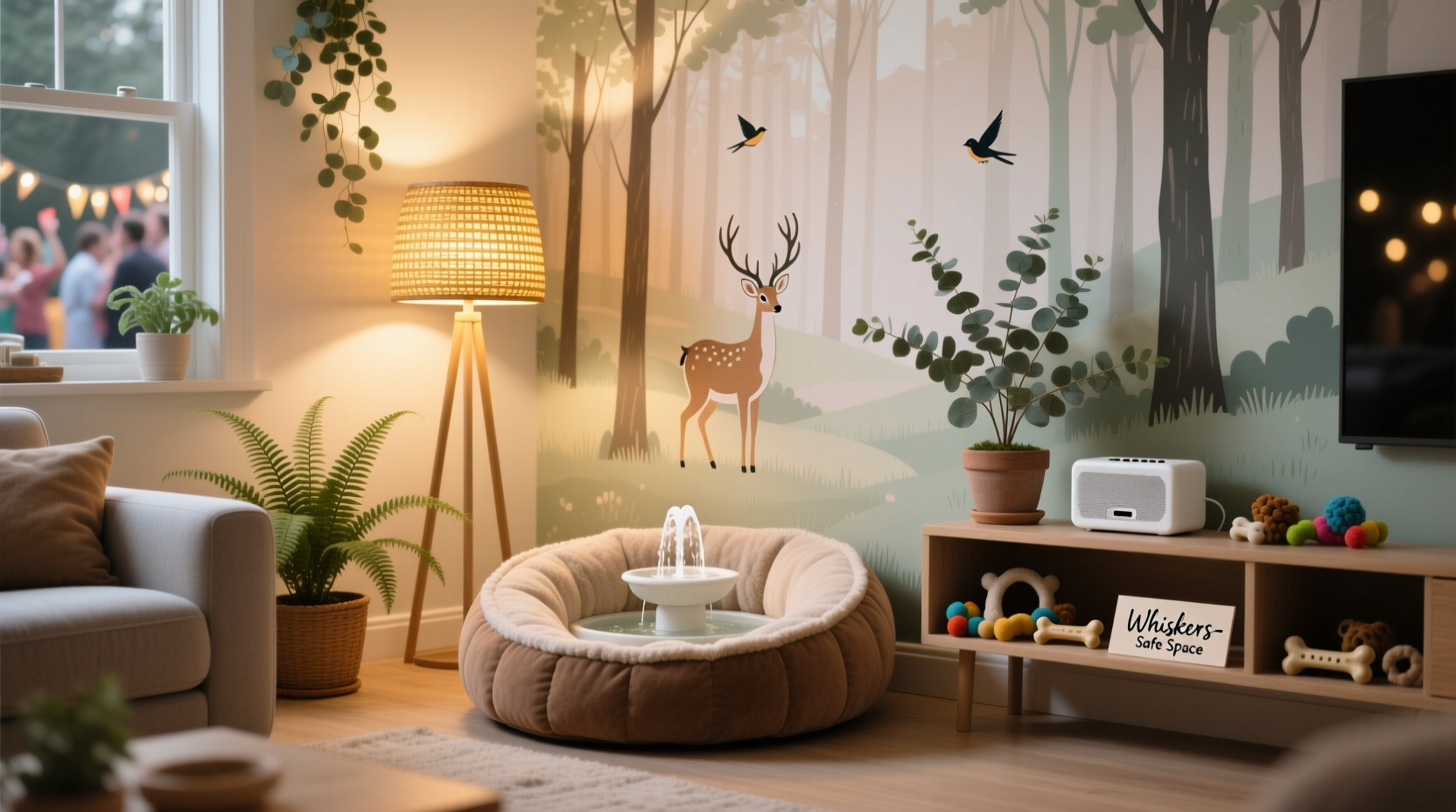
Unlike everyday stressors, holiday noise is unpredictable, layered, and prolonged. A single firecracker may startle, but sustained auditory bombardment—from overlapping conversations, music, TV, cooking sounds, and children’s play—prevents full nervous system recovery. Pets don’t understand context; they perceive volume spikes as threats. Without a reliable refuge, they resort to coping mechanisms that can escalate: pacing, destructive chewing, attempts to flee (leading to lost pets), or shutdown behaviors mistaken for “calmness.”
Veterinary behaviorists emphasize that perceived control reduces distress more effectively than sedation alone. Dr. Lisa Radosta, board-certified veterinary behaviorist and founder of Florida Veterinary Behavior Service, explains:
“The most powerful tool we have for reducing noise-related anxiety isn’t medication—it’s predictability. When an animal knows exactly where to go, what it will feel like there, and that it’s fully theirs to use without interference, their baseline stress drops significantly—even before the event begins.”
This principle underpins every element of the calming corner: location, sensory input, accessibility, and consistency. It’s not decoration. It’s functional neuroarchitecture for nonverbal beings.
Step-by-step: Building your pet’s calming corner (before guests arrive)
Timing is critical. Begin setting up the space at least 3–5 days before the first gathering. This allows your pet to explore, habituate, and form positive associations *before* stress hormones rise. Rushing setup on the day of the event undermines its effectiveness.
- Choose the right location: Prioritize distance from high-traffic zones—away from entryways, kitchens, stairwells, and living room speakers. A spare bedroom, quiet closet, or interior bathroom (with door slightly ajar for airflow) works best. Avoid basements (dampness, poor ventilation) or garages (temperature extremes, fumes).
- Minimize sensory intrusion: Close blinds or curtains to block visual stimulation. Use heavy drapes or a blanket over the doorway if sound bleed is severe. Place white noise machines or low-volume nature sound apps (e.g., rainforest or gentle ocean waves) *outside* the space—not inside—to avoid adding auditory load.
- Layer comfort intentionally: Start with a firm orthopedic base (not a soft pillow alone—support prevents joint strain during prolonged rest). Add a familiar, unwashed blanket or t-shirt bearing your scent. Include one worn item with your scent *and* one with your pet’s own scent (e.g., a used fleece bed liner) to reinforce security.
- Add low-arousal enrichment: Place a few high-value, long-lasting chews (e.g., frozen Kongs stuffed with pumpkin + peanut butter for dogs; lick mats with tuna water for cats) *only* in this space. Never offer these elsewhere—this builds exclusive positive reinforcement.
- Install clear boundaries: Use a baby gate, pet-safe barrier, or simply a closed door with a sign: “Quiet Zone – Do Not Enter.” Train household members—and inform guests—that this area is off-limits unless assisting the pet. No peeking, no calling, no coaxing.
What to include (and exclude): A vet-approved essentials checklist
Not all items marketed for “calm” are safe or effective. Below is a curated, behaviorally informed checklist—tested across species and temperaments. Prioritize function over aesthetics.
- ✅ Orthopedic pet bed or memory foam pad (minimum 3-inch thickness)
- ✅ One unwashed article with your scent (t-shirt, sock)
- ✅ One item with your pet’s scent (used fleece liner, small towel)
- ✅ Low-noise white noise device placed *outside* the space
- ✅ Closed, opaque door or visual barrier (no glass or mesh doors)
- ✅ Access to fresh water in a spill-proof bowl (avoid ceramic—too loud if tipped)
- ✅ Species-appropriate chew or lick mat (used exclusively here)
- ❌ Essential oil diffusers (toxic to cats, irritating to dogs’ respiratory systems)
- ❌ LED string lights or blinking decorations (flicker triggers seizures in some animals)
- ❌ Stuffed toys with squeakers or crinkly fabric (auditory triggers)
- ❌ Litter boxes in the same room as sleeping areas (cats associate elimination with stress)
- ❌ Human food leftovers—even “safe” ones like turkey skin (high-fat, pancreatitis risk)
Do’s and Don’ts: Calming corner management during the event
How you interact with the space *during* the gathering determines its success. Missteps—even well-intentioned ones—can erase weeks of conditioning.
| Action | Do | Don’t |
|---|---|---|
| Monitoring | Check briefly every 30–45 minutes via a quiet peek—no calling out or opening the door. Note breathing rate, posture, and whether eyes are open/closed. | Hover, stand outside the door talking, or repeatedly call your pet’s name to “see if they’re okay.” |
| Feeding | Offer meals in the corner 1–2 hours before guests arrive. Use slow-feed bowls or puzzle feeders to extend engagement. | Feed in the main gathering area “to keep them socialized”—this forces exposure during peak stress. |
| Interaction | If your pet chooses to leave the corner voluntarily, let them—without praise or redirection—unless safety is compromised (e.g., near open doors). | Drag them out for photos, force cuddles, or say “Come say hello!” while guests are present. |
| Emergency response | If trembling or panting escalates, quietly enter, sit beside (not over) them, and offer gentle chin scratches *if they lean in*. Then leave immediately. | Hold, restrain, or wrap them tightly “to calm them down”—this increases helplessness and panic. |
Real-world example: How Maya’s rescue terrier avoided trauma during Christmas Eve
Maya adopted Leo, a 3-year-old Jack Russell mix, six months before his first holiday season. He’d previously been surrendered after repeated escape attempts during neighborhood fireworks. His baseline anxiety manifested as lip-licking, whale-eyeing, and frantic circling when doorbells rang.
Three days before Christmas Eve, Maya set up his calming corner in a quiet guest bedroom: a thick orthopedic bed, her old flannel shirt, his favorite fleece blanket, and a frozen Kong filled with plain yogurt and blueberries. She practiced “go to your spot” with treats twice daily. On Christmas Eve, she fed him his dinner in the room at 4:30 p.m., then closed the door with a “quiet zone” sign. Guests arrived at 6 p.m. By 7:15 p.m., Leo was curled on his side, eyes half-closed, gently licking his paw—a sign of deep relaxation.
When a neighbor’s firecrackers exploded at 8:45 p.m., Leo startled—but instead of bolting, he lifted his head, sniffed the air, and walked calmly back into the room, settling within 90 seconds. Maya didn’t enter. She didn’t call him. She honored his choice—and his nervous system responded with resilience, not rupture. That night, he slept soundly. The next morning, he greeted guests with tail wags—not fear barks.
This wasn’t luck. It was architecture of safety, built with consistency and respect.
Frequently asked questions
Can I use calming supplements or pheromone diffusers alongside the corner?
Yes—but only under veterinary guidance. Adaptil (dog-appeasing pheromone) and Feliway (feline facial pheromone) diffusers can support the corner’s effectiveness when plugged in *2–3 days prior* to the event. Supplements like L-theanine or melatonin require dosing trials *weeks* ahead to assess tolerance and efficacy. Never introduce new medications or supplements on the day of the gathering.
My cat hides under the bed instead of using the corner. What should I do?
That’s normal—and valuable data. Under-bed hiding is a natural feline response. Instead of forcing relocation, bring the calming corner elements *to* that space: place the scented blanket, water bowl, and a quiet lick mat underneath. Block access to other dark, inaccessible spots (e.g., behind dressers) so the under-bed zone becomes the *only* secure option. Gradually, over several low-stress sessions, entice movement toward your designated corner using feather wands or food trails.
What if I live in a studio apartment with no separate rooms?
Use verticality and barriers. Set up a covered crate or large cardboard box lined with blankets in the quietest corner—away from windows and doors. Drape a heavy quilt over three sides (leave front open), creating a cave-like enclosure. Place a white noise machine on the opposite side of the room. Anchor the space with scent and routine: feed, nap, and offer chews there daily for a week pre-event. Even 3 feet of separation, when consistently reinforced, provides meaningful relief.
Conclusion: Your pet’s peace is part of the celebration
A calming corner does more than mute noise—it affirms dignity. It tells your dog or cat, “Your feelings are valid. Your need for safety is non-negotiable. You belong here, exactly as you are.” In a season often defined by performance and perfection, this simple act of accommodation is profoundly countercultural—and deeply loving.
You don’t need expensive gear or architectural renovation. You need observation, intention, and the willingness to prioritize your pet’s nervous system over social expectations. Start today: choose the location, gather two scented items, and place them where your pet already seeks stillness. Watch how they respond—not with gratitude, but with quiet, steady breaths. That’s the sound of safety taking root.
This holiday, let compassion be your most visible decoration. Build the corner. Honor the retreat. Protect the peace. And when your pet rests deeply while laughter echoes down the hall, know you’ve given them something no gift wrap can hold: the profound, unshakeable gift of being truly seen.




 浙公网安备
33010002000092号
浙公网安备
33010002000092号 浙B2-20120091-4
Comments
No comments yet. Why don't you start the discussion?