
Christmas trees have long been canvases for personal expression—but in the age of immersive storytelling and richly detailed game worlds, they’ve become portals. A Zelda-themed tree isn’t just green and gold; it’s a miniature Hyrule Field under starlight, where Korok seeds dangle like dewdrops and Triforce ornaments glow with quiet reverence. A Cyberpunk 2077 tree doesn’t merely shimmer—it pulses with neon-lit circuitry, flickering like a hacked netrun, its branches strung with holographic data shards and chrome-plated NCPD badges. This isn’t cosplay or fan art—it’s environmental storytelling made three-dimensional, rooted in nostalgia but executed with intentionality. Creating a game-inspired tree bridges digital devotion and tactile tradition. It rewards deep familiarity with lore, aesthetics, and tone—and invites you to translate abstract world-building into something you can gather around, light up, and share. The result is more than decoration: it’s a curated shrine to the worlds that shaped your imagination.
1. Choose Your Game World with Narrative Intention
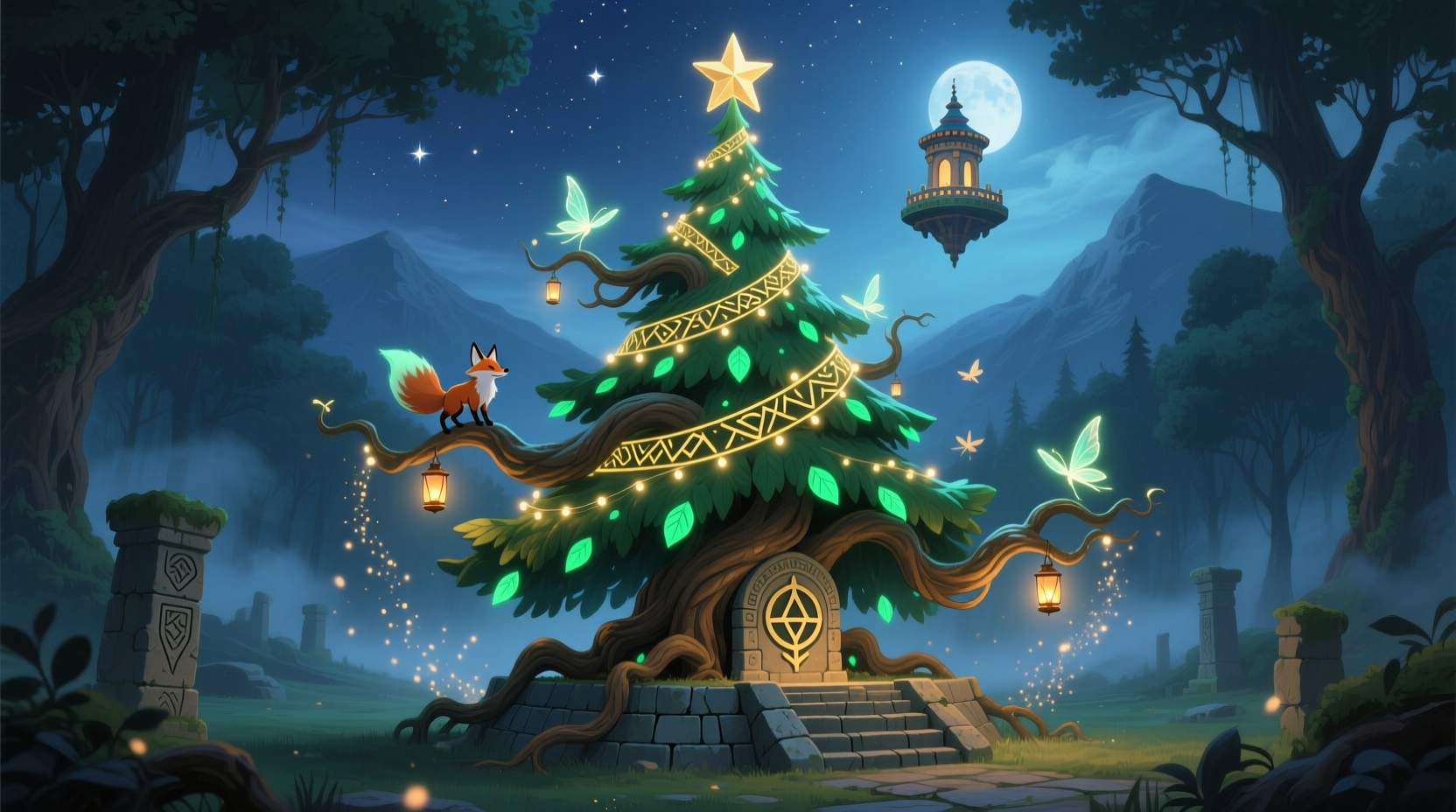
Selecting the right game isn’t about popularity or graphics—it’s about emotional resonance and visual coherence. Ask yourself: Which world feels *alive* to you? Where do you instinctively recognize color palettes, recurring symbols, ambient textures, and tonal rhythms? A vibrant, high-fantasy title like Octopath Traveler offers layered pastel gradients and ornate brass motifs; a melancholic, rain-slicked universe like Disco Elysium leans into muted ochres, frayed wool textures, and typewriter-font ornaments. Avoid games with overly fragmented aesthetics (e.g., anthology titles without unified art direction) or those whose core themes clash with seasonal warmth—unless you’re intentionally subverting tradition (e.g., a Dead Space tree using stark white branches, pulsing red “Marker” lights, and minimalist Necromorph silhouettes as minimalist ornaments).
Consider gameplay loops, too. A Stardew Valley tree should feel abundant, handmade, and gently imperfect—think hand-painted wooden fruit, yarn-wrapped carrots, and miniature barns dangling from boughs. A Dark Souls tree embraces austerity: blackened birch branches, ash-gray baubles, and subtle ember-glow LEDs embedded in cracked ceramic “Estus flasks.” The strongest trees emerge when mechanics, mood, and materiality align.
2. Map the Game’s Visual Language to Tree Zones
A Christmas tree has natural zones: base/trunk, lower branches (heaviest ornament load), mid-branches (focal point), upper branches (lighter, more delicate), and apex (crowning element). Treat each as a distinct “level” in your game’s world map. This ensures spatial storytelling—not just thematic sprinkling.
| Tree Zone | Design Function | Video Game Analogy | Real-World Execution Example |
|---|---|---|---|
| Base/Trunk | Grounding & lore foundation | Starting town or hub world (e.g., Kakariko Village) | Wrapped in burlap dyed with walnut stain (earthy texture); adorned with miniature clay houses, tiny lanterns, and moss mimicking grassy terrain |
| Lower Branches | Gameplay density & interactivity | Early-game zones with frequent encounters (e.g., Mushroom Kingdom plains) | Clustered ornaments: hand-glazed mushroom caps, polymer clay Goombas, fabric Yoshi eggs, and battery-powered “coin” lights that chime softly when tapped |
| Mid-Branches | Narrative climax & visual anchor | Key story location (e.g., Hyrule Castle courtyard) | Centerpiece ornaments: laser-cut acrylic castle silhouette backlit with warm LED, suspended on fine wire; surrounded by smaller “guard” figures (Zelda, Link, Impa) crafted from wood and ink |
| Upper Branches | Aspiration & wonder | Sky realms or celestial spaces (e.g., Ori’s Spirit Tree canopy) | Delicate elements: iridescent dragonfly wings (acetate), tiny glass stars etched with constellation maps from the game, fiber-optic “shooting stars” |
| Apex | Thematic culmination | Final boss arena or divine symbol (e.g., the Triforce, the All-Maker Stone) | Custom-crafted crown: folded copper foil forming the Triforce, wired for gentle pulse lighting; or a translucent resin sphere containing suspended “spirit light” particles |
This zoning method prevents visual chaos. It transforms randomness into rhythm—mirroring how game designers pace discovery, reward attention, and escalate emotional stakes across environments.
3. Source & Craft Ornaments with Lore Accuracy
Authenticity lies not in replication, but in translation. You don’t need official merchandise—you need symbolic fidelity. A Red Dead Redemption 2 ornament shouldn’t be a plastic “RDR2” logo; it should be a miniature, weathered leather satchel holding a tiny hand-drawn map of Ambarino, stitched with rust-colored thread. A Portal ornament isn’t just an orange-and-blue sphere—it’s a clear acrylic orb with two precisely placed reflective decals, angled so they create an infinite recursive tunnel effect when lit from below.
Three sourcing tiers work best:
- Repurposed & Found Objects: Old circuit boards (for Cyberpunk), dried lavender bundles (for The Witcher 3’s herbalism), vintage keys (for BioShock’s Rapture architecture), or sea glass (for Subnautica’s oceanic palette).
- Handmade Elements: Polymer clay characters baked with matte glaze (avoiding plastic shine), watercolor-printed paper ornaments sealed with beeswax, or embroidered felt “power-ups” (e.g., Super Mario’s 1-Up mushrooms).
- Curated Third-Party Items: Select only pieces matching your game’s era and craft ethos. For Ghost of Tsushima, choose Japanese washi paper stars—not mass-produced glitter balls. For Outer Wilds, use astronomy-themed ornaments (realistic planet models, not cartoonish ones) and avoid anything with visible branding.
“The most powerful fan creations honor the spirit, not the surface. A single, well-chosen detail—a specific font, a deliberate weathering technique, the exact Pantone of a faction’s banner—can resonate deeper than a hundred licensed products.” — Lena Torres, Game Environment Artist & Exhibit Designer, former lead on *The Art of Journey* retrospective
4. Lighting Logic: Beyond Brightness, Embrace Behavior
Lighting is where most game-inspired trees falter. Strings of uniform white LEDs flatten a world’s atmosphere. Instead, emulate how light functions *in the game*. In Shadow of the Colossus, light is sparse, directional, and sacred—use focused spotlights mounted low, casting long, dramatic shadows of branch silhouettes onto the wall behind. In Animal Crossing, light is cheerful, diffuse, and slightly playful—opt for warm-white micro-LEDs with gentle twinkle modes, interspersed with battery-operated “firefly” lights that float on nearly invisible monofilament.
Build a lighting hierarchy:
- Base Layer: Soft, even ambient glow (e.g., string lights wrapped *inside* a sheer white fabric cone beneath the tree, diffusing upward like a campfire’s halo).
- Interactive Layer: Motion-triggered elements (e.g., a small PIR sensor activates a “Mega Man” blue energy blast sound + flash when someone walks nearby).
- Narrative Layer: Timed sequences mirroring game events (e.g., every 90 seconds, a single “Heart Container” ornament pulses red, then fades—echoing health regeneration in *Zelda*).
Wiring matters. Hide cords with braided jute or wrap them in game-appropriate tape (e.g., duct tape printed with Fallout’s Vault Boy logo). Use dimmer switches calibrated to match in-game time-of-day cycles—dawn (soft amber), noon (crisp white), dusk (rose gold), night (deep indigo with UV accents).
5. The Step-by-Step Build Timeline (7 Days Before Christmas)
Creating a cohesive game tree demands sequencing—not rushing. Follow this realistic, tested timeline:
- Day 7: World Audit & Sketch
Replay key scenes. Sketch your tree’s five zones. List 3–5 non-negotiable symbols (e.g., for *Celeste*, the strawberry, the mountain peak, the feather, the cassette tape, the heart icon). Prioritize meaning over quantity. - Day 6: Base & Structure Prep
Assemble tree stand. Wrap trunk/base with chosen material (burlap, raw linen, faux leather). Build or source zone-specific stands (e.g., a miniature stone plinth for the base, a cloud-shaped foam form for upper branches). - Day 5: Ornament Creation (Bulk)
Make 70% of ornaments—focus on lower/mid branches first. Use consistent materials (e.g., all clay pieces baked same day, all paper ornaments printed same batch). Let dry/cure fully. - Day 4: Lighting Integration
Test all lights and circuits *before* hanging. Map cord paths. Secure battery packs discreetly (velcro inside hollow ornaments or behind trunk wraps). Program timers or sensors. - Day 3: Strategic Hanging
Start at the base. Hang ornaments in order of weight and visual importance—never top-down. Step back every 10 minutes. Adjust spacing using the “rule of thirds”: no zone should feel visually heavier than another. - Day 2: Narrative Refinement
Add subtle storytelling layers: tiny scrolls tied to branches (“Notes from the Archivist”), miniature books with spines labeled *Codex of the Ancients*, or a hidden “Easter egg” ornament only visible from one angle (e.g., a tiny, perfect replica of the *Skyward Sword* Loftwing, viewable only when standing directly left of the tree). - Day 1: Final Calibration & Atmosphere
Adjust light brightness/direction. Add scent (optional but powerful): pine needles for *Skyrim*, ozone + vetiver for *Cyberpunk*, sandalwood + cedar for *Journey*. Play the game’s ambient soundtrack softly in the background while you finalize.
Mini Case Study: The “Hollow Knight” Tree by Maya R., Portland, OR
Maya spent six weeks building her Hollow Knight tree—not as a tribute to the game’s visuals, but to its emotional arc. She chose a narrow, asymmetrical artificial tree (mimicking the twisted roots of Hallownest). The base was draped in grey silk, stained with diluted black tea to evoke damp stone. Lower branches held fragile, hand-blown glass “shell-shards” filled with bioluminescent algae (cultured safely in her home lab). Mid-branches featured delicate, articulated moth-wing ornaments—each wing jointed with micro-hinges so they fluttered subtly in air currents. The apex wasn’t a star, but a suspended, slowly rotating bell crafted from recycled brass, inscribed with the phrase “The Nailmaster’s Last Bell.” Most powerfully, she embedded a single, unlit white LED near the trunk’s base. Only when the room fell completely silent for 10 seconds did it glow—mirroring the game’s “Quiet Places” mechanic. Visitors didn’t just see a tree; they experienced stillness, fragility, and quiet reverence. “It’s not about looking like Hallownest,” Maya explains. “It’s about making people *feel* what it means to walk through it.”
FAQ
Can I mix elements from multiple games?
Only if they share a coherent aesthetic or narrative lineage—e.g., *Final Fantasy VII Remake* and *XIII* both use industrial-mystical fusion; *Stardew Valley* and *Harvest Moon* share pastoral sincerity. Avoid mashing genres (e.g., *Bloodborne* + *Kirby*) unless you’re executing a deliberate, high-concept contrast (e.g., “The Innocence of Dreamland vs. The Horror of Yharnam”). Even then, designate one game as the primary language and the other as a subtle, ironic counterpoint.
What if my favorite game has dark or violent themes?
Translating darkness into holiday context is an opportunity for sophistication. Focus on texture, restraint, and symbolic abstraction. For *Silent Hill*, use fog-diffused lighting, distressed parchment ornaments with faint, unreadable script, and a base wrapped in coarse, salt-bleached burlap. Avoid literal monsters or gore. As game designer Hideo Kojima advises: “Horror lives in absence, not exposition. Let the mind complete the dread.”
How do I explain the theme to guests who aren’t gamers?
Prepare one elegant, universal sentence: “This tree is inspired by a world where courage grows in quiet places, where light returns after long winters, and where even broken things hold stories worth honoring.” Then point to one tangible detail—the way the light catches a particular ornament, the texture of the base wrap, the sound of a single chime—and let that speak. Authenticity resonates beyond fandom.
Conclusion
Your favorite video game world isn’t confined to screens or controllers. It lives in the way you notice patterns in rain on glass, hum forgotten melodies, or pause at thresholds—waiting for a door to open, a path to reveal itself, a story to begin again. Building a game-inspired Christmas tree is an act of deep listening—to the world you love, and to your own capacity for creation. It asks you to slow down, observe closely, translate meaning into matter, and celebrate not just the spectacle of a game, but its soul: its patience, its poetry, its stubborn, luminous hope. You don’t need rare collectibles or advanced crafting skills. You need curiosity, care, and the willingness to treat your living room like a sacred level—one where joy, memory, and imagination converge. So choose your world. Gather your materials. Light your first bulb—not as decoration, but as declaration. Then step back, breathe, and watch your favorite game world rise, branch by branch, into the quiet magic of the season.




 浙公网安备
33010002000092号
浙公网安备
33010002000092号 浙B2-20120091-4
Comments
No comments yet. Why don't you start the discussion?