
Most people reach for a pre-made “Christmas tree” candle without realizing that the authentic, evocative aroma of a freshly cut fir isn’t a single note—it’s a carefully orchestrated composition. Luxury fragrance houses don’t bottle pine needles; they reconstruct the *experience*: the crisp snap of boughs underfoot, the resinous warmth of sun-warmed bark, the faint sweetness of forest floor decay, and the clean, almost medicinal lift of cold air. Creating a scent profile that mirrors this depth requires more than dumping in some pine essential oil. It demands understanding olfactory families, volatility, diffusion behavior, and the psychological resonance of memory-triggering accords. This isn’t about replication—it’s about intelligent interpretation.
The Anatomy of a Real Christmas Tree Scent
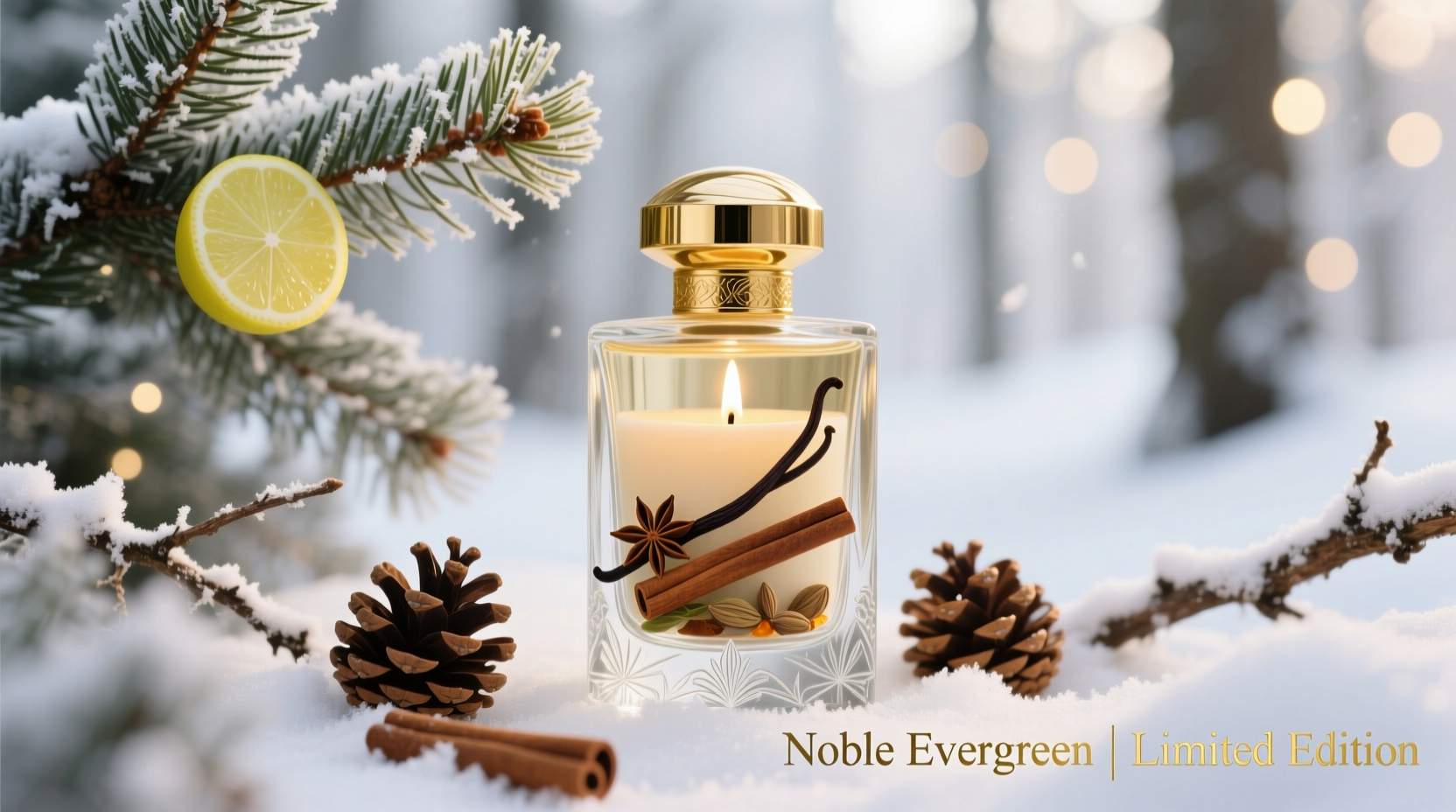
A live Nordmann fir or Balsam fir doesn’t smell like a generic “pine” candle. Its aroma shifts with temperature, humidity, and time. When you first bring it indoors, the dominant impression is sharp, green, and camphoraceous—almost medicinal. As the tree warms and begins to release sap, deeper, richer notes emerge: woody, slightly sweet, with hints of citrus peel and damp earth. Over days, as needles dry and resin oxidizes, the scent softens into warm amber, cedarwood, and faint vanilla-like lactones. A luxury candle captures this evolution—not as a static snapshot, but as a three-act narrative.
This structure mirrors classic perfumery: top, heart, and base notes—but applied with seasonal intentionality. The top is the *first breath*—the shock of cold air and crushed needles. The heart is the *emotional core*—resinous warmth, forest intimacy, quiet reverence. The base is the *lingering memory*—dry woodsmoke, aged paper, distant incense, or the faintest whisper of beeswax from candlelight.
Building Your Olfactory Palette: Essential Oils & Accords
Luxury candles avoid synthetic “pine” or “fir” fragrance oils because they lack nuance and often smell plasticky or flat. Instead, they build complexity using natural isolates, CO2 extracts, and rare absolutes—combined with purposeful synthetics that enhance diffusion or stability without compromising authenticity.
Here’s how professionals layer the key dimensions:
- Green Top Notes: Siberian fir needle (crisp, sharp), petitgrain (bitter orange leaf—adds citrusy greenness), clary sage (herbal, slightly floral lift), and small amounts of eucalyptus radiata (cool, clean, not medicinal).
- Resinous Heart Notes: Frankincense CO2 (balsamic, lemony, sacred), elemi resinoid (lemony-woody, sticky-sweet), and black spruce absolute (damp, forest-floor depth). These are non-negotiable for authenticity—they provide the “sap on bark” texture.
- Woody Base Notes: Atlas cedarwood (dry, pencil-shaving clarity), vetiver co2 (earthy, smoky rootiness), and guaiac wood (soft, leathery, slightly smoky). Avoid sandalwood unless it’s sustainably sourced Australian sandalwood—its creamy sweetness can flatten the forest realism.
- Subtle Enhancers: A trace of benzoin resinoid (vanillic, balsamic warmth) adds candlelit coziness without sugar. A whisper of cypress absolute (sharp, green, slightly metallic) mimics the scent of snapped twigs.
Critical insight: No single oil delivers “Christmas tree.” It’s the ratio—and the timing—that creates the illusion. For example, too much Siberian fir needle overwhelms; balanced with 15% frankincense CO2 and 5% vetiver, it becomes immersive, not aggressive.
The Science of Balance: Ratios, Volatility & Wax Compatibility
A luxury candle scent profile fails not from poor ingredients—but from poor physics. Essential oils behave differently in soy wax versus coconut-apricot blend versus paraffin. Their volatility (how quickly they evaporate) dictates when each note emerges during burn. A well-structured profile accounts for this.
| Note Type | Volatility (Burn Time) | Ideal % in Total Fragrance Load | Wax Compatibility Tip |
|---|---|---|---|
| Top (e.g., fir needle, petitgrain) | First 10–20 mins | 35–40% | Use in lower concentrations in soy wax—it traps top notes. Boost slightly in coconut blends for faster lift. |
| Heart (e.g., frankincense, elemi) | 20–60 mins | 45–50% | These anchor the scent. Add at 65°C during pour for optimal binding in natural waxes. |
| Base (e.g., cedarwood, vetiver) | 60+ mins / Cold Throw | 10–15% | Higher molecular weight oils need longer melt time. Pre-dilute in DPG before adding to wax to prevent separation. |
The total fragrance load—the percentage of scent oil to wax—is equally critical. Mass-market candles use 8–10%, sacrificing longevity for immediate punch. Luxury candles use 6–7% precisely calibrated loads. Why? Because overloading causes “scent fatigue,” uneven burning, and sooting. A 6.5% load of a perfectly balanced profile outperforms an 8.5% load of a blunt, single-note blend every time. The goal isn’t volume—it’s fidelity.
A Step-by-Step Scent Development Process
Creating your own luxury-level Christmas tree profile isn’t intuitive—it’s iterative and disciplined. Follow this proven sequence:
- Define the Narrative: Choose one emotional intent: “Frost-kissed forest at dawn,” “Grandfather’s attic with vintage ornaments,” or “Candlelit Nordic lodge.” This guides all subsequent choices.
- Select Core Trio: Pick one top (e.g., Siberian fir), one heart (e.g., frankincense CO2), and one base (e.g., Atlas cedarwood). Keep it minimal for round one.
- Test Cold Throw First: Blend 1g total oil (e.g., 0.4g fir, 0.45g frankincense, 0.15g cedarwood) in a sealed glass vial. Smell daily for 3 days. Does it evolve? Does the cedar appear too early?
- Burn Test in Small Batch: Make three 4oz test candles using identical wax and wick. Vary only the ratio: Batch A (40/45/15), Batch B (35/50/15), Batch C (45/40/15). Burn side-by-side for 2 hours each. Note which has the most natural progression and least “chemical” off-note.
- Add One Enhancer: Based on results, add a single enhancer: 2% cypress for twiggy realism, or 1.5% benzoin for cozy depth. Re-test.
- Refine & Scale: Lock the final ratio. Scale up only after confirming stability across 5+ burns and 2 weeks of shelf aging. Natural resins oxidize—what smells perfect on Day 1 may deepen beautifully by Day 10.
“The difference between a decorative candle and a memory-catalyst lies in restraint. A luxury scent doesn’t shout ‘Christmas’—it whispers ‘remember?’ through precise, unhurried layers.” — Lena Dubois, Senior Perfumer, Maison Bois & Cire
Real-World Example: The “Hearth & Hemlock” Profile
In late 2022, Brooklyn-based apothecary Hearth & Hemlock launched a limited-edition holiday candle inspired by the Adirondack forests. Their brief was clear: “No candy cane, no cinnamon, no glitter. Just the tree, the snow, and the silence.” They began with a field sample of balsam fir resin collected in December—then reverse-engineered its GC-MS (gas chromatography-mass spectrometry) report.
They discovered high levels of α-pinene (green/crisp), moderate limonene (citrus peel), and trace amounts of bornane (camphoraceous depth)—but crucially, also detectable vanillin precursors from natural lignin breakdown. That finding led them to add 0.8% ethyl vanillin—not for sweetness, but for the *olfactory signature of aged wood*. Their final profile: 38% Siberian fir needle, 32% balsam fir absolute, 12% frankincense CO2, 8% Atlas cedarwood, 5% cypress absolute, 3% ethyl vanillin, and 2% vetiver CO2. The result wasn’t “Christmassy”—it was profoundly still, quietly majestic, and unmistakably alive. Retailers reported customers buying it year-round—not for holidays, but for focus and calm.
Frequently Asked Questions
Can I use fragrance oils instead of essential oils for a luxury effect?
Yes—if they’re IFRA-compliant, phthalate-free, and designed for high-end applications (e.g., CPL Aromas’ “Forest Resin” or Bell Flavors’ “Nordic Fir”). But avoid generic “Pine” or “Christmas Tree” oils. Their synthetic terpenes lack the micro-notes that trigger deep memory recall. Natural materials offer irreplaceable complexity, especially in the heart and base.
Why does my homemade tree candle smell medicinal or harsh?
Almost always due to over-reliance on top notes (especially eucalyptus or high-pinene oils) without enough balancing heart/base. A 50% fir needle blend will dominate and fatigue the nose. Reduce top notes to ≤40%, and ensure your heart accord contains at least one balsamic material (frankincense, elemi, or benzoin) to soften the edge.
How do I make the scent last longer in the wax?
It’s not about loading more oil—it’s about binding. Add 1–2% cyclodextrin (a starch-derived molecule) to your fragrance blend before mixing with wax. It forms inclusion complexes that slow evaporation, extending hot throw by 25–30% while preserving nuance. Also, cure candles for 10–14 days before burning—this allows volatile alcohols to mellow and resins to fully integrate.
Conclusion: Craft the Feeling, Not the Label
A luxury Christmas tree scent profile isn’t defined by festive packaging or price point—it’s defined by intentionality. It asks: What emotion should this candle evoke? Which memory should it gently surface? How can chemistry serve poetry? When you move beyond “pine + cedar = Christmas tree” and begin studying the volatile compounds in a freshly cut Fraser fir, testing how frankincense evolves beside vetiver in warm soy wax, and listening to how a trace of ethyl vanillin deepens silence rather than adding sweetness—you stop making candles. You start composing experiences.
This level of craftsmanship transforms a seasonal ritual into something reverent. It turns a living room corner into a snow-hushed grove. And it reminds us that the most powerful scents aren’t the loudest—they’re the ones that know exactly when to enter, how long to stay, and what to leave behind in the air.




 浙公网安备
33010002000092号
浙公网安备
33010002000092号 浙B2-20120091-4
Comments
No comments yet. Why don't you start the discussion?