
A well-coordinated lighting plan does more than illuminate space—it connects rooms emotionally and visually, turning a collection of separate areas into a unified, intentional home. Too often, homeowners install fixtures room by room without considering how light quality, color temperature, fixture style, or control strategy flows from the entryway to the bedroom. The result? A disjointed experience: a warm, inviting living room next to a sterile, over-bright kitchen; recessed lights in the hallway that don’t match the pendant over the dining table; smart switches that can’t communicate across zones. Coordinated lighting isn’t about uniformity—it’s about thoughtful continuity. It balances consistency with context: using similar color rendering and dimming behavior in adjacent spaces while adapting brightness, fixture type, and layering to each room’s purpose. This article walks through the principles, decisions, and execution steps that turn fragmented lighting into a harmonious system—grounded in real-world constraints, human-centered design, and measurable outcomes.
1. Start with a Unified Lighting Language
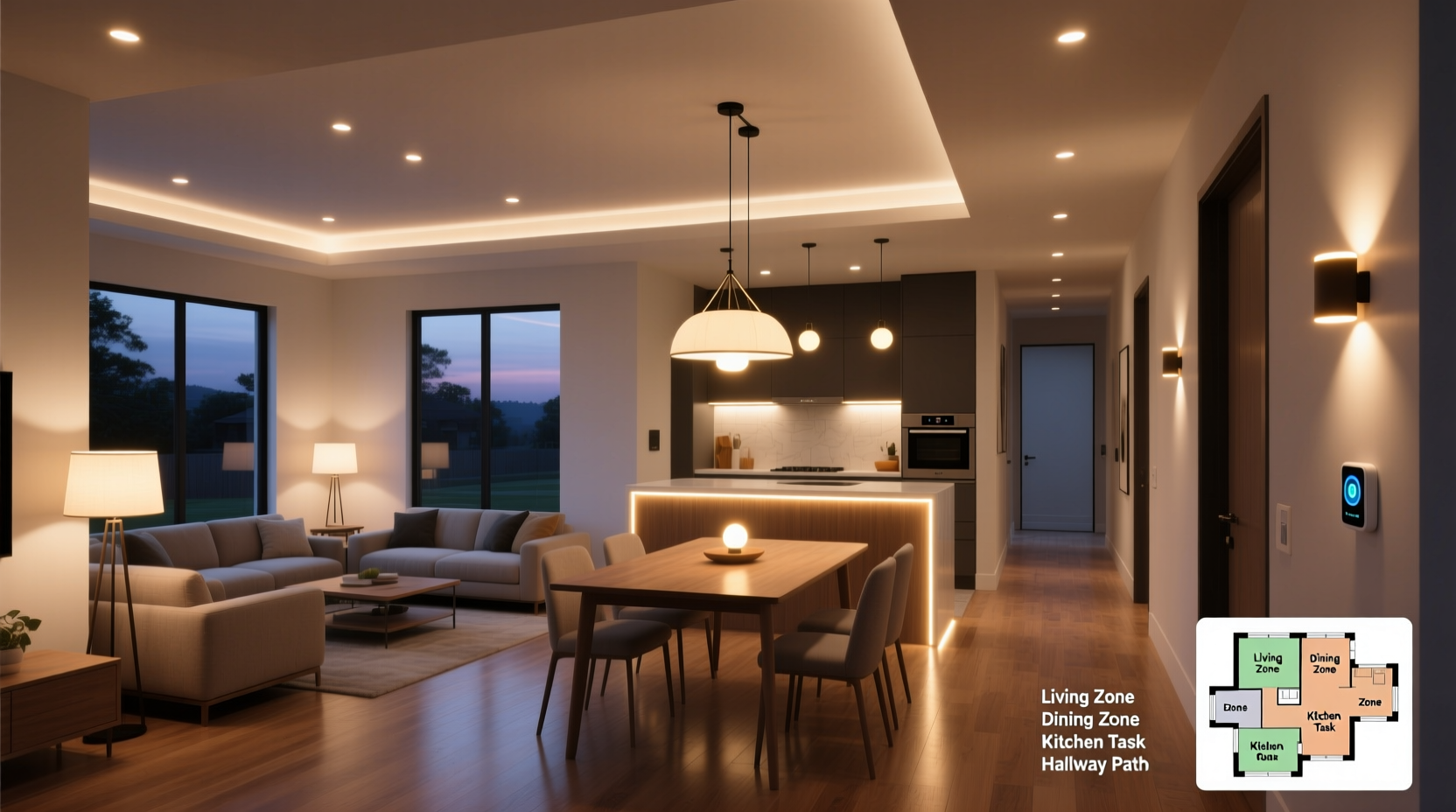
Before selecting bulbs or fixtures, define three non-negotiable parameters that will apply across all rooms: correlated color temperature (CCT), color rendering index (CRI), and dimming compatibility. These form your “lighting language”—the baseline grammar that ensures visual cohesion.
CCT determines whether light feels warm (2700K–3000K), neutral (3500K–4000K), or cool (5000K+). For residential coordination, 2700K–3000K is strongly recommended. It mimics sunset warmth, supports circadian rhythm in evenings, and creates perceptual continuity—even if fixture styles vary. Avoid mixing 2700K in the bedroom with 4000K in the kitchen unless there’s a deliberate, transitional design intent (e.g., a dedicated task zone).
CRI measures how accurately colors appear under a light source. Aim for CRI ≥90 across all rooms. Lower-CRI bulbs (especially cheap LEDs at CRI 80 or below) distort skin tones, mute wood grain, and make paint colors look flat or inconsistent from room to room. A high-CRI standard ensures your navy sofa reads the same deep blue in natural daylight, living room lamplight, and hallway sconce glow.
Dimming compatibility is where most plans fail silently. Not all LED bulbs dim smoothly—or at all—with every switch. Choose bulbs certified for your dimmer brand (e.g., Lutron CLi® or Leviton D2000 series), and verify compatibility *before* purchase. Test one bulb per fixture type in a single room first. If flickering, buzzing, or limited dimming range occurs, replace either the bulb or dimmer—not both at once.
2. Layer Light Consistently—Then Adapt by Room
All functional lighting relies on three layers: ambient (general illumination), task (focused activity light), and accent (highlighting architecture or objects). Coordination doesn’t mean replicating identical layers everywhere—it means applying the *same layering logic*, adjusted for scale and use.
In a small powder room, ambient light may come from a single flush-mount fixture; task light from mirrored sconces; accent from a subtle LED strip behind the vanity. In a large open-plan kitchen-living area, ambient light might be a grid of 6-inch recessed downlights spaced 5 feet apart; task light, under-cabinet strips and a focused pendant over the island; accent, adjustable track heads aimed at artwork or shelving.
The key is consistency in *intent* and *quality*. All ambient sources should deliver even, glare-free coverage with minimal shadows. All task lights should provide ≥300 lux at the work surface (measured with a $25 light meter app like Lux Light Meter Pro). All accent lights should have beam angles ≤30° and be positioned to avoid hotspots or washout.
| Room | Ambient Strategy | Task Target (lux) | Accent Guidance |
|---|---|---|---|
| Living Room | Recessed + floor lamps + cove lighting | N/A (no fixed task) | 30° beam, 2x wall-wash height, 30cm from wall |
| Kitchen | Recessed grid (1.2m spacing) | 500 lux at countertop | Downlights on open shelves; avoid cabinet-top glare |
| Bedroom | Dimmable ceiling fixture + bedside wall sconces | 300 lux at reading nook | Uplights behind headboard; avoid direct eye exposure |
| Bathroom | Vanity-mounted linear fixture | 400 lux at mirror plane | None—prioritize shadow-free face illumination |
| Entryway | Statement pendant + recessed path lights | N/A | Wall sconce highlighting art or texture |
3. Control Systems: Unify Operation, Not Just Aesthetics
Fixture appearance matters—but how you control them matters more for daily coordination. A beautiful set of black matte pendants means little if one dims via app, another via wall switch, and a third only turns fully on/off.
Adopt a single control platform across the entire home. This doesn’t require full smart-home integration—but it does require protocol alignment. Choose one ecosystem (e.g., Matter-over-Thread, Lutron RadioRA 3, or Philips Hue Bridge) and stick to it for all new installations. Retrofit older switches gradually, prioritizing high-traffic zones first: living room, kitchen, primary bedroom.
Group controls logically—not just by room, but by *function* and *flow*. Create scenes like “Evening Arrival” (entryway + hallway + living room lights at 40% warm white), “Dinner Mode” (dining pendant at 70%, kitchen ambient at 30%, no accent), or “Wind Down” (bedroom ambient at 10%, bedside sconces at 20%, bathroom nightlight on). These cross-room scenes reinforce unity far more than matching fixture finishes ever could.
“Lighting coordination fails not at the fixture level, but at the control layer. When users must remember six different ways to adjust brightness, the experience fractures—even if every bulb is 2700K/95 CRI.” — Maya Chen, Lighting Designer & Principal at Lumina Collective
4. A Real-World Coordination Timeline: The 6-Week Implementation Plan
Creating coordination isn’t a weekend project—it’s a phased process that respects budget, contractor availability, and learning curves. Here’s how a typical homeowner executes it without overwhelm:
- Week 1: Audit & Document — Photograph every existing fixture. Note bulb type, wattage, base, CCT (if labeled), and dimmer model. Map circuits. Identify which lights are on shared switches vs. independent ones.
- Week 2: Define Standards — Select your unified CCT (e.g., 2700K), minimum CRI (90), and dimmer platform (e.g., Lutron Caseta). Research compatible bulbs for each fixture type (recessed, pendant, sconce, track).
- Week 3: Prioritize Zones — Rank rooms by usage frequency and visual impact: 1) Entry/Living/Dining (high visibility), 2) Kitchen, 3) Primary Bedroom/Bath, 4) Secondary Rooms. Focus procurement and installation here first.
- Week 4: Procure & Test — Buy bulbs for Zone 1 only. Install in one room. Test dimming behavior, color consistency, and layer balance. Adjust if needed before ordering more.
- Week 5: Install & Calibrate — Replace all Zone 1 fixtures. Program scenes into your control system. Measure lux levels at key surfaces. Refine dimming curves (e.g., slow ramp-up for bedrooms, instant-on for kitchens).
- Week 6: Expand & Refine — Repeat for Zone 2. Audit transitions: Does hallway light feel like a natural extension of living room ambiance? Does kitchen task light “hand off” to dining pendant brightness? Tweak scene settings until flow feels intuitive.
5. Mini Case Study: The Open-Plan Condo Transformation
When architect Lena Rodriguez moved into her 900-sq-ft downtown condo, she loved the light-filled space—but hated the lighting chaos. The developer-installed recessed lights were 4000K with poor CRI, the kitchen island pendant was 3000K but non-dimmable, and the bedroom had a harsh, single-bulb ceiling fixture. She couldn’t host dinner without guests squinting at food or commenting on the “hospital vibe” in the hall.
Lena began with a $30 light meter app and documented lux levels: 120 lux in the living area (too low), 750 lux at the kitchen sink (glaring), and 200 lux at her bedside (insufficient for reading). She selected 2700K, 95 CRI, dimmable BR30 bulbs for all recessed fixtures, paired with Lutron Maestro dimmers. For the kitchen island, she replaced the pendant with a dimmable, high-CRI version matching the recessed CCT. In the bedroom, she added wall sconces with integrated dimmers and swapped the ceiling fixture for a soft-diffused disc.
The biggest shift wasn’t the bulbs—it was the scenes. She programmed “Sunset” (all ambient lights at 30%, warm white) to activate automatically at 7 p.m., and “Entertain” (living recessed at 60%, dining pendant at 85%, kitchen ambient at 25%) for guests. Within two weeks, friends stopped asking, “Why is your hallway so bright?” Instead, they said, “Your place feels calm—like one continuous space.” That’s coordination: invisible, intentional, and deeply felt.
6. Common Pitfalls—and How to Avoid Them
Even experienced homeowners stumble on coordination. These five missteps derail cohesion faster than any aesthetic choice:
- Mixing CCTs without transition logic: Using 2700K in the bedroom and 4000K in the adjacent bathroom creates jarring contrast. If cooler light is needed for tasks (e.g., makeup application), use 3000K—not 4000K—and ensure the bathroom has excellent CRI to compensate.
- Ignoring beam spread in accent lighting: A 60° flood beam washing a narrow hallway wall creates uneven pools of light. Use 25°–30° spots for precision, and always aim from a 30° angle, not straight on.
- Overlooking vertical light: Relying solely on ceiling sources flattens space and increases glare. Add wall sconces, uplights, or cove lighting in at least two rooms to create depth and warmth.
- Assuming “dimmable” means “smoothly dimmable”: Many budget LEDs dim only between 100% and 70%, then cut off abruptly. Test dimming range across 10%–100% before bulk purchasing.
- Forgetting maintenance cycles: Bulbs degrade—CRI drops, CCT shifts warmer, lumen output falls. Replace all bulbs in a coordinated zone every 3 years, even if some still “work,” to preserve consistency.
7. FAQ
Can I coordinate lighting in a rental apartment?
Yes—focus on plug-in and screw-in solutions. Use high-CRI, dimmable LED bulbs in all existing sockets. Add plug-in floor and table lamps with warm-white, high-CRI bulbs. Install battery-powered wireless dimmers (like Lutron Aurora) on existing switches. Avoid permanent modifications, but prioritize light quality over fixture aesthetics.
Do all rooms need the same CRI rating?
Technically no—but practically yes for coordination. A 95 CRI living room next to an 82 CRI kitchen makes food colors look dull and walls appear mismatched. Since high-CRI bulbs now cost only ~15% more than standard LEDs, the consistency payoff outweighs the marginal expense.
How do I handle rooms with no ceiling access (e.g., concrete ceilings)?
Rely on surface-mounted solutions: track lighting with adjustable heads, wall-mounted uplights, and strategically placed floor and table lamps. Use adhesive-backed LED tape for cove effects along crown molding or under cabinets. Prioritize layered control—even without recessed options, you can achieve rich, coordinated light.
Conclusion
A coordinated lighting plan isn’t a luxury reserved for high-budget renovations or professional designers. It’s a sequence of deliberate, accessible choices—starting with CCT, CRI, and control—that compound into a home where light feels like a quiet, consistent presence rather than a series of disconnected events. It’s the difference between walking into a space and feeling instantly grounded, versus pausing mid-hallway to wonder why the light suddenly changed. You don’t need to replace every fixture at once. Start with one high-impact zone—the living room, the kitchen, the entryway—and apply the principles: unify the color temperature, demand high color fidelity, ensure smooth dimming, and program at least one cross-room scene. Measure the results. Notice how shadows soften, how textures emerge, how time seems to slow when light flows without friction. Then expand. Your home doesn’t need more light—it needs better-connected light. And that begins not with hardware, but with intention.




 浙公网安备
33010002000092号
浙公网安备
33010002000092号 浙B2-20120091-4
Comments
No comments yet. Why don't you start the discussion?