
When homes feature more than one Christmas tree—a towering centerpiece in the living room, a slender silver fir in the entryway, a miniature tabletop version in the study, or even an outdoor tree on the patio—the potential for visual harmony is immense. Yet without intentionality, multiple trees can easily devolve into a disjointed spectacle: warm white indoors, cool blue on the porch, multicolor on the desk, and flickering amber on the stairs. A coordinated lighting theme doesn’t mean identical strings—it means thoughtful unity across scale, tone, rhythm, and purpose. It’s what transforms a collection of trees into a curated seasonal narrative. This guide distills proven principles used by professional holiday stylists, interior designers, and lighting technicians—not as abstract theory, but as actionable decisions you can make before buying a single bulb.
1. Define Your Core Lighting Palette First—Before Selecting Any Bulbs
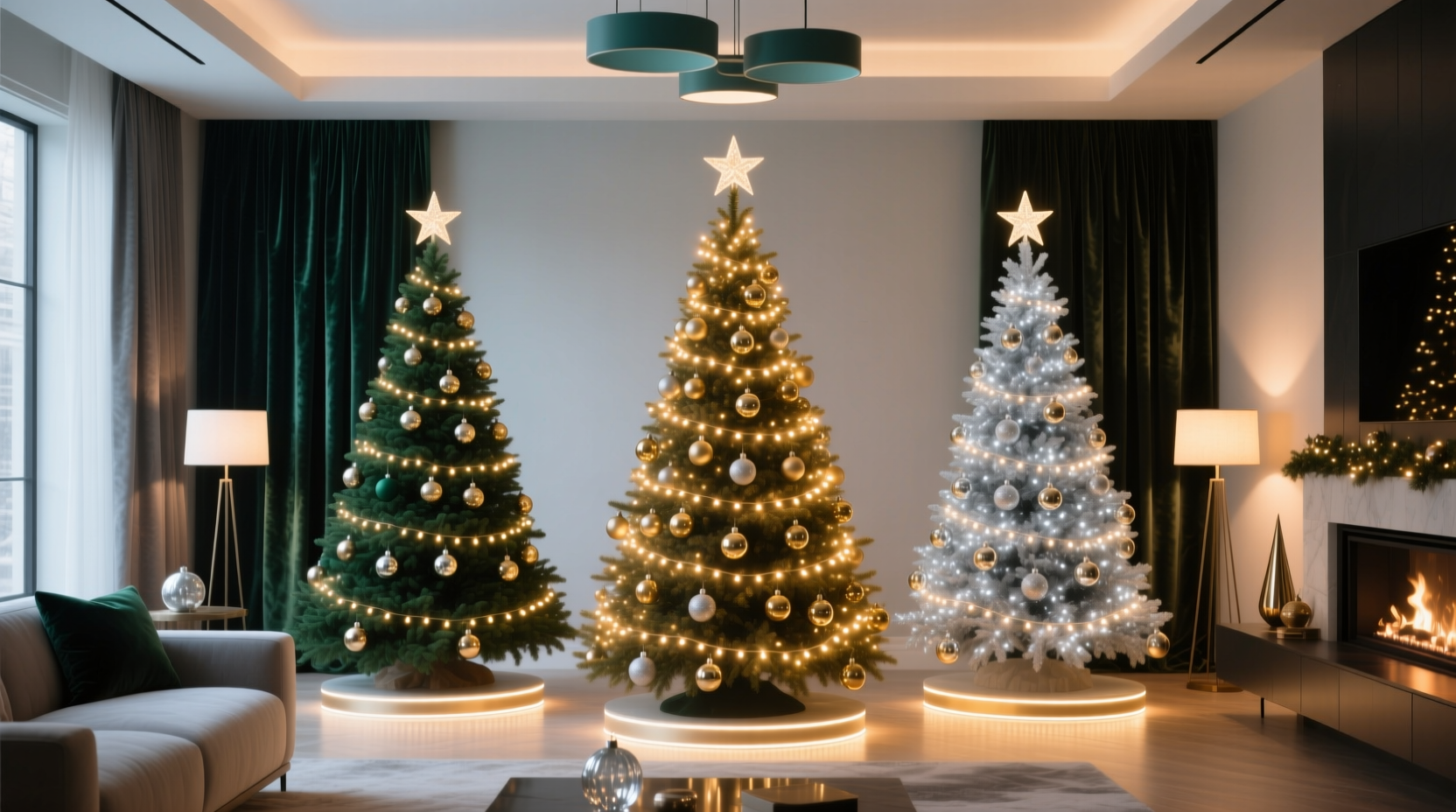
Start not with trees, but with light itself. A successful multi-tree theme rests on three interlocking attributes: color temperature (measured in Kelvin), light rhythm (steady, twinkle, fade, or chase), and bulb style (mini, wide-angle LED, vintage filament, or net lights). Choose *one* dominant attribute to unify all trees—and allow controlled variation in the other two.
For example, anchoring your theme around color temperature ensures emotional consistency: 2200K–2700K delivers candlelit warmth ideal for traditional, cozy, or rustic interiors; 3000K offers clean yet inviting neutrality for modern or Scandinavian spaces; while 4000K+ introduces crisp, energized clarity best suited for contemporary outdoor displays or high-ceilinged foyers. Once you fix this anchor, you gain flexibility elsewhere—e.g., using steady-warm-white on the main tree, gentle fade-warm-white on the dining table tree, and slow-pulse-warm-white on the porch tree.
Equally critical is selecting a consistent brightness ratio. A 7-foot tree typically needs 700–1000 bulbs for fullness; a 3-foot tabletop tree needs only 150–250. But brightness isn’t just about count—it’s about lumen output per bulb. Mixing 2-lumen mini LEDs with 8-lumen premium LEDs on adjacent trees creates jarring contrast, even if both are labeled “warm white.” Always verify lumen specs on packaging or spec sheets—not just wattage or “brightness” claims.
2. Map Trees by Function and Spatial Relationship
Treat each tree as a node in a lighting ecosystem—not as an isolated object. Categorize them by their role in your home’s flow:
- Anchor Tree: The largest or most visible tree (e.g., living room corner). Sets the tonal baseline.
- Transition Tree: Placed where sightlines intersect (e.g., stair landing, hallway archway). Bridges lighting moods between zones.
- Intimate Tree: Small-scale, close-proximity (e.g., bedroom nightstand, office desk). Prioritizes low glare and soft diffusion.
- Architectural Tree: Integrated into structure (e.g., wrapped around a column, mounted on a balcony railing). Emphasizes line and form over density.
- Threshold Tree: Positioned at entries (front door, garage, patio). Signals arrival and sets first impression.
This mapping prevents accidental hierarchy clashes. For instance, a dazzling, high-intensity chase-light sequence on a Threshold Tree will visually overpower a serene Anchor Tree just ten feet away—unless intentionally designed as a “reveal.” Instead, use rhythmic progression: steady light on the Anchor, gentle pulse on Transition, ultra-soft fade on Intimate, linear glow on Architectural, and crisp steady-on Threshold. The eye perceives continuity because the *pace* of change follows spatial logic—not random preference.
3. Build a Multi-Tree Wiring & Power Strategy
A coordinated theme collapses without reliable, invisible infrastructure. Overloading circuits, daisy-chaining too many strings, or hiding unsightly extension cords undermines aesthetic cohesion—even if every bulb matches perfectly.
| Tree Location | Max Recommended Strings Per Circuit | Preferred Cord Type | Critical Consideration |
|---|---|---|---|
| Indoor Anchor (7–9 ft) | 3–4 (LED only) | Flat, black, low-profile (0.12\" thick) | Use a dedicated outlet with GFCI protection; never share with space heaters or audio equipment. |
| Outdoor Threshold (6 ft) | 2–3 (UL-listed outdoor-rated) | Heavy-duty, UV-resistant, coiled (for easy storage) | Run cord through conduit or under mulch—not across walkways—to prevent tripping and moisture exposure. |
| Stair Landing (4 ft) | 1–2 (battery or USB-powered preferred) | Thin, flexible silicone-jacketed | Battery life must exceed 30 days at minimum brightness; avoid alkaline—use lithium or rechargeable NiMH. |
| Bedroom Nightstand (2 ft) | 1 only (low-voltage DC) | Micro-thin (under 0.08\"), fabric-wrapped | No transformer hum; verify no electromagnetic interference with CPAP machines or pacemakers. |
Always calculate total wattage: Multiply bulb count × watts per bulb. A standard 15-amp household circuit supports 1,800 watts max—but derate to 1,440 watts (80%) for safety. Most modern LED strings draw 2–7 watts per 100 bulbs. If your Anchor Tree uses four 200-bulb strings at 4.5W each, that’s 36W—well within limits. But add three outdoor strings drawing 12W each, plus two battery trees with AC adapters pulling 5W each, and you’re at 82W. Infrastructure becomes invisible only when it’s engineered—not improvised.
4. Step-by-Step: Creating Your Theme in 7 Days
Follow this realistic timeline—designed for busy households—to implement a unified lighting scheme without last-minute stress:
- Day 1 – Audit & Inventory: List every tree (height, location, power access), note existing lights (take photos of labels), and identify dead or dim bulbs. Discard non-LED strings older than 5 years—they lack color consistency and efficiency.
- Day 2 – Choose Anchor Temperature & Rhythm: Buy one string for your Anchor Tree first. Test it at dusk for 2 hours. Observe how it interacts with wall color, artwork, and ambient lamps.
- Day 3 – Select Supporting Strings: Purchase all remaining strings in the same Kelvin rating. Vary rhythm (pulse, fade, steady) and bulb shape (cone, globe, candle) — but never temperature or base color.
- Day 4 – Pre-String & Label: Wind each string onto its own cardboard spool. Label with tree name and rhythm (e.g., “Dining Pulse,” “Patio Steady”). This prevents mid-hanging confusion.
- Day 5 – Install Anchor & Threshold Trees: These set the bookends of your lighting journey. Ensure brightness feels balanced when viewed from the front door looking in—or from the living room looking out.
- Day 6 – Install Transition & Intimate Trees: Stand in key vantage points (sofa, kitchen island, top of stairs) and adjust spacing between bulbs to ensure even density. Use twist-ties every 6 inches to prevent sagging.
- Day 7 – Final Walkthrough & Refinement: View all trees at night with curtains closed. Turn off overheads. Note where light pools, where shadows fall heavily, and where one tree visually “shouts” over another. Swap one string’s rhythm if needed—never temperature.
“Lighting coordination across multiple trees isn’t about sameness—it’s about resonance. When a guest walks from porch to parlor, the light should feel like a single breath, not a series of gasps.” — Lena Torres, Principal Designer, Evergreen Studio & former lighting consultant for Rockefeller Center Christmas Tree Program
5. Real-World Application: The Henderson Family’s Three-Tree Home
The Hendersons live in a 1920s brick rowhouse with distinct zones: a sun-drenched living room (Anchor), a narrow enclosed porch (Threshold), and a built-in library nook with a 3-foot birch sapling (Intimate). Last year, they used cool-white icicle lights on the porch, warm-white mini LEDs on the living room tree, and multicolor net lights on the sapling—resulting in visual static and complaints from guests about “eye fatigue.”
This December, they applied the palette-first method. They chose 2400K warm white as their anchor—matching the amber glow of their vintage brass sconces and honey-oak flooring. For the living room tree, they selected steady-output LEDs with micro-diffused lenses to soften glare. For the porch, they chose the same 2400K string—but added a programmable controller set to a 12-second fade cycle, mimicking candle flicker against the brick. For the sapling, they used ultra-low-lumen 2400K micro-LEDs (0.3W per 50 bulbs) with fabric-wrapped wire, powered by a silent USB battery pack hidden inside a hollowed-out leather-bound book.
The result? Guests consistently comment on the “calm warmth” flowing through the house. The porch no longer competes—it invites. The sapling doesn’t distract—it delights. And the living room tree remains the grounded heart of it all. No single tree dominates; instead, light moves with intention.
FAQ
Can I mix LED and incandescent lights across trees?
No. Incandescents operate at 2700K–3000K but emit inconsistent color due to filament variance and rapid lumen decay. More critically, their heat output risks melting nearby LED wiring insulation and creates fire hazards when daisy-chained. All trees in a coordinated theme must use the same technology—LED exclusively.
What if my trees are different species—does that affect lighting choices?
Yes—indirectly. Dense firs and spruces hold light well and support higher bulb counts. Open-branched birches or willows need wider-spaced, higher-lumen bulbs to avoid “sparse” appearance. But species shouldn’t dictate color or rhythm—only density and placement strategy. A birch still belongs in your 2400K theme; it just needs fewer, brighter bulbs spaced 8 inches apart instead of 4.
How do I handle smart lighting across multiple trees without app overload?
Use one central hub (e.g., Philips Hue Bridge or Nanoleaf Essentials Hub) and assign each tree to a named zone (“Living Room Tree,” “Porch Tree”). Program scenes—not individual strings. Create a “Sunset Warm” scene that sets all zones to 2400K at 85% brightness with gentle fade. Avoid per-string scheduling; it fragments control and invites inconsistency.
Conclusion
A coordinated lighting theme across multiple Christmas trees is less about decoration and more about spatial storytelling. It reflects care—not just for aesthetics, but for how light shapes human experience: how it guides movement, modulates mood, and connects disparate parts of a home into a single, breathing environment. You don’t need identical strings, expensive controllers, or professional installers to achieve it. You need clarity of intent, disciplined selection, and attention to the physics of light—its temperature, its rhythm, its reach. Start small: choose your Kelvin. Test it. Let that decision ripple outward. Then watch as your home transforms from a collection of lit objects into a unified seasonal sanctuary.




 浙公网安备
33010002000092号
浙公网安备
33010002000092号 浙B2-20120091-4
Comments
No comments yet. Why don't you start the discussion?