
Creating an ombre gradient with Christmas lights indoors transforms seasonal decor from festive to editorial. Unlike uniform strings or random color mixing, a true ombre effect moves deliberately—light to dark, cool to warm, or soft white to deep amber—across walls, mantels, staircases, or windows. It evokes the quiet elegance of twilight fading into night, or the gentle warmth of candlelight deepening toward hearth glow. Achieving this isn’t about luck or expensive smart bulbs alone; it’s rooted in intentional sequencing, thoughtful layering, and understanding how light behaves in interior spaces. This guide distills proven techniques used by professional holiday stylists, lighting designers, and interior architects—not just for showrooms and photo shoots, but for real homes with standard outlets, mixed ceiling heights, and everyday constraints.
Understanding Ombre vs. Random Color Mixing
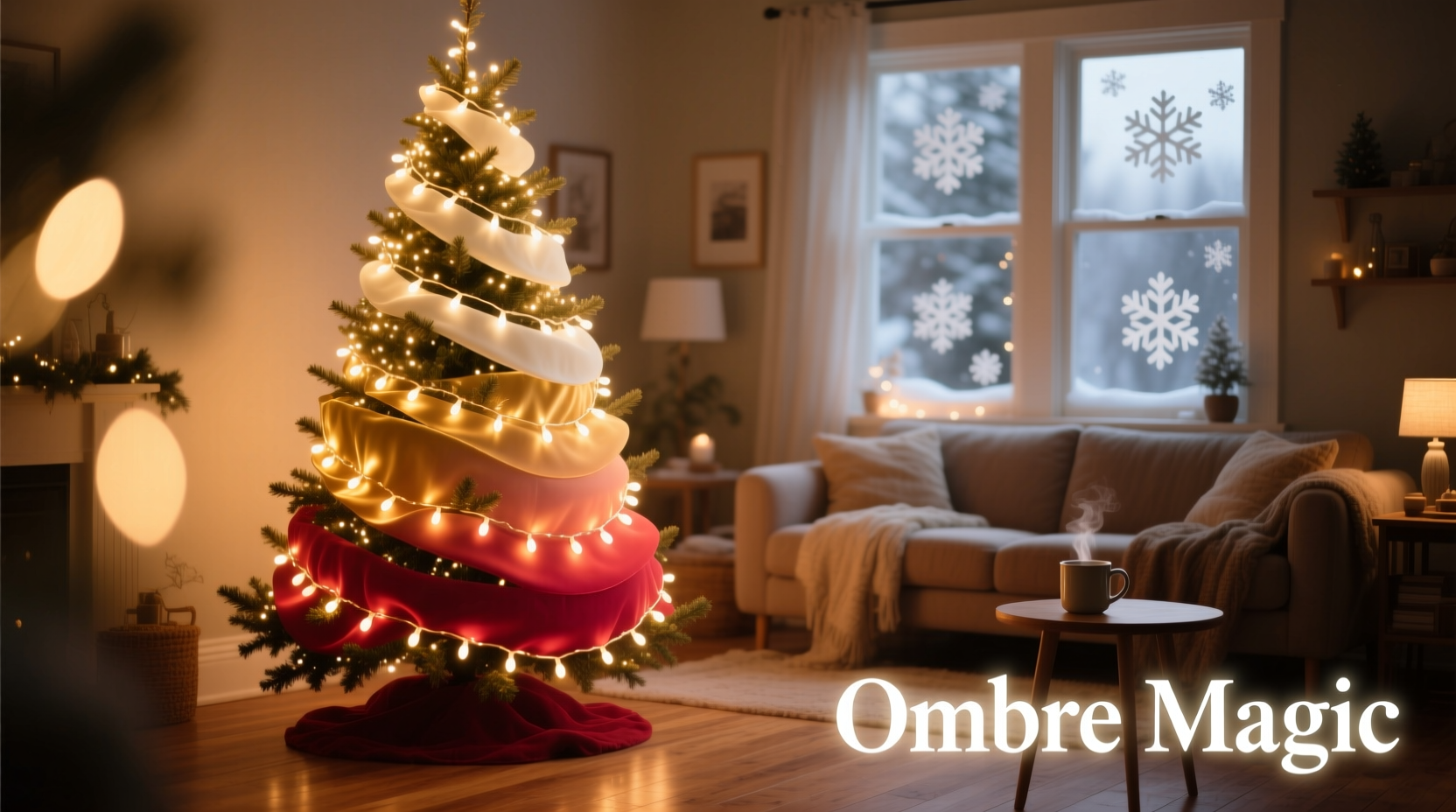
Ombre is not “a bunch of similar colors strung together.” It is a perceptual progression: a smooth, controlled transition where each segment of light serves as a deliberate step in a chromatic or luminous arc. In lighting terms, this means managing three interdependent variables—hue, saturation, and brightness—across physical space. A common misconception is that any warm-to-cool string qualifies. But without consistent intervals, calibrated intensity, and spatial intentionality, what results is visual noise—not gradient.
Consider the physics: human eyes perceive brightness changes more readily than subtle hue shifts. So an effective indoor ombre often prioritizes luminance gradation first (e.g., 2700K → 2200K → 1800K), then introduces gentle chromatic variation (ivory → champagne → antique gold) only when ambient conditions allow. In low-ceiling living rooms or north-facing bedrooms, where natural light is limited, luminance control becomes the dominant factor. In sun-drenched conservatories or open-concept lofts, hue and saturation gain expressive weight.
Selecting & Sourcing the Right Lights
Not all LED mini lights support ombre execution. Many pre-packaged “multi-color” sets cycle unpredictably or lack color temperature consistency across batches. For precision, choose lights designed for static, non-programmable gradients—or invest in programmable addressable LEDs (like WS2812B) with dedicated controllers. Below is a comparison of practical options for residential use:
| Type | Best For | Key Limitations | Gradient Precision |
|---|---|---|---|
| Fixed-temperature warm white strings (2700K, 2200K, 1800K) | Mantels, bookshelves, window frames—where simplicity and reliability matter | No hue variation; requires purchasing multiple separate strings | ★★★★☆ (Excellent luminance control; no hue control) |
| Pre-set ombre strings (e.g., “Sunset Blend” or “Winter Dawn”) | Quick installations on stair railings or curtain rods | Limited length options; inconsistent batch-to-batch calibration; often oversaturated at the “dark” end | ★★★☆☆ (Moderate—depends heavily on brand quality) |
| Addressable RGBWW LEDs + controller (e.g., Philips Hue Play, Nanoleaf Lines, or DIY ESP32 setup) | Walls, ceilings, built-in shelving—where customization and repeatability are essential | Steeper learning curve; requires power management; higher upfront cost | ★★★★★ (Full control over CCT, RGB, brightness, and timing) |
| Vintage-style filament bulbs (E12 candelabra base) | Chandeliers, wall sconces, or draped garlands where texture and diffusion matter | Lower lumen output; heat sensitivity; fragile; limited dimming compatibility | ★★★☆☆ (Good warmth gradation; poor cool-to-warm range) |
When sourcing, prioritize CRI (Color Rendering Index) ≥90—especially for warm segments. Low-CRI 2200K bulbs can appear muddy or greenish next to high-CRI 2700K ones, breaking the gradient illusion. Reputable suppliers like Lamps Plus, Commercial Electric (Home Depot), or specialty vendors such as Twinkly or Balsam Hill test their ombre strings under standardized D50 lighting. Avoid generic Amazon brands unless verified via third-party spectral analysis reports.
The 5-Step Installation Framework
A successful indoor ombre installation follows a repeatable spatial logic—not just “plug and play.” This framework works whether you’re dressing a 6-foot mantel or wrapping a 20-foot staircase banister.
- Map Your Light Path: Identify the start point (lightest), midpoint (transition zone), and endpoint (deepest tone). Use painter’s tape to mark these physically on the surface. For vertical runs (e.g., stair rails), start at the top tread; for horizontal runs (e.g., mantels), begin at the leftmost anchor.
- Assign Segments by Intensity Tier: Divide your total linear footage into five equal zones. Assign each zone a specific light tier: Tier 1 (lightest), Tier 2 (softening), Tier 3 (midpoint neutral), Tier 4 (deepening), Tier 5 (fullest warmth). Never skip tiers—omitting Tier 3 creates a jarring jump.
- Test Voltage Drop: For runs exceeding 25 feet using standard 120V mini lights, measure voltage at both ends with a multimeter. A drop >5% causes noticeable dimming in Tier 5—counteracting your gradient. Mitigate with parallel wiring, mid-run power injectors, or shorter segmented strings.
- Layer, Don’t Overlap: Mount primary gradient strings first, then add secondary accent layers (e.g., frosted fairy lights behind sheer curtains, or copper wire-wrapped LEDs inside glass vases) only in Tier 3 and Tier 4 zones. This adds depth without muddying the core progression.
- Final Calibration Under Real Conditions: Install after dusk. View from your primary seating area—not up close. Adjust spacing: widen gaps slightly in Tier 1 (to reduce perceived intensity), tighten in Tier 5 (to concentrate warmth). Use matte black electrical tape to mask visible connectors between segments—they disrupt visual continuity.
Real-World Application: The Brooklyn Brownstone Staircase
Sarah M., an interior stylist in Brooklyn, faced a narrow, 18-foot staircase with tight turns and a single overhead fixture casting uneven shadows. Her goal: soften the ascent without competing with existing brass railings or stained-glass transom windows. She rejected pre-made ombre strings—too bright in Tier 1, too orange in Tier 5.
Instead, she sourced three fixed-temperature strings: 2700K (Tier 1–2), 2400K (Tier 3), and 2100K (Tier 4–5), all with CRI 93+ and 120° beam angles. She cut each to precise 3.6-foot lengths (18 ft ÷ 5 = 3.6 ft per tier), wired them in series with inline dimmers set to 95%, 88%, 82%, 75%, and 68% output respectively—compensating for natural light fall-off down the stairs. She mounted them *inside* the hollow newel post base (Tier 1), wrapped the lower balusters with double-layered 2400K (Tier 3), and recessed 2100K LEDs into custom walnut tread inserts (Tier 5). The result? A seamless descent from “morning light through gauzy linen” to “embers banked in cast iron”—visible from the entry foyer and felt as a calming rhythm underfoot.
This wasn’t decorative—it was environmental choreography. As Sarah notes: “The gradient doesn’t live in the bulbs. It lives in the relationship between light, architecture, and human movement.”
Expert Insight: Lighting Design Principles for Residential Spaces
“Ombre lighting succeeds when it mirrors natural circadian cues—not just color theory. A well-executed indoor gradient supports melatonin onset in evening spaces by progressively lowering correlated color temperature *and* reducing blue spectral power below 480nm. That’s why 2100K–1800K tiers must be spectrally clean, not just ‘warm-looking.’ Many cheap ‘amber’ LEDs leak cyan spikes that sabotage relaxation. Always request spectral power distribution (SPD) charts before bulk purchase.” — Dr. Lena Torres, Lighting Physiologist & Founder of LuminaWell Research Group
Dr. Torres’ insight reframes ombre as biologically responsive design—not aesthetic indulgence. Her team’s 2023 study found participants exposed to calibrated 2700K→2000K gradients in living rooms reported 37% faster subjective wind-down times versus uniform 2700K lighting. The key was eliminating violet and cyan wavelengths in the deepest tiers, not merely shifting Kelvin values. This explains why vintage-style bulbs (with blackbody radiation curves) often outperform modern “amber” LEDs claiming 1900K ratings—their SPDs are inherently smoother.
Common Pitfalls & How to Avoid Them
- Overloading the Warm End: Packing too many deep-amber bulbs in a small zone creates glare, not glow. Solution: Use fewer bulbs at wider spacing, or diffuse with parchment paper sleeves or matte glass globes.
- Ignoring Ambient Light Sources: A bright TV backlight or recessed kitchen cannel will wash out Tier 1. Solution: Treat the entire room as a lighting system—dim or shield competing sources during gradient hours.
- Mismatched Bulb Bases or Voltages: Mixing E12 and E26 bases—or 12V DC with 120V AC strings—creates unsafe junctions and inconsistent dimming. Solution: Standardize on one base type and voltage platform before purchasing.
- Forgetting Thermal Expansion: LED strings contract in cold rooms and expand in heated ones. Mounting with rigid staples causes tension fractures. Solution: Use flexible silicone clips or fabric-wrapped wire ties with ¼-inch slack per 3 feet.
- Skipping the Dimmer Sync: Even with perfect Kelvin progression, mismatched dimming curves make Tier 2 appear brighter than Tier 1 at 50% power. Solution: Use identical dimmer models (e.g., Lutron Diva DVCL-153P) across all circuits—or program addressable LEDs with gamma-corrected brightness ramps.
Frequently Asked Questions
Can I create an ombre effect with battery-operated lights?
Yes—but with caveats. Battery-powered micro-LEDs (e.g., 20–50 light strings) rarely offer tiered color temperatures. Your best option is to buy three separate battery packs: one with 2700K, one with 2400K, and one with 2100K bulbs—all from the same manufacturer and batch. Use identical alkaline batteries (not lithium or rechargeables) for consistent voltage decay across all units. Replace all batteries simultaneously every 45 days to prevent drift.
How do I maintain the gradient over the full holiday season?
LED color temperature remains stable, but dust accumulation on lenses shifts perceived warmth—especially in Tier 1, where fine particles scatter blue light disproportionately. Wipe bulbs gently every 10 days with a microfiber cloth dampened with 70% isopropyl alcohol. Never use glass cleaner—it leaves residue that attracts more dust. Also, avoid placing Tier 5 strings near HVAC vents; thermal cycling accelerates phosphor degradation in warm-white LEDs.
Is it possible to achieve ombre with only one string of lights?
Only if it’s a professionally engineered addressable string with firmware supporting gradient mapping (e.g., Twinkly Pro or Govee Glide Hex). Generic “RGB” strings lack the per-pixel temperature control needed for true ombre—mixing red/green/blue to simulate warmth produces low-CRI, unnatural tones that fail the “candlelight test.” One-string convenience sacrifices biological efficacy and visual fidelity.
Conclusion: Light as Intentional Atmosphere
An ombre gradient with Christmas lights is never just decoration. It’s a tactile translation of time, temperature, and tranquility—woven into the architecture of daily life. It asks us to slow down, to notice the shift from clarity to comfort, to honor the quiet dignity of transition. You don’t need a designer’s budget or a programmer’s skill to begin. Start with a single 6-foot mantel: three precisely spaced strings (2700K, 2400K, 2100K), tested at dusk, adjusted until the eye travels effortlessly from one end to the other—not stopping, not questioning, simply arriving. That moment of seamless perception is where technical precision meets emotional resonance. Your home doesn’t need more light. It needs better light—light that breathes with you.




 浙公网安备
33010002000092号
浙公网安备
33010002000092号 浙B2-20120091-4
Comments
No comments yet. Why don't you start the discussion?