
Modern holiday traditions often prioritize spectacle: bright LEDs, animated ornaments, synchronized light shows. But for many—especially those managing sensory sensitivity, insomnia, shift work, or simply craving intentional stillness—the glare of conventional Christmas trees can feel jarring rather than joyful. A low-light Christmas tree display isn’t about dimming the season—it’s about deepening it. It invites slower movement, quieter reflection, and tactile warmth over visual overload. This approach aligns with evidence-based principles in environmental psychology: reduced blue-light exposure after dusk supports melatonin production, while warm-toned, diffused illumination lowers sympathetic nervous system activation. Done thoughtfully, a low-light tree becomes a focal point for calm—not just decoration, but a functional element of your home’s restorative rhythm.
Why Low Light Works Beyond Aesthetics
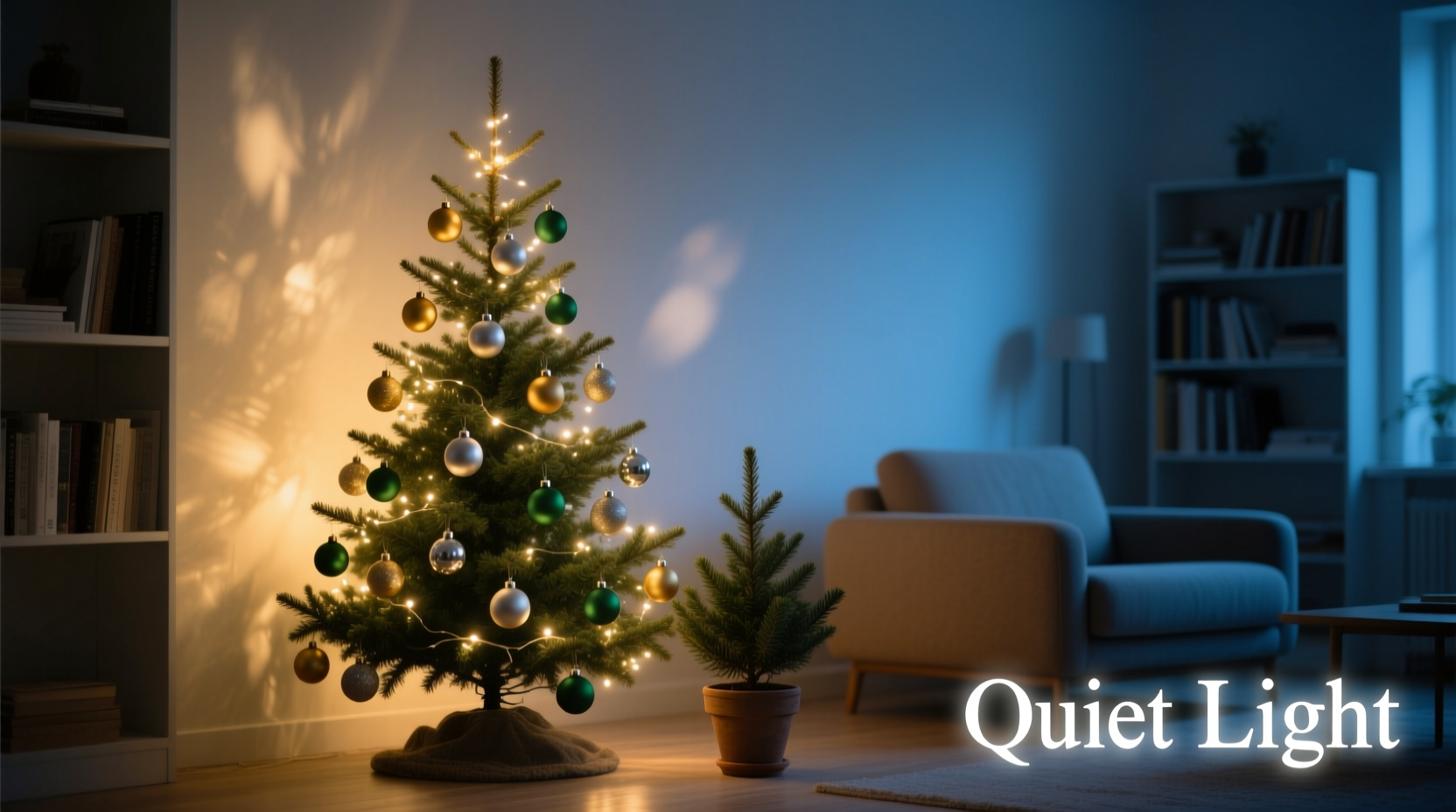
Low-light tree displays respond to real physiological and psychological needs. Research from the Lighting Research Center at Rensselaer Polytechnic Institute confirms that exposure to cool-white or high-intensity light after 8 p.m. suppresses melatonin by up to 50%, disrupting circadian alignment. In contrast, amber or warm-white light (under 2200K color temperature) has minimal impact on melatonin secretion—even at moderate intensities. A low-light tree also reduces visual clutter, which neuroscientists link to lower cognitive load and improved emotional regulation. For households with children who thrive on routine, adults recovering from burnout, or elders sensitive to glare, this subtle shift supports well-being without sacrificing seasonal meaning.
Core Principles for a Calming Tree Display
A truly calming low-light tree rests on three non-negotiable foundations: intentionality, layering, and restraint. Intentionality means every element serves a sensory purpose—not just visual appeal. Layering refers to building ambient depth through multiple soft light sources at varying heights and intensities, avoiding single-point glare. Restraint governs density: fewer ornaments, wider spacing, and deliberate negative space allow the eye—and mind—to rest.
Begin by choosing a tree species and structure that supports diffusion. Real Nordmann firs or Fraser firs offer dense, horizontal branching ideal for hiding cords and scattering light gently. Artificial trees with PVC or PE tips (not PVC-only) replicate natural texture and soften reflections better than rigid plastic alternatives. Avoid metallic or mirrored ornaments entirely—these amplify and scatter light unpredictably, undermining calm. Instead, favor matte, organic materials: hand-blown glass in amber or smoke gray, unfinished wood slices, dried citrus wheels, or ceramic baubles glazed in muted ochre or slate.
Step-by-Step: Building Your Low-Light Tree
- Select & Prep the Tree: Choose a 6–7 foot tree with full lower branches. Fluff each branch outward—not upward—to create volume and light-diffusing surface area. Remove any pre-strung lights; they’re rarely warm enough or dimmable.
- Install Base Lighting: Wrap 2–3 strands of warm-amber (2200K), ultra-dimmable LED fairy lights *inside* the tree—starting at the trunk and spiraling outward toward tips. Use clips to secure wires along branches. These are your “foundation layer” and should remain barely visible—just a soft halo within the foliage.
- Add Mid-Canopy Warmth: Hang 5–7 small, battery-operated warm-amber LED pillar candles (3–5 inches tall) on sturdy lower-to-mid branches using padded ornament hooks. Ensure they sit level and face slightly inward to avoid direct line-of-sight glare.
- Introduce Texture & Depth: Place 3–5 handmade fabric pouches filled with dried lavender, cedar shavings, or cinnamon sticks among inner branches. Their scent and tactile presence reinforce calm without competing visually.
- Final Ornament Placement: Hang no more than 25–35 ornaments total—spaced at least 8 inches apart. Prioritize weight distribution: heavier pieces (wood, ceramic) near the base; lighter ones (felt, paper) higher up. Avoid clustering—each ornament should have breathing room.
Lighting Specifications That Matter
Not all “warm” lights deliver the same effect. The table below compares key technical attributes critical for low-light efficacy:
| Feature | Ideal Specification | Why It Matters |
|---|---|---|
| Color Temperature | 2000K–2200K (amber-gold) | Matches candlelight spectrum; avoids melatonin disruption |
| Luminous Flux per Bulb | ≤2 lumens per bulb | Prevents localized brightness spikes; maintains even glow |
| Dimmability | Fully dimmable via physical slider or smart app (no flicker) | Enables real-time adjustment to time of day or mood |
| CRI (Color Rendering Index) | ≥95 | Preserves natural warmth of wood, wool, and skin tones—critical for ambient harmony |
| Power Source | Battery-operated (alkaline or rechargeable) or UL-listed low-voltage transformer | Eliminates cord clutter and fire risk; allows placement flexibility |
Never use standard household extension cords for indoor tree lighting. Opt instead for UL 2238-certified low-voltage wiring kits designed for decorative lighting—these limit current to safe levels (<24V) and include built-in thermal cutoffs.
Real-World Application: The Thompson Family’s Evening Ritual
In Portland, Oregon, the Thompsons redesigned their holiday display after their 8-year-old daughter was diagnosed with sensory processing disorder. Previously, their 7-foot artificial tree pulsed with multicolor strobes and played hourly carols—a source of daily meltdowns. They replaced it with a real Noble fir, wrapped in 3 strands of 2200K filament LEDs (dimmed to 30% intensity), and added five hand-thrown ceramic ornaments glazed in iron-rich clay tones. Each evening at 6:30 p.m., they light the tree, brew chamomile tea, and read aloud for 20 minutes in its soft radiance. Within two weeks, their daughter began initiating quiet time independently. “It’s not that the tree is ‘less festive’,” says parent Maya Thompson. “It’s that the festivity now lives in our breath, our voices, and the way light settles on the wall like honey. We didn’t lose joy—we made space for it to land gently.”
Do’s and Don’ts for Long-Term Calm
- Do test light intensity before final placement: view the tree from your primary seating area at dusk—no individual bulb should be distinguishable as a point source.
- Do incorporate sound-absorbing elements nearby: a wool rug beneath the tree stand, linen curtains nearby, or a small tabletop fountain on a side table.
- Do refresh scent elements weekly—dried citrus loses potency after 5–7 days; replace with fresh slices or a drop of pure orange essential oil on a wood disk.
- Don’t use timers that force abrupt on/off cycles. Instead, use a smart plug with gradual ramp-up (e.g., 15-minute fade-in starting at sunset).
- Don’t place the tree directly opposite reflective surfaces like mirrors or glossy cabinets—they bounce residual light unpredictably.
- Don’t add motion-based elements (rotating bases, blinking effects, or motorized ornaments). Stillness is foundational to the low-light ethos.
“True holiday calm isn’t achieved by removing light—it’s cultivated by curating its quality, direction, and relationship to human biology. A well-designed low-light tree functions as a biological anchor, signaling safety and rest to the nervous system long before the first carol begins.” — Dr. Lena Petrova, Environmental Neuroscientist and Author of *Light & Limbic Health*
FAQ
Can I convert my existing bright tree into a low-light display?
Yes—with careful upgrades. First, remove all existing lights. Replace them with warm-amber (2200K), fully dimmable LED strings rated for indoor use. Add battery-powered warm-amber candle inserts for layered depth. Swap out reflective or neon ornaments for matte ceramic, wood, or hand-felted wool. Finally, drape a sheer unbleached linen cloth over the stand base to diffuse any residual floor-level light. Avoid retrofitting cool-white bulbs with colored gels—they distort color accuracy and don’t reduce blue-light emission.
How do I maintain safety with low-light setups?
Safety starts with certified components: only use UL-listed or ETL-certified lights and transformers. Keep all wiring concealed within branches—not draped over the stand or across floors. For real trees, water daily and inspect for dryness; a well-hydrated fir is far less flammable than a dehydrated one, regardless of light type. Battery-operated lights should use fresh alkaline batteries (not rechargeables unless specifically rated for continuous low-load use) and be checked weekly for leakage.
Won’t a low-light tree feel “sad” or underwhelming?
That perception usually stems from cultural conditioning—not physics. Our eyes adapt rapidly to low light: within 10–15 minutes of dim conditions, rod photoreceptors increase sensitivity 1000-fold. What initially reads as “dim” becomes richly textured and deeply atmospheric. The absence of glare reveals subtle gradients in ornament glaze, wood grain, and fabric weave—details lost under bright light. Many report that low-light trees feel more intimate, more personal, and more enduring than high-impact displays.
Conclusion
A low-light Christmas tree is an act of quiet resistance against the season’s relentless stimulation—and a profound gift to yourself and those you love. It asks nothing more than presence: the patience to select each ornament with care, the attention to adjust light intensity as dusk deepens, the willingness to let stillness hold space alongside celebration. You don’t need special tools or expensive gear—just intention, warm-toned light sources, and the courage to let your tree breathe. Start small: replace one strand of lights tonight. Dim it to 40%. Sit with it for ten minutes before bed. Notice how your shoulders soften. How your breath slows. How the holiday begins not with fanfare, but with a sigh of relief. That’s where true calm takes root—and where the most meaningful traditions begin.




 浙公网安备
33010002000092号
浙公网安备
33010002000092号 浙B2-20120091-4
Comments
No comments yet. Why don't you start the discussion?